Dole for the Middle Class

13 Feb

Image

 In need of more government help?

Fewer and fewer people today want their tax dollars to go to the poor. According to the New York Times, their wish is coming true. The government safety net established to keep people from poverty is going through a shift. Its newer mission is to support the middle class. 

The Sunday Times article says:

“The share of benefits flowing to the least affluent households, the bottom fifth, has declined from 54 percent in 1979 to 36 percent in 2007, according to a Congressional Budget Office analysis published last year.”

Interestingly, many members of the middle class who are getting the money oppose government handouts.

“They are frustrated that they need help, feel guilty for taking it and resent the government for providing it,” the Times says. “They say they want less help for themselves; less help in caring for relatives; less assistance when they reach old age.”

Some of the people interviewed, when asked to discuss the inconsistency between reality and their political beliefs, cried.

Said one:

“You have to help and have compassion as a people, because otherwise you have no society, but financially you can’t destroy yourself. And that is what we’re doing.”

A truly great performance

12 Feb

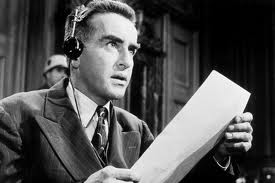
Montgomery Clift in "Judgment at Nuremberg".

Each time this year, TCM – the cable movie channel – presents, “31 Days of Oscar.” I happened to have tuned in when it was showing the 1961 film, “Judgment at Nuremberg.” I had never seen it. From the beginning, it was easy to tell this film is not only very good, it is very special and unique, with a strong, unusual perspective and a universal message.

I had been expecting anti-German propaganda.

Directed by Stanley Kramer, the film is studded with stars: Spencer Tracy, Burt Lancaster, Marlene Dietrich, Montgomery Clift, Judy Garland – even a young William Shatner pops up. The story is about the post-war trials in Germany. Top Nazis have already been prosecuted, and the film focuses on the trial of three judges who approved Nazi-ordered sterilizations (read castrations).

What motivated me to write this post, however, was Montgomery Clift.

His performance on the witness stand as a not-very-intelligent sterilization victim overwhelmed me with its power.

I was never a fan of Monti’s, who looks very different in this film. I had seen him play roles like soldiers and boxers and never felt they were right for him.

As the sad little witness, frightened and damaged, he is incredible. His screen time is a mere 12 minutes.

Please watch. (the first minute or so is missing)

Here is the interesting part, as reported on the Internet Movie Database site: Clift was having an extremely difficult time remembering his lines, so the director told him to ad lib, and that his confusion would ad to the confusion the character was going through under cross examination.

God did that work.

Clift usually cut his hair short after each movie, and didn’t make another until it grew back. In this film, there was no time for it to grow back.

The end of privacy

11 Feb


Digital technology brings the world to you and you to the world.

It tracks and records you, follows you around, knows where you have been, what you like, who your friends are. It can predict what you are likely to do.

There is a story circulating that a person with good credit was denied a mortgage because his friends in the digital world were un-creditworthy. You know, birds of a feather.

True? Don’t know. But certainly possible.

Now it seems people with information to protect are taking great steps to secure it when they go abroad. The New York Times this morning describes the precautions taken by a China expert at the Brookings Institute when he travels to that country. The account says such measures are now commonplace for government and business officials.

He leaves his cellphone and laptop at home and instead brings ‘loaner’ devices, which he erases before he leaves the United States and wipes clean the minute he returns. In China, he disables Bluetooth and Wi-Fi, never lets his phone out of his sight and, in meetings, not only turns off his phone but also removes the battery, for fear his microphone could be turned on remotely. He connects to the Internet only through an encrypted, password-protected channel, and copies and pastes his password from a USB thumb drive. He never types in a password directly, because, he said, “the Chinese are very good at installing key-logging software on your laptop.”

At home, the average person’s privacy is compromised for marketing purposes. Someone wants to sell you something. It’s not a pleasant idea, but most can live with it. If it ever becomes political and used as a repressive tool of government, we’ll have quite a lot to worry about over a simple game of Angry Birds.

Am I’m being naïve by saying “if it ever ….”?

Sticks, stones and free speech

10 Feb

Hateful or merely unfunny?

I’ve noticed that more and more celebrities, politicians, broadcasters and sports figures are saying things that offend people. Reporting gaffs, if they are indeed that, has become its own news genre.

What people say rarely offends me. I’m an advocate of free speech. And I like to hear what people really think. Don’t others feel this way? It is difficult for me to believe that, say, a Jew, would prefer an anti-Semitic congressman keep quiet and never be found out, rather than speak honestly and reveal himself.

Do those who complain about people like Roland Martin think Roland Martin would be a different person if he didn’t say what he said?

I once found myself among a large group of traveling North Koreans. They didn’t say a word, didn’t crack a facial expression, didn’t show they were human. Fear encapsulated them. I’d much rather be around a bigot than an automaton. I’m hoping the current tendency to castigate offensive utterances doesn’t turn Americans into North Koreans.

Can’t we just ignore celebrity offenders? That’s severe punishment, since these are people who can’t seem to live without attention.

There once was a politician in my town who probably was a good fellow at heart. He liked to make jokes and never worried about offending people. He thought himself a scream. He held a high county office and once had to deal with a small riot in a Hispanic neighborhood.

He was unable to play it straight.

During a public meting he said this: “We could have avoided the problem if someone had just put up a taco stand.”

He was roundly criticized.

At the next meeting, he took the podium to apologize, even though he was not the kind of man to do so.

“I was completely wrong,” he told his audience. “It’s the Mexicans who like tacos. The people who rioted were Puerto Ricans.”

And he belly laughed.

Was this man a racist or simply a failed comedian?

To me he was someone who refused to hide himself. If I chose to, I could have run from him, knowing more about him than I knew about most people.

He lost the next election, retired and died. Roland Martin, on the other hand, probably has followers on social media than ever before.

How hungry do you have to be?

8 Feb

gleaners

“The Gleaners,” by Jean-Francois Millet

I heard a little – not much – about a gleaner movement where volunteers seek permission from farmers to glean fruit and vegetables from fields, then use what they harvest to feed the hungry.

When I learned about the movement, my grandfather came to mind.

He was an immigrant, and his own gleaner. If he passed a fruit tree where apples were left on the ground, he would walk up to the door of the house and ask if he could have them. The gleaned food was in addition to what he grew in his own garden.

His son, my father, with disgust for modern life, once told me his father “fed his family on less than you spend today for paper towels.”

My grandfather was a proud, ingenious man who felt no shame in gleaning what would otherwise be wasted. If I were hungry – and I doubt he ever was – I’m not sure which I would find less tasteful: gleaning for myself or having others glean for me.

Finish one war, start another

5 Feb

Remember this?

If you believe news reports, it seems likely that Israel will attack Iran in an attempt to knock out its ability to make nuclear weapons. Iran denies it has plans to build such weapons. The reports took me back to those days when we were threatening to attack Iraq because it had weapons of mass destruction. There were no weapons, but we did, of course, attack.

Question for thought: If Iran truly did not intend to build nukes, would the U.S. and the Israelis acknowledge that and back off?

Second question: If you were the leader of Iran, would you prefer to be an unthreatened nation without nukes who concentrates on making money from oil, or one who plans to build nukes and has its economy destroyed by an attack from a neighbor allied with the U.S.?

If pre-emptive action is necessary, I prefer cyber war to hot war. Generally, no one dies. It also is less expensive. The downside: it invites  counter-attacks, which require not billions in military spending but only a single, clever mind.

A recent cyber attack on Iran’s reactors proved pretty successful. I assumed that was going to be the continued course of action. Seems I was wrong. I also thought the Iranian nuke problem was mostly solved by the assassinations of its top nuke scientists.

Wrong again.

Perhaps nations wouldn’t build nuclear weapons if they felt secure and unthreatened. How does one go about doing that? Religion is a logical start, but I think that was tried and actually made things worse.

Anyway, we all should brace ourselves for another major world conflict, a loss of the recent stock market gains and the fun and excitement of lining up for $5 a gallon gas.

Class Warfare Parable

4 Feb

How many do you have?

Here is what I call a Class Warfare Parable, a simple little story that tries – and I think succeeds – in saying a lot about class. It appeared in a piece by syndicated columnist Leonard Pitts Jr., who heard it from one of his students.

This is it:

A rich white man sits with a poor white man and a poor black man at a table laden with cookies. The rich white man snatches all the cookies but one, then turns to the poor white man and says, “Watch out for that darky. I think he wants to take your cookie.”

When technology kills art

29 Jan

"The Artist"

Chaplin

I never thought much about how technology can create art forms until I saw Laurie Anderson perform. I never thought much about how technology can destroy art forms until I saw “The Artist.”

In the movie, a popular star of the silent screen refuses to make talking pictures. He does so for artistic reasons. His protests aside, the studio and public really don’t want him anymore.

He’s out of work; out of a career; out of a life.

Laurie Anderson

The film’s main character is endearing, but vain and maybe not even a real artist. He is certainly not Chaplin, a historically great performer who for a time also refused to make talkies.

The old and new film mediums required such different skills. The new forced actors to give up almost everything. How could Chaplin, such a master, abandon everything he knew simply because someone invented a new machine? How does a person at the utter and absolute top of his craft retire an art form that not only made him rich and famous but defined him to the world?

It’s nearly impossible.

More important, how is it that the art consuming public allows a great art form to be retired?

Things Chaplin did are still being done by mimes and clowns and dancers and comedians. But they are not being done in such a concentrated fashion and they are not being delivered to such a mass audience.

I find this sad, as I found “The Artist” sad.

Still, the work of tech-art pioneers like Laurie Anderson makes me feel good, which is at least some compensation.

Invariably, if you give an artist a new form of expression, he or she will use it to create something so exciting that people will turn away from the past.

Ancient technologists, in pre-historic times, learned to make paint-like materials and then decorated caves with them. Since then, and perhaps even before, technology and art have been forever linked.

No one can really fault that. In a way, it’s life affirming.

Can the unexplainable be explained?

28 Jan

Ernest Rutherford


Ernest Rutherford, a great and historic Nobel Prize winning scientist, once said, “All science is either physics or stamp collecting.”

As physics gets stranger, with the counter-intuitive Quantum mechanics and the many inelegant versions of string theory and multi-dimensional universes, the deep core of science almost seems unexplainable, perhaps unknowable.

How close to the shore of heaven can we get before light blinds us?

So, with a tip of the hat to Rutherford, I say:

All science is metaphor.

What do you scientists say to that?


The 16th Century’s version of the Colbert Report

27 Jan

“A prince never lacks legitimate reasons to break his promise.”
Niccolo Machiavelli


I’ve made a lot of assumptions in my life, like thinking a rich man can get into heaven. Then I do something as simple as reading the Bible and learn he can’t.

Another assumption of mine was that Niccolo Machiavelli, author of “The Prince,” was a heartless cutthroat who would do anything to get ahead. “The ends justify the means” is how high school teachers summarize the book’s message. I recently read it (way too late) and don’t think that’s in there. To me, Machiavelli is a man whose spirit is wounded and disappointed by humanity’s inability to be human.

He recommends extreme harshness as a way to attain and keep power, but this comes across as a combination of satire and sarcasm. Machiavelli was the Colbert Report of his day, but no one seems to have gotten the joke.

At the end of “The Prince” the writing turns true and the author sadly pleads, begs even, for a savior who can unite and free Italy from foreign rule. Tears practically drip off the page.

I would love to hear from one other person who sees this great man as I. Without some small affirmation I’ll have to assume I am wrong.