Don’t pull on Superman’s cape, and don’t mess with Bill Shatner

11 Mar

William Shatner is funny, very funny. But there is a tendency to laugh at him, not with him.

This happens to some people. With Shatner, it somehow is related to his role as Captain James T. Kirk on Star Trek. So many people loved that show, but with time it and the Kirk character became the butt of jokes.

The post-Trek work of Shatner, a one-time Shakespearean actor, has consistently stood out, winning top awards. I especially liked him in the TV show “Boston Legal” in the character of Denny Crane. But he remains haunted by Star Trek and appears quite sensitive about it.

Shatner has a one-person show that was on Broadway and is now on a national tour. It’s called “Shatner’s World,” and he wrote it. He recently went on the Colbert Report to plug it. Colbert opened the show saying Shatner would appear, mentioned the Kirk character and made a lame joke about Star Trek. Shatner came out later and was hostile. Really hostile.

Watching performers, I often wonder what is real and what is show business. The audience loved it when Shatner, in defensive mode, ripped apart Colbert, blunting all the attempted humor of the normally agile comedian. So it was a good bit; good for business. Maybe Colbert and Shatner worked it out ahead of time, but I doubt it.

Shatner so much as said he did not like Colbert, came on the show only for a plug, and wanted to get off as soon as possible. It was great theater. Colbert, unfortunately, came off looking like an amateur.

Shatner’s message was clear: It’s time to stop laughing at him and take him seriously.

I’d like to hear what people think of the Colbert-Shatner interview, if they agree the host was indeed an unwitting victim. Please watch the episode (linked above) and comment.

India hasn’t forgotten the English – A case of true bilingualism

10 Mar

No words in this trailer, but the movie — Guzaarish — is an example of mixed language. Watch it on Netflix.


I like language, its power, its beauty and its imperfections.

Learning about a language can tell you a lot about the people who speak it. Chinese, for example, is structured in a way that allows the speaker to say something without really saying it. It is a subtle and metaphorical tongue. This is due in part to the fact that many, many words share the same pronunciation, like the English “dear” and “deer” but on a much wider scale.

The given name of deceased Chinese leader Deng Xiao Ping, for example, sounds just like the words “little bottle.” When the Chinese people tried to convince the Communist government to install Deng as their leader, they marched through the streets holding up little bottles. This allowed them to make a point while denying they were engaged in political activity.

That’s cool.

In India, they do something even cooler, something I find fascinating but don’t understand. I hope someone can explain it to me.

I haven’t been to India and know nothing of Hindi, the official language, but I do watch Indian movies. In those movies people will be speaking a blue streak of Hindi – to a friend, to a lover, to a business acquaintance or government official – then without warning or pause switch to English. Then just as quickly, they will switch back to Hindi, then do it again and again.

Ten words of Hindi, five of English, 100 of Hindi, three of English … on and on.

I’ve tried to figure out if certain things are said in English for effect or emphasis, but it doesn’t appear that way. It appears random – totally random, without reason. But it can’t be. Or can it?

Who out there can explain?

Imagine a land where girls go to school

8 Mar

The few Iranians I’ve known I’ve liked. But they pre-date the ayatollah. Curious about what people and life are like in today’s Iran, I went to see “A Separation,” an Iranian movie that won the Oscar for best foreign film.

Here are my quick observations about what makes that country different from ours:

  1. The women cover their heads.
  2. All buildings are in need of interior and exterior paint jobs.
  3. In court there are no lawyers.

Aside from those differences, people and life are the same as in the U.S.

Husbands and wives fight. People lie and cheat. Cities are busy and crowded. There are strong women able to fix problems caused by men. There is traffic. Girls go to school. Children are valued. The unfortunate find themselves out of work and out of money. There is an attempt to see that justice prevails.

I was looking for strong evidence of Islam. Little was found, even in court. Court mainly consisted of all parties yelling and screaming and a judge (in street clothes) trying to rule without the aid of procedure.

Some people, like in America, were more devout that others. A woman hired to take care of an Alzheimer’s patient telephoned a spiritual advisor to ask if it was OK to change the man’s soiled paints. Others didn’t seem so devout and would swear in front of women and children. Someone was accused of stealing money but there was no attempt to cut off her hand.

In the end, a couple divorces and a child is forced to choose which parent to live with.

Iran could easily have been Brooklyn.

So be advised. If we bomb them, we are bombing people very much like ourselves

One thing I also should mention: Those Iranians can act. “A Separation” was a simple yet worthy film, well executed in a shockingly realistic style. You don’t even think you are watching actors.

Can’t we just stay home and make money?

7 Mar

Much is being written about Iran and a possible attack. If it happens, it will be an Israeli initiative that requires U.S. military support … a pre-emptive strike designed to stop a nuke program. Obama has spoken with some caution, but the Republicans seem to want a new war. In all this, it rarely is said that both American and Israeli intelligence agencies believe Iran discontinued its nuclear program in 2003.

The New York Times wrote at least once about this, but doesn’t mention the intelligence in fresh stories. No one does. Is this yet another case of ignoring the facts to accomplish the dastardly?

Why the madness? If one can’t accept the moral arguments for peace, I hope they can accept the financial ones.


Remember the Poor Immigrant

5 Mar

A zip-lock bag with a small rock inside for weight was tossed onto my lawn today. In my neighborhood, this is a standard method of advertising lawn services. What was not so standard was the pamphlet inside, which in part read: “Teofilo Sanchez Landscaping.”

I have friends who argue that immigrants, both legal and illegal, are a drain on taxes and the economy. While I really don’t know anything for sure, I always argue back that immigrants, legal and illegal, will provide the boost we need to restart our economy, and that they will become the next great wave of entrepreneurs.

It seems to me that it doesn’t take too long before a hired lawn guy earning minimum wage (or less) realizes that if he saves enough money for a mower and a truck, he can be the boss.

For all I know, Teofilo Sanchez is a Fortune 500 exec whose family came across on the Mayflower. But I will assume he is not. I will assume he is part of the new wave. I will assume that my theory (which required no insight or imagination) is coming true. I will assume that more and more marketing will target this new demographic, that the people in it will buy more houses and cars, that more will enter college, become wealthy, enter politics and lead.

This story has been repeated so many times it is a cliché. Why then is it so difficult to remember?

Don’t go without a phone

4 Mar

At the Philadelphia International Flower Show, in front of the better exhibits, arms shoot up in the semi-darkness like a mass salute … a salute with glowing smart phones.

Standing among the throng, my immediate worry was for the companies that make cameras. (They’ve got to be going out of business) My second worry was for myself: How am I going to take a decent picture with all these arms in the air?

While the flower show, which I attended on opening day, was full of rich, lush plant life (the theme was “Hawaii: Islands of Aloha), the event was mostly about getting in the way of people taking pictures and people getting in your way as you try to take pictures.

Putting that aside, however, the show truly can be enjoyed as a mass display of intricate, complex natural beauty tamed and woven into poetic design by human beings.

It can take your breath away. It is well worth the trip, even if you don’t get a decent photo out of it.

Linebackers as Modern Day Bounty Hunters

3 Mar

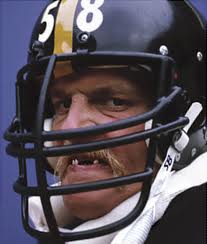
Jack Lambert -- not afraid to hit.

Jack Lambert, the “Man of Steel” who played middle linebacker for the Pittsburgh Steelers, is famous for tough hits and saying that quarterbacks should be forced to wear dresses.

It was a cute little quote suggesting the sport of football is all about violence, and that the violence should not be held in check.

But football also is about money, lots of money, and when you mix money with violence, you end up with sub-human behavior.

It was revealed this week that members of the New Orleans Saints contribute bounty money to pay players who seriously hurt members of the opposing team. A hit that results in a player being carried off the field earned $1,000; if a player was knocked out of a game the payoff was $1,500, and so forth. In a 2009 playoff, it appears a bounty of $10,000 was provided for disabling a quarterback.

So … does this make football fans feel good or bad? Or indifferent?

While the athletic abilities and physical finesse of NFL players are sublime, the brutality of football may be its biggest attraction. With the epidemic of concussions, things are being done to make the game safer, with the risk of making it less lucrative. Despite this, the game probably won’t get much safer until the players – who gain so much from winning – accept that football is not the Ultimate Fighting Championship.

They might be convinced of this if the NFL trots out the hundred of retired players who are physical wrecks, the ones who live with daily pain and don’t even get medical coverage from their former teams. Let these guys lecture the active players – like one of Scrooge’s ghosts.

That might convince them.

Even better, for at least one game, make them all wear dresses.

The preservation of the game is at stake.


Hey, Hey I’m a Monkee!

1 Mar

Image

The Associated Press obit on Davy Jones, lead singer of the Monkees, used the adjective “pre-fab” to describe his band. When it was assembled by television executives trying to rip off the Beatles – their charm, their wit and their movie “A Hard Day’s Night” – the search was for actors, not musicians. Oddly, they came together pretty well as a band, with remarkably good songs. It wasn’t until today that I realized some of the top people in the business were providing them with material and musical assistance.

The AP obit mentions such helpful luminaries as Carole King and Gerry Goffin, Neil Diamond, Billy Preston, Ry Cooder and Neil Young.

How can one not succeed with that kind of support?

Overlooked and under-appreciated

26 Feb

Under-appreciated


The Philadelphia Inquirer today carries an interesting piece on the 50th anniversary of Wilt Chamberlain scoring 100 points in a single basketball game. It carries a shocking disclosure that this historic accomplishment was not universally accepted as a tour de force. Many considered Chamberlain, at 7 foot 1, a freak of nature who actually was hurting the game. After Wilt’s 100-point outing against the Knicks (in Hershey, Pa.), the Philadelphia Warriors went to Madison Square Garden to again face the New York club. Interest was low. Only half of the 18,496 seats were sold.

Why is time and perspective required to understand the relevant and important?

Overlooked

I once worked at a newspaper in north Florida that had won a Pulitzer Prize for photography in 1967, long before I arrived. The winning photo was of a lineman up on a telephone pole. He had been shocked by an electrical surge and had passed out. His safety belt kept him hanging, enabling an apprentice lineman to climb up and give him mouth-to-mouth resuscitation. The photo was taken by Rocco Morabito and entitled, “The Kiss of Life.”

From the stories that were told, the photo ran on an inside page and of only modest size.

Can anyone recall instances where something historic or significant was overlooked or underappreciated until much later?


What good are crowds when you’re dead?

20 Feb

Mulberry Tree

Yesterday I stood in line with hundreds of people waiting to see a show by an artist who, while alive, sold only one painting.

The “Van Gogh Up Close” exhibit at the Philadelphia Art Museum was a collection of paintings done in the last four years of the artist’s life. Many were completed at an asylum where he was being treated for mental illness.

In the context of his time (the late 1800s), his work was revolutionary. It was unacceptable – almost a joke — to the majority of the established art world. Vincent Van Gogh, in his life, was a failure. It is a sad thing that greatness has to suffer in its time because it is so far ahead of its time.

The rest of us are so slow to catch up.

“This was done by a free mind,” my wife, an artist and teacher, said. “My young students can do work like this.”

Van Gogh self-portrait

She did not mean they reach Van Gogh’s level of artistry, craft and creativity. She meant that like Van Gogh their minds are unshackled.

It takes time to shackle a mind, but in the end they get locked down pretty tight.

In many ways, the reaction to new art is like the reaction to great scientific discovery, which is said to have three stages:

  • First, people deny that it is true.
  • Then they deny that it is important.
  • Finally they credit the wrong person.

Well, at least Van Gogh got his credit … belated though it was.