Tag Archives: Trump

Shocking Disclosure: I LOOKED AT THE U.S. BUDGET!

27 Sep

By Lanny Morgnanesi

I had an hour to kill, and I did something peculiar with that precious time.

 I went online and found President Trump’s proposed federal budget for fiscal year 2027. My first reaction was negative, since the fiscal year begins Oct. 1 and the budget would not be approved by Oct. 1. There was disappointment and confusion. Nevertheless, I moved on.

Looking closer, I expected a cold, impersonal grouping of numbers on a spreadsheet and perhaps a pie chart or two. I expected a complete list of expenditures, a complete list of revenue sources, and estimates of what our growing deficit will be. At the end of the 92-page document there are indeed a few incomplete summary tables, but overall, this was a text document, and hardly cold and impersonal. Rather, it was political, with constant and consistent swipes at liberal programs and the policies of former President Joseph Biden. Nasty little comments throughout.

This particular budget deals mainly with discretionary spending, but not mandatory spending like Social Security and Medicare. And in addition to showing incomplete expenses, there are no revenue figures. No revenue numbers at all. This means readers of the budget do not know where the money is coming from, how much is coming in, if it will be enough to cover expenses, and how much it will add to our $40 trillion deficit.

Before looking at some of the numbers, let’s first look at some of the politics.

Russell T. Vought, director of the Office of Management and Budget, says in the message to Congress that begins the document, “When President Trump took office, the Nation was facing a financial catastrophe under the failed leadership of the Biden Administration. Under the fiscal status quo, the deficit was exploding and Federal spending was being wasted on futile, ineffective programs.  In just one year, the Trump Administration has made historic progress on righting our fiscal ship—the speed and scope of which have not been seen in Washington for many years.”

Then we get into a discussion of programs and their funding.
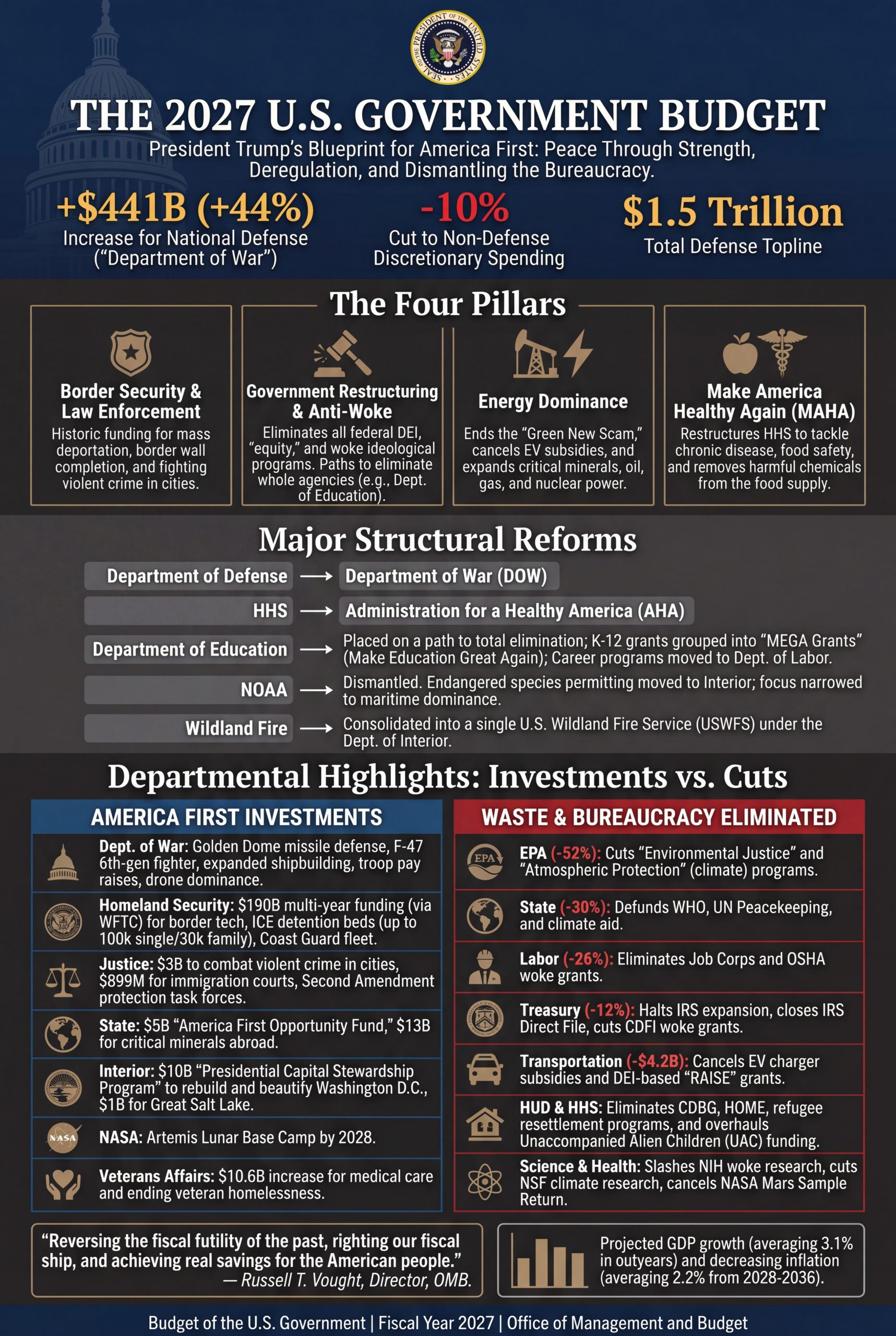
One thing you can’t help notice is the slamming of environment/climate change spending, which this budget refers to as the “Green New Scam.” That term is mentioned 21 times in the document. Another noticeable touch is there is no Department of Defense, only the Department of War.

The actual budget work begins with the Department of Agriculture. An interesting passage is this: “The Budget significantly reduces formula grants that act as pre-determined earmarks for university pet projects. USDA research will instead be competitively awarded to projects in the national interest, as opposed to the woke radical left projects these grants previously funded.”

The preface to the Department of Education says: “The Budget puts the Department of Education (ED), which has failed the Nation’s children, teachers, and families, on a path to elimination. Nationally, approximately 70 percent of eighth graders are below proficient

in reading and math. These abysmal results demonstrate that Federal control of education is not working.”

The Budget eliminates the Minority Business Development Agency, which the Trump budget says “promotes certain activities that violate the Civil Rights Act of 1964. In 2024, a U.S. District Court found MBDA’s presumption of ‘social disadvantage based on race or ethnicity’ in its funding decisions to be unconstitutional. Divisive and discriminatory diversity, equity, and inclusion (DEI) practices are the core mission of MBDA, which is why the Budget eliminates the Agency.”
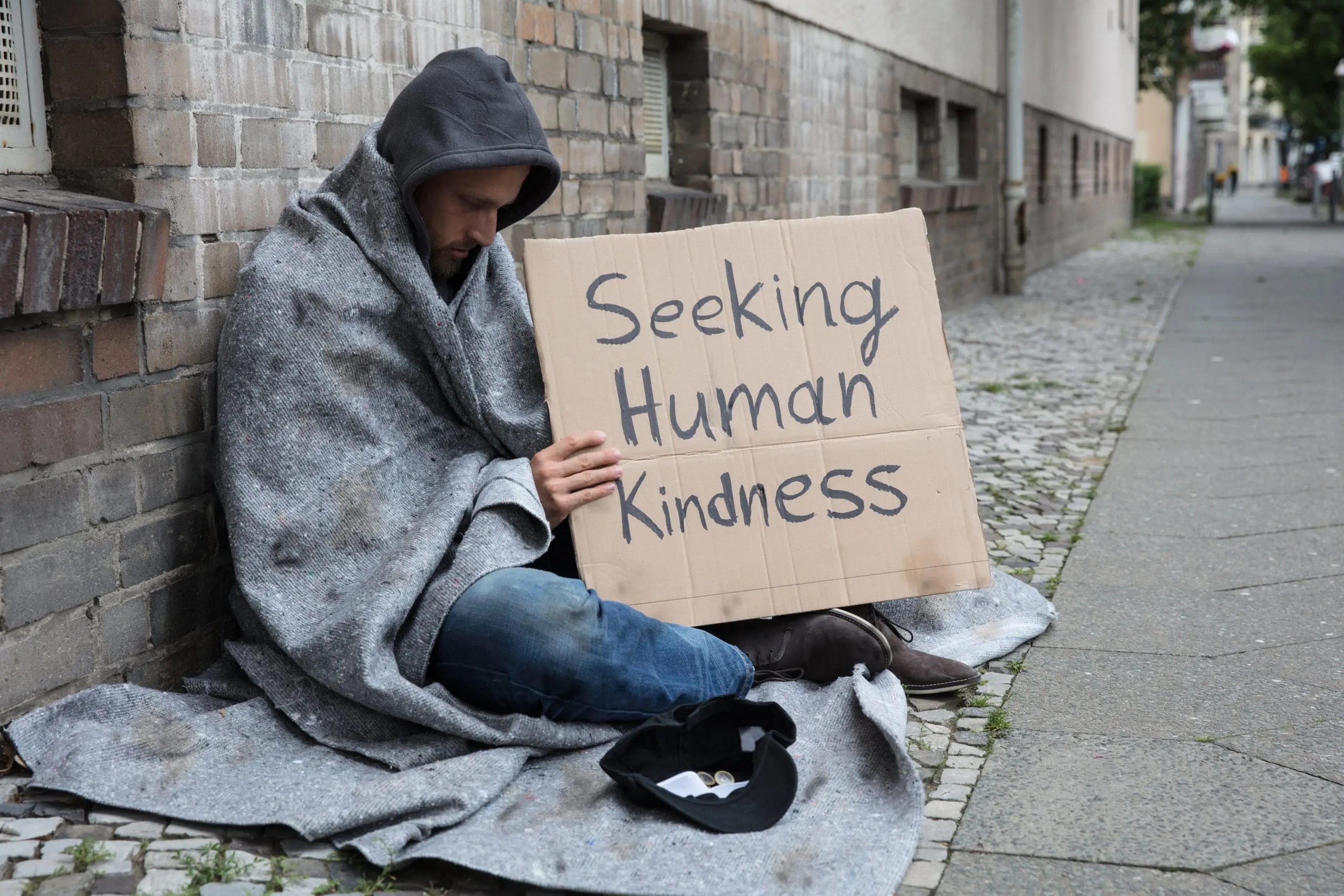
Under the Department of Commerce we learn, “At the end of the Biden Administration, HUD reported that street homelessness increased 20 percent since 2020, hitting the highest level ever recorded despite an over 50-percent increase in funding … and the Congress providing the highest levels of funding ever devoted to homelessness programs in 2024.”

The budget then goes on to cut $393 million from homeless assistance programs.

Here are other winners and losers:

War — up 43.7 percent

Agriculture — down 19 percent

Environmental Protection – down 52.4 percent

Justice – up 13 percent

Health and Human Services – down 12.2 percent

Nuclear Security – up 12.4 percent

National Science – down 54.7 percent

Small Business – down 67.2 percent

Veteran Affairs – up 8.7 percent

Labor – down 25.9 percent

NASA – down 23 percent

When writing any budget, certain assumptions must be made. The Trump budget is written with some very optimistic assumptions that, if proven wrong, will mess up the whole budget. For example, Trump’s budget expects growth, or GDP, to be roughly 3 percent for the long term. The Congressional Budget Office and the Federal Reserve put that figure at around 2 percent.

An even more critical figure is the amount of interest the government will pay on 10-year treasury notes, which are loans to our government for taxes we don’t want to pay. The interest we pay now on our $40 trillion debt is $1 trillion a year, more than we currently spend on our military. Trump thinks the interest rates will stay at 3.3 percent until at least 2036. Right now, the rate on 10-year notes is 5.1 percent. If anything can blow up the budget, it is higher interest on our loans.

My hour of free time had almost ended, so I put away the budget. I spent a couple more minutes, however, looking for Congress’ version of the budget, assuming it might be more detailed. I couldn’t find one. Quickly then, I looked at the U.S. Constitution to see what it says about Congress and the budget. Although Congress clearly oversees spending and taxation, there is no constitutional edict requiring it to prepare a budget.

My hour was up, and so I went out to cut my grass, trying to be a good steward of both my property and my neighborhood, even if those with much larger responsibilities have chosen to ignore theirs.

Modeling a Country After a Shopping Destination

23 Oct

By Lanny Morgnanesi

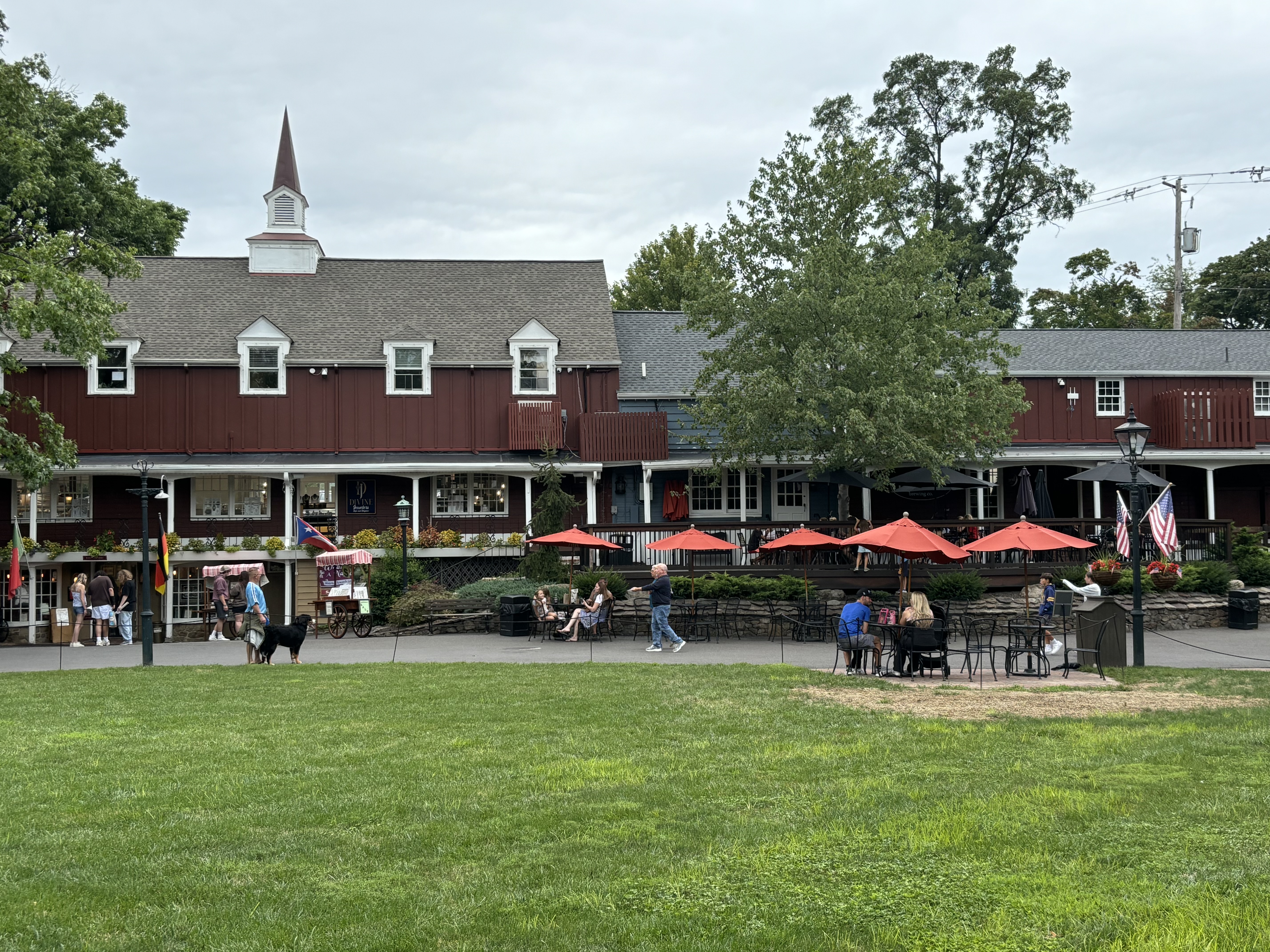
Near my home, in a place called Lahaska, there’s a tranquil spot of beauty and commerce called Peddler’s Village. It was built by a somewhat eccentric man named Earl Jamison. The village is spread over 42 acres. It has old-fashioned shops, restaurants, bars, lodging, even a carnival merry-go-round. The peddlers at Peddler’s Village peddle everything from clothes to hats to paintings to fresh pastry, popcorn, maple syrup, and beef jerky.

Part of the attraction is the artful landscaping. Jamison liked gardening, and when he was alive you could mostly find him at Peddler’s Village on his knees, tending to plants. That kind of attention and that kind of tradition has been passed on to others. The place looks great.

The summer day of my recent visit was pleasant, and everyone was having a good time. Parents, kids, babies, older couples, dogs. In this part of suburban Philadelphia and at Peddler’s Village, the crowd is mostly – what’s a good word? – Anglo. With a fair number of Asians. The people who walked the brick promenades seemed comfortable in their lives, safe, and secure. As I did. This was an enviable America.

This simple Saturday was starkly different from the America depicted in the political ads of Democrat Kamala Harris and Republican Donald Tump, both of whom want to lead a country they have extreme doubts about. During the broadcast of the July Olympics in Paris, Harris and Trump ran harsh ads designed to shock and get you to the polls. There was an inescapable onslaught of these ads. I couldn’t tell which America was worse, the one the Republicans blame the Democrats for, or the one the Democrats blame the Republicans for. It wasn’t much of a choice. Made me think horrible things about a country that, to me, seems all right.

Shoppers relaxing

The trump and the Republicans presented a nation ravaged by inflation and overrun with invading foreigners who bring in drugs and commit a wide assortment of crimes, including murder and rape. These same foreigners suck the money and life out of our social service and health systems, so there is little left for us. Kamala Harris, the Democratic candidate for president, is said to be dangerous and weak, a radical who clearly will destroy whatever is left of the America that they say once was great but obviously no longer is. The Democrats, for their part, cast Trump as a crude, weird, racist dictator whose speech and actions resemble Hitler’s.

What these ads showed and preached was nothing at all like the idyllic Peddler’s Village, where not even a trace of discontent could be found. And so I thought of my own life and happiness. As my wife shopped, I sat on a bench and enumerated the America I knew and appreciated, and that I think others would recognize, regardless of the horrors in the political ads.

In my America:

  • No one is shooting at me or dropping bombs on or near my house.
  • My home is nice, comfortable, and in good working order.
  • I have clean water and plenty of food.
  • The stores are filled with everything I could possibly need or want.
  • They take away my trash and sewage.
  • They take away the snow.
  • We have good hospitals and good doctors, and you can get appointments.
  • We have good schools.
  • The police protect us.
  • We are free to go where we want, when we want.
  • Contrary to what some people may prefer, we can say whatever we want.
  • We have a strong tradition where the rule of law prevails, and the legal system works.
  • We are allowed to invest our money in companies that can make us money.
  • Generally, you don’t have to bribe a public official to get something done.

I’ll stop there. I hope you can see the difference between what the presidential candidates are saying and what I am living.

Elsewhere, beyond me and beyond Peddler’s Village, there are people living lesser, unenviable lives. In these last few decades, inequality in America has bounded ahead in a rampage. There is nothing unusual about inequality in America, but it has gotten worse. For many there is food insecurity, job insecurity, little or no medical attention, poor or no housing, poor schools, high crime, discrimination and lack of opportunity. None of this was on display at Peddler’s Village.

Philosophers and do-gooders will say that in a country as rich as the United States, poverty is unnecessary. Others will say poverty is the self-inflicted disease of the shiftless and not something for government to fix. But in almost every society and culture, the natural, human tendency is for a strong and aggressive minority to acquire nearly all the wealth and broker all the power. Sometimes, this inevitable pattern is halted or reversed by uprising and revolution, but only for a period, and then the inexorable progression of the dominant human forces continues, and the once-again complacent majority – usually with a very worse-off minority substrata –allows its modest wealth to trickle up.

Therefore, it is difficult for a nation such as ours to eliminate poverty and establish of nation of Peddler’s Villages.

In my mind, eliminating poverty is not about giving money to the poor. Rather, it is about allowing the poor to be productive. This requires removing the often-invisible restraints and barriers holding them back, as well as reorienting a defeatist mindset and the established alternative culture of the outsider.

Not an easy thing to do. Maybe impossible. But for the sake of discussion, let’s see how much money is out there for the poor, as if we just wanted to give it to them, which of course we do not.

Forbes magazine says there are about 400 billionaires in the US. It says they are worth a total of $54,000,000,000,000 – that’s $54 trillion. (The entire federal budget in 2024 was about $6.5 trillion). The top five billionaires are:

Elon Musk — $244 billion

Jeff Bezos — $197 billion

Mark Zuckerberg — $181billion

Larry Ellison — $175 billion

Warren Buffett — $150 billion

If, in some crazy world that is not ours, we took 25 percent of the wealth away from the 400 billionaires and handed it to the 37 million people living in poverty, each would receive $36,000. I guess a family of three would get more than $100,000. That’s enough to start a small business, send the kids to college, or maybe get a mortgage on a house.

This is just fun with numbers and of no meaningful purpose when it comes to problem solving. It is for perspective only. A more practical solution to income inequality is a return to tax policies of the ‘50s and ‘60s that allowed for a more even distribution of the wealth.

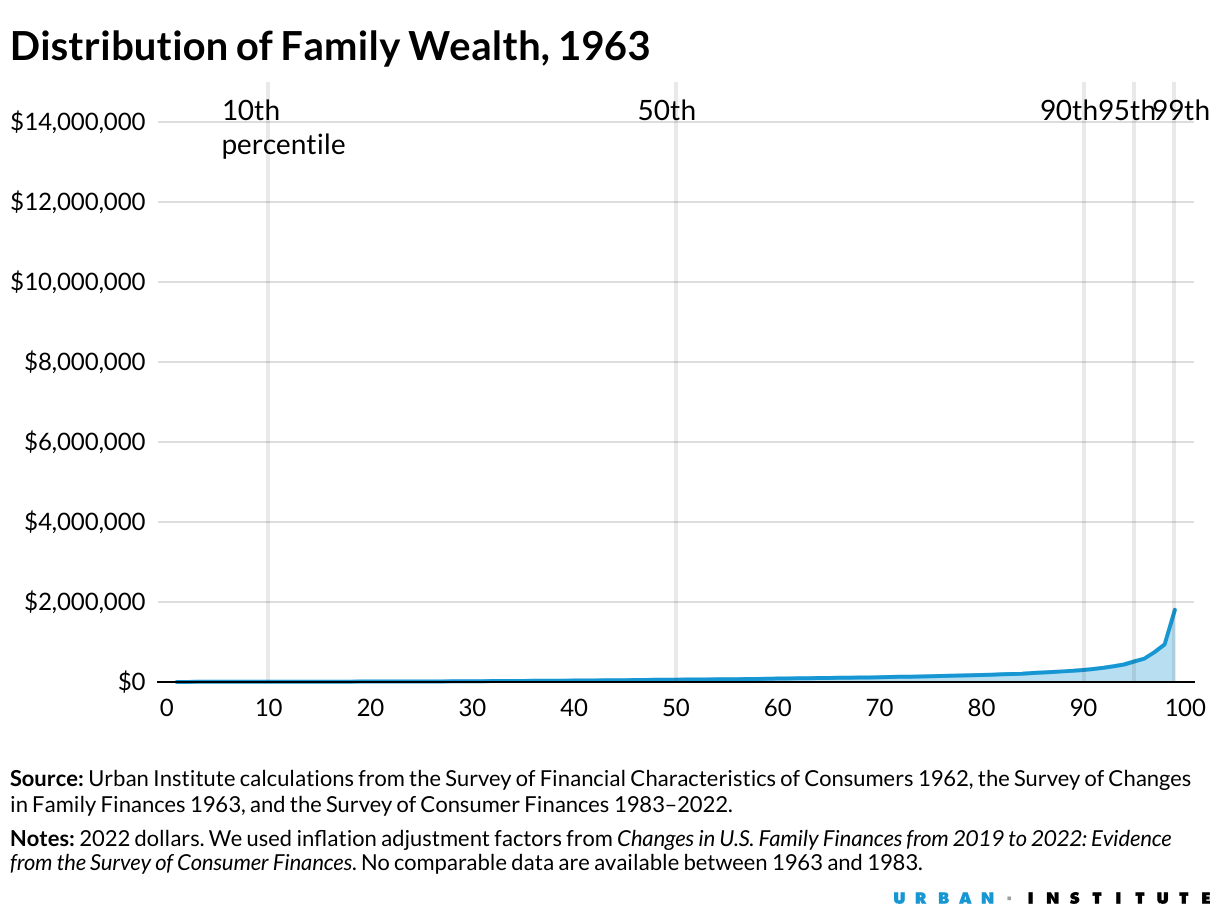
To illustrate the change, in 1963, the wealthiest families had 36 times the wealth of families in the middle class. By 2022, they had 71 times the wealth of those families. The top 10 percent now own about 70 percent of the nation’s wealth, with the bottom 50 percent owning 2.5 percent.

The charts below show how the money was spread out then, and how it is spread out now. The blue is the money. The poor are on the left. The rich are on the right. Most of us are in the middle.

If we can find the strength and courage to eliminate barriers to opportunity, and there is a redistribution of some wealth, without so much money sitting in the hands of so few, maybe there will be enough money to fix things up in our country. Maybe our crumbling cities can look like Dubai, or Shanghai, or Singapore. Maybe, if neighborhoods aren’t economic dead zones, they’ll be welcoming places and not fearful haunts to be avoided. With the proper changes, maybe escalators and streetlights will work. Maybe we will have fast trains, and wide, smooth roads, and bridges not in danger of collapsing, and JFK airport won’t be a 21st century embarrassment.  Maybe we can prop up Medicare and Social Security and have a good universal health care program. Maybe, state universities can be free. It’s not that we need free stuff, it’s that we’ve worked hard enough to get them, and that wide access to education and health care will result in a stronger, more productive country with greater participation by its population. With a vibrant, involved population, there will be great costs savings in law enforcement and prisons, mental health, public housing, all kinds of things. This is a great trade off.

New York City subway

I was disheartened when I heard of an American who returned home after living for a decade in Japan. “Nothing works here,” he said. “And the public bathrooms are disgusting.”  So let’s fix things up. Fix ‘em up good.

There is a theory that if you don’t repair a broken window in a building, the entire neighborhood will eventually collapse. If you do repair it, the entire neighborhood will keep itself up and thrive.

I want the latter for my neighborhood and my country. Why don’t others?

Visit the clean, the organized, the efficient, the beautiful Peddler’s Village and perhaps you will change your mind.

The Trump-man Show puts an end to the Sounds of Silence

5 Feb