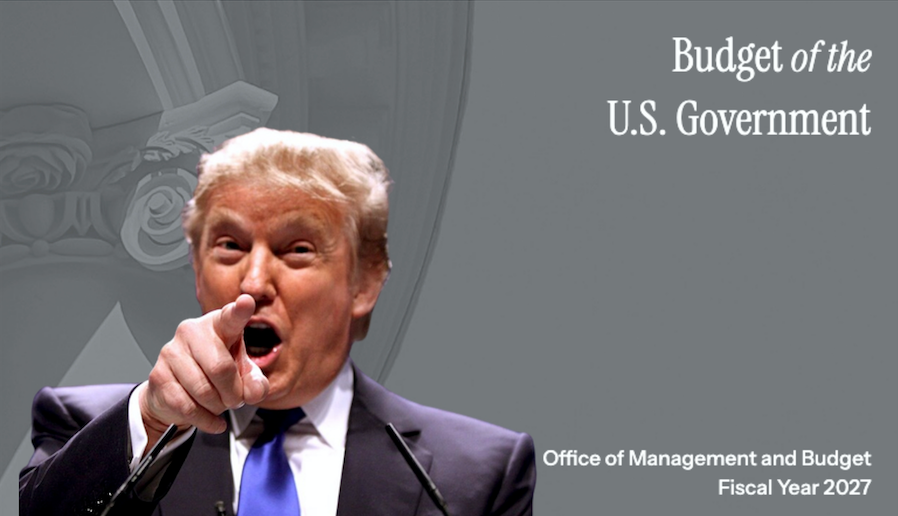
By Lanny Morgnanesi
I had an hour to kill, and I did something peculiar with that precious time.
I went online and found President Trump’s proposed federal budget for fiscal year 2027. My first reaction was negative, since the fiscal year begins Oct. 1 and the budget would not be approved by Oct. 1. There was disappointment and confusion. Nevertheless, I moved on.
Looking closer, I expected a cold, impersonal grouping of numbers on a spreadsheet and perhaps a pie chart or two. I expected a complete list of expenditures, a complete list of revenue sources, and estimates of what our growing deficit will be. At the end of the 92-page document there are indeed a few incomplete summary tables, but overall, this was a text document, and hardly cold and impersonal. Rather, it was political, with constant and consistent swipes at liberal programs and the policies of former President Joseph Biden. Nasty little comments throughout.
This particular budget deals mainly with discretionary spending, but not mandatory spending like Social Security and Medicare. And in addition to showing incomplete expenses, there are no revenue figures. No revenue numbers at all. This means readers of the budget do not know where the money is coming from, how much is coming in, if it will be enough to cover expenses, and how much it will add to our $40 trillion deficit.
Before looking at some of the numbers, let’s first look at some of the politics.
Russell T. Vought, director of the Office of Management and Budget, says in the message to Congress that begins the document, “When President Trump took office, the Nation was facing a financial catastrophe under the failed leadership of the Biden Administration. Under the fiscal status quo, the deficit was exploding and Federal spending was being wasted on futile, ineffective programs. In just one year, the Trump Administration has made historic progress on righting our fiscal ship—the speed and scope of which have not been seen in Washington for many years.”
Then we get into a discussion of programs and their funding.
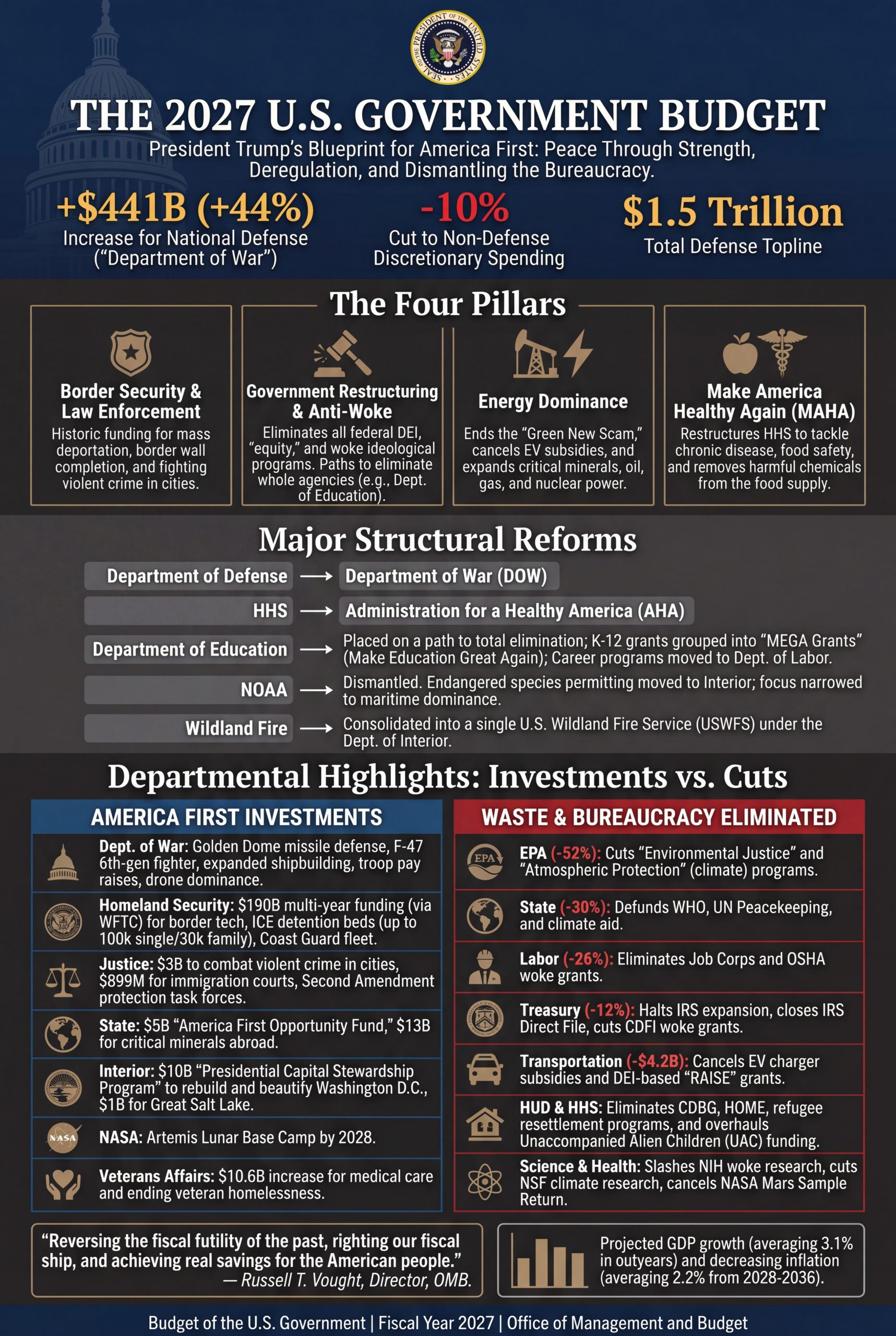
One thing you can’t help notice is the slamming of environment/climate change spending, which this budget refers to as the “Green New Scam.” That term is mentioned 21 times in the document. Another noticeable touch is there is no Department of Defense, only the Department of War.
The actual budget work begins with the Department of Agriculture. An interesting passage is this: “The Budget significantly reduces formula grants that act as pre-determined earmarks for university pet projects. USDA research will instead be competitively awarded to projects in the national interest, as opposed to the woke radical left projects these grants previously funded.”
The preface to the Department of Education says: “The Budget puts the Department of Education (ED), which has failed the Nation’s children, teachers, and families, on a path to elimination. Nationally, approximately 70 percent of eighth graders are below proficient
in reading and math. These abysmal results demonstrate that Federal control of education is not working.”
The Budget eliminates the Minority Business Development Agency, which the Trump budget says “promotes certain activities that violate the Civil Rights Act of 1964. In 2024, a U.S. District Court found MBDA’s presumption of ‘social disadvantage based on race or ethnicity’ in its funding decisions to be unconstitutional. Divisive and discriminatory diversity, equity, and inclusion (DEI) practices are the core mission of MBDA, which is why the Budget eliminates the Agency.”

Under the Department of Commerce we learn, “At the end of the Biden Administration, HUD reported that street homelessness increased 20 percent since 2020, hitting the highest level ever recorded despite an over 50-percent increase in funding … and the Congress providing the highest levels of funding ever devoted to homelessness programs in 2024.”
The budget then goes on to cut $393 million from homeless assistance programs.
Here are other winners and losers:
War — up 43.7 percent
Agriculture — down 19 percent
Environmental Protection – down 52.4 percent
Justice – up 13 percent
Health and Human Services – down 12.2 percent
Nuclear Security – up 12.4 percent
National Science – down 54.7 percent
Small Business – down 67.2 percent
Veteran Affairs – up 8.7 percent
Labor – down 25.9 percent
NASA – down 23 percent
When writing any budget, certain assumptions must be made. The Trump budget is written with some very optimistic assumptions that, if proven wrong, will mess up the whole budget. For example, Trump’s budget expects growth, or GDP, to be roughly 3 percent for the long term. The Congressional Budget Office and the Federal Reserve put that figure at around 2 percent.
An even more critical figure is the amount of interest the government will pay on 10-year treasury notes, which are loans to our government for taxes we don’t want to pay. The interest we pay now on our $40 trillion debt is $1 trillion a year, more than we currently spend on our military. Trump thinks the interest rates will stay at 3.3 percent until at least 2036. Right now, the rate on 10-year notes is 5.1 percent. If anything can blow up the budget, it is higher interest on our loans.
My hour of free time had almost ended, so I put away the budget. I spent a couple more minutes, however, looking for Congress’ version of the budget, assuming it might be more detailed. I couldn’t find one. Quickly then, I looked at the U.S. Constitution to see what it says about Congress and the budget. Although Congress clearly oversees spending and taxation, there is no constitutional edict requiring it to prepare a budget.
My hour was up, and so I went out to cut my grass, trying to be a good steward of both my property and my neighborhood, even if those with much larger responsibilities have chosen to ignore theirs.



Leave a comment