Two quotes, one old, one new, about something that existed then and continues to exist now

12 Jul

Caradoc in Rome


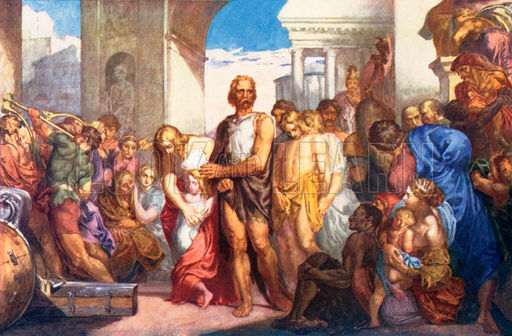
The first speaker is Caratacus, the British tribal leader who resisted the Roman invasion in 43 AD. He eventually became a prisoner of the Romans. After a convincing speech prior to his scheduled execution, his life was spared. Caratacus was so impressed by the city of Rome that, in amazement, he said this to his captors, who conquered and occupied Britain:


“And can you, then, who have got such possessions and so many of them, covet our poor tents?”


Goldman-Sachs-CEOThis second quote was said by Lloyd Blankfein, CEO of Goldman Sachs, a man whose job it is to make abnormal amounts of money in any and all ways possible and some that are not possible:


“Too much of the GDP over the last generation has gone to too few of the people… . It’s a very big issue and something that has to be dealt with.”


In both cases, the powerful have taken and then tried to exercise at least modest restraint to make things a little better. And so it continues.

By Lanny Morgnanesi

You’re nothing, but suddenly you’ve got what everyone wants

7 Jul

Venezuelan prostitutes


Without judging, blaming, or saying I wouldn’t do it, the standard model for business is that those who dominate the financial markets rig them in their favor. That’s really not a shocker. The shocker is that once in a great while something occurs in the market place that benefits those of little means.


Right now the beneficiaries of fate’s largess are the prostitutes of Puerto Cabello, Venezuela.


Not long ago, Venezuela was flush with petro-cash and acted brashly and boldly on the world scene. Under socialist President Hugo Chavez, Venezuela even helped 400,000 poor Americans pay their winter heating bills. Chavez, however, is dead and gone and the Venezuelan economy has all but collapsed. People can no longer find things like cooking oil and flour in their local stores.


Spared from this hardship are the prostitutes of Puerto Cabello. This has not so much to do with the sex trade as it does with the currency trade.


An article by Anatoly Kurmanaev in Bloomsberg Businessweek explains the scenario.


The Venezuelan currency is the bolivar, and it has taken a nosedive. The official exchange rate is 6.3 bolivars per dollar but the going rate on the street is 71 bolivars and climbing. Either way, dollars are very hard to get. The government restricts their circulation.


But foreign sailors, the primary customers of prostitutes in Puerto Cabello, a port town, pay in dollars. This means the prostitutes now possess the most sought-after item in the country. Currency traders seek them out and lavish them with bolivars in exchange for their dollars. This enables them to purchase whatever they want on the black market.


By the way, the prostitution is legal but the currency trading is not.


Sailors are charged a flat rate of $60 an hour. With the new market conditions, one trick is equal to the monthly wage of some people. But the prostitutes also book hotels and taxis for the visiting sailors. They charge them in dollars and pay for the rooms in bolivars. This increases their salary another 50 percent.


So here’s to the horizontalists of Puerto Cabello. I think they deserve this unexpected turn of events. No word yet on anyone rushing in to deny them their windfall. That’s noble. I sense in the United States the good times wouldn’t last long. If something the poor had became valuable it would be taken away. If a commodity as unwanted as, say, rat droppings was needed to make a new cancer drug, rich investors would quickly buy up the dropping rights at all the infested slums of major American cities, leaving the tenants unable to benefit from a sad condition turned bright.


On this score, the Venezuelan elite seem much better sports than their American counterparts. The extra money earned by the prostitutes, incidentally, goes for things needed by their families. But as a prostitute named Elena points out in the article, she still has to sell her body.


By Lanny Morgnanesi


(Photo by Vladimir Marcano /Bloomberg)

A minor indiscretion that went unnoticed

24 Jun

Hot tub blur

I live in a picture-postcard town with lots of shops on and off Main Street. The merchants come and go and recent openings include a waffle-and-ice cream emporium, two vap parlors and a store made up like a pharmacy that sells “medicinal” cold-pressed juice for $7 a bottle.


People around here keep up with the shops, but there’s one that everyone overlooks. Instead of being parallel to Main Street, it’s set at an angle. When you round the corner right before it, your line of sight is directed elsewhere.


No one ever looks in that window. I know because I sat in it with two blondes wearing bikinis.


That was years ago.


The story begins at the county courthouse in the center of town. I covered the government there as a reporter. The important offices were on the fifth floor and were guarded by two sentinels sitting at adjacent desks that formed a sort of barrier. The sentinels were young, blonde and attractive. They looked alike and both had the same first name.


For the sake of this story, let’s say it was Donna.


To secure information or to speak with the people running the county, reporters had to get past the two Donnas.


On a day when I needed something special, the two Donnas were in a good mood and complied. In exchange, they demanded something of me.


“Tomorrow, meet us on Main Street at noon. Bring cheese, crackers, pepperoni and your bathing suit. We’ll bring the wine.”


They would say no more. As I think about it now, I really didn’t need to know more.


The two Donnas showed up as promised and walked me to the store that sits at an angle. We made the little turn and they explained.


“Our friend is renting this now,” one of the Donnas said. “He asked if during lunch we could help with his new business. He wants us to sit in there,” and she pointed to a steaming, redwood hot tub in the window.


This was a government town and I was fairly well known by all the government officials. Most took lunch at the local restaurants and would be passing by. While there was great appeal to the idea of being immersed in hot water with two almost-identical women who had the same name, I worried about my reputation. This was a town where people talked. I didn’t want them to be talking about me, especially when my job was to talk about them.


“Oh, c’mon,” one Donna said.


“Oh, c’mon,” the other Donna said.


And so I went on.


They were relaxed but I was tense. I watched the window as people passed, waiting for that moment when some authority figure – maybe a judge — would pause, stop, turn, point and show utter disgust. After a glass of wine, the tension seemed to boil off.


We were having a good time and had forgotten the world. But after a while we grew concerned – perturbed – that not a single person had noticed us. How odd. In an effort to draw attention, we frolicked in a more pronounced way, and still nothing. We yelled and waved, but no one waved back.


Was it us?


No, it was the store.


Hot tubs were popular around this time, but the friend of the two Donnas went out of business in just a few months.


I learned a couple of important lessons from this. First, have fun while you can. Second, before you open a business, for god sakes do a little research.


By Lanny Morgnanesi

When the poor stop going to McDonald’s, we’re all in trouble

20 Jun

mcdonalds-meal

Businesses like Wal-Mart and McDonald’s haven’t been doing well.


People without a lot of money usually go to these places, but because they now have even less money, they’ve stopped going. When people who work at Wal-Mart and McDonald’s can no longer afford to shop and eat there, it’s a sure sign of a coming, broad-based financial decline.


It will affect us all, even the rich, who don’t amount to much if they can’t get the poor to give them money.


Reports show that the parade of U.S. customers into Wal-Mart fell 1.4 percent during the first quarter. That followed a decline of 1.8 percent in the prior year.

The discount retailer blamed the bad winter weather but also cited cuts in food stamps, higher payroll taxes and the increased cost of health care.


You know things are bad when Wal-Mart relies on the food stamp program to move product.


Walm-MartRecent U.S. sales at McDonald’s also have declined, by 1 percent. To lure back low-end customers, the burger behemoth increased its value menu, but that hurt profits even more.


What’s happening is the downward pressure on income is leading to downward pressure on sales.


Henry Ford used to pay his people well so they could buy cars. If Wal-Mart and McDonald’s have any sense, they and the other minimum-wage shops will copy this strategy. Not doing so will have consequences. It could turn the U.S. into another Japan – the bad one, not the good one.


Japan was once the globe’s supreme economic power. It made and sold great products while setting new standards for manufacturing. Flush with cash, Japanese investors bought up billions in prime New York real estate, and nearly everything else. During this period, in the mid-80s, I visited Hawaii, which seemed more like Japan. Japanese tourism and culture were so strong that hippie beach bums peddling sailing lessons had to learn Japanese.


Then came the bust, the swoon and massive disinflation. It began around 1990. People in the U.S. don’t understand disinflation. It’s when prices fall and fall and fall and still no one buys anything. The economy becomes comatose. Seems impossible, until you look at Japan, where disinflation has been a cruel fact of life for a couple decades.


According to Bloomberg Businessweek, one contributor to Japan’s disinflation is falling wages. The recent habit of businesses there, as in the United States, is to avoid hiring full-time workers and instead contract with temporary workers who earn less and have no job security. These temps now make up about 40 percent of the Japanese work force. They are paid about 38 percent less than full-time workers.


The financial and social divide between the two kinds of workers has grown and is causing multiple calamities. For example, no one wants to marry a temp. This depresses birthrates and is making Japan a nation of elderly people. Banks won’t give temps mortgages, which doesn’t encourage building. These and other negative trends cascade and the country stagnates.


In the current era, U.S. corporations have reaped huge profits from selling to the developing world. But those markets, at least to some degree, are cooling and maturing. The bread-and-butter American markets may have to be revived in order to maintain profits. That could require a higher minimum wage and more opportunity for the middle class. The government and the business community finally are waking up to this.


The Great Cure for so much – including crime and falling education standards — is to put money back in the hands of traditional spenders. For a time, greed will blind us to this reality. Then the cash register stops ringing and we see.


Wal-Mart and McDonald’s — and all the other places where you can work full-time and not earn a living — now see. Each is probably afraid to take the first big step. Sooner or later someone has to, otherwise that first big step will be involuntary and it will send us over a cliff.


Think about the return of the 25-cent McDonald’s hamburger. Think about taking the family out for one on a very special night, maybe once every couple of months. That disinflation, and it will make 15 percent inflation seem like good times.


Now, we wait.


By Lanny Morgnanesi

Like Ben Stiller, he felt the pain of an unfortunate act. Unlike Ben, he couldn’t discuss it.

9 Jun

franks_and_beans

The Ben Stiller movie, “There’s Something About Mary,” was on the other night and it reminded me of Bill Foley.


Bill Foley was a reporter who always carried a notebook and pen. He needed them for work but also because he couldn’t talk. When you asked Bill a question, he’d pull out the notebook and write his answer. Often, it was only a word or two. Usually, it was funny.


Because of throat cancer, Bill had his voice box removed.


Everyone assumed he could not utter a sound. Through odd personal circumstance, however, I learned this was not true.


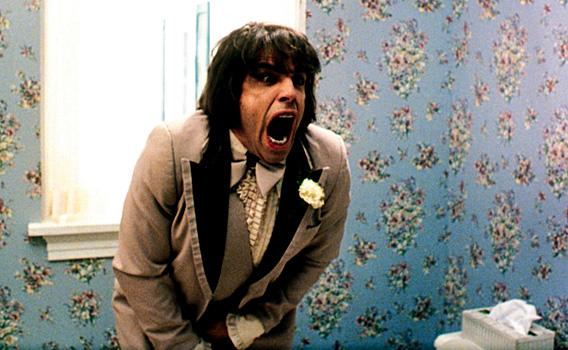
It happened while we both were in the men’s room at the Florida Times-Union in Jacksonville. As we stood side-by-side at the urinals, I noticed Bill was in a hurry. Upon closing up, he – like Ben Stiller’s character in “There’s Something About Mary” — caught the frank-N-beans between the teeth of his zipper. And just like Ben, but not as loud, he let out a sound of agony and helpless distress.


The Stiller character, comically, was unable to free himself. Bill quickly fixed things and exited.


And there I was, with a secret to share: Bill Foley can’t talk but when it’s necessary he can moan! I tried being discreet and limited in my telling of the tale, but the worst got the best of me and the story spread. I never heard back from Bill and don’t know if my disclosure ever made it to his ears, which worked just fine.


Bill was a wonderful, witty columnist. Some knew him before the operation. I didn’t. I knew him only from his column, his actions and his laconic, handwritten retorts.


For a quiet guy, he brought lots of personality to the newsroom. I remember the time when lunches were being stolen from the office refrigerator. Members of the Refrigerator Users Group – RUG – went on a tear, sending out threatening memos and edicts to all possible suspects and devising multiple strategies of defense. Bill’s running commentary on the crisis was hilarious and ultimately silenced RUG.


It was pleasant to think of him again.


He died in 2001 at age 62 after working in newspapers for 40 years. I left the Times-Union in 1993 and never read his obit. I looked it up today.


Among other things, it said that, “Mr. Foley had written columns about generations of visionaries, bootleggers, politicos and hapless saps whose exploits helped shape the city.”


It said, “His wry humor and precise, staccato language attracted a following of readers that ranged from schoolchildren to corporate executives.”


It mentioned that he had played catch with Hank Aaron and spent time in Cuba with Che Guevara.


It didn’t mention Ben Stiller, frank-N-beans or “There’s Something About Mary.” For that I am grateful. I’m also grateful that Mr. Stiller, via his one-of-a-kind performance, was able to bring back some nearly forgotten memories of a man who could say a whole lot with so very little.


By Lanny Morgnanesi

<iframe width=”420″ height=”315″ src=”//www.youtube.com/embed/7cm0FZtlcxc” frameborder=”0″ allowfullscreen>

Goldman Sachs: Altruism for a profit

27 May

goldman-sachs,jpg

Investment powerhouse Goldman Sachs has made money with schemes that were ingenious, inventive, complex, arcane, morally vacant and, some might say, criminal. Now it hopes to make money by exploiting the dysfunctions of government.


Goldman has long mastered the art of generating cash without actually producing a product. Its techniques include:


  • Using influence to rig a trading system in its favor.
  • Finding a market where it can buy low and then finding a second market where it can sell high.
  • Identifying gross inefficiencies that are costing someone or something money and offering to fix them.


Goldman’s new plan is along the lines of the third. The firm is financing crime reduction measures in Massachusetts in exchange for a percent of what is saved by not having to incarcerate thugs.


Ingenious, inventive, complex.


New profit center for investors

New profit center for investors

This type of investment carries an extra dividend: It makes Goldman Sachs – a villain in the eyes of the Occupy movement – look like a Good Guy. Indeed, the investment vehicle designed to reduce crime is called a social impact bond, or in Wall Street parlance, an SIB.


Some view these investments as a marriage between capitalism and charity, but capitalism is the strong, dominant partner.


Bloomberg Businessweek reported on Goldman and the SIBs in early May. Writer Esme E. Deprez cites a prediction by the Rockefeller Foundation that the market for SIBs is growing and by 2015 will reach $500 million.


That’s a lot of social impact, enough to give government the idea that it no longer is responsible for maintaining order and structure in society. Or has it already decided that?


According to the Businessweek article, Goldman is investing $9 million and betting that crime will go down – or more accurately that young men will spend fewer days in jail.


The bonds help fund a program called the Massachusetts Juvenile Justice Pay for Success Initiative. In that program, a non-profit agency called Roca works with young adult males on probation. The agency provides outreach, therapy and training. After two years, participants are supposed to leave, take a steady job and lead a crime-free life.


If a graduate stays out of jail for a year, Massachusetts saves $12,400. If the state is able to reduce crime enough to close a 300-person prison, it saves $47,500 per inmate.


This is how the SIBs and Goldman get paid off.


In this particular case, Goldman has partnered with other investors who financed an additional $12 million in bonds, making the total $21 million.


The bonds earn 5 percent no matter what, but pay nothing else until the men in the program manage to spend 22 percent fewer days in jail. There’s a sliding scale for payment, with a maximum of $27 million being paid to bond holders if jail time is reduced by 70 percent.


It’s a risk, like a junk bond, but $27 million for a $21 million investment is pretty good money (28 percent profit) and worthy of the risk.


Roca had been working with 375 men. With the SIB money, it can handle 550.


A skeptic might look at all this and ask:


  • Why doesn’t Massachusetts put up the $21 million itself and forego the $6 million payout to investors?


  • Why doesn’t society as a whole recognize that employed people from stable families commit fewer crimes?


  • Why does the nation exclude million of people from an otherwise viable system of commerce, education and opportunity and allow the existence of acres and acres of urban decay that breed crime and insanity?


There are clear answers to these questions. I won’t go into them because our preference is to ignore them, deny them and maintain a monstrous blind spot in spite of religious teachings, well-intended laws and glorious, inclusive rhetoric.


But as a culture, we have reached an all-time low when we allow things to get so bad

that Goldman Sachs can make money off our failures. The promise of money, more so than altruism or mere brotherhood, does seem to get things done. Perhaps we can turn the VA hospitals over to Goldman. With all those returning vets, there’s got to be a profit in there somewhere.


By Lanny Morgnanesi


Is the son of a god a god? The problem of famous sons

13 Apr


charlie  parker


In Bob Dylan’s remarkable autobiography, “Chronicles Vol. 1,” there is a retelling of the evening he went to see a performance by Frank Sinatra Jr.


It was an unusual turn in the book. After reading about the young man from Minnesota finally winning the day amongst all the competing voices of Greenwich Village, we have him stopping in – very deliberately – on someone so apart from folk culture that the attraction cannot immediately be understood.


Dylan very much liked the performance. He liked the voice and style of the man who could never, ever, stand outside his father’s shadow. In the book, Dylan expresses true sadness for the predicament of the junior Sinatra, perhaps knowing that someday his own children would face this struggle for meaning, purpose and acceptance.


bobdylan1I’m not sure why, but we expect greatness from the off springs of the great, or at least some semblance of distinction. And like Dylan, we take the disappointment to heart.


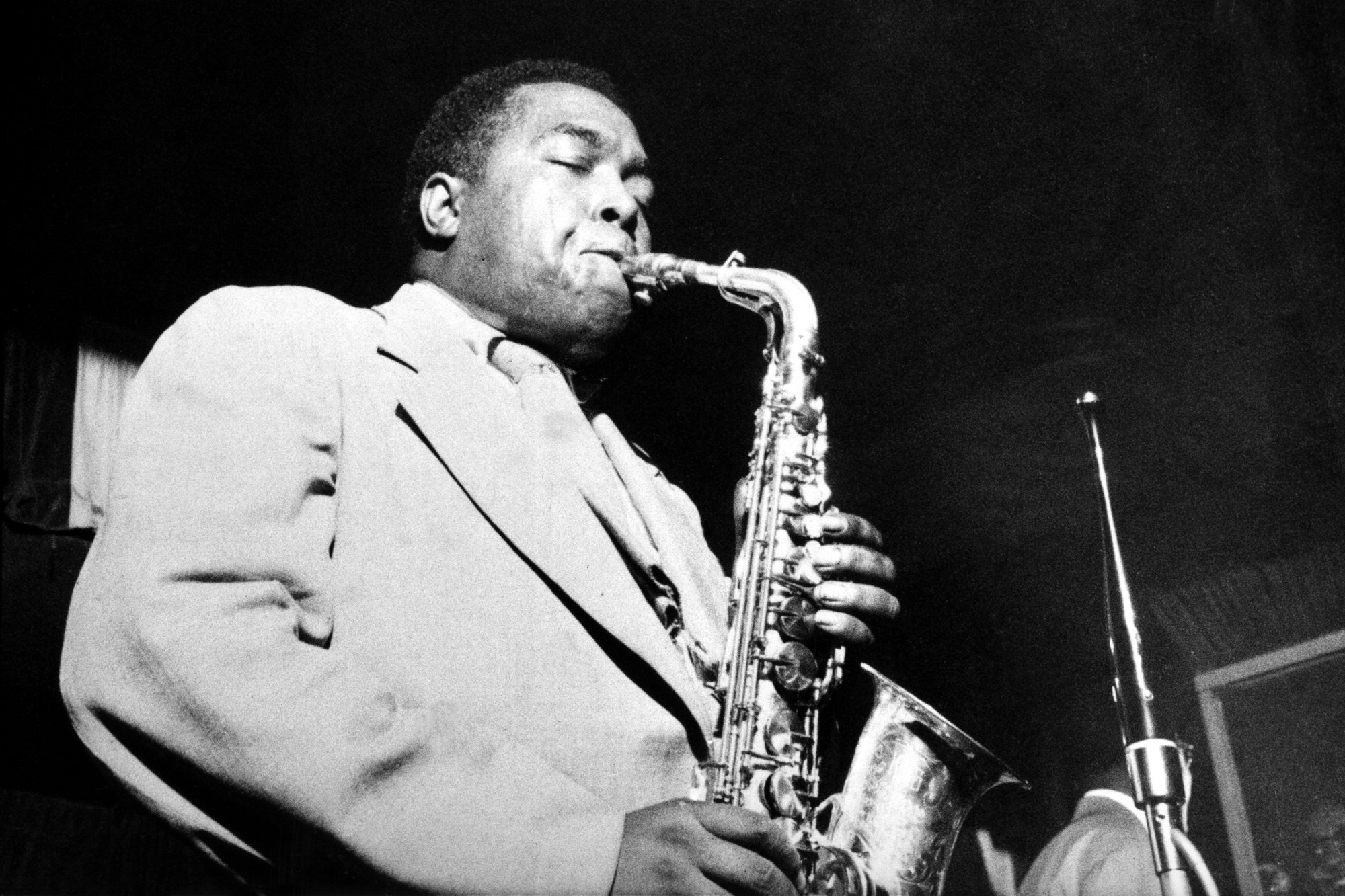
There was a great man of jazz that many young people may not know. His name was Charlie Parker, but everyone called him “Bird.” He played the saxophone and was an incredible innovator and force in the world of music. “Birdland,” a jazz club in New York, was named in his honor.


Frank-Sinatra-jrJust recently Charlie Parker’s son died and I read his obit. I hadn’t known this man even existed, but apparently he lived a couple towns over from mine, in Lansdale, Pa. Learning of his simple, pedestrian life, one of relative failure, troubled me.


The great man’s son – Charles Baird Parker — had for a time worked in the bakery of his local supermarket. But for many years prior to his death he was unemployed. He lived off the royalties of his father’s music.

“The jazz world expected Baird to fill Bird’s shoes,” his late mother, dancer Chan Woods, wrote of her son. “Those expectations almost destroyed him.”


I’m sure his father, who died in 1955 at age 34, wasn’t around much to guide him. Bird, for all his success with music, had nearly destroyed himself with drugs and alcohol. Sometimes he would play on the street for drug money. It is even said that he once pawned his instrument.


Yet Bird is a music god, and the common belief is that the son of a god also deserves worship. Because it is impossible to worship a supermarket baker, we end up feeling sorry for the baker and for the god.


The obituary did not list the time and date of the funeral. Had it done so, I might have gone. I can’t say why. It would have been strange … about as strange as Bob Dylan going to a performance by Frank Sinatra Jr.


Lanny Morgnanesi


<iframe width=”420″ height=”315″ src=”//www.youtube.com/embed/eAQg-55tZxg” frameborder=”0″ allowfullscreen>

Let me tell you a story about a man, a horse and a joke

5 Apr

The jokes of a people tell you much about the people.

A little hobby of mine is to learn of and listen to the jokes of foreign cultures. I’m proud to say that with patience, an open mind and an attention to the nuances of language, I’ve been able to laugh alongside many a hysterical foreigner.

In so many cases, it’s really about the language, which because it is not English can be used in ways that English cannot.

Chinese, for example, has so many sound-alike words that there is an entire genre of Chinese comedy called Cross Talk, where Abbott and Costello-like characters stand on stage and grossly misunderstand each other. These bits are much like “Who’s On First.”

This week, large numbers of Chinese people are cracking up not over misunderstood language but over a short video. It is of a man getting brutally kicked in the head by a horse. The humor is not in that brutality but in a message conveyed by the kick – a message that has nothing to do with animals.

Here’s the background.

In China, there is a popular idiom that translates literally to: “Pat the horse’s ass.”

When someone pats the horse’s ass, they are sucking up to the boss or flattering people to get ahead. We use the similar expression, “kissing ass” or “brown nosing.”

While many Chinese have benefited from patting the horse’s ass, there is a danger to the practice if it is too transparent. It can backfire. Most Chinese who watch their sycophantic colleague advance would prefer that they fail. No one likes as ass kisser.

In the video widely circulating among Chinese, the victim, prior to being kicked so hard and so directly, walks across the street and actually pats the horse’s ass.

The payoff for doing so is pretty damn clear.

And that’s why it is so funny to this culture that relies heavily on metaphor and symbolism. The humor is achieved without a single word.

All right now Mister and Misses America — DO YOU GET IT?

Lanny Morgnanesi

I never ate there, but I always expected a line

30 Mar

7_13_500x362

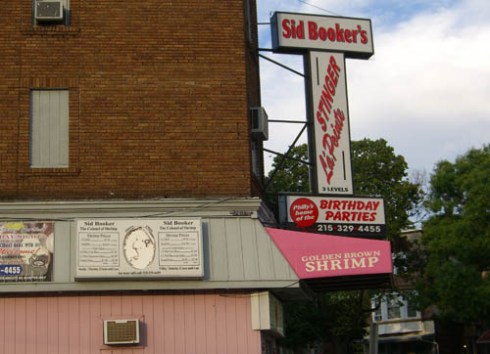
I once dated a woman who knew Philadelphia much better than I. On the few occasions when we passed Broad and Belfield Avenue, she’d say, “There’s always a line at the Shrimp Corner.”

And there always was.

My friend spoke these words as if they were a cliché, something that had been repeated a thousand times by a thousand people. But I had never heard the expression and I didn’t know the Shrimp Corner.

For me, it had escaped the notoriety of, say, Pat’s King of Steaks on Passyunk Avenue in South Philadelphia. I knew there was always a line at Pat’s. I’d waited in it at 3 a.m. Pat’s was in an Italian neighborhood and I felt comfortable there. People went there after Phillies games. The very different Shrimp Corner is in North Philadelphia, a poor, high-crime area. I’m sure it is considered home to many, but to those in the suburbs, sadly, it was simply a place to avoid.

On Yelp someone advises that before going to the Shrimp Corner one should “practice standing around and looking tough so no one messes with you.”

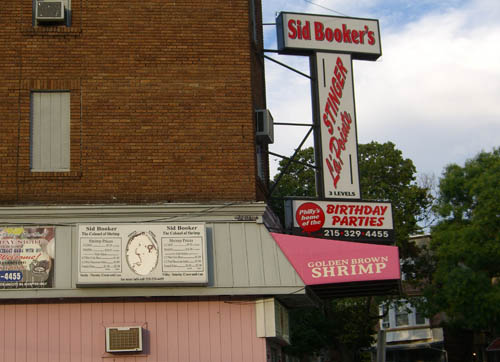
philly-360-creative-ambassador-brandon-pankey-spot-check-sid-booker-s-shrimp.582.345.cFormally known as Sid Booker’s Shrimp Corner, the takeout eatery opened in 1966. As the name suggests, it juts out on a block that forms an acute angle. To order, you walk up to a window made of bulletproof glass. The food is not cheap. A dozen batter-fried shrimp with fries costs about $20. The rest of the building, painted pink, houses Sid Booker’s Stinger Lounge.

Because of the Shrimp Corner, I thought about my old girlfriend this month. As circumstance would have it, I drove by Broad and Belfield three times in the last four weeks. Each time, there was no line at the Shrimp Corner.

What changed?

When I first saw the Shrimp Corner more than a couple decades ago, North Philadelphia may have been at its lowest. It was in great deterioration. I know so little of these neighborhoods, but I do recall how the homes and small business were sinfully neglected. Some were actually falling down. On Broad Street, the main thoroughfare, there wasn’t a fresh coat of paint to be seen. I doubt a nickel had been invested in the place.

7_15_800x600Then, about the time when real estate prices took off and business loans were easier to get, new shopping centers went up. Franchises like CVS settled in, as did more fast food restaurants. The regional transportation authority, SEPTA, even brought in new buses.

Meanwhile, a so-so college in the heart of North Philadelphia was expanding. An incredible number of well-designed, multi-story buildings appeared on Broad Street — for miles. Temple University, once a commuter college for the working class, had become a residential college that was attracting a new generation of students seeking an urban experience.

Houses were fixed up and rented to students. New housing was constructed.

If a Temple student was stupid enough to start selling drugs, he might get busted up in his nice apartment and have his stash and cash stolen. There would be episodes like when three neighborhood girls went around smashing bricks in the faces of female students. But overall, things really seemed to improve.

Today you can drive portions of Broad Street and it looks commercially alive. Some developer even wants to build a $700 million French-themed hotel-casino complex – The Provence – on Broad just south of Vine. He said it will be “one of the most dynamic entertainment destinations on the East Coast”

So why isn’t there a line at the Shrimp Corner?

I don’t know, but I do have a suggestion.

Recently there have been a series of Flash Mobs at old, nearly forgotten, Eleanor Rigby/Father McKenzie type cathedrals. Calling themselves “Mass” Mobs, Catholics are trying to revive these still elegant structures by using social media to fill pews.

If its true that the Shrimp Corner is not the draw it once was, wouldn’t it be fun to organize a Flash Mob – call it a “Flash Fry” — and send the line at the window down the block and all the way to Temple? Sid sure would go for the idea. Maybe he could donate some of the profits to fix up North Philly’s Uptown Theater, which has been trying and trying and trying to come back but can’t.

I have no deep emotional connection to any of this, so it’s not for me to organize an event. Still, I’d love to see North Philadelphia attract more investment and make Broad Street once again a great and grand boulevard.

If not this, then I’d at least  like– for old times sake – to be able to drive by and be correct when I say to a fellow passenger, “There’s always a line at the Shrimp Corner.”

By Lanny Morgnanesi

Call centers: Where foreign accents now sound less foreign

16 Mar

call-center

When something goes wrong with the cable, or the credit card or a household product, the horrid thought of spending long periods of time on the phone with a call center associate becomes real.

In the early phase of these calls, there is a strong, perky, recorded voice – an American voice – telling you what digits to push. For myself, I usually have questions unanticipated by the automated system, meaning I need to speak with an agent.

That point is reached only after shrewd and patient navigation. The digital world fades away and you are routed to a far off place where call centers are cheap to operate. The agents, God bless them, so much want to help.

“Good day! And how may I give you the extraordinary service you deserve to assist with your problem?” an agent said to me recently.

“Well,” I answered. “To begin with, I don’t need extraordinary service. All I need is good service.”

It’s meant as a joke, but it comes off as nasty. Still, the voice on the other end stays positive. But lately, it’s been a strange voice. It does not sound entirely human.

Hence, I’ve concluded that voice synthesizers are being used to strip away heavy foreign accents. But they do a poor job of it.

First, you can still tell the person is foreign. If the synthesizer’s purpose is to let Americans think they are talking to Americans (and not that jobs have been moved overseas), it fails at that.

Second, it makes communications less clear. An extra layer of audio noise is added, making it more difficult to conduct business.

When somebody is already in a foul mood from being on hold, that’s not good.

What strikes me most, however, is the transparent hypocrisy of this effort – if indeed my theory is correct. All these companies are too cheap to pay Americans to answer their phones, yet they are willing to spend extra money on technology to cover this up.

If anyone has knowledge of call centers using technology to strip away foreign accents, please comment here. I sense I’m right, but it’s only a guess.

By Lanny Morgnanesi