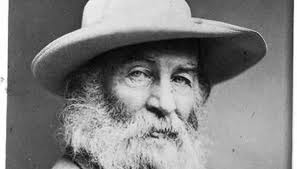
Walt Whitman – better now than ever

18 Oct

Here’s a little secret:

Over the years, the things we were forced to read in high school have gotten better.

It was punishing to read great literature at a young age. Personally, I was not only incapable of appreciating it; I didn’t want to appreciate it.

Aside from things like “Catcher in the Rye” and maybe those THE FUTURE IS GOING TO BE TOTALITARIAN books, there was no desire to spend time with genius writers. The time was for living; not so much for reading.

After the edge is worn off life experiences, literature has more of a place. Yes, you can jump out of an airplane if that’s your idea of excitement, but it’s not like going to a Friday night football game and expecting a fight; it’s not like kissing a girl that you cannot stop thinking about; it doesn’t compare to that first road trip with five guys in a rusty car and a total of $100 between you.

Certainly none of this can compete with Melville or Ezra Pound. Those two can’t even compete with the understated magic of hanging around a parking lot complaining that there is nothing to do – but hoping that soon there will be.

Those anticipatory adrenalin rushes fade for reasons both physical and metaphysical. When they are gone, great books becomes much sweeter.

Someone recently discarded an anthology of American Literature. I picked it up. The book is filled with writers rarely read outside of classrooms but there are in there because they are brilliant.

I reviewed the preface to Walt Whitman; learned how much time he spent on “Leaves of Grass,” basically rewriting it his entire life; thought he was just a human and that the person describing him was over stating his case.

Then I read Whitman, putting him in the context of his time (meaning no one ever wrote like this before), and quickly realized how deserving he is of the place he holds.

I remember from high school that Whitman was considered the ultimate optimist, the lover of everything.

“I am satisfied – I see, dance, laugh, sing.”

He would not allow bleakness and atrocity to wither his spirit.

Battles, the horrors of fratricidal war, the fever of doubtful news, the fitful events;

These come to me days and nights and go from me again,

But they are not the Me myself.


To Whitman, there is no death . . . as mortals understand it.

All goes onward and outward, nothing collapses,

And to die is different from what any one supposed, and luckier.


Would I seem ridiculous if I gushed: This kind of stuff goes on and on for page after page after page.

The enormity of it overwhelmed me. Whitman’s ability to sustain his pace and prophetic message mystified me.

My advice then: A retreat to the refuge of beauty and truth, even if they are under appreciated, is recommended when you can no longer find the Heart of Saturday Night.

And so I end, from the anthology, with Emily D:

I died for Beauty – but was scarce

Adjusted in the Tomb

When One who died for Truth, was lain

In an adjoining Room –


He questioned softly, “Why I failed”?

“For Beauty,” I replied–

“And I – for Truth – Themselves are One—

We Bretheren, are,” He said—


And so, as Kinsmen, met a Night—

We talked between the rooms—

Until the Moss had reached our lips—

And covered up—our names—

–By Lanny Morgnanesi 


Arlen Specter was his own man

14 Oct

Arlen Specter, who died today, was an intelligent, courageous creature.  What I liked most about him was he spoke his mind. He refused to be one of those pre-programed politicians.

If you are a United States senator, as was Spector, you are supposed to hate – among many things – Fidel Castro. The dictator came up in a conversation I once had with the senator. I was a journalist and he was running for re-election.

“I liked Castro,” he told me. “I had dinner with him in Cuba and we talked all night. He’s a very interesting man. I asked him if he killed Kennedy and he said, ‘I’m many things, but I’m not crazy.’ ”

In America, we tend to paint our enemies as monsters and psychopaths. No one dares entertain the idea – except Specter – that such people often gain power through personality and charisma.

Years ago, I attended a Republican rally at a swank hotel in Philadelphia. A major national candidate was to appear (It might have been Ronald Reagan). This was right before the primary election and the endorsed Republican candidates for high Pennsylvania offices were given seats on the stage. Specter was not endorsed and was without a place of honor. It fazed him not. He took a chair from the hotel ballroom, put it on stage and sat down with the endorsed candidates.

Later, he won the election.

You know a man like that votes his mind and thinks for himself.

There are too few left like Specter.

By Lanny Morgnanesi

Afghanistan: Will lessons be learned?

13 Oct

When the war in Afghanistan started 11 years ago, I got a haircut.

My barber was a former Russian intelligence officer who served his country in Afghanistan. I wanted him to assess America’s chances.

“We leveled the place,” he said. “We turned it into a parking lot. We destroyed it. We did everything we could, and we still lost. You will, too.”

Soviet helicopters in Afghanistan, after an attack on a camel caravan from Pakistan

There was a time when the United States, for the sake of its image, could not leave a conflict without winning. Politicians refused to be blamed for a lost war. In the Vietnam era, with that war’s purpose forgotten and everyone tired of the slaughter, there were government recommendations to “declare victory and leave.”

Which is pretty much what President Nixon did.

We seem to have progressed since then and no longer require victory in war or even face saving. After $500 billion and 2,000 lives, our role in Afghanistan is ending. There will be no “Mission Accomplished” banners. Some who fought there aren’t even sure what the mission was.

But we still retain this idea that well-armed, well-financed invaders can defeat a local population that doesn’t want to be occupied and has a history of expelling invaders by simply not giving up.

Some in Washington, for sure, would like another test in Iran.

The United States attained its freedom by fighting a guerrilla war against a powerful, well-trained, well-armed, advanced nation. Yet we fail to recognize the power of the underdog or even devise the proper tactics against him.

Better to take the advice in a New York Times review of the book, THE GREAT GAMBLE: The Soviet War in Afghanistanby Gregory Feifer:

“Never underestimate fanatics who know the terrain.”

Now, with a lot less money to spend on arbitrary wars, we may finally take that lesson to heart.

By Lanny Morgnanesi


The End of Jobs

6 Oct

Imagine there were no jobs.

         Virtually none. There would still be someone running General Motors, but not a soul would be building cars.Nearly everything in America would be done with robotics, programming or overseas labor. This includes the service sector, law, medicine, education and government. Algorithms, for example, would take the places of judges, lawyers and the town council.

Cops, of course, would be cyborgs.

You get the idea.

Now the question.

If no one worked, could everyone still get paid?

Part of our economic problem today is unemployment. People who don’t work have no money and don’t consume, which leads to higher unemployment, recession and general nastiness. In some cases, businesses increase productivity and profits from layoffs. But with fewer and fewer employees overall, demand ultimately is bound to fall for all products and services.

There’s a story from the 1950s about Walter Reuther, then head of the United Auto Workers. He was taking a tour of a modern, highly mechanized Ford plant that used robots to build cars. Ford execs were on the tour and one said to Reuther, “How are you going to collect union dues from those guys?”

Reuther answered, “How are you going to get them to buy cars?”

You can’t, but you can still sell cars if you pay the people the robots replaced. Pay them for doing nothing. Give them the ultimate is a short workweek.

There was a time when the workweek was long. Not 40 hours or five days. It was at least six days, maybe seven. People put in 70 hours or more. This was necessary to produce the things we needed. With the advent of industrialization, people were able to work less – and still pretty much get the same pay.

Remarkable!

When the U.S. was a bold nation in the 50s, living well through science and experiencing the atomic age and the space age, there was this idea that greater efficiency in the work place would allow people to work less and have more leisure time. They were using the paradigm that reduced work from 70 hours to 40 hours.

Now, in a more realistic age, we know that doesn’t happen.

When you don’t need workers, you don’t reduce their hours. You fire them.

It seems ridiculous that people believed businesses and corporations would actually pass profit from productivity back to workers and let them go home early.

So what happens when there are no workers?

Maybe the paradigm shifts again.

If no workers means no consumption, and no consumption means no profit, then people might actually have to be paid for doing no work. It would be a cost of doing business. It would keep business running.

What I’ve described here is mainly a mental exercise that is much more exercise than mental. Can an economist out there, someone who studies such things, tell me whether this would work?

One final note:

In 1780, John Adams wrote something complex that later was boiled down to: “I’m a soldier so my son can be a farmer and his son can be a poet.”

He was expressing the utopian progression of civilization from barbarism to domesticity to enlightenment.

The no-job economy will either take us back to the first stage or ahead to the last. I’m not sure who will decide which.

Maybe an algorithm.

All right, now let’s hear from those economists.

—  By Lanny Morgnanesi


The 47 percent is really the 1 percent.

22 Sep

Let’s be logical for a moment.

If I have something of value, to whom am I likely to give it ?  Someone who gives me nothing in return, or someone who provides me with a replacement form of value?

We know the answer.

It is a reflection of human nature. It is the art and science of the marketplace.

You got nothing; you get very little.

The federal government possesses something of value, namely the money in its treasury. Does it mostly go to the poor, who give nothing in return to lawmakers and don’t even vote? Or to the very rich, who bankroll elections and do vote?

True, there are some illusions worked into the system, like Obamacare, a healthcare system that seemingly benefits the poor – and in fact does. But not in the way that it benefits the all-powerful insurance industry.

What conservative describe as socialism in America is really a skilled, deft way of funneling tax money to the corporate world and the 1 percenters.  Of course, a great deal more money takes a direct route and never goes anywhere near the poor.

I’m not sure what conservatives call that.

Almost every highly successful business or businessperson spends heavily to finance elections. Conversely, if a successful business does not, it is likely to be crushed by competitors who do. Microsoft was a rare example of a corporate giant that stayed out of the political arena. When the Justice Department came after it on anti-trust charges, it changed its strategy.

The 1 percenters, be they people or corporations, need friends.

President Nixon was friends with Pepsi and brought it to Russia.

President Carter was friends with Coke and brought it to China.

The competitors of the two drinks stayed home and lost market share.

So when Mitt Romney speaks about the 47 percent who rely on government, he doesn’t let on that some of his ilk might be selling apples on the street if it weren’t for government support.

In summary then, if Congress votes to give every poor person in America an iPhone 5, it’s not because America is a socialist country. It’s not because politicians like poor people. It’s because the lobbyist for the cell phone industry, after providing great sums to politicians, had a very good day on Capitol Hill.

Who is apt to throw a bomb?

16 Sep


“Real anarchists don’t throw bombs,” the political science professor said while lecturing a class at a Lancaster County (Pa.) college. “There’s a large group of them living on farms not far from here. They’ve never thrown a bomb. Do you know who they are?”

The class didn’t.

“They’re the Amish.”

The professor went on to explain about organized groups who prefer to live without government.

It was an interesting exercise, separating violence and radicalism from a term that normally suggests only terror.

I thought about this lecture, given during a time of great unrest in the U.S., after reading a piece by Carlin Romano in the Chronicle of Higher Education. (I’d link to it but you have to subscribe.) Romano, a former journalist at the Philadelphia Inquirer, teaches philosophy at Ursinus College. He called his piece, “Getting to the Root of ‘Radical’ ”

In part, he takes a look at some of the clever definitions historic figures have given to political labels.

Here’s FDR:

“A Radical is a man with both feet planted — in the air. A Conservative is a man with two perfectly good legs who, however, has never learned to walk forward. A Reactionary is a somnambulist walking backwards. A Liberal is a man who uses his legs and his hands at the behest  — at the command  — of his head.”

And Woodrow Wilson:

“By ‘radical,’ I understand one who goes too far; by ‘conservative,’ one who does not go far enough; by ‘reactionary,’ one who won’t go at all.”

Poet Robert Frost, according to Romano, said:

“I never dared be radical when young for fear it would make me conservative when old.”

Pretty good.

OK. So how should we categorize the thousand who have taken to the streets of Middle Eastern cities in anti-Western protests?

How about young, unemployed, angry, outraged, frustrated? I’m not sure there is any real politics involved. The non-political radical may be the most dangerous of all. Unlike the Amish, they will throw bombs.

–– Lanny Morgnanesi


God and Man on a Visit To Russia

8 Sep

I like to think of Jesus as a man so I can marvel at his God-like brilliance and ability to see and express truth.

If you think of him as God, then his acts and works would not necessarily be worthy of attention. Pavarotti, after all, received no praise for humming a pop tune, nor Einstein for giving correct change to the paperboy.

A god can easily transform water to wine; it is much more difficult for a man.

For me, one of Jesus’ greatest moments was when he was approached by spies trying to trick him into sedition. They coyly ask if it was acceptable to pay tribute to Caesar. Jesus, quick on his feet, asked them to produce a coin, which carried Caesar’s image.

Then came the unforgettable, genius response: “Render to Caesar the things that are Caesar’s, and to God the things that are God’s.”

In my last post I mentioned a rabbi named Joseph Krauskopf and his visit to Tolstoy in 1894. Today I’d like to discuss Krauskopf and his response when Tolstoy asked him about Jesus.

The intelligence and poetry of the answer brought to mind the “render” response.

In Russia at that time, Jews knew little of Jesus and those familiar with him cared not much for him. But Krauskopf struck Tolstoy as a different breed. The American rabbi from Philadelphia was an early member of the reformed movement and, among other things, advocated moving the Jewish Sabbath to Sunday as a way to bring Christians and Jews together.  He believed that all religions – including his own — contained good and bad, and that the good should be practiced and the bad eradicated.

Some Jews, I’m sure, refused to consider Krauskopf a Jew.

“What is your belief respecting Jesus?” Tolstoy asked.

Krauskopf told the writer, “I regard the Rabbi of Nazareth as one of the greatest of Israel’s teachers and leaders and reformers, not as a divine being who lived and taught humanly but as a human being who lived and taught divinely.”

Can we safely say that he who lives divinely is divine?

Sometimes we allow words and their interpretation to muddle or even destroy something that in its raw form and on its own is simply and clearly exceptional.

I would love to hear from others, Christians and Jews, on Krauskopf’s statement about Jesus.

Tolstoy, who wrote of aristocracy, had much in common with the Occupy movement

5 Sep

My work recently brought me to the writings of a reformed rabbi named Dr. Joseph Krauskopf. He lived around the turn of the 20th century. While not well-known today, he was friends with presidents and world leaders during his day.

In today’s light it is easy to categorize him as a visionary and possibly a radical. What may be truer is that free thinking and free speech flourished more then than now, and that others at the time were expressing similar ideas – equality and dignity for all, women’s rights, the end of poverty, a government hand in the inspection of food and housing, world peace.

In 1894 Krauskopf traveled to Russia and met with Count Leo Tolstoy, known now as a great novelist; known then as an incredibly influential, larger-than-life, cultish leader of humanists. Krauskopf, in utter awe of the man, recorded every facet of the meeting. The account is fascinating and revealing. In one exchange, the Russian asks the rabbi if he had read “What to Do,” a work of non-fiction by Tolstoy calling for the liberation of the oppressed.

Krauskopf had not, but said he did read “War and Peace” and “Anna Karenina.”

Tolstoy, according to Krauskopf, described those books as trash and said he would prefer if the world instead read his “serious writings.”

But what I really want to report here is Tolstoy’s timeless description of the United States and its faults.

“You call yourselves a republic; you are worse than an autocracy. I say worse because you are ruled by gold, and gold is more conscienceless, and therefore more tyrannical, than any human tyrant. Your intentions are good; your execution is lamentable. Were yours the free and representative government you pretend to have, you would not allow it to be controlled by the money powers and their hirelings, the bosses and machines, as you do.”

I wish someone would read this from the podium at the Democratic National Convention, or from any podium for that matter.

What are your thoughts?

— Lanny Morgnanesi

Secrets of the Universe Revealed – Or Not?

29 Aug

A pause in the conversation led the old man to look up at the cloud formation and think about his future, which is death.

“I wonder if you learn everything,” he said. “How it all came to be; its meaning and purpose. It can’t be like that Big Bang crap. How could it all have gotten down into an infinitesimal speck, and how did it explode, instead of being sucked into itself like a black hole? And if there was nothing outside of it, how did it have a place to go?”

Death would be sweet if it meant getting all the answers. Without a body you couldn’t do much, but if you knew everything you’d feel pretty good about yourself. It would be like learning how the magician did the trick, only a trillion times better.

My intention was not to depress the old man, but I told him my theory of the moment.

“I doubt we get to know,” I said. “Our opinion of ourselves is exaggerated. Considering all that exists, I’d say we lack importance. I’m sensing we are the equivalent of a low-level employee who gets no time or attention from the boss.”

Top management, to whom the secrets might be disclosed, probably occupies another planet or dimension, is not prone to war and genocide and generally makes things easier for the CEO rather than more difficult.

While the Bible tells how Jesus came to save us, there also are passages like this one in Isaiah:

All the nations before him are as nothing; and they are counted to him less than nothing, and vanity.

In a wonderfully written New York Times column (The Man in the Moon) Lydia Netzer says:

When humanity was in its infancy, we thought the universe revolved around us. Then, with Copernicus, we aged into heliocentrism, became aware we were one of a family of planets inside the walls of our house, the solar system. Nearby stars gather like a town, rotating through the galaxy, our country. Clusters are like continents. We realized in stages that we were very insignificant. And then, almost like grown-ups, we pulled our boots on and began to try to leave a significant mark anyway.

Sitting in a car seat next to the old man, I couldn’t accept that in a few years he would know it all. It’s too grand a gift. In the military, personnel are told things on a “need to know” basis. As humans, do we really need to know?

Once we have performed on Earth, it’s likely we will be whisked away like a bad vaudeville act. There’s plenty more in the wings.

But all is not lost.

“In a way, we are immortal,” I said. “Since matter is neither created nor destroyed, every atom that is you remains as part of the creation. After you die, your atoms eventually scatter. They say we could easily have been part of someone like Socrates or Newton. Can you image that? On the other end, you may help create the next Newton. But you won’t be conscious of it.”

“If what you say is true, I’ll make the next Newton but never know an ounce of what he will know,” he said.

“Look, this is only what I’m thinking today,” I said. “Tomorrow, when the clouds are different and I read a different Bible passage and cut and paste from a different New York Times column, I’ll have another opinion for you.”

“So maybe I will get to know everything.”

“Maybe you will.”

And then he went off to play cards with some ladies who had outlived their husbands and only worry about getting from one place to another without it causing too much pain.

— Lanny Morgnanesi

As its old enemy grows weak and it grows strong, China hasn’t forgotten World War II

23 Aug

Almost 11 years have passed and the war in Afghanistan is still a war. It has helped drain the treasury of a nation that doesn’t want to pay taxes.

An even bigger threat to that treasury and to global peace is occurring thousands of miles away in the Pacific. Its roots are deep, dating at least to 1937, when Japan invaded China.

The Chinese of today look at Americans and wonder how we can be friends with the Germans and the Japanese. We’ve forgotten World War II. They haven’t. Their country was occupied. Ours was not.

The hate never dissipated.

Around 1985, Chinese consumers were getting their first chances to buy televisions. Many were imported from Japan. Many didn’t work right. True or not, the perception was that Japan was dumping its faulty products on China. As the TVs failed, anger rose, then raged. Demonstrations were held to criticize the government for allowing this to happen and for being a party to this loss of face.

The protests continue.

E-mail has been circulating all over China calling for the boycott of Japanese products. One complaint in the e-mail is that the bosses of Japanese companies in China treat their Chinese employees like dogs. Beneath that remains the revulsion of doing business with a nation that murdered millions of Chinese and committed vicious, wide-scale atrocities that included massive gang rapes and burying people alive.

Americans don’t realize it, but almost 90 percent of Japan’s fighting forces in World War II were in China, not the islands we fought over.

While powerful back then, the Japanese of today are struggling to recover from a lengthy economic malaise.  As they do, they watch China grow wealthy and strong. Out of frustration, a bunch of them jumped in boats last weekend and landed on an Island that China claims. They planted Japanese flags.

This lit a fuse back in China, and several thousand took to the streets in protest.

All very interesting, and right now harmless. If, however, these skirmishes escalates and Vietnam, the Philippines, Indonesia and Taiwan also feel threatened, the U.S. could be lured in.

Anticipating the future, our presence in the Pacific already has grown. If the events of last week continue, it is likely to grow further.

Will there be a dialogue or will it just happen? In such a case, Americans will have to ask themselves: Is this our role, and are we willing to pay for it?


I think debate is needed now, while it is only pleasure craft and civilians taking over disputed islands, while decisions on budgets and taxes are still pending, and while national lunacy is still treatable.

This one could make Afghanistan look like a street fight.

Lanny Morgnanesi