Archive | Income inequality RSS feed for this section

Modeling a Country After a Shopping Destination

23 Oct

By Lanny Morgnanesi

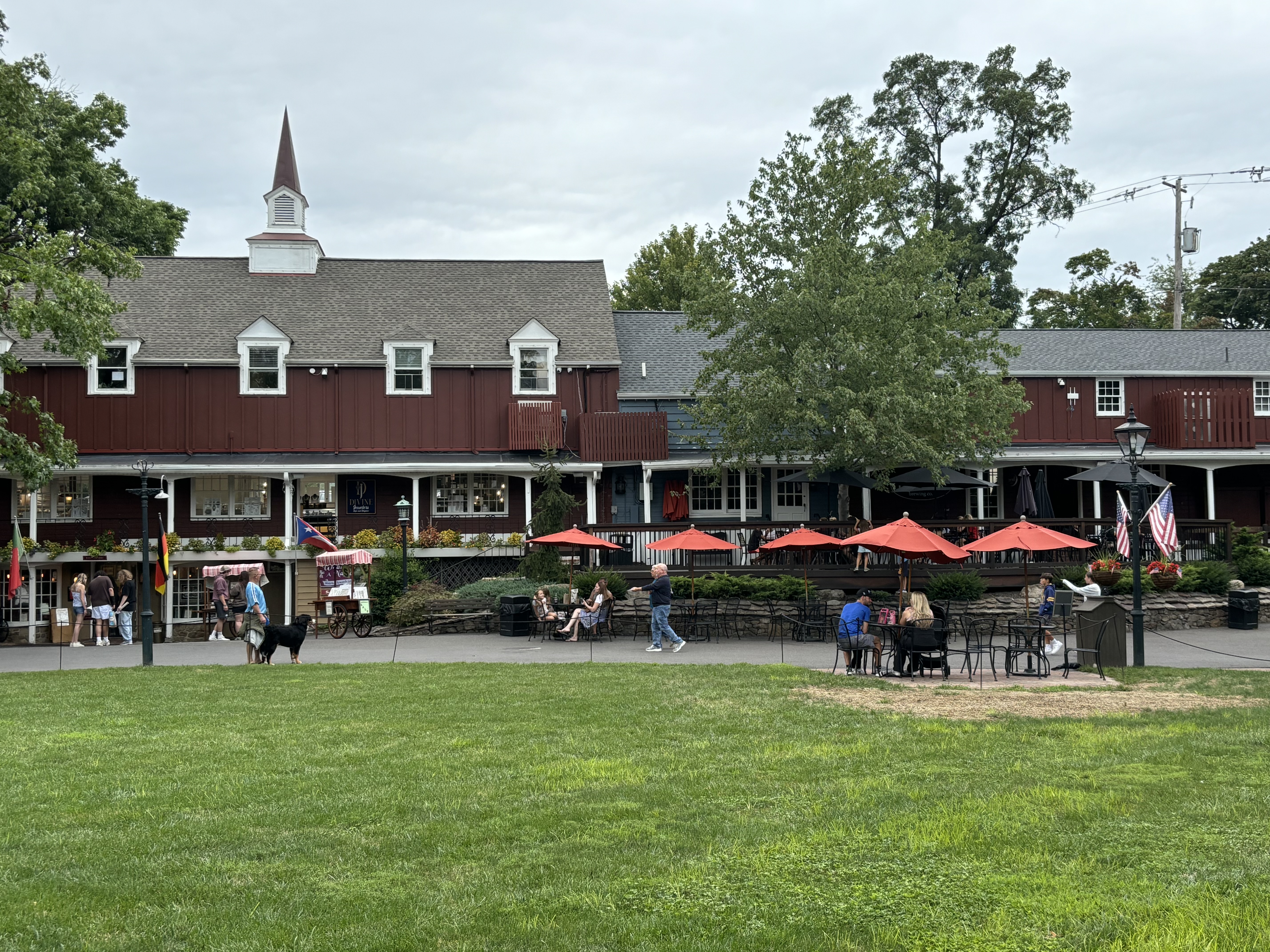
Near my home, in a place called Lahaska, there’s a tranquil spot of beauty and commerce called Peddler’s Village. It was built by a somewhat eccentric man named Earl Jamison. The village is spread over 42 acres. It has old-fashioned shops, restaurants, bars, lodging, even a carnival merry-go-round. The peddlers at Peddler’s Village peddle everything from clothes to hats to paintings to fresh pastry, popcorn, maple syrup, and beef jerky.

Part of the attraction is the artful landscaping. Jamison liked gardening, and when he was alive you could mostly find him at Peddler’s Village on his knees, tending to plants. That kind of attention and that kind of tradition has been passed on to others. The place looks great.

The summer day of my recent visit was pleasant, and everyone was having a good time. Parents, kids, babies, older couples, dogs. In this part of suburban Philadelphia and at Peddler’s Village, the crowd is mostly – what’s a good word? – Anglo. With a fair number of Asians. The people who walked the brick promenades seemed comfortable in their lives, safe, and secure. As I did. This was an enviable America.

This simple Saturday was starkly different from the America depicted in the political ads of Democrat Kamala Harris and Republican Donald Tump, both of whom want to lead a country they have extreme doubts about. During the broadcast of the July Olympics in Paris, Harris and Trump ran harsh ads designed to shock and get you to the polls. There was an inescapable onslaught of these ads. I couldn’t tell which America was worse, the one the Republicans blame the Democrats for, or the one the Democrats blame the Republicans for. It wasn’t much of a choice. Made me think horrible things about a country that, to me, seems all right.
Shoppers relaxing

The trump and the Republicans presented a nation ravaged by inflation and overrun with invading foreigners who bring in drugs and commit a wide assortment of crimes, including murder and rape. These same foreigners suck the money and life out of our social service and health systems, so there is little left for us. Kamala Harris, the Democratic candidate for president, is said to be dangerous and weak, a radical who clearly will destroy whatever is left of the America that they say once was great but obviously no longer is. The Democrats, for their part, cast Trump as a crude, weird, racist dictator whose speech and actions resemble Hitler’s.

What these ads showed and preached was nothing at all like the idyllic Peddler’s Village, where not even a trace of discontent could be found. And so I thought of my own life and happiness. As my wife shopped, I sat on a bench and enumerated the America I knew and appreciated, and that I think others would recognize, regardless of the horrors in the political ads.

In my America:

  • No one is shooting at me or dropping bombs on or near my house.
  • My home is nice, comfortable, and in good working order.
  • I have clean water and plenty of food.
  • The stores are filled with everything I could possibly need or want.
  • They take away my trash and sewage.
  • They take away the snow.
  • We have good hospitals and good doctors, and you can get appointments.
  • We have good schools.
  • The police protect us.
  • We are free to go where we want, when we want.
  • Contrary to what some people may prefer, we can say whatever we want.
  • We have a strong tradition where the rule of law prevails, and the legal system works.
  • We are allowed to invest our money in companies that can make us money.
  • Generally, you don’t have to bribe a public official to get something done.

I’ll stop there. I hope you can see the difference between what the presidential candidates are saying and what I am living.

Elsewhere, beyond me and beyond Peddler’s Village, there are people living lesser, unenviable lives. In these last few decades, inequality in America has bounded ahead in a rampage. There is nothing unusual about inequality in America, but it has gotten worse. For many there is food insecurity, job insecurity, little or no medical attention, poor or no housing, poor schools, high crime, discrimination and lack of opportunity. None of this was on display at Peddler’s Village.

Philosophers and do-gooders will say that in a country as rich as the United States, poverty is unnecessary. Others will say poverty is the self-inflicted disease of the shiftless and not something for government to fix. But in almost every society and culture, the natural, human tendency is for a strong and aggressive minority to acquire nearly all the wealth and broker all the power. Sometimes, this inevitable pattern is halted or reversed by uprising and revolution, but only for a period, and then the inexorable progression of the dominant human forces continues, and the once-again complacent majority – usually with a very worse-off minority substrata –allows its modest wealth to trickle up.

Therefore, it is difficult for a nation such as ours to eliminate poverty and establish of nation of Peddler’s Villages.

In my mind, eliminating poverty is not about giving money to the poor. Rather, it is about allowing the poor to be productive. This requires removing the often-invisible restraints and barriers holding them back, as well as reorienting a defeatist mindset and the established alternative culture of the outsider.

Not an easy thing to do. Maybe impossible. But for the sake of discussion, let’s see how much money is out there for the poor, as if we just wanted to give it to them, which of course we do not.

Forbes magazine says there are about 400 billionaires in the US. It says they are worth a total of $54,000,000,000,000 – that’s $54 trillion. (The entire federal budget in 2024 was about $6.5 trillion). The top five billionaires are:

Elon Musk — $244 billion

Jeff Bezos — $197 billion

Mark Zuckerberg — $181billion

Larry Ellison — $175 billion

Warren Buffett — $150 billion

If, in some crazy world that is not ours, we took 25 percent of the wealth away from the 400 billionaires and handed it to the 37 million people living in poverty, each would receive $36,000. I guess a family of three would get more than $100,000. That’s enough to start a small business, send the kids to college, or maybe get a mortgage on a house.

This is just fun with numbers and of no meaningful purpose when it comes to problem solving. It is for perspective only. A more practical solution to income inequality is a return to tax policies of the ‘50s and ‘60s that allowed for a more even distribution of the wealth.

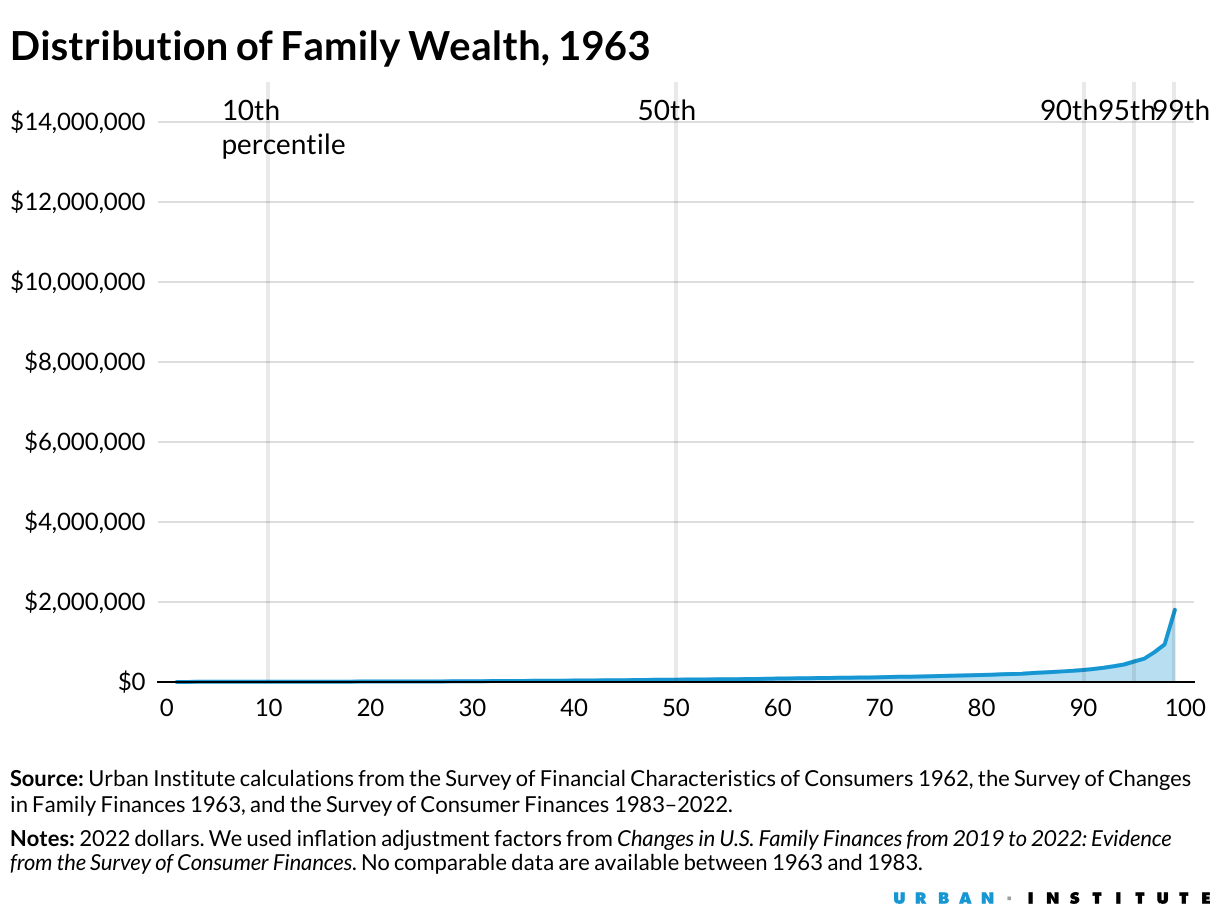
To illustrate the change, in 1963, the wealthiest families had 36 times the wealth of families in the middle class. By 2022, they had 71 times the wealth of those families. The top 10 percent now own about 70 percent of the nation’s wealth, with the bottom 50 percent owning 2.5 percent.

The charts below show how the money was spread out then, and how it is spread out now. The blue is the money. The poor are on the left. The rich are on the right. Most of us are in the middle.
If we can find the strength and courage to eliminate barriers to opportunity, and there is a redistribution of some wealth, without so much money sitting in the hands of so few, maybe there will be enough money to fix things up in our country. Maybe our crumbling cities can look like Dubai, or Shanghai, or Singapore. Maybe, if neighborhoods aren’t economic dead zones, they’ll be welcoming places and not fearful haunts to be avoided. With the proper changes, maybe escalators and streetlights will work. Maybe we will have fast trains, and wide, smooth roads, and bridges not in danger of collapsing, and JFK airport won’t be a 21st century embarrassment.  Maybe we can prop up Medicare and Social Security and have a good universal health care program. Maybe, state universities can be free. It’s not that we need free stuff, it’s that we’ve worked hard enough to get them, and that wide access to education and health care will result in a stronger, more productive country with greater participation by its population. With a vibrant, involved population, there will be great costs savings in law enforcement and prisons, mental health, public housing, all kinds of things. This is a great trade off.

New York City subway

I was disheartened when I heard of an American who returned home after living for a decade in Japan. “Nothing works here,” he said. “And the public bathrooms are disgusting.”  So let’s fix things up. Fix ‘em up good.

There is a theory that if you don’t repair a broken window in a building, the entire neighborhood will eventually collapse. If you do repair it, the entire neighborhood will keep itself up and thrive.

I want the latter for my neighborhood and my country. Why don’t others?

Visit the clean, the organized, the efficient, the beautiful Peddler’s Village and perhaps you will change your mind.


Discomfort in America and a Labor Movement Without Unions

16 Oct

By Lanny Morgnanesi

Something’s happening here. And to be frank, what it is ain’t exactly clear. There’s a man, and a woman, with an attitude over there, and a realization, and a new way of thinking, and opened eyes, and a tired will. He, and she, and an assortment of other strange, unfamiliar phenomena, have unknowingly cojoined to produce discomfort in America and the world. He, and she, and all the rest, have caused you to pay more for bacon and chicken wings and refrigerators and stoves. Because of her, and him, and all the rest, it is harder or impossible to get certain products, things you have always relied on, things that you always expected to be there. Because of her, and him, and all the rest, supply trucks to stores are late, half empty, or never arrive. Prepare to wait 26 weeks for kitchen cabinets.

         In the end, what he and she have done will result in something good for America.

         But what it is isn’t exactly clear. Not to me, anyway. Still, I’m trying to think it through, read about it, figure it out on my own. My conclusions may be accurate, semi-accurate or ridiculous. In these times, what does it matter?

         In these times, what broken and weakened unions failed to do – join workers in a wide confederation that confronts big management and rejects low wages, decimated benefits, poor working conditions and corrosive indignity – is being done quite effectively on an individual, uncoordinated, one-by-one basis. I’m speaking of  the men and women with attitudes, realizations, a new way of thinking, opened eyes, and tired wills.

         In short, disgusted people have decided not work. Without consulting each other, they have – separately but together – stopped making you breakfast at your local diner, they have stopped helping you find socket wrenches at Home Depot, and they no longer answer the phone at your doctor’s office. Without unions, without campaigns and encouragement, and without organization of any kind, much of America has gone on strike. The U.S. Labor Department reported in October that a record 4.3 million workers quit their jobs in August. I don’t know this for a fact, but I’m guess this is unprecedented in the history of the American labor movement.

Ships backed up in port, unable to unload

                   It’s really about time. New York Times columnist Paul Krugman says the typical American worker, after adjusting for inflation, hasn’t gotten a raise in 40 years.

          To illustrate the plight of the low-wage worker, a conceptual artist and self-taught engineer named Blake Fall-Conroy  built a machine as a way to duplicate the frustrations and hopelessness felt by workers. The machine is a box filled with pennies. It has a crank. When the user (worker) turns the crank, he receives payment in pennies for the time he or she has turned the crank. If payment is at the rate of $7.25 an hour, the federal minimum wage, the machine gives the worker one penny every 4.97 seconds. The payments stop when the cranking stops. Blake’s contraption begs the question: How long is the average person willing to turn that crank? Today’s labor shortage suggests the answer: Not long.

         In a New York Times story, we are told about Sandra Beadling, the manager of a Dollar General store in Maine. She’s claims to put in 70-hour workweeks (without overtime), doing the job of several employees, including stocking shelves. The story doesn’t mention her salary but does say she has a difficult time hiring people at the Dollar General rate of $12 an hour because Walmart is paying $16. In August, she got home from work one night at 11:30, left her house the next morning at 4 a.m. to do an inventory check, then quit. No more of this, she said.

         This is happening a lot.

         How can so many people just quit their jobs? How do they live?

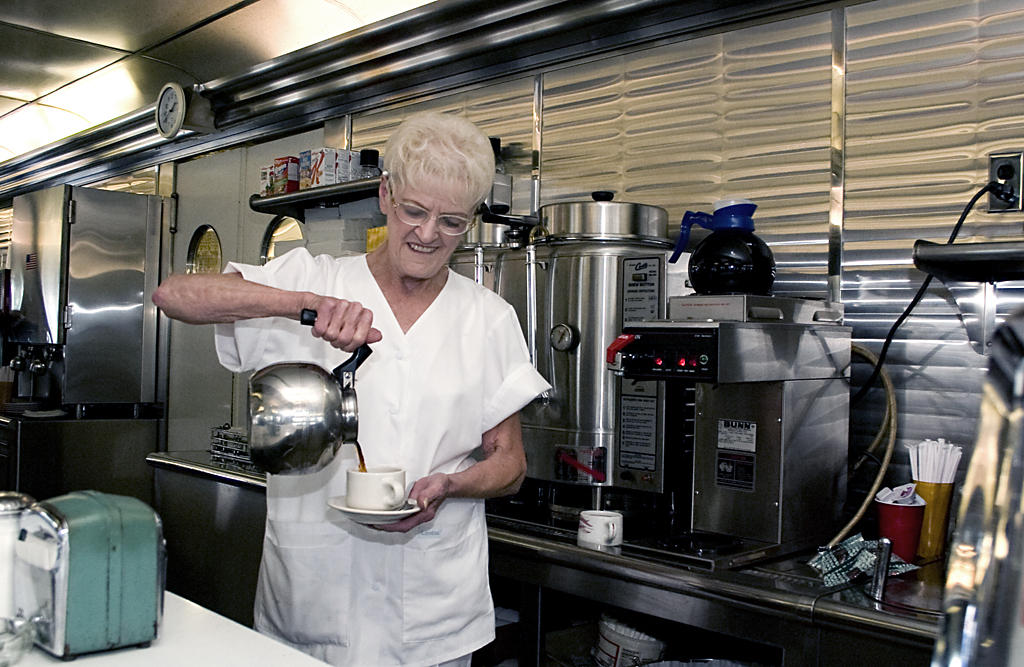
With people quitting jobs, it’s harder to get a cup of coffee

         Well, let’s hope they have a working spouse and some savings. But the person who quit no longer needs a car, can probably save money on lunches, coffee and clothes, no longer has to pay for daycare or now can provide free daycare for grandchildren. They also can earn extra cash as a free agent in the gig economy, working when they want for companies like Uber and Door Dash or even Amazon delivery.

         The quitter might actually come out even, especially is you add value to free time, family time and the absence of stress and aggravation.

         But as I said, it’s not exactly clear what’s going on. There is indeed a labor shortage related to the COVID-19 pandemic, with some people unwilling to work jobs that put them at risk. Also, some factories may have shut down due to COVID, making it difficult or impossible to get certain products. Then there are demand shifts that have caused havoc in the market and its supply chains. For example, in the beginning of the pandemic, there was this idea that automobile sales would suffer but people staying at home would buy more gaming systems, kitchen equipment, exercise equipment, hair clippers, and so on. So computer chip factories that were still operating shifted production away from chips used in cars and trucks and began focusing on chips for home electronics. When the auto market roared back, there weren’t enough chips for the new cars. Since then, the price of used cars has risen to unbelievable heights. And  because of all those orders for gaming systems, kitchen equipment, exercise equipment, hair clippers, and so on, container ships are clogging American ports and there are not enough dock workers to unload them. There is also a shortage of containers.

         Fueling some of our current woes is an energy crisis in China, Europe and elsewhere. We are ordering more from China, but China is running short of coal to fuel the factories that make the products we want. Major flooding has shut down major Chinese coal mines, and China somehow got into a spat with Australia, a main exporter of coal to China, and China no longer buys from them. So coal prices have soared and China is forced to conserve by shutting down factories. Naturally, it takes longer to get your Chinese-manufactured goods.

A coal shortage in China has caused factories to shut down

         Meanwhile, in Britain, non-British truck drivers (and there were a lot of them) were forced from their jobs when Britain exited the European Union. Fuel is going undelivered, as well as other goods. Food is rotting in fields.

         So the world’s in a mess.

         Again, while it is not quite clear what is happening, my main culprit in all this is mostly unseen, unless you look closely. It’s a demographic shift caused by income inequality. And I’ll explain this simply and quickly:

         All around the world, a higher percentage of wealth has accumulated in a smaller number of hands. The hands that go wanting see no reason to incur the added cost of children and family, and populations fall. Meanwhile, the large number of older people – part of a population boom after World War II – are retiring and leaving their jobs, or dying and leaving their jobs. With so few young people coming into the job market, and with the widespread anti-immigration movement keeping foreign workers out, there aren’t enough people around to fill the vacant jobs, especially low-paying jobs. Important things don’t get done anymore.

         The end.

         And so, wages must rise – significantly. Inequality must ebb. People must once again feel the degree of economic security that convinces them to bear children and work hard at their jobs, to strive for something better rather than withdraw from something worse. The process will be slow, but inexorable. When it happens, maybe everything will once again become clear. And balance, now out of whack, will be restored.

The Shoe Salesman as Relic

27 Sep

846-02792528


He is thin, well postured and wears a fine suit and silk tie. His shoes, of course, are high quality. They are shined.


He is the Shoe Salesman, a man from another era. Proud, maybe arrogant, certainly fussy about footwear, he treats you, his customer, with respect and wants you to walk away in style and comfort.


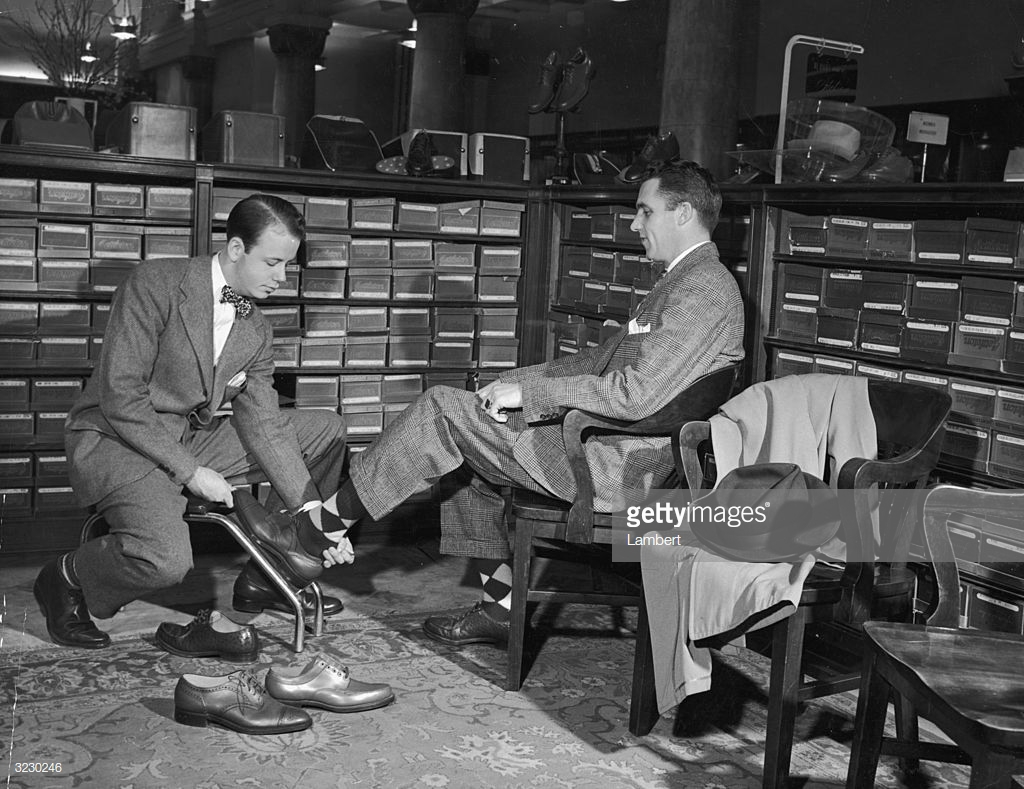
You are seated when the Shoe Salesman approaches. He is polite and professional. You notice he moves well. There is some discussion about what you need and want. He makes suggestions and you tend to agree with him.


Now he must measure your feet.

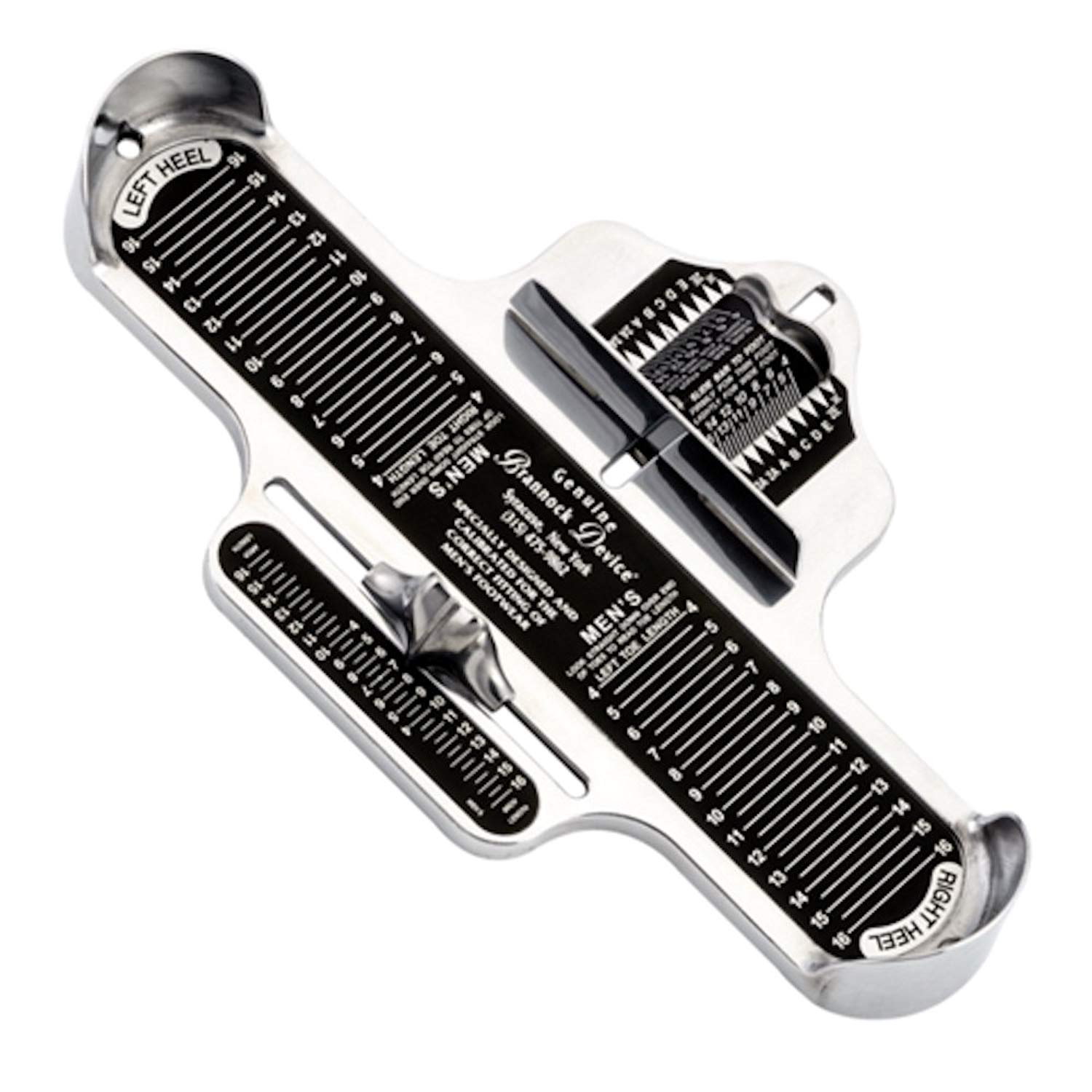
shoe measuring device

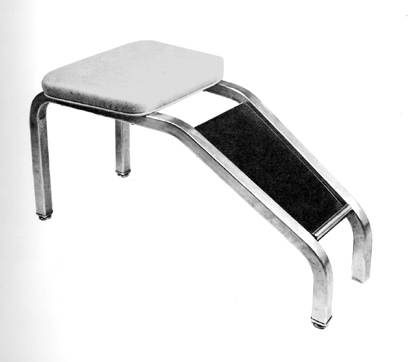
The Shoe Salesman pulls up a specially designed bench that allows him to sit and you to put a foot up so he can place a shoe on it. But that comes a little later, after the measurement, which is done using a device that looks as if it belongs in his hands. He can move it about easily, flipping it to measure either your right or left foot.


On his request, you stand for the measurement. He moves the calibrators, touches your big toe, presses the foot flat and – regardless of what size you see on the device – tells you what size you should wear.

Eatons Shoe Salesman Chair 1970 1

Using the information from your earlier discussion with the Shoe Salesman, he goes into the back to get your shoes. A moment later he returns with three or four boxes. There are different styles and even different sizes, just in case his measurement is off.


The Shoe Salesman puts down all but one box. He holds it in his left hand, gracefully removes the lid and secures it underneath the box. There is a “fliff, fliff” sound as the Shoe Salesman deftly pushes aside the two pieces of tissue covering the shoes. You notice how good the shoes look.


He sits on his bench and takes one shoe from the open box. Then, in a move that would humble a magician, the Shoe Salesman produces a silvery shoehorn from somewhere. You are not certain from where. He manipulates the shoehorn and the shoe glides silently onto your foot with minimal friction.


The Shoe Salesman ties the laces like you never could. He repeats all this for the second shoe and asks you to stand. With your foot inside the shoe, he uses his thumb and forefinger to squeeze the tip of the shoe. This is to judge the distance, if any, from the top of your big toe to the leather in front. The Shoe Salesman decides if it’s enough.


He asks you to walk, which you do. He watches you closely. He asks questions.


You try on another pair or two and, upon the recommendation of the Shoe Salesman, make a decision. He expresses delight at your choice and while boxing up the shoes asks if you need socks. You say no, and then a point of importance is mentioned: Do you need shoe trees?

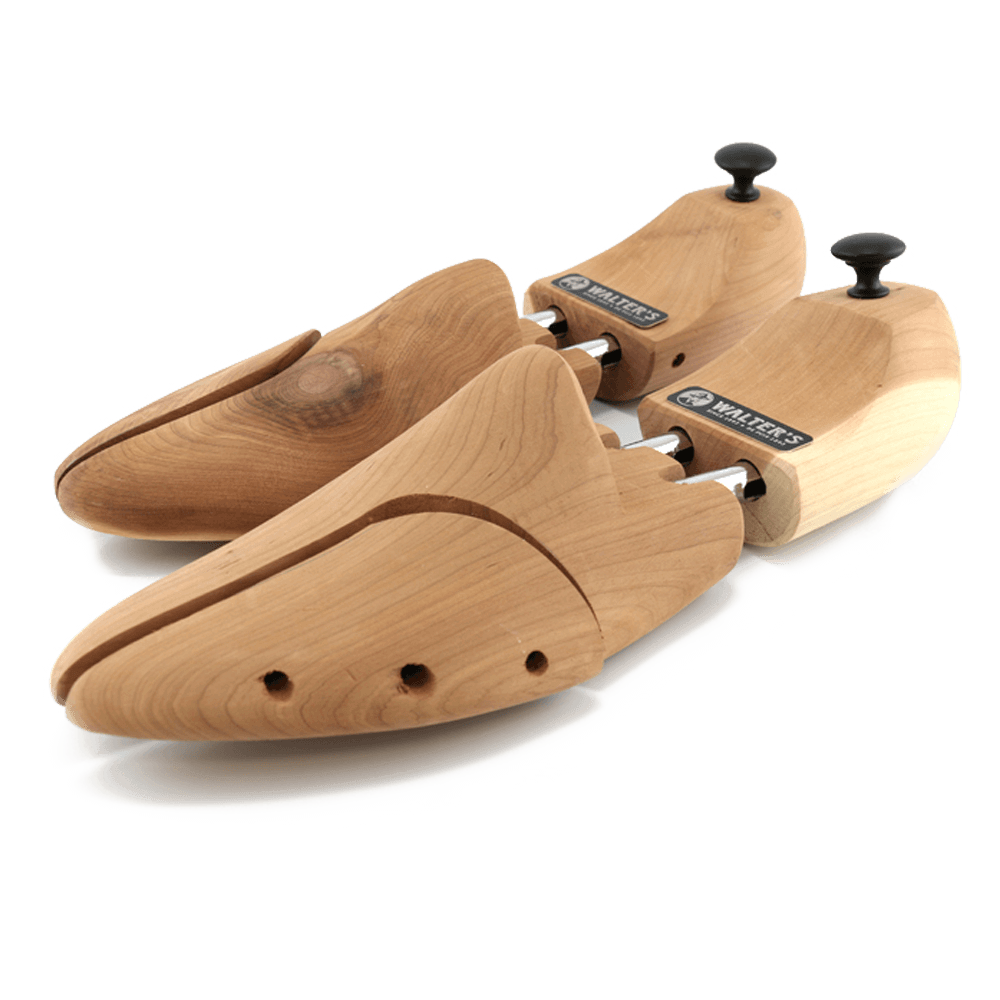
CedarShoeTree

Cedar shoe trees: $25

The shoe trees, he explains, are vital to the care and life of shoes. They allow the shoes to hold their shape and help to disperse odor. They come in plastic, but those are not recommended. You should only buy cedar, the Shoe Salesman advises, even if they are expensive.


With a degree of embarrassment, you decline the shoe trees. There is a look of disappointment on the face of the Shoe Salesman. This detracts from the near joy of the shoe purchasing experience. Something in you wants to make the Shoe Salesman happy, and you seemed to have failed at that.


But the Shoe Salesman rallies and the transaction finishes in upbeat fashion. There is a request that you visit again soon.

shoes-2000-dollars

A pair of $2,000 shoes


The Shoe Salesman may still exist at fine men stores where shoes sell for the price of a good suit. There was a time, however, when they were found in main street establishments and in family department stores like Sears.


It takes dignity, a reasonable salary and longevity to produce the kind of service described here. It is unfortunate these things were severed from shoe sales decades ago. So today, we are accustomed to what would have been an unacceptable horror in 1960: We must try on our own shoes and judge for ourselves whether or not they fit. In the entire shoe department, it may be impossible to find anything even resembling a rudimentary shoehorn.


Like in restaurants where we must serve and clean up after ourselves, we are pretty much on our own in the shoe department.


This is the American economy, a place sucked dry of everything deemed unessential. Remarkably, without someone trying to sell you shoes, the shoes manage to get sold. This is the miracle of our time. In a society where labor is horribly undervalued and skills like those of the Shoe Salesman will never be properly rewarded, the American public has been trained to supply free labor that previously was paid for.


How did this happen? Damned if I know. Perhaps it’s the results of global markets and the ability of foreign people with lower living standards to produce things once produced by those in countries with higher standards of living.


But I think it’s also related to the predatory nature of our society championed by corporations that want to keep an increasingly larger portion of their revenue. They succeed at this in the absence of any morality requiring a more even distribution of wealth, and with no market forces pushing up wages.


When Henry Ford needed to ramp up production on his new assembly line in order to meet the swelling demand for his cars, he famously boosted wages to $5 a day, an unheard of rate. Slyly, that rate was enough so all his employees could afford cars.


Today there are legions of undervalued workers, many at multi-billion dollar companies such as Walmart and Amazon, who cannot afford an automobile. As long as cars and other American products are purchased by consumers in the global market, this presumably doesn’t matter. It does, however, create instability, conflict and adds stress to government.

A Snug Fit

A shoe salesman attends to a customer in 1955


I say this not because I am a Bleeding Heart Liberal. I say this not because I want to penalize private enterprise. Rather, I say this because I am a person who once enjoyed purchasing a pair of men’s shoes and would like very much to someday enjoy that experience again.


By Lanny Morgnanesi


With so many in “deep poverty,” mere poverty is almost like the middle class

29 Sep

Philly poverty

If one of us, or many of us, falls behind, way behind, is it the responsibility of those ahead to pull up the less fortunate, the unfortunate and all those whom fortune has woefully forsaken?

Those living in and around Philadelphia should be giving this serious thought. In this city, the name of which means brotherly love, the economy, the culture, the dynamics, the thoughts and the ideals are too weak to sustain the population. What exists there represents gross failure.

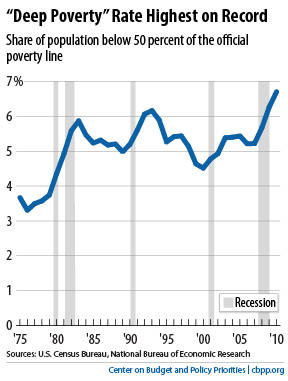
A new report says that 12 percent of Philadelphia residents live in something called deep poverty. Sadly, the times have forced us to look beyond mere poverty, which in Philadelphia is 26 percent.

The city, which I live outside of, ranked highest in deep poverty when compared to the nation’s 10 biggest cities. Nearby Camden, across the river in New Jersey, is not among the biggest and wasn’t ranked. But it has a deep poverty rate of 20 percent and a poverty rate of 43 percent.

From my little cloister, that’s difficult to even imagine.

Deep poverty chartAll these figures come from the U.S. Census’ 2013 American Community Survey, which was recently released.

By definition, a family of three is in poverty if it lives on $20,000 a year. In deep poverty, three survive on $10,000 a year.

In terms of sheer numbers, there are 184,000 people in Philadelphia who are clinging to its lowest rung. Alfred Lubrano, a staff writer for the Inquirer, said that’s about the size of cities like Tallahassee, Florida or Salt Lake City, Utah.

It strikes me as being post-apocalyptic.

But I almost never go to the neighborhoods were the 184,000 live. Camden to me is like Mars.

Still, I can’t help feel as if people like me have somehow failed those in deep poverty, even though many have failed themselves.

In any group, on any place in the world, there are people who do well and people who do not. There are those who need no help and there are the helpless. Now and in the past, however, social units like Native-American tribes or New England colonies or even extended families would try to lift up those that some might describe as laggards. They would do so simply because the unit was a unit and felt responsible for its members. To some degree, we do this in America. We have networks of social services, we have churches and synagogues, and we have government.

Lubrano, the Inquirer reporter, interviewed a Philadelphia women in deep poverty. She is 42 years old, separated with three children ages 7 to 17. Born into an Irish-Italian family, she had dropped out of high school and worked as a cashier. According to Lubrano, she fell into depression and was unable to work. So the government provided her with disability payments of $8,880 a year.

This is a nice gesture, but not a solution to the problem.

So what is? With so many types of poverty, there probably would have to be an assortment of solutions, and even then many couldn’t be reached or helped or encouraged. But it’s for certain a studied, intelligent approach would reduce Philadelphia’s Tallahassee-size problem to perhaps a problem the size of Lost Springs, Wyoming, or Bozeman, Montana.

I lack the training, depth and insight of a social engineer, but one thing I’d like to see in every poor neighborhood is a “Factory of Last Resort.” Employment would be open to all those in poverty and deep poverty who are looking for an out. They would manufacture a mundane but useful item, like brooms or soap. These factories probably would operate at a loss, but there would be incentives to keep loses to a minimum and inch toward profitability. Included with the job would be access to health clinics, day care, a dining hall and dorms.

We would be building the equivalent of an urban kibbutz.

After a time, management positions would go to employees who exhibit leadership skills, the ones who have learned and blossomed from the experience. Awakenings often come with restored dignity.

Those of us who are doing well would be encouraged to buy the brooms and soap as a sign of support. It would be a way for all of us to make our cities whole again and to keep humanity human.

And then, should we want to, we can safely and happily visit the once great and now great-again places like Camden, which spawned RCA Records and Campbell Soup. And the City of Brotherly Love can free itself from the embarrassing irony of its name. It can return to its Quaker roots of service, justice, community, self-improvement and independence.

I love a good city. This would give us more of them.

By Lanny Morgnanesi

Hobos, happiness and the Big Rock Candy Mountain

24 Aug


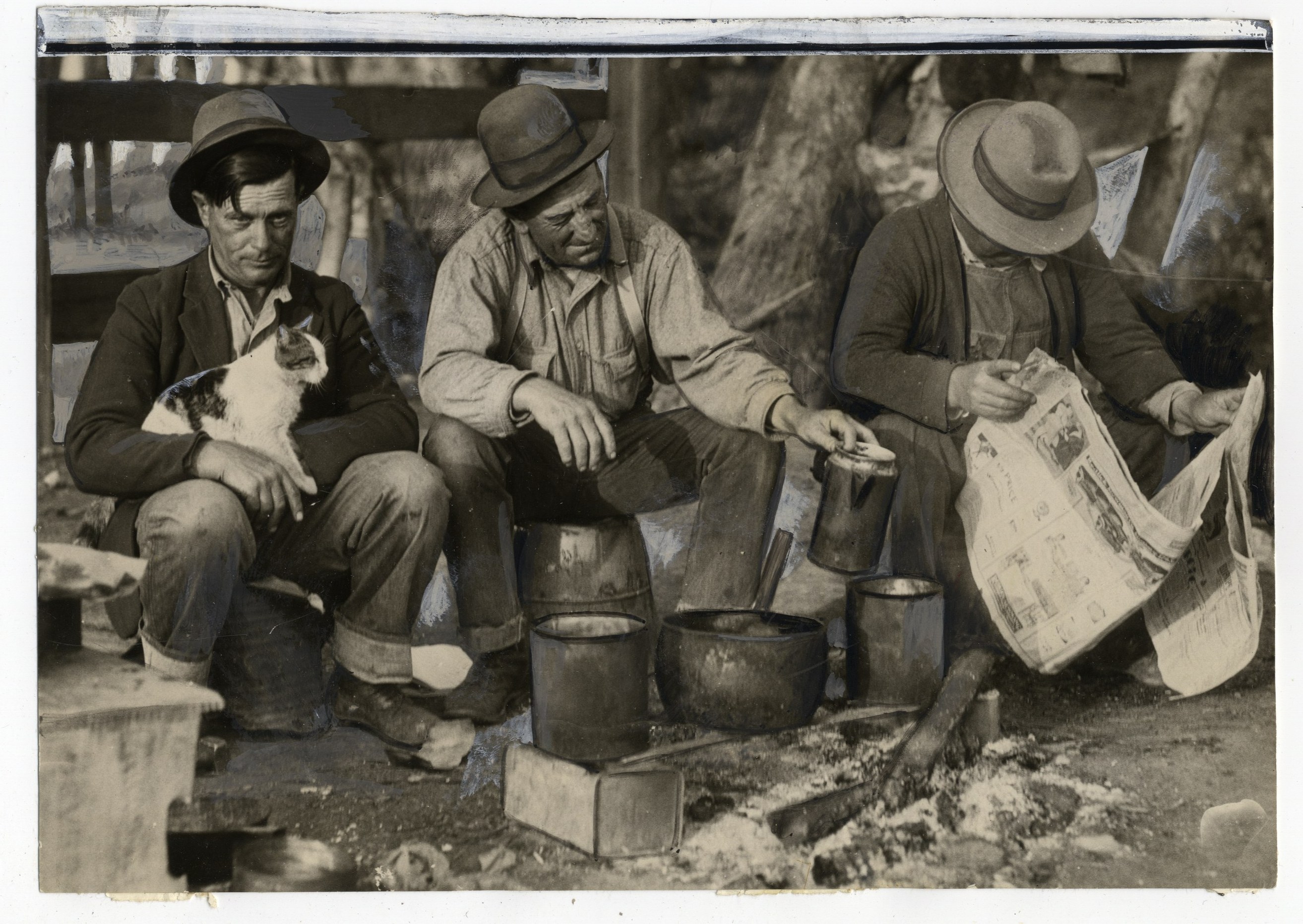
Hobos

I used to think “Big Rock Candy Mountain” was a children’s song. It’s not. It’s a song by and about hobos that someone made into a children’s song.


Harry McClintock, a hobo known as Haywire Mac, was the first to record it in 1928. It depicts a hobo’s paradise. You don’t see many hobos today but they were common and plentiful during the Depression.


The Coen brothers used the song in the movie, “Oh Brother Where Art Thou?” Recently, I watched the movie again on TV and gave a close listen to the lyrics of the song.


Harry-mcclintockIt describes a place where cops have wooden legs so hobos can out run them. The jails are made of tin so hobos can easily escape. On the Big Rock Candy Mountain, boxcars are always empty and lakes are filled with stew and whiskey. There are no short-handled shovels.


That’s the hobo’s idea of paradise.


After hearing the song, I though that if I were a hobo my paradise would have no cops and no jails. It would be a place where someone down on their luck could crawl out of their hole and make a good living; a place where even a hobo could be somebody.


What I failed to understand was that in my hobo paradise, a hobo would cease being a hobo. As I listened to the song again, it became clear that while hobos may want an easier life, they still want to be hobos.


Which raises the question: How true is this of other people and their lives?


Amidst our general hardship and discomfort, apart from our complaints and dissatisfaction with the small and the large, are we actually … happy?


As you think, consider this little story.


I once spent the Fourth of July at a country club. The fireworks were fantastic and the food was beyond good. There were hot dogs and hamburgers but also barbecued chicken and ribs, all you could eat. On a table the length of an interstate was an assortment of desserts.


In addition to bringing me, my host brought an African-American boy, about 12. He was from a Philadelphia neighborhood that was experiencing a rash of random shootings and killings. The little man was brought to the suburbs via a program designed to give poor children a break from the stresses of violence and poverty.

He was the only black person at the affair.


As I worked on my second helping of ribs, he sat with his head on the table, almost dozing off.


“Tell me,” I said. “Would you rather be here or home?”


He paused, apparently not wanting to seem ungrateful, then smiled and said, “Home.”


For him, happiness was the familiar, not the strange.


The familiar is comfortable and predictable. While I can’t document this, I have heard of a study showing that people, if given the chance to exchange all their problems and ills with the problems and ills of another person, would decline. If true, this is further evidence that no matter who we are, we like our lives.


Andy-Capp-Cartoon Pictures (1)It’s been said that England is defined by its class structure, and that people recognize and take pride in their station, be it high or low. They wear cloths and banners proclaiming their class – like the Jeff cap worn by the working-class cartoon character Andy Capp.


I don’t think we do that in America, but maybe I’m just blind to it. Either way, listening closely to “Big Rock Candy Mountain” has made me believe that America, for all its problems, is a land of contentment for both the haves and have-nots.


It’s so content that most don’t even vote.


While a peaceful populace has its advantages, it also has its dangers. Injustices are easily wrought upon the passive. Eventually, they create a destabilizing imbalance that will harm everyone – even their originators.


Income inequality is such an imbalance. In nations, stability and economic might are derived from a deep, viable, productive middle class, with a minimum of poverty and want. But when wealth is concentrated among the few, as has occurred in the U.S., the whole system is threatened because the many stop spending.


An alarm was sounded recently by Standard and Poor’s, the bond-rating company. It released a study showing that income inequality is responsible for a slowdown in the American economy. A headline on Fortune.com read:

More concentrated wealth means less spending than if money was spread to more people, according to a new report.


This realization, and others like it, is putting income inequality on the national agenda. Balance, to some degree, eventually will be restored. But it is because the elite acted, not the complacent.


I realize people get set in their ways; that they like routine and follow habits religiously. Still, there comes a point when routine is dispensed with in order to preserve dignity, honor and respect that were compromised by imbalance. At home, this happened in Ferguson, Missouri. Abroad, it happened in Gaza. The wise nation will avoid such flashpoints. More common is that they will act after the fact.


The better way, at least in the U.S., is self-action prior to the flashpoints.


We all need to get off the Big Rock Candy Mountain and take personal responsibility for our collective fate. Areas of concern are fairness, equal opportunity, equal treatment, social justice and civility. Legislation and tax policy must be designed for large segments of the population rather than small.


Key tools: Vocalization and voting.


Voting, real voting, is a powerful concept that has gone dormant in the U.S. We should try reviving it, just to keep the system fair and honest. Voting shows we are alive and paying attention.


There is nothing wrong with being happy and complacent. Complaisance, however, should never interfere with our ability to stop those who would chip away at our happiness.


Human rights, said Alexander Hamilton, are written “by the hand of the divinity itself.” They cannot, he said, “be erased or obscured by mortal power.”


By Lanny Morgnanesi


<iframe width=”420″ height=”315″ src=”//www.youtube.com/embed/JqowmHgxVJQ” frameborder=”0″ allowfullscreen>