Archive | Culture RSS feed for this section

Imagine a land where girls go to school

8 Mar

The few Iranians I’ve known I’ve liked. But they pre-date the ayatollah. Curious about what people and life are like in today’s Iran, I went to see “A Separation,” an Iranian movie that won the Oscar for best foreign film.

Here are my quick observations about what makes that country different from ours:

  1. The women cover their heads.
  2. All buildings are in need of interior and exterior paint jobs.
  3. In court there are no lawyers.

Aside from those differences, people and life are the same as in the U.S.

Husbands and wives fight. People lie and cheat. Cities are busy and crowded. There are strong women able to fix problems caused by men. There is traffic. Girls go to school. Children are valued. The unfortunate find themselves out of work and out of money. There is an attempt to see that justice prevails.

I was looking for strong evidence of Islam. Little was found, even in court. Court mainly consisted of all parties yelling and screaming and a judge (in street clothes) trying to rule without the aid of procedure.

Some people, like in America, were more devout that others. A woman hired to take care of an Alzheimer’s patient telephoned a spiritual advisor to ask if it was OK to change the man’s soiled paints. Others didn’t seem so devout and would swear in front of women and children. Someone was accused of stealing money but there was no attempt to cut off her hand.

In the end, a couple divorces and a child is forced to choose which parent to live with.

Iran could easily have been Brooklyn.

So be advised. If we bomb them, we are bombing people very much like ourselves

One thing I also should mention: Those Iranians can act. “A Separation” was a simple yet worthy film, well executed in a shockingly realistic style. You don’t even think you are watching actors.

Remember the Poor Immigrant

5 Mar

A zip-lock bag with a small rock inside for weight was tossed onto my lawn today. In my neighborhood, this is a standard method of advertising lawn services. What was not so standard was the pamphlet inside, which in part read: “Teofilo Sanchez Landscaping.”

I have friends who argue that immigrants, both legal and illegal, are a drain on taxes and the economy. While I really don’t know anything for sure, I always argue back that immigrants, legal and illegal, will provide the boost we need to restart our economy, and that they will become the next great wave of entrepreneurs.

It seems to me that it doesn’t take too long before a hired lawn guy earning minimum wage (or less) realizes that if he saves enough money for a mower and a truck, he can be the boss.

For all I know, Teofilo Sanchez is a Fortune 500 exec whose family came across on the Mayflower. But I will assume he is not. I will assume he is part of the new wave. I will assume that my theory (which required no insight or imagination) is coming true. I will assume that more and more marketing will target this new demographic, that the people in it will buy more houses and cars, that more will enter college, become wealthy, enter politics and lead.

This story has been repeated so many times it is a cliché. Why then is it so difficult to remember?

Don’t go without a phone

4 Mar

At the Philadelphia International Flower Show, in front of the better exhibits, arms shoot up in the semi-darkness like a mass salute … a salute with glowing smart phones.

Standing among the throng, my immediate worry was for the companies that make cameras. (They’ve got to be going out of business) My second worry was for myself: How am I going to take a decent picture with all these arms in the air?

While the flower show, which I attended on opening day, was full of rich, lush plant life (the theme was “Hawaii: Islands of Aloha), the event was mostly about getting in the way of people taking pictures and people getting in your way as you try to take pictures.

Putting that aside, however, the show truly can be enjoyed as a mass display of intricate, complex natural beauty tamed and woven into poetic design by human beings.

It can take your breath away. It is well worth the trip, even if you don’t get a decent photo out of it.

Linebackers as Modern Day Bounty Hunters

3 Mar

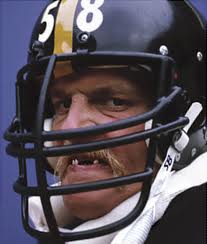
Jack Lambert -- not afraid to hit.

Jack Lambert, the “Man of Steel” who played middle linebacker for the Pittsburgh Steelers, is famous for tough hits and saying that quarterbacks should be forced to wear dresses.

It was a cute little quote suggesting the sport of football is all about violence, and that the violence should not be held in check.

But football also is about money, lots of money, and when you mix money with violence, you end up with sub-human behavior.

It was revealed this week that members of the New Orleans Saints contribute bounty money to pay players who seriously hurt members of the opposing team. A hit that results in a player being carried off the field earned $1,000; if a player was knocked out of a game the payoff was $1,500, and so forth. In a 2009 playoff, it appears a bounty of $10,000 was provided for disabling a quarterback.

So … does this make football fans feel good or bad? Or indifferent?

While the athletic abilities and physical finesse of NFL players are sublime, the brutality of football may be its biggest attraction. With the epidemic of concussions, things are being done to make the game safer, with the risk of making it less lucrative. Despite this, the game probably won’t get much safer until the players – who gain so much from winning – accept that football is not the Ultimate Fighting Championship.

They might be convinced of this if the NFL trots out the hundred of retired players who are physical wrecks, the ones who live with daily pain and don’t even get medical coverage from their former teams. Let these guys lecture the active players – like one of Scrooge’s ghosts.

That might convince them.

Even better, for at least one game, make them all wear dresses.

The preservation of the game is at stake.


Overlooked and under-appreciated

26 Feb

Under-appreciated


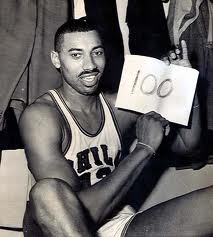
The Philadelphia Inquirer today carries an interesting piece on the 50th anniversary of Wilt Chamberlain scoring 100 points in a single basketball game. It carries a shocking disclosure that this historic accomplishment was not universally accepted as a tour de force. Many considered Chamberlain, at 7 foot 1, a freak of nature who actually was hurting the game. After Wilt’s 100-point outing against the Knicks (in Hershey, Pa.), the Philadelphia Warriors went to Madison Square Garden to again face the New York club. Interest was low. Only half of the 18,496 seats were sold.

Why is time and perspective required to understand the relevant and important?

Overlooked

I once worked at a newspaper in north Florida that had won a Pulitzer Prize for photography in 1967, long before I arrived. The winning photo was of a lineman up on a telephone pole. He had been shocked by an electrical surge and had passed out. His safety belt kept him hanging, enabling an apprentice lineman to climb up and give him mouth-to-mouth resuscitation. The photo was taken by Rocco Morabito and entitled, “The Kiss of Life.”

From the stories that were told, the photo ran on an inside page and of only modest size.

Can anyone recall instances where something historic or significant was overlooked or underappreciated until much later?


No Briticisms, please

14 Feb

Watch those tweets, mate.

Bloomberg Business week reports that a couple of Brits were picked up at the Los Angeles airport by Homeland Security after tweeting that they were going to “destroy America” (read: party it down) and dig up the body of Marilyn Monroe. They were detained for five hours.

The end of privacy

11 Feb


Digital technology brings the world to you and you to the world.

It tracks and records you, follows you around, knows where you have been, what you like, who your friends are. It can predict what you are likely to do.

There is a story circulating that a person with good credit was denied a mortgage because his friends in the digital world were un-creditworthy. You know, birds of a feather.

True? Don’t know. But certainly possible.

Now it seems people with information to protect are taking great steps to secure it when they go abroad. The New York Times this morning describes the precautions taken by a China expert at the Brookings Institute when he travels to that country. The account says such measures are now commonplace for government and business officials.

He leaves his cellphone and laptop at home and instead brings ‘loaner’ devices, which he erases before he leaves the United States and wipes clean the minute he returns. In China, he disables Bluetooth and Wi-Fi, never lets his phone out of his sight and, in meetings, not only turns off his phone but also removes the battery, for fear his microphone could be turned on remotely. He connects to the Internet only through an encrypted, password-protected channel, and copies and pastes his password from a USB thumb drive. He never types in a password directly, because, he said, “the Chinese are very good at installing key-logging software on your laptop.”

At home, the average person’s privacy is compromised for marketing purposes. Someone wants to sell you something. It’s not a pleasant idea, but most can live with it. If it ever becomes political and used as a repressive tool of government, we’ll have quite a lot to worry about over a simple game of Angry Birds.

Am I’m being naïve by saying “if it ever ….”?

Sticks, stones and free speech

10 Feb

Hateful or merely unfunny?

I’ve noticed that more and more celebrities, politicians, broadcasters and sports figures are saying things that offend people. Reporting gaffs, if they are indeed that, has become its own news genre.

What people say rarely offends me. I’m an advocate of free speech. And I like to hear what people really think. Don’t others feel this way? It is difficult for me to believe that, say, a Jew, would prefer an anti-Semitic congressman keep quiet and never be found out, rather than speak honestly and reveal himself.

Do those who complain about people like Roland Martin think Roland Martin would be a different person if he didn’t say what he said?

I once found myself among a large group of traveling North Koreans. They didn’t say a word, didn’t crack a facial expression, didn’t show they were human. Fear encapsulated them. I’d much rather be around a bigot than an automaton. I’m hoping the current tendency to castigate offensive utterances doesn’t turn Americans into North Koreans.

Can’t we just ignore celebrity offenders? That’s severe punishment, since these are people who can’t seem to live without attention.

There once was a politician in my town who probably was a good fellow at heart. He liked to make jokes and never worried about offending people. He thought himself a scream. He held a high county office and once had to deal with a small riot in a Hispanic neighborhood.

He was unable to play it straight.

During a public meting he said this: “We could have avoided the problem if someone had just put up a taco stand.”

He was roundly criticized.

At the next meeting, he took the podium to apologize, even though he was not the kind of man to do so.

“I was completely wrong,” he told his audience. “It’s the Mexicans who like tacos. The people who rioted were Puerto Ricans.”

And he belly laughed.

Was this man a racist or simply a failed comedian?

To me he was someone who refused to hide himself. If I chose to, I could have run from him, knowing more about him than I knew about most people.

He lost the next election, retired and died. Roland Martin, on the other hand, probably has followers on social media than ever before.

How hungry do you have to be?

8 Feb

gleaners

“The Gleaners,” by Jean-Francois Millet

I heard a little – not much – about a gleaner movement where volunteers seek permission from farmers to glean fruit and vegetables from fields, then use what they harvest to feed the hungry.

When I learned about the movement, my grandfather came to mind.

He was an immigrant, and his own gleaner. If he passed a fruit tree where apples were left on the ground, he would walk up to the door of the house and ask if he could have them. The gleaned food was in addition to what he grew in his own garden.

His son, my father, with disgust for modern life, once told me his father “fed his family on less than you spend today for paper towels.”

My grandfather was a proud, ingenious man who felt no shame in gleaning what would otherwise be wasted. If I were hungry – and I doubt he ever was – I’m not sure which I would find less tasteful: gleaning for myself or having others glean for me.

Class Warfare Parable

4 Feb

How many do you have?

Here is what I call a Class Warfare Parable, a simple little story that tries – and I think succeeds – in saying a lot about class. It appeared in a piece by syndicated columnist Leonard Pitts Jr., who heard it from one of his students.

This is it:

A rich white man sits with a poor white man and a poor black man at a table laden with cookies. The rich white man snatches all the cookies but one, then turns to the poor white man and says, “Watch out for that darky. I think he wants to take your cookie.”