Tag Archives: politics

Is There New Relevance to a 2004 Novel About a History That Never Was?

19 Nov

By Lanny Morgnanesi

In 2004, more than a decade before Donald Trump first became president, Philip Roth published a novel entitled, “The Plot Against America.” There was an effort to make it into a TV show, but it failed — initially. After Trump was elected in 2016, it was green lighted into a six-part series.

The novel has nothing to do with Trump and takes place during World War II. It’s an alternative history. But reading it now, it carries an eerie sense of familiarity and dread. It actually gave me chills. Frankly, with Trump in his second presidency, I’m surprised it hasn’t been reissued.
Charles Lindbergh

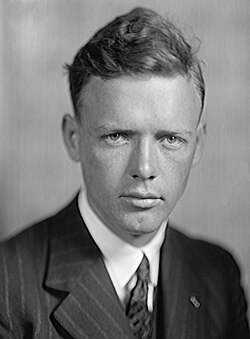
 In the novel, President Franklin Delano Roosevelt loses his 1940 re-election bid to Charles Lindbergh, the America hero who in 1927 flew solo from New York to Paris in his small plane, The Spirit of St. Louis. In the novel and in real life, Lindbergh was an American Firster who wanted to keep the U.S. out of war. In the book, if not in real life, Lindbergh is sympathetic to the rise of Adolf Hitler and exhibits anti-Semitic tendencies.

Columnist Walter Winchell

Once in office, he signs an official truce with Hitler to keep America out of the war. Then he begins a series of programs to marginalize American Jews, mainly moving them out of urban enclaves (the book is set in Newark, N.J.) and scattering them about the Christian Midwest, hoping they assimilate and discard their Jewishness. Out of fear, some leave for Canada. The main voice of opposition – almost the singular point of dissent — is columnist and radio commentator Walter Winchell, a Jew. Frightened Jews rally around him and listen to his Sunday night broadcasts with both fear and hope.

 Then, Winchell is fired from his job, runs for president, and is assassinated. Jews protest. This sets off a violent wave of anti-Jewish pogroms. Murder and mayhem come to the streets of Jewish neighborhoods while Lindbergh’s government remains silent. Antisemitism builds and spreads, bursting like a volcano. Then Lindbergh, while flying alone back from a speech (he does this frequently) disappears. He and his plane cannot be found.

Author Philip Roth

Hitler (who, we learn later and secretively, may have kidnapped him; we’re not sure) claims Lindbergh was killed by a Jewish conspiracy, and the anti-Jewish rioting further intensifies. Much intrigue and strange happenings follow. The vice president takes over and arrests the top Jewish leaders in America, including real life figures Henry Morgenthau Jr., Herbert Lehman, and Bernard Baruch. Also arrested is New York Mayor Fiorella La Guardia, seemingly the only non-Jew to condemn America’s turn toward fascism.  Ultimately, a level-headed Mrs. Lindbergh, acting like a widow who knows something we don’t know, calms down the nation and announced that the Jews did not kill her husband. With her help, FDR is reelected, stops the pogroms, enters the war against Germany and Japan, and (we guess) saves America.

Joachim von Ribbentrop

What makes this story contemporary is the immense popularity of a conservative president who takes the country in an entirely new direction. Everything he does, including the relocation of Jews, is framed in a positive, pro-American narrative and is readily accepted by nearly all Americans, including – at least at first – many Jews. Lindbergh has enlisted the help of the nation’s top rabbi to convince his people that all is well and right. The rabbi is given a top position in the government, is treated and feted like a celebrity, and attends state dinners and other functions, including one where the guest of honor is Hitler’s foreign secretary, the real life Joachim von Ribbentrop.

So many people, big and small, compromise themselves because they see a winner and want to be on his team, and they assume when the government goes after people, it does so for a good reason, and will never come after them.

Newark, N.J. in the 1940s

As intra-family squabbles take place today, in the book Jewish families fight among themselves about whether or not the government is good intended, whether America is stronger by staying out of the war, whether they should move to Canada or take part in the relocation program, and more. We see how people are not worried at first, then as the Lindbergh policies take hold and escalate, the worrying begins. But people still aren’t sure. It takes violence, murder, and assassination before they realize what’s taking place is wrong.

If you can, look in on the book, “The Plot Against America” or stream the TV series on HBO or Hulu. (Here is the trailer)  Perhaps you won’t see it as I see it … or maybe you will see it as an even darker specter of what is to come.

Modeling a Country After a Shopping Destination

23 Oct

By Lanny Morgnanesi

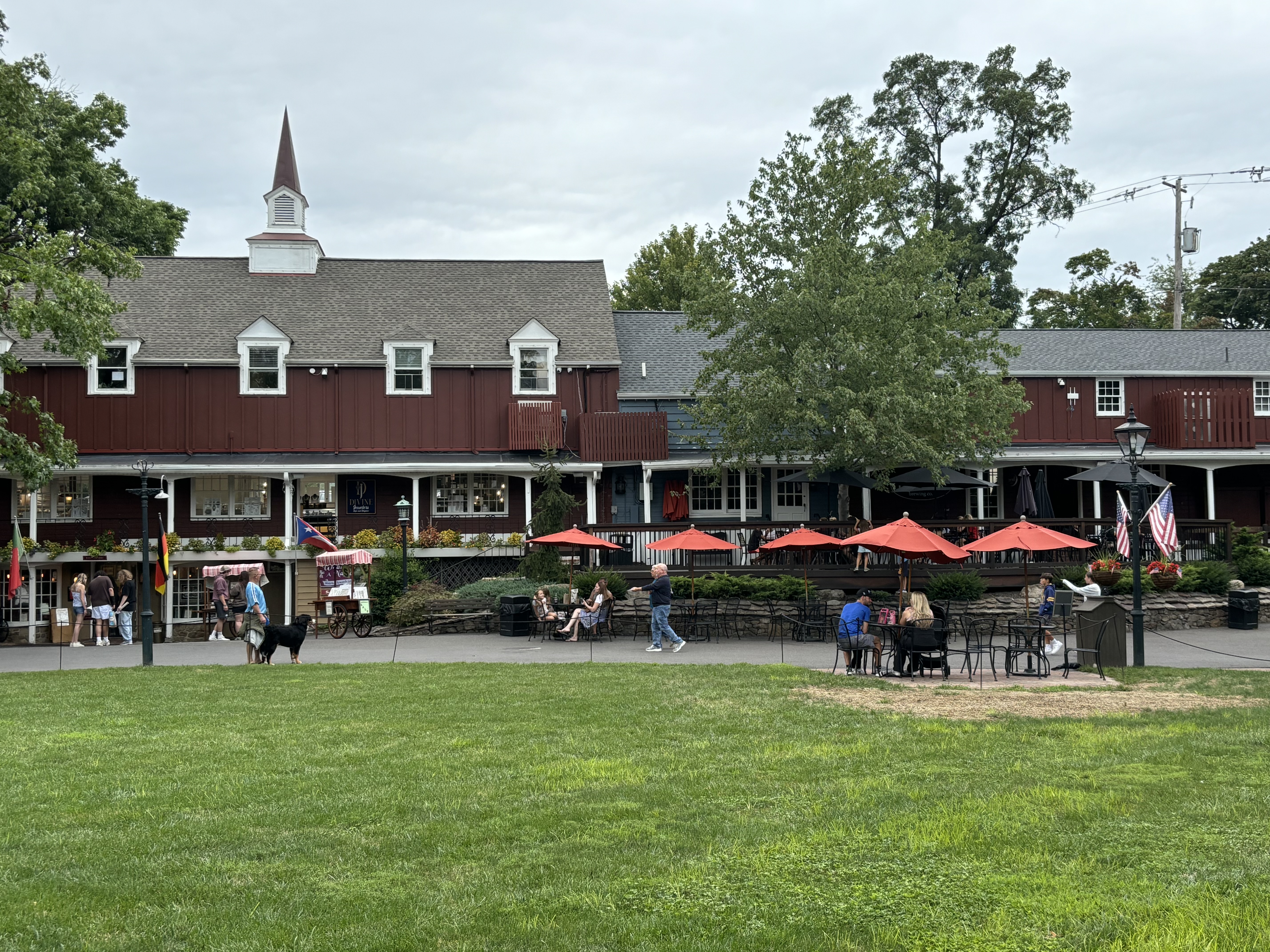
Near my home, in a place called Lahaska, there’s a tranquil spot of beauty and commerce called Peddler’s Village. It was built by a somewhat eccentric man named Earl Jamison. The village is spread over 42 acres. It has old-fashioned shops, restaurants, bars, lodging, even a carnival merry-go-round. The peddlers at Peddler’s Village peddle everything from clothes to hats to paintings to fresh pastry, popcorn, maple syrup, and beef jerky.

Part of the attraction is the artful landscaping. Jamison liked gardening, and when he was alive you could mostly find him at Peddler’s Village on his knees, tending to plants. That kind of attention and that kind of tradition has been passed on to others. The place looks great.

The summer day of my recent visit was pleasant, and everyone was having a good time. Parents, kids, babies, older couples, dogs. In this part of suburban Philadelphia and at Peddler’s Village, the crowd is mostly – what’s a good word? – Anglo. With a fair number of Asians. The people who walked the brick promenades seemed comfortable in their lives, safe, and secure. As I did. This was an enviable America.

This simple Saturday was starkly different from the America depicted in the political ads of Democrat Kamala Harris and Republican Donald Tump, both of whom want to lead a country they have extreme doubts about. During the broadcast of the July Olympics in Paris, Harris and Trump ran harsh ads designed to shock and get you to the polls. There was an inescapable onslaught of these ads. I couldn’t tell which America was worse, the one the Republicans blame the Democrats for, or the one the Democrats blame the Republicans for. It wasn’t much of a choice. Made me think horrible things about a country that, to me, seems all right.

Shoppers relaxing

The trump and the Republicans presented a nation ravaged by inflation and overrun with invading foreigners who bring in drugs and commit a wide assortment of crimes, including murder and rape. These same foreigners suck the money and life out of our social service and health systems, so there is little left for us. Kamala Harris, the Democratic candidate for president, is said to be dangerous and weak, a radical who clearly will destroy whatever is left of the America that they say once was great but obviously no longer is. The Democrats, for their part, cast Trump as a crude, weird, racist dictator whose speech and actions resemble Hitler’s.

What these ads showed and preached was nothing at all like the idyllic Peddler’s Village, where not even a trace of discontent could be found. And so I thought of my own life and happiness. As my wife shopped, I sat on a bench and enumerated the America I knew and appreciated, and that I think others would recognize, regardless of the horrors in the political ads.

In my America:

  • No one is shooting at me or dropping bombs on or near my house.
  • My home is nice, comfortable, and in good working order.
  • I have clean water and plenty of food.
  • The stores are filled with everything I could possibly need or want.
  • They take away my trash and sewage.
  • They take away the snow.
  • We have good hospitals and good doctors, and you can get appointments.
  • We have good schools.
  • The police protect us.
  • We are free to go where we want, when we want.
  • Contrary to what some people may prefer, we can say whatever we want.
  • We have a strong tradition where the rule of law prevails, and the legal system works.
  • We are allowed to invest our money in companies that can make us money.
  • Generally, you don’t have to bribe a public official to get something done.

I’ll stop there. I hope you can see the difference between what the presidential candidates are saying and what I am living.

Elsewhere, beyond me and beyond Peddler’s Village, there are people living lesser, unenviable lives. In these last few decades, inequality in America has bounded ahead in a rampage. There is nothing unusual about inequality in America, but it has gotten worse. For many there is food insecurity, job insecurity, little or no medical attention, poor or no housing, poor schools, high crime, discrimination and lack of opportunity. None of this was on display at Peddler’s Village.

Philosophers and do-gooders will say that in a country as rich as the United States, poverty is unnecessary. Others will say poverty is the self-inflicted disease of the shiftless and not something for government to fix. But in almost every society and culture, the natural, human tendency is for a strong and aggressive minority to acquire nearly all the wealth and broker all the power. Sometimes, this inevitable pattern is halted or reversed by uprising and revolution, but only for a period, and then the inexorable progression of the dominant human forces continues, and the once-again complacent majority – usually with a very worse-off minority substrata –allows its modest wealth to trickle up.

Therefore, it is difficult for a nation such as ours to eliminate poverty and establish of nation of Peddler’s Villages.

In my mind, eliminating poverty is not about giving money to the poor. Rather, it is about allowing the poor to be productive. This requires removing the often-invisible restraints and barriers holding them back, as well as reorienting a defeatist mindset and the established alternative culture of the outsider.

Not an easy thing to do. Maybe impossible. But for the sake of discussion, let’s see how much money is out there for the poor, as if we just wanted to give it to them, which of course we do not.

Forbes magazine says there are about 400 billionaires in the US. It says they are worth a total of $54,000,000,000,000 – that’s $54 trillion. (The entire federal budget in 2024 was about $6.5 trillion). The top five billionaires are:

Elon Musk — $244 billion

Jeff Bezos — $197 billion

Mark Zuckerberg — $181billion

Larry Ellison — $175 billion

Warren Buffett — $150 billion

If, in some crazy world that is not ours, we took 25 percent of the wealth away from the 400 billionaires and handed it to the 37 million people living in poverty, each would receive $36,000. I guess a family of three would get more than $100,000. That’s enough to start a small business, send the kids to college, or maybe get a mortgage on a house.

This is just fun with numbers and of no meaningful purpose when it comes to problem solving. It is for perspective only. A more practical solution to income inequality is a return to tax policies of the ‘50s and ‘60s that allowed for a more even distribution of the wealth.

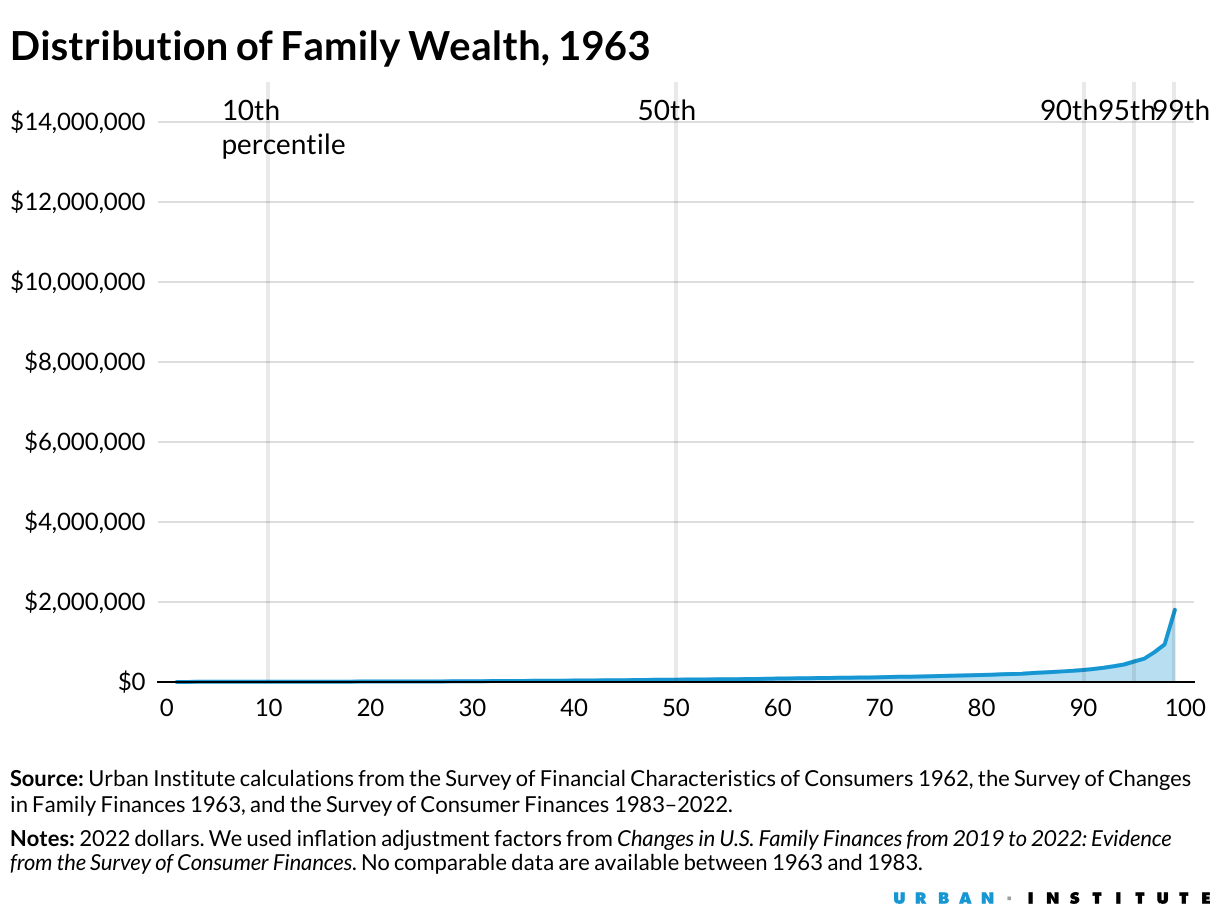
To illustrate the change, in 1963, the wealthiest families had 36 times the wealth of families in the middle class. By 2022, they had 71 times the wealth of those families. The top 10 percent now own about 70 percent of the nation’s wealth, with the bottom 50 percent owning 2.5 percent.

The charts below show how the money was spread out then, and how it is spread out now. The blue is the money. The poor are on the left. The rich are on the right. Most of us are in the middle.

If we can find the strength and courage to eliminate barriers to opportunity, and there is a redistribution of some wealth, without so much money sitting in the hands of so few, maybe there will be enough money to fix things up in our country. Maybe our crumbling cities can look like Dubai, or Shanghai, or Singapore. Maybe, if neighborhoods aren’t economic dead zones, they’ll be welcoming places and not fearful haunts to be avoided. With the proper changes, maybe escalators and streetlights will work. Maybe we will have fast trains, and wide, smooth roads, and bridges not in danger of collapsing, and JFK airport won’t be a 21st century embarrassment.  Maybe we can prop up Medicare and Social Security and have a good universal health care program. Maybe, state universities can be free. It’s not that we need free stuff, it’s that we’ve worked hard enough to get them, and that wide access to education and health care will result in a stronger, more productive country with greater participation by its population. With a vibrant, involved population, there will be great costs savings in law enforcement and prisons, mental health, public housing, all kinds of things. This is a great trade off.

New York City subway

I was disheartened when I heard of an American who returned home after living for a decade in Japan. “Nothing works here,” he said. “And the public bathrooms are disgusting.”  So let’s fix things up. Fix ‘em up good.

There is a theory that if you don’t repair a broken window in a building, the entire neighborhood will eventually collapse. If you do repair it, the entire neighborhood will keep itself up and thrive.

I want the latter for my neighborhood and my country. Why don’t others?

Visit the clean, the organized, the efficient, the beautiful Peddler’s Village and perhaps you will change your mind.

Imagine America with a Queen

29 Jul

I don’t think too many Britons say nasty things about their Queen.

They don’t object to her politics because she really doesn’t have any. They may get mad at all the money – their money – she spends on palaces and servants, but they get over that.

What she represents is them, the collective whole, and they seem to appreciate it, rally round it, and draw strength from it.

A keen memory of mine is from a dinner toast at a British embassy. It consisted of two words that meant 10,000. It was simple and so reverent:

“The Queen.”

The leader and figurehead of the United States, by contrast, is called names and blamed for all kinds of bad things. His motives are questioned, as if he refuses out of spite to use clear and easy solution to big and complicated problems. It is frequently suggested that he is out to destroy America — on purpose.

Not so with a queen.

I was never much for monarchy. In fact, a favorite movie line of mine comes from Monty Python after, I think, a noble personage advises a lowly peasant, “I’m your king,” and gets the answer, “Well I didn’t vote for you.”

But seeing Queen Elizabeth at the Olympics, sitting there as an honored representation of all Great Britain, inspired envy.

From afar, and perhaps in fact, the British seem to have a cultural homogeneity that the U.S. does not. While Britain is markedly divided by class and is mixed racially (from immigration), there is something holding all together.

You only have to listen to the way the Brits sing their anthem “Jerusalem” to know this. They did so at the Olympics and it moved even me, a non-Brit. The final, powerful verse is:


I will not cease from Mental Fight,

Nor shall my Sword sleep in my hand,

Till we have built Jerusalem,

In England’s green and pleasant Land


Americans love being Americans, but we are a country of individualists. We can be distrustful of each other. Our tendency is to work on our own to improve our lives, not to work collectively for a new Jerusalem. In Britain and much of Europe, there is a collective desire to see that all have health care, that all can afford higher education, that all can get around on trains, subways and buses.

We don’t have that in the states. We do have the Interstate Highway system, but only because the military needed evacuation routes in case of nuclear war.

The American continent does have a distant legacy of working as a tribe. But the ways of the Native American people never had an impact on the rugged, go-it-alone settlers.

Hardworking, innovative Americans have performed technological and economic miracles working alone. It was this kind of culture that allowed us to break from the English, better them and pretty much rule the world.

Still, I feel as if we lack something as a people. When I see the Queen of England, who I didn’t vote for, I have this wish that we could get behind our leaders in a forceful way that lifts our spirits and moves us ahead quicker. Of course, such a system would require that leaders be pure of heart and dedicated to the American cause and not their own.

This would be the hardest thing to accomplish, even if we gave them all palaces.

A different kind of 1 percenter

20 Jan

A friend said he is rooting against the San Francisco 49ers because he doesn’t want the people who voted for Nancy Pelosi to have the satisfaction of a Super Bowl champion.

A scheme for making politics civil

26 Dec

I consider my local congressman a friend, even if I don’t agree with all his party’s policies. I’m especially opposed to its extreme wing, which at present seems to dominate. Its traditional philosophy is sound and sensible but was retired sometime ago.

When I saw my local congressman at a Christmas party, we both bemoaned the state of the nation, the ineffectiveness of Congress and the horrid, incivility of politics. In a fit of frivolity, my friend the congressman suggested I run against him. He said we could both vow to wage a polite, positive campaign.

On the hustings, in full public view, we could hug and ask about each other’s families.

Such a campaign would surely get us viral national press coverage and perhaps start a moment that would alter, if ever so slightly, the face of politics.

I, of course, wouldn’t have a chance of winning.

He, with his organization, experience and a redistricting that went squarely in his favor, would kill. No bother. My goal, and part of his, would be to establish a template for a rational, thoughtful campaign that would seriously address the issues. There would be no pandering, and no ripping the other person or distorting his views.

We wouldn’t go big with discovered evidence that one of us may have, at one point in our lives, been mean to a dog.

We issue complements and acknowledge each other’s intelligence, competence, moral character and desire to help the nation.

If publicity came, it could rally people around us and have other candidates make the same pledge.

It is a very tempting idea. If I were a self-sufficient man, and I am not, I would quit my job and surely do it. It would bring inner satisfaction and an authentic sense of purpose.

I worry about our nation, our people, our economy, our will, our unity and our place in the world. This plan, hatched with laughs at a party, would take me off the sidelines and allow me to at least do something about all that.

A nice dream.