Tag Archives: China

A Buddhist would have no trouble with this

17 Jan

Chinese labor camps

It could be argued that all experiences are good ones.

Philosophically, we could say that if God is good and great then all our burdens are worthwhile and purposeful. We can even learn to like what we hated.

Last week in a bar I told a story of one of the worse nights of my life. I told the story with verve, delight and nostalgia. I got laughs. I was glad to tell it; glad it happened; glad to learn from it. For the first time I realized I was glad to have this piece of film on my reel.

It is too personal to tell here, so I won’t. Its importance is not in the sharing but in reminding me that the misery of each moment carries within it a miraculous value.

It was more than the bar story that forced this revelation. There was also a news story about China. The report said China might dismantle its system of labor camps.

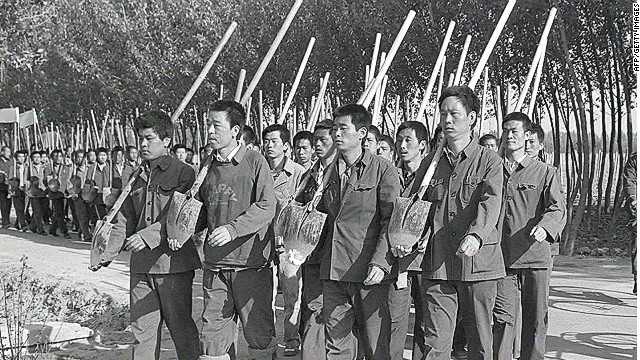
I have no idea what a modern Chinese labor camp is like, but I’m familiar with the tradition of locking up political prisoners and trying to “re-educate” them. I’ve known many people who were victimized by this system during the Cultural Revolution of the 1970s. Some were driven to suicide or to the brink of it.

During this period, all schools were shut and an entire generation of young people was sent to the countryside to labor on farms. Some were considered “red,” or part of the revolution. Others were labeled “black,” or counter-revolutionary. For them it was harsher. They were watched closely and always under suspicion.

While all worked together, the “blacks” were more like prisoners and the “reds” more like guards.

From a first-hand witness I heard a story of a young woman – a “black” – who was laboring in mud. To keep the dampness out of her cloth shoes she put in newspapers. When everyone returned to their rundown barracks, a “red” youth noticed the newspaper inside this woman’s shoe contained a picture of Mao Zedong.

For that show of disrespect she was beaten.

But like myself in the bar story, this was a time of youth. The times contained moments of ultimate value.  Lasting friendships (even between blacks and reds) were forged. These “sent-down” youth, in some respects were very free. They grew up and learned about themselves and others. There is joy in that.

Which is why many Chinese from that generation – those living both in China and in the United States – visit these former labor camps while on vacation. It’s a for-real trend, and they visit with fondness and to share old times with comrades. They take smiling photos of themselves standing near the squalor they thought would be a permanent part of their lives. (Modernization hasn’t changed everything.)

What they went through is far, far, far from my so-called worse night. Yet they have reacted as I did. Their moments carried something and will occupy a peaceful part of their memories.

I don’t claim to truly understand this, and the exceptions must be legion. Even so, there clearly is something to this idea that all experience is good. And so my new goal is not to wait 30 years for warm nostalgia but to live fully and happily in the present.

To accomplish that in even a small measure would be exquisite.

By Lanny Morgnanesi


Grand Dad was a Communist

8 Dec

Comrades Some Republicans say President Obama is a Communist. He’s not much of a Communist.

For real Communism consider Earl Browder, an ultimate Red Stater who took orders from Stalin and was covertly followed by both the FBI and the KGB. On the Communist party ticket, he ran twice for president against FDR. He made the cover of Time magazine. At the time, Browder’s popularity had been fueled by turmoil of the Great Depression.

While people may have understood and even respected him during those years, times did change. In changing times, his surviving family members mostly had to live uncomfortably with this unusual legacy, or else hide from it.

Granddaughter Laura Browder decided to write about it. But first she had to learn about it.

A professor of American studies at the University of Richmond, Browder had authored a book on the radical 1930s but always maintained her family’s privacy. Until recently, she hadn’t venture too deeply into the past of Earl Browder, a man she knew as a quiet visitor on Thanksgivings. Now she is probing his life and parting decades of silence.

“I was struck by the impossibility of finding definitive answers to the mysteries of the past and the desperate importance of trying anyway,” she wrote in a Nov. 23 issue of The Chronicle of Higher Education.

At Syracuse University, she found a trove of archival material that Earl Browder, then broke, had sold. Among his papers were family letters and photos, including a picture of Laura’s father as a child, posing in shorts while holding a real sickle and a real hammer.

Her father told her he had no recollection of the photo.

I wish Laura Browder luck with her project and hope it brings her family closer while promoting an understanding of things we don’t understand.

Her piece in the Chronicle made me ponder the idea of Communism in general, how its advocates went from philosophy to revolution, to inspired hope, to authoritarian brutality, to controlling half the world, to creating great fear and insecurity in the U.S., to finally becoming an utter failure and an almost laughable concept.

Oddly, it remains vital enough to be used as a political smear.

During the later part of the Cold War, the American preoccupation with Communism made me want to observe it. So I took a job in China, working as a low-level editor in the English language section of the government’s top news agency, Xinhua. On the plane over I spoke to a party man returning home.

His English was good. So was his suit. He was sharp and intelligent. Dapper and cool. He said he preferred a system where the government looked out for its people.

“You don’t seem the type that needs looking after,” I said.

“That’s true,” he answered. “I can take care of myself. I can survive under any system. But I have a brother. Without Communism he would be lost.”

I guess it’s a comforting idea to think one can never be lost.

My very first real reaction to upclose Communism was equally comforting. I walked into my office on the first day and an elderly Chinese woman handed me a fat envelope filled with cash. She said it was my pay for the month.

“But I haven’t done anything yet,” I said.

“You will.”

“Suppose I run away?”

“You won’t.”

Another good thing about Communism back in the mid-80s was you didn’t pay rent, or you paid very little. For the Chinese, almost all they earned was disposable income. I knew a young guy who blew his entire month’s salary on payday and managed to make it to the end of the month.

Under old Communism – as opposed to the new, market-based variety —  the Chinese didn’t worry about finding a job. One was assigned. That was good, unless the job was in some wasteland 2,000 miles from home and it was something you didn’t want to do. A woman I knew studied the Portuguese language in college and upon graduation was sent to Brazil to be a foreign correspondent. She knew nothing of journalism.

Things were easiest for those friendly with party bosses, even the minor ones. Conversely, offending a party boss could destroy your life, especially if the boss was a bad Communist. Where I worked, we knew who the bad and good Communists were. The bad Communists used their positions to get ahead and destroy their enemies. The good Communists volunteered to work holidays and cleaned the office (there were no janitors). The so-so Communists loved them.

In those days, powerful Communists used influence to get two-room apartments (a quantum leap from one room) and to score beer during summer shortages. Today they use influence to take over companies and become multi-millionaires.

Irony has yet to strike American Communists. Without power, influence or temptation they can remain pure. In the video below, Glenn Beck interviews an avuncular old man who probably resembles Laura Browder’s grandfather. For 40 years he has been the head of the American Communist Party, an organization about as visible as bad breath. He almost gets the best of Beck. Then the Communist, in an inadvertent knock against private property, takes a sip of Glenn Beck’s water. Watch Beck react.

 –By Lanny Morgnanesi

As its old enemy grows weak and it grows strong, China hasn’t forgotten World War II

23 Aug

Almost 11 years have passed and the war in Afghanistan is still a war. It has helped drain the treasury of a nation that doesn’t want to pay taxes.

An even bigger threat to that treasury and to global peace is occurring thousands of miles away in the Pacific. Its roots are deep, dating at least to 1937, when Japan invaded China.

The Chinese of today look at Americans and wonder how we can be friends with the Germans and the Japanese. We’ve forgotten World War II. They haven’t. Their country was occupied. Ours was not.

The hate never dissipated.

Around 1985, Chinese consumers were getting their first chances to buy televisions. Many were imported from Japan. Many didn’t work right. True or not, the perception was that Japan was dumping its faulty products on China. As the TVs failed, anger rose, then raged. Demonstrations were held to criticize the government for allowing this to happen and for being a party to this loss of face.

The protests continue.

E-mail has been circulating all over China calling for the boycott of Japanese products. One complaint in the e-mail is that the bosses of Japanese companies in China treat their Chinese employees like dogs. Beneath that remains the revulsion of doing business with a nation that murdered millions of Chinese and committed vicious, wide-scale atrocities that included massive gang rapes and burying people alive.

Americans don’t realize it, but almost 90 percent of Japan’s fighting forces in World War II were in China, not the islands we fought over.

While powerful back then, the Japanese of today are struggling to recover from a lengthy economic malaise.  As they do, they watch China grow wealthy and strong. Out of frustration, a bunch of them jumped in boats last weekend and landed on an Island that China claims. They planted Japanese flags.

This lit a fuse back in China, and several thousand took to the streets in protest.

All very interesting, and right now harmless. If, however, these skirmishes escalates and Vietnam, the Philippines, Indonesia and Taiwan also feel threatened, the U.S. could be lured in.

Anticipating the future, our presence in the Pacific already has grown. If the events of last week continue, it is likely to grow further.

Will there be a dialogue or will it just happen? In such a case, Americans will have to ask themselves: Is this our role, and are we willing to pay for it?


I think debate is needed now, while it is only pleasure craft and civilians taking over disputed islands, while decisions on budgets and taxes are still pending, and while national lunacy is still treatable.

This one could make Afghanistan look like a street fight.

Lanny Morgnanesi

Go here to see your comrades in a bathing suit

22 Jul

There is a coastal beach resort in China called Beidaihe.  It’s  a summer retreat for top Communist officials. While vacationing, they seek alliances and plan political strategy for their big fall conference.

The resort was featured in a New York Times story today. It brought back memories because I once was there.

Years ago, before China got rich, I was living and working in Beijing. I traveled extensively in China and Beidaihe was the first town I visited that made me feel as if I were no longer in China.

Beidaihe may  have been somewhat seedy. but it was also bright, colorful and cheerful.  I liked it very much. In a way, it reminded me of the Jersey Shore.

At that time, few Chinese went on vacations. Evidence of this was the little stands in Beidaihe where visitors could rent bathing suits for the day. The women’s suits, if I recall, were very modest and dowdy.

The Times story points out that Beidaihe is known for political intrigue. The town is connected to the tale of Lin Baio, a top leader that some expected to replace Mao Zedong. Indeed, Mao is said to have sanctioned the succession by publicly telling Lin, “With you in charge, I’m at ease.”

But it was determined later that Lin may have been planning a coup. He tried to escape to Russia in a plane from Beidaihe. The plane crashed and all were killed. To this day, many consider the crash suspicious.

So, while in China, it was a common joke among the foreign workers to voice support for each other with the ironic, “With you in charge, I’m at ease.”

It always got a laugh.

I wish I could use it in the states, but it just won’t work.

Anyway, that’s my little story about Beidaihe.

The end of privacy

11 Feb


Digital technology brings the world to you and you to the world.

It tracks and records you, follows you around, knows where you have been, what you like, who your friends are. It can predict what you are likely to do.

There is a story circulating that a person with good credit was denied a mortgage because his friends in the digital world were un-creditworthy. You know, birds of a feather.

True? Don’t know. But certainly possible.

Now it seems people with information to protect are taking great steps to secure it when they go abroad. The New York Times this morning describes the precautions taken by a China expert at the Brookings Institute when he travels to that country. The account says such measures are now commonplace for government and business officials.

He leaves his cellphone and laptop at home and instead brings ‘loaner’ devices, which he erases before he leaves the United States and wipes clean the minute he returns. In China, he disables Bluetooth and Wi-Fi, never lets his phone out of his sight and, in meetings, not only turns off his phone but also removes the battery, for fear his microphone could be turned on remotely. He connects to the Internet only through an encrypted, password-protected channel, and copies and pastes his password from a USB thumb drive. He never types in a password directly, because, he said, “the Chinese are very good at installing key-logging software on your laptop.”

At home, the average person’s privacy is compromised for marketing purposes. Someone wants to sell you something. It’s not a pleasant idea, but most can live with it. If it ever becomes political and used as a repressive tool of government, we’ll have quite a lot to worry about over a simple game of Angry Birds.

Am I’m being naïve by saying “if it ever ….”?

Manufacturing: Ain’t what it used to be

25 Jan

When we think of manufacturing, we think of jobs. Unfortunately, that notion is outdated. Thomas Friedman, in his New York Times column today, repeats a joke about modern textile mills. Here’s the joke:

The average mill has only two employees, a man and a dog. The man is there to feed the dog, and the dog is there to keep the man away from the machines.

But even without many jobs, America should still seek to lead in manufacturing. On a sort-of bright note, we probably have more manufacturing than most people realize. Here is an interesting tidbit:

A Chinese company called Wanxiang Group controls dozens of factories in the U.S. that serve the auto and mining industries in Indonesia, western China and – hard to believe – North Korea.

We’re not out of it yet.

Why America loses jobs

22 Jan

Jobs fair in China (NYT photo)

A noted columnist recently said that young Americans would like a 35-hour work week, as compared to young Indians, who would like a 35-hour work day.

The willingness of those in the developing world to labor hard and long is no longer commendable. In many cases, it represents an acceptance of a new form of servitude.

The New York Times today reports on why Apple can’t assemble its products in America. As an example, it mentions a case where last-minute design changes were made to iPhone, which needed to be on store shelves in two weeks. According to an executive interviewed by the Times, this is what happened at a Chinese plant.

“A foreman immediately roused 8,000 workers inside the company’s dormitories, according to the executive. Each employee was given a biscuit and a cup of tea, guided to a workstation and within half an hour started a 12-hour shift fitting glass screens into beveled frames. Within 96 hours, the plant was producing over 10,000 iPhones a day.”

The executive said: “The speed and flexibility is breathtaking.”

My question: Will those workers eventually become more like us, or will we become more like them?

A Workers State No More

18 Dec

China once prided itself on being a Workers State. Now, according to Bloomberg Businessweek, extreme worker dissatisfaction is widespread. A professor at Tsinghau University in Beijing said in 2010 there were 180,000 riots, strikes and protests.

I worked in China back in 1985, for the New China News Agency. The first day I walked into my dusty, dingy office I was handed a month’s pay – in cash. “I haven’t done anything yet,” I told my supervisor. She answered, “In China we pay you for work you will do; not for work that you have done.”

That suited me fine.

At the time there was a great surplus of labor so we didn’t work very hard. It was a six-day work week but we could have done it all in four. You were allowed time off if a relative died and women could stay home during their periods. As an expected result, fathers sometimes had multiple deaths and females on occasion menstruated twice a month.

No one cared.

When there were beer shortages in the summer, the Agency got us beer. For those who didn’t have showers or bathtubs at home (there were many) you could take a shower in the company washroom while on the clock. (I once naively asked a co-worker: Why is your hair all wet?)

Food in the dinning hall was heavily subsidized. If you donated blood you got three days off to rest and coupons for free milk and meat. If you were sick, you went down stairs to the company clinic to be treated, for free, of course.

In the heat of summer you ate a quick lunch and slept for two hours. (In winter it was only an hour.)

Pay was low, but people paid minuscule rent, if any. There were few regular expenses and from what I saw, it was clear the disposable income of Chinese workers was actually higher than that of some Americans.

I think most of this has changed.

Today, companies in China try to take land from people and towns, causing protests. They will try to relocate factories to areas where labor is cheaper, causing riots.

Someone at a demonstration ought to stand up with one of those old books of propaganda about the supremacy of the worker and ask, “Hey, aren’t we a Communist country?” and see what happens.

Jail, probably.