The lives we lead are not our own: Why privacy is valued

14 Mar


Privacy

Aton Chekhov, in one of his most famous stories, pauses from character development to discuss privacy.

The passage comes in “The Lady with the Pet Dog,” about a young woman and an older man having an adulterous affair that they have kept secret.

“The personal life of every individual,” he wrote, “is based on secrecy, and perhaps it is partly for that reason that civilized man is so nervously anxious that personal privacy should be respected.”

That was written in 1899, long before the act of “liking” something would send data on your habits and behavior to thousands of marketers. The Internet has become a place where we share its wonders and benefits in exchange for our privacy. We do so either without complaint, or else unknowingly.

Chekhov didn’t have to worry about such things. Nevertheless, he studied the nature of the private life and believed “every man led his real, most interesting life under cover of secrecy as under cover of night,” and that everything in the open was false.

A person who, for career or avocation, looks closely at something will share this notion. For as they investigate one thing they invariably see other things not meant to be seen.  Investigate the assassination of President Kennedy and find that there is a cult in Texas wearing underwear made of aluminum foil. I made that up. Real examples would be stranger.

Last night I read the Chekhov passage on privacy. This morning in the newspaper I noticed stories about:

  • A “cannibal cop” convicted of conspiracy to abduct, roast and eat women.
  • An ex-principal charged with possessing child porn.
  • A bookkeeper who stole nearly $650,000 from her employer over several years.

This was just one section in one newspaper in one day.

I agree with the Russian writer that we don’t project much truth in our daily comportment, but it is a little frightening to think that people we consider normal  harbor great inner darkness. Perhaps it’s the complexity of our DNA and the innumerable variations of its structure that produce humans destined to act or think in so many different ways that there is no normal and that everything imaginable – and unimaginable – gets covered.

We are going to be learning a lot more about this, what with cameras everywhere now and odd folks freely indulging themselves on the never private Internet.

All of us are bound to long for the days when those phony exteriors Chekhov spoke of hid the harsh truth of our species.

By Lanny Morgnanesi

A land once overcrowded now builds cities for no one

9 Mar


Struggling to sell real estate. -- NEW YORK TIMES PHOTO

Struggling to sell real estate. — NEW YORK TIMES PHOTO


A Chinese casino dealer from Vancouver called about an investment. He said vacation homes in China’s tropical Hainan Island, off the southeast coast, were selling for 600,000 yuan or about $92,000. A friend of his bought 16.

China once had no room for its people. Dingy one-room apartments were the norm. That was 25 years ago. Today, there is housing galore. There is so much housing that many cities are completely empty.

Shiny, modern, architecturally splendid ghost towns.

They’ve been built for no one.

According to a report on CBS’s 60 Minutes, these empty new cities are being constructed at a rate of 20 or more a year.

The ghost towns – the name used for them by the Chinese – are not modest. They are grand, with rows of skyscrapers. Many resemble Manhattan.

Why are they being built?

They are being built because people like my friend and his friend are willing to buy them whether they are empty or not. People want to buy them because they see housing as a sure investment, with prices – because of massive speculation – going up and up and up, as if there will be no end to it.

To a smaller extent, this happened in the U.S. Remember? Homeowners all thought they were rich, or would be soon. A bubble was created, and it burst, causing the recession of 2008. The thought of easy money (the easier it looks the harder it hooks) causes people in both the West and the East to lose all reason. But how in God’s name can someone look upon an empty city, knowing that many other empty cities exist, and think real estate is a good investment?

How can developers get financing for these cities? How can an economy that not long ago could not feed its people sustain such ridiculous, irresponsible and wasteful practices? It strains my mental capacity to come up with answer.

But I feel confident of this: Soon there will be great hell to pay.

As the high price of wheat caused an Arab Spring, a drop in housing prices could cause revolt and even revolution in China. I see it as that serious. Average people have invested entire fortunes that will most certainly be lost. Chaos will follow, but it won’t bring back the money.

The Chinese government has tried to cool the housing market and stop the wild speculation. Recently, it said it would apply a 20 percent tax on the sale of investment homes. The New York Times photo at the top of this post shows people struggling to sell their properties after they learned of the new tax.  The Times also reported that couples are getting divorced as a way to skirt the tax and have two people claim residence in two houses.

Some China experts say crafty people will find ways to avoid the tax or the government will end up ignoring it.

So, the frenzied buying of homes is not likely to stop soon. It’s like a contagious disease. Even I would like to have a $92,000 vacation home on lovely Hainan Island if it will be worth $200,000 in a year or so. But if I can control myself and wait a little longer, I might be able to get it for $10,000 – or maybe two for 10.

In a country of 1.3 billion people, I’ll probably have the Hainan beach all to myself. A ghost beach is so much better than a ghost town.

By Lanny Morgnanesi

Murder under my nose: How I made an innocent man look guilty

26 Feb

Justice

One afternoon last week a coworker sat down next to me and I focused on his shirt.

“Were you wearing that this morning?” I asked.

“I was,” he said.

This innocuous exchange revived in me a memory of murder. It brought back a decades-old crime and thoughts of an innocent man I wanted to put behind bars because someone said he changed his pants at lunch.

Circumstance, no matter how incriminating, should never be mistaken for truth. This I have learned.

The incident occurred at a newspaper where I was an editor. Our building was adjacent a large parking lot. At the far end of the lot, away from the building, was a patch of grass and some picnic tables.

No one but Janice used them.

Janice was a 26-year-old secretary who would sunbathe at lunch, lying on one of the tables.  Her meal would be a salad from the Burger King across the street. She’d drive over there, get the salad, then come back and park her car near the picnic tables.  The keys were left in the car and the sound system was turned up so she could hear it while taking in the sun.

A guy she was dating worked in the advertising department of the newspaper, but word was their relationship was coming undone. Janice planned to head north that weekend to visit a Canadian football player friend. But on Friday, before she left, she planned to talk with the old boyfriend and explain things.

She never did because she went missing. After a few days her body was found in the woods near a river. She had been stabbed about 40 times. Bloodstains were found on the parking lot near the picnic tables.

When word got out, everyone at work huddle together to cry, grieve, commiserate and ask why. I was the editor on the story and had to put aside personal feelings. I informed my coworkers that reporters would be interviewing them to find out if they had witnessed anything odd in the past few days and to learn what they knew about Janice.

The boyfriend was there. He looked terrible. He hadn’t slept or shaved for days. He seemed a wreck. Normally, his hair was perfectly coiffed in what could be called “disco” style. Now it was all mussed.

He took me aside and said, “I’m sorry, but I can’t talk to you about Janice. I just can’t.” He shook as he spoke.

I told him it was his decision to talk or not talk, but I asked him what he meant by “can’t talk.”

He was quiet for a moment then said, “Let’s go into an office.”

We did, and he shut the door.

“The thing is,” he said nervously. “The thing is . . . if I talk about Janice, if I tell you the story of Janice … the real story … she’ll come off looking like” – and he paused – “the devil.”

At that exact moment I decided I was alone in a locked room with a murderer.

Over the next few days, the reporters and editors worked feverishly to find Janice’s killer. The boyfriend is always a suspect and much of our findings were pushing us toward him.

The jealousy motive was clearly present. But there was more. A colleague told us that on the day of the murder the boyfriend had been wearing a pair of brown pants in the morning and in the afternoon had change to black.

Witnesses from outside the paper were coming forward. One was a hairdresser who said she had been driving past our building around the time of the murder and saw a man and a woman at the end of the parking lot. The man was raising and lowering his arm in the direction of the woman, she said. Being a hairdresser, she said she couldn’t help notice the man’s hair. She said it was neat and styled, like the hair of men who frequented discos.

When we spoke to the police, they suggested we could be onto something. It was odd, however, that they never wrote down anything we said.

Meanwhile, the boyfriend found it difficult to come to work. Janice had been well liked. This was not true of him. Now, popularity was a moot issue. He was being looked upon as the most horrid of creatures.

That did not change, although it should have.

Everyone at the paper, me more than anyone, was stunned when police arrested a 16-year-old high school dropout and charged him with the murder.

The boy, who hung out at the Burger King, recently got his driver’s license and wanted his parents to buy him a car. They refused. He liked Janice’s car, a hot black number that he’d see when she drove in to buy her salads. He decided he wanted it and followed her on foot to the newspaper parking lot across the street.

While she was on the table sunning, he got in the open car and was preparing to take it. She challenged him. He pulled the knife and stabbed her repeatedly. He put the body in the trunk and drove away with his prize.

All this happened in broad daylight, on a heavily traveled road, outside a building that employed hundreds of people, including journalists trained to observe and photograph news.

I don’t think any of us ever apologized to the boyfriend. In the face of rock solid evidence to the contrary, a few continued to believe he committed the crime.

Not long after the arrest, the largest fire in the area’s history broke out. A Kmart warehouse the size of several football fields was fully engulfed in flames and smoke. It was massive. The scene looked like World War II. The newspaper sent someone up in an airplane to shoot the fire, and the dramatic photo ran across six columns in the paper.

A copy of that day’s paper with the huge fire picture was on my desk when I arrived at work. There was a note attached. It was note I’ll never forget; a very short note that was very long on black humor; a note full of hurt.  Somewhere I must have it in my archives, but I’m not sure where. It was from the boyfriend, and this is what it said:

“Honest to God. I didn’t do this.”

The boyfriend eventually resigned from the newspaper. Years later, on Valentine’s Day, the murderer hanged himself in prison.

The whole episode is something I think about from time to time, especially when a colleague has innocently and maybe for no good reason changed an article of clothing in the middle of the day, or at least I or someone else thought he did.

 By Lanny Morgnanesi

Something I recently learned

20 Feb

Library of Congress 12

The Library of Congress, the keeper of everything, is in the process of archiving more than 170 billion tweets. Some of them may be yours.

The lucrative tunnels of Gaza

18 Feb

gaza-tunnels


For those without it, money always seems to end up in the wrong hands.

A fool and his money are soon parted because there never will be a shortage of disreputable types willing to fleece the weak and unknowing. Writer Dorothy Parker said if you want to know what God thinks of money, just look at the people he gave it to. And the Bible itself, in Matthew 19-24, plainly and poetically states that heaven is not for the rich.

But while money has caused great misery in the world, it also has the remarkable, almost magical power of solving problems. It can literally break down barriers.

In the Middle East, in Gaza, there is a wall. On one side are people who need things they can’t get. One the other side are those things.

Due to the force and power of money, the wall and all its associated political obstructions have been circumvented.

They’ve been circumvented by tunnels, which in Gaza can make millions for their owners.

These outlaw entrepreneurs find the means to acquire the wood, concrete and excavation equipment needed to create 700-meter corridors of commerce. Some might even dig a tunnel by hand, even though it could be destroyed by Israeli bombs.

These tunnels are in the town of Rafah, which is split down the middle. Egypt controls one side; Israel the other. According to Bloomberg Businessweek, Gaza has 1.6 million people, with 40 percent living below the United Nations poverty line. Unemployment is at 31 percent.

Yet the tunnels can cause the economy to boom. Businessweek says that the tunnel system employs almost 15,000 and carries 75 percent of the good sold in the area.

One successful tunnel owner, Emad Shaaer, has family members on both side of the barrier, which greatly facilitates his business. Payment for his services vary. “Sometimes you got $200,000, and sometimes you got nothing,” he said.

Tunnel construction can cost about $200,000, but you only need $50,000 to get started. You don’t have to pay the labors and tunnel experts until the flow of goods starts.

Things became really good for the smugglers in 2007 when Hamas took control of Gaza from the Palestinian Authority. To punish Hamas and Gaza residents for taking a more radical stance, Israel closed the borders even tighter. If anything can make a smuggler rich it’s a tight border. But as success and profits grew, they attracted attention.

When Hamas realized how much money the tunnel owners were making, it began to tax the operations, raising an estimated $188 million annually. (Hamas denies this.) The local Gaza government also regulates the good that can be transported, outlawing all the things that make the most money. (Further outlawing what is already outlawed.)

Even so, it is doubtful the tunnels will go away. Taxes and regulations can be skirted. Or, maybe there is enough for both the tunnel owners and Hamas.

The only thing that can truly destroy the tunnel system is peace, a highly unlikely prospect. Still, it is possible that the day may come when there will be enough profit in peace that the power and force of money will have succeeded in making us civil.

In such a case, I would argue that the time has finally arrived to allow the rich into heaven.

By Lanny Morgnanesi


If the Republican Party were a person, Dorothy Parker would slap his face, both of them.

10 Feb


latino-obama-sign

Consider the case of the young man who hates his uncle and has always treated him dastardly. One day the uncle reveals that by living poor he was able to accumulated a small fortune. The young nephew then begins to shower the old man with kindness and attention.

For the uncle, it is easy to see that the nephew is a disingenuous louse. The real insult, however, is that the young man thought the uncle could be fooled.

The young man reminds me of the Republican Party.

Here is a party that, for the most part, staked out a very tough position against amnesty or general kindness for 11 million people living and mostly working in the United States without the legal right to do. It was a legitimate position, although it is one I considered unwise.

When President Obama was re-elected after winning 80 percent of the minority and ethnic vote, the Republican Party realized that the poor uncle they didn’t care much for was actually rich.

Now they want to be friends. Now they want legislation to assist the 11 million. Now they want those votes.

And, I guess, they don’t think the Hispanic population is intelligent enough or aware enough to see the hypocrisy.

That’s the real zinger.

Gov. Bob McDonnell, a Republican from Virginia, thinks the GOP can get those votes if it just changes its tone. That’s what reporter Thomas Fitzgerald wrote today in the Inquirer. Tone, rather than the choice of whom you truly represent in Congress, is what’s important.

Reality is always second to image.

When someone says, “People want to know we’re like them”  (which Republican Congressman Scott Perry said this weekend) it usually means “We’re not like them.” When someone says, “We can win the presidency. … We don’t need to fix the laws to make that happen (which Pennsylvania party chairman Rob Gleason said), it usually means they ARE trying to win the presidency by rigging the system.

A good rule in politics is to exercise caution and maintain skepticism.

I’m very curious to see if the GOP efforts to gain Hispanic support will work. Woody Allen once said that the lion will one day lie down with the lamb, but the lamb won’t get any sleep. That’s the kind of alliance this speaks of.

By Lanny Morgnanesi

Israel Loves Iran — and so can you!

2 Feb


Chuck Hagel, nominated for secretary of defense, was treated roughly this week by his former colleagues in the Senate. In part, it was because he appears not to be in complete lockstep with Israel and also because he has shown moderation in his position on Iran.

In the U.S. we hold a compendium of complex and diverse political views. Oddly, we are expected to be monolithic in our support of Israel. In some way, Hagel was treated like a traitor. I’m not sure why a single, blindly supportive position is required on Israel. If I had to guess, I’d say it’s because the Israeli lobby is smart, strong and well-funded, and because a large part of the American Christian community regularly muscles Congress on Israel because it wants to protect and maintain that country until it can be converted en masse.

If I’m wrong about that I apologize.

What I’m probably not wrong about is this: Opinion on Israeli policy is more divergent in Israel than in America.

Can you image buses traversing major American cities covered with the message: “Iranians we love you.”

People would probably go to jail for that.

There are, however, such buses in Israel, funded by Israelis who don’t feel hostile to Iran and believe the current talk of war is dangerous bombast.

While the buses are highly visible, the campaign for peace is mainly online. There are thousands of Facebook followers, and related Facebook sites from various people and countries pop up each day in support. It is something of a movement, a movement for peace in the face of impending war.

Its leader, graphic designer Ronny Edri, has told the people of Iran, “For there to be a war between us, first we must be afraid of each other, we must hate. I’m not afraid of you, I don’t hate you.”

His movement involves individual people creating posters of themselves with variations on the message: Israel loves Iran.

The posters are then placed on the Internet.

After a time, Iranians were creating their own posters saying: We love Israel.

Please hear the story straight from Edri’s mouth in a TEDs talk he gave. At the end of this 15-minute video you can see many of the wonderful posters of peace that people have made. Also, at the top of this page is a Youtube video from Edri.

Coverage of Edri, who served in the Israeli army, and the thousands of resulting posters has been on ABC and CNN, in the New York Daily News and the New Yorker magazine and in many, many international publications.

Consider becoming a part of this movement, or at least learning about it.

It seems people may not hate each other as much as their governments would like them to.

Maybe Chuck Hagel wouldn’t be such a bad secretary of defense after all.

By Lanny Morgnanesi

Those who benefit from Hillary Clinton (and others) should pay more to Washington

20 Jan

Hillary Clinton

Here is what I think is a logical, no-nonsense tax policy: Those who benefit most from the government should pay the most.

Let’s say I own land on which I plant corn for ethanol. If the government decides to restrict the importation of sugar cane – which if allowed kill my sales– then I am indebted to the government in a big way. I’m a Great Benefiter.

I should not be able to get off just by contributing to the political campaigns of the few congressional leaders who pushed my bill through. I should have to pay more for the actual government, since it is working directly for me. I’ve got to pay more salaries, more electric bills, more for everything that keeps it running.

The same would be true for Amgen, the largest biotech company in the world. The New York Times recently reported that a few paragraphs in the “fiscal cliff” legislation give Amgen a two-year delay on Medicare price restraints for a drug it makes. This was its second delay, God bless them. Amgen is willing to pay 74 Washington lobbyists to get what it wants, but is it willing to pay more in taxes?

It should be.

It’s a Great Benefiter.

I’m glad our 430-ship Navy protects the sea-lanes so I can purchase imported products. That, however, is only an indirect benefit. What about the people and companies who profit from safe shipping?

They’re Great Benefiters. Charge them!

A couple weeks ago there was a somewhat surprising article in Bloomberg Businssweek. Well, maybe not so surprising. It was about Secretary of State Hilary Clinton, but the headline was: “Secretary of Commerce.” The underline was, “How Hillary Clinton turned the State Department into a machine for promoting U.S. business.”

It begins by recounting her 79th visit overseas, which took her to the Czech Republic. She discussed foreign policy but also found time to ask Prime Minister Petr Necas to choose Westinghouse Electric for a nuclear plant contract worth $10 billion.

The article says she regularly makes personal pitches to world leaders on behalf of businesses.

What is that worth? Whatever it is, it’s a lot more than the $50,000 Westinghouse might later pay Hilary to speak for an hour at a corporate retreat.

Westinghouse needs to pay more.

So, have I come up with the answer to our budget and debt problems? All we need is some accountant to figure out what is owned, and for Congress to do the right thing and pass legislation that taxes the Great Benefiters. Of course, the Great Benefiters should have the option of not paying in exchange for the not benefiting. In such cases, the government would have to permit, say, an attack on Exxon tankers by Somalian pirates.

That is an option the Great Benefiters are unlikely to choose. Hence, we have found a way to balance the budget. See, things aren’t as bad as they seem.

By Lanny Morgnanesi

A Buddhist would have no trouble with this

17 Jan

Chinese labor camps

It could be argued that all experiences are good ones.

Philosophically, we could say that if God is good and great then all our burdens are worthwhile and purposeful. We can even learn to like what we hated.

Last week in a bar I told a story of one of the worse nights of my life. I told the story with verve, delight and nostalgia. I got laughs. I was glad to tell it; glad it happened; glad to learn from it. For the first time I realized I was glad to have this piece of film on my reel.

It is too personal to tell here, so I won’t. Its importance is not in the sharing but in reminding me that the misery of each moment carries within it a miraculous value.

It was more than the bar story that forced this revelation. There was also a news story about China. The report said China might dismantle its system of labor camps.

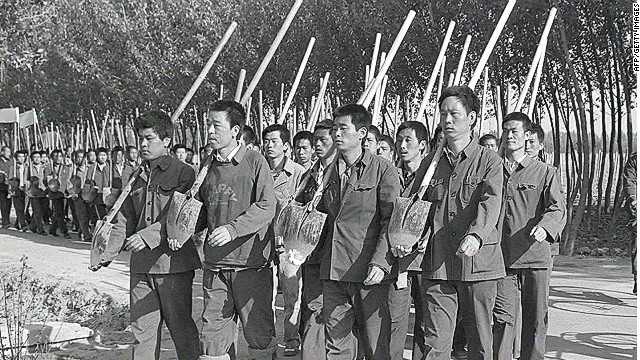
I have no idea what a modern Chinese labor camp is like, but I’m familiar with the tradition of locking up political prisoners and trying to “re-educate” them. I’ve known many people who were victimized by this system during the Cultural Revolution of the 1970s. Some were driven to suicide or to the brink of it.

During this period, all schools were shut and an entire generation of young people was sent to the countryside to labor on farms. Some were considered “red,” or part of the revolution. Others were labeled “black,” or counter-revolutionary. For them it was harsher. They were watched closely and always under suspicion.

While all worked together, the “blacks” were more like prisoners and the “reds” more like guards.

From a first-hand witness I heard a story of a young woman – a “black” – who was laboring in mud. To keep the dampness out of her cloth shoes she put in newspapers. When everyone returned to their rundown barracks, a “red” youth noticed the newspaper inside this woman’s shoe contained a picture of Mao Zedong.

For that show of disrespect she was beaten.

But like myself in the bar story, this was a time of youth. The times contained moments of ultimate value.  Lasting friendships (even between blacks and reds) were forged. These “sent-down” youth, in some respects were very free. They grew up and learned about themselves and others. There is joy in that.

Which is why many Chinese from that generation – those living both in China and in the United States – visit these former labor camps while on vacation. It’s a for-real trend, and they visit with fondness and to share old times with comrades. They take smiling photos of themselves standing near the squalor they thought would be a permanent part of their lives. (Modernization hasn’t changed everything.)

What they went through is far, far, far from my so-called worse night. Yet they have reacted as I did. Their moments carried something and will occupy a peaceful part of their memories.

I don’t claim to truly understand this, and the exceptions must be legion. Even so, there clearly is something to this idea that all experience is good. And so my new goal is not to wait 30 years for warm nostalgia but to live fully and happily in the present.

To accomplish that in even a small measure would be exquisite.

By Lanny Morgnanesi


Something I recently learned

9 Jan

Chilean dogs

There are millions of free-roaming dogs in the South American nation of Chile, and many have allied themselves with protesting students who tangle daily with police.

The dogs march when the students march; attack when the students attack. They take blasts from police water hoses (which they seem to like), growl angrily at police and sometime bite them. When police sirens sound, the dogs run to greet them.

For the last 18 months or so, students have been protesting the state of the school system. According to the Associated Press, the protesters claim public schools provide a poor education, private universities are too expensive and the interest on education loans is too high.

A few of the dogs have been turned into Internet celebrities. One is Blacky, who has 7,000 “likes” on Facebook.

“Dogs are super-loyal,” said one 17-year-old. “They stand with the people and I think they support the students.”

By Lanny Morgnanesi