Archive | Race RSS feed for this section

My Celebrity Podcaster Plane Companion

7 Sep

(I don’t usually publish fiction here, but I’d like to share this short story. Please let me know what you think.)

By Lanny Morgnanesi

I hope this is worth it, stewing in an airport during a five-hours delay then, after freaking out to a supervisor, getting compensated with a first-class upgrade. Well, at least I’m sitting next to someone famous.

He is one of those conservative podcasters with a thousand million followers. Goes by the name Rook Arnold. He mostly visits college campus and debates short-sighted, overzealous students who think with their hearts instead of their heads, exhibiting poor reasoning skills and coming across as mildly comic. Rook Arnold asks them things they do not know and points out – somewhat effectively – that college is a sham and a waste of time, suggest they are dumb, and that he, Rook Arnold, who never went to college, is prepared to unleash a bevy of all-convincing facts that the rolling camera can easily record and make him look, to his legions of followers, heroic.

He has the window seat. I the aisle.

A major claim in many of his online clips is that systemic racism is NOT the reason blacks, comprising 13 percent of the population, commit 26 percent of all crimes and 51 percent of all murders. The reason is culture, he explains. Black students go a little nuts when he says this. I’ve always wanted to be there and ask him: What generates culture?

I guess I could ask him now. I mean, he’s sitting right next to me.

Best to wait for an opening.

He probably would call me a liberal, but I’m not. I can’t even remember pronouns let alone use them. I don’t care about abortion, for the selfish reason I’m unlikely at my age to get anyone pregnant. And regardless of your opinion on anything, I believe you should be able to speak freely and not suffer the wrath of those you offend. Liberals are so easily offended, plus, they are way too serious. I’m not. If someone like Rook Arnold tried to debate me, I’d probably make a joke.

“Do you even know who wrote the Constitution?” he would say.

“I do know who wrote the Constitution,” I would answer. “Many credit James Madison, who only came to the constitutional convention because he had a mistress in Philadelphia. He rarely showed up. One day an angry group told him to get to work and start writing. So, he told his valet, Henry Squib, to write the Constitution and mostly copy the one used by Massachusetts, which was good enough, he said. And that’s what happened. Henry Squib, a valet, wrote the Constitution while James Madison was boinking a floozy.”

While I don’t care about much, I am bothered by racism. I’m bothered on moral grounds, and because I think racism hurts everyone.  It creates a sub-stratum of people who are not permitted a proper education, who are not permitted to fully contribute to society, who are not eligible for loans to fix up their homes, whose businesses are ignored by white customers, who, with a nearly invisible hand, are kept separate, and who unleash a police response when they try to take what they feel is theirs or exercise rights that should be God given.  This kind of society is not optimized. It is costly. It is dangerous. It is nonproductive and stressful. It is one hand tied behind your back. An engine not running on all cylinders.

Conservatives like Rook Arnold speak against racism but claim it no longer exists. They contend that black people are fully protected by civil rights laws and can achieve anything to which they aspire. In a way, that’s true, but difficult. Achieving what you aspire is a longshot even for whites.

The pilot comes on and tells us our altitude and speed. The weather at our destination is sunny and pleasant, he says. Then Rook leans towards me and speaks.

“Looks like we got a DEI hire.”

From the pilot’s voice, he sounds black. Rook’s well-known opinion is that programs with rules or guidelines for Diversity, Equality, and Inclusion end up hiring the less qualified and even the unqualified.

This is my opening, but I don’t want to get on his bad side right away, so I laugh and say, “Don’t worry. These planes fly themselves.”

Drinks are served.

Then I say, “You know, I’m a lot older than you. We called DEI affirmative action. I’m sure there were and are bosses given quotas to fill, and that some bosses dropped their standards because they were lazy, in a rush, or didn’t care. But affirmative action – DEI – was designed as a prod to overcome a common reluctance to hire those who are different – not cut people breaks.”

He looks at me a little funny and starts to speak. Boldly, I cut him off, but he cuts back in.

“Race should not be a factor in hiring,” he says.

“Exactly,” I say. “There should be no advantage to being white. Ever hear the joke about the bank manager trying to hire a teller?”

“I don’t think so,” Rook says dismissively, looking at a magazine on his lap.

“Well, the manager tries out three candidates. At the end of the day, the cash drawer of one is $10 over. Another is $15 under. The third comes out perfect. Which person did he hire?”

“Tell me.”

“The one with the big tits. That’s a joke. In real life the answer is the white one. That’s why we have DEI.”

He puts the magazine aside.

“I’m the first to acknowledge past discrimination, denial of rights, segregation, Jim Crow, redlining … all that,” Rook said while ordering a second drink. “But it’s over. It’s over. We all need to move ahead together, without everything being tainted by race. Your problem is your age. You remember all the bad stuff and refuse to believe it’s gone.”

“Feelings and attitudes about people linger, even after laws change,” I say. “Laws don’t erase hate, and those who hate find ways around the laws.”

He’s silent. No debate. I don’t think he wants to do for free what he normally gets paid to do. Meanwhile, I continue.

 “In the mid-60s, my parents were taking me and my two sisters to a day resort in Jersey called Lake Lonnie. It may not be there anymore. There was a long line of cars trying to get in, but it moved quickly. When there was just one car ahead of us, the line stopped. They wouldn’t let the people in front of us in.”

“Yes, it happened,” Rook says. “That was yesterday.”

“Yeah, yesterday. So my father gets out of the car to investigate. He comes back and say they won’t let the people in because they aren’t members. I asked my father if we were members. He seemed disgusted. He said we were not members, but we’d get in, and we did.”

Rook put on a smirk.

“Of course, the people who didn’t get in were back. This was a different era. Today, the people denied entrance to Lake – what was it? – Lakota, would have …”

“Lonnie. Lake Lonnie.”

“The people denied entrance to Lake Lonnie would have sued, and come up with a huge settlement, more than they could expect to earn in a lifetime … maybe 10 lifetimes.”

“I guess you don’t see much of that anymore,” I say. “But on July 4th, I was back in Jersey, to the shore. Very crowded. Not an inch of sand unclaimed. I went down to the ocean, got my feet wet and walk 10 or so blocks. I could be wrong, but I didn’t see one black face. It was just like Lake Lonnie six decades earlier. Nothing had changed.”

Rook’s experience at debating uninformed college students made him quick to answer such questions.

“Culture,” he said. “Culture took them someplace else. In lots of cases, blacks continue to frequent the beaches they were restricted to during segregation. They prefer those places. Culture drives them to certain spots, just like it drives a disproportionate share of our population to commit murder, or for fathers to abandon families.”

“But what drives culture?” I ask. “Let’s switch to Jews. Why do Jews eat bagel?”

No quick answer this time, just a look of bemusement.

“A bagel is basically boiled dough,” I say. “There was a time in parts of Europe when Jews, who were barred from many trades, weren’t permitted to be bakers. So instead of baking bread, they boiled it. Often, it’s a negative, outside force driving culture.”

I don’t think Rook Arnold had heard this bagel story, and I assume he understood my implication that black crime and family abandonment are reactions — protective, defensive, vengeful, whatever – to unpleasantness put upon them by others. There are experts who study such things, with research, and data points, interviews, and intricate analysis, but even simple people know, even if they don’t admit it, that minorities face a rash of cruel and regular hardships. Comedian Chris Rock, who is black, sums it up perfectly when he tell his audience, “There’s not one white person here who would switch places with me – and I’m rich!”

Rook Arnold reacts to the bagel story with this: “My main argument, and I hope I can get this through to you, is that society today is, for the most part, just and fair. It does not hold back people who want to get ahead. Today, you bake what you want, bread, bagels, lasagna. It’s your free choice.”

“And yet Jews still eat bagels.”

With a hint of anger, Rook says, “We all eat bagels.”

Now I pause. I’ve been so busy talking I’ve not enjoyed or appreciated the comfort of first class. I guess the food will be along soon. I haven’t even looked around much. Nor have I seen my friend, a federal sky marshal on this flight. We’re both getting off in Denver for a hunting trip. He’s in coach.

“Sorry,” I say. “No more bagels.”

Rook shakes his head.

I say, “The students you debate, they often tell you poverty and the unjust incarceration of blacks cause the high black crime rate.”

“That’s right. And they are wrong,” he says.

“An ex-con I know – a white guy who committed armed robbery and is now getting his Ph.D in psychology — once told me half the guys in prison wouldn’t be there if they had been shown a shred of dignity on the outside. A person can live happily while poor, but not without dignity … not if he or she is routinely treated as a subhuman, as someone deserving of less than the average white man, as someone who isn’t wanted in that restaurant or golf club or hotel, or position of authority. In that situation, you either go crazy and kill yourself, maybe with drink or drugs, or you lash out … or you do both. Even as children, you go to broken down schools, with few books, dirty floors, clocks that don’t work, and the worst teachers. That’s a message. It carries meaning about what people think of you.”

“Well, some people don’t deserve dignity,” Rook Arnold said. “They father children, then leave. An astounding 64 percent of black children grow up in single-family homes. There’s no parenting, no guidance, no instruction for being a good, upstanding human being. These children grow up to be monsters.”

“Yes, I agree. If you treat someone like a monster, they become monsters.”

Rook’s body language was signaling that our conversation was over, and I don’t blame him.

“Can I tell you one more story?” I ask. “Then I’ll go to the restroom, come back, eat my meal, read a book and shut up.”

“One more. And that’s it. I actually have some work to do.”

“OK. There’s this NFL assistant coach. He was the first black football player at a small, rural, mostly agricultural college. Lots of students were from small towns. Aside from football, there were two things about him. He was good at math, and he washed his hands a lot. To earn pocket money, he tutored other students in math. One told him he had never met a black person before but was taught they were dumb and dirty. ‘But you’re not dumb and you’re not dirty,’ the student said. ‘So, I’ve got to think, what else have I been taught that’s a lie?’ That’s my story. Be mindful that it takes generations, if ever, for lies to dissipate. Now, I’m off to the restroom.”

“Thank you, Jesus,” Rook said.

Instead, I went back to coach and saw my friend, the sky marshal. We chatted briefly. I was back in my seat for dinner when my friend came into first class. He politely addressed Rook.

“Excuse me, sir,” he says. “I’m a federal marshal. May I see your boarding pass?”

“Why? What is this about?”

“And some identification, please,” the marshal says. “What is the reason for your trip and where is your final destination?”

Rook, under questioning, attracted the stares of his fellow passengers.

“I don’t have to answer these questions,” he says. “Do you know who I am.”

“I’m very sorry, but we’ve received some potentially threatening information about a passenger who fits your description. If you cooperate, this will be over in a few minutes. Please produce some identification, sir.”

“Are you accusing me of something?” Rook asks.

“No sir. We just want to check out a tip.”

“What kind of tip?”

“Just some identification, please.”

“What the hell is going on here?”

“Sir, if you don’t cooperate, I’m going to cuff you and take you to the back of the plane.”

This is when I step in.

“Look, I can vouch for this guy,” I say with confidence. “He’s all right. He’s famous. No threat to anyone. Could you please leave us alone so we can finish our meal?”

The marshal pauses and looks directly at me and then at Rook.

“Very well,” he says. “I’m sorry to have bothered you.”

And he walks away.

I shovel in some mash potatoes then turn to Rook.

“Dignity. A person just got to have it.”

Speaking, and only a few understanding … well, a few meaning 26 million

28 Sep

By Lanny Morgnanesi

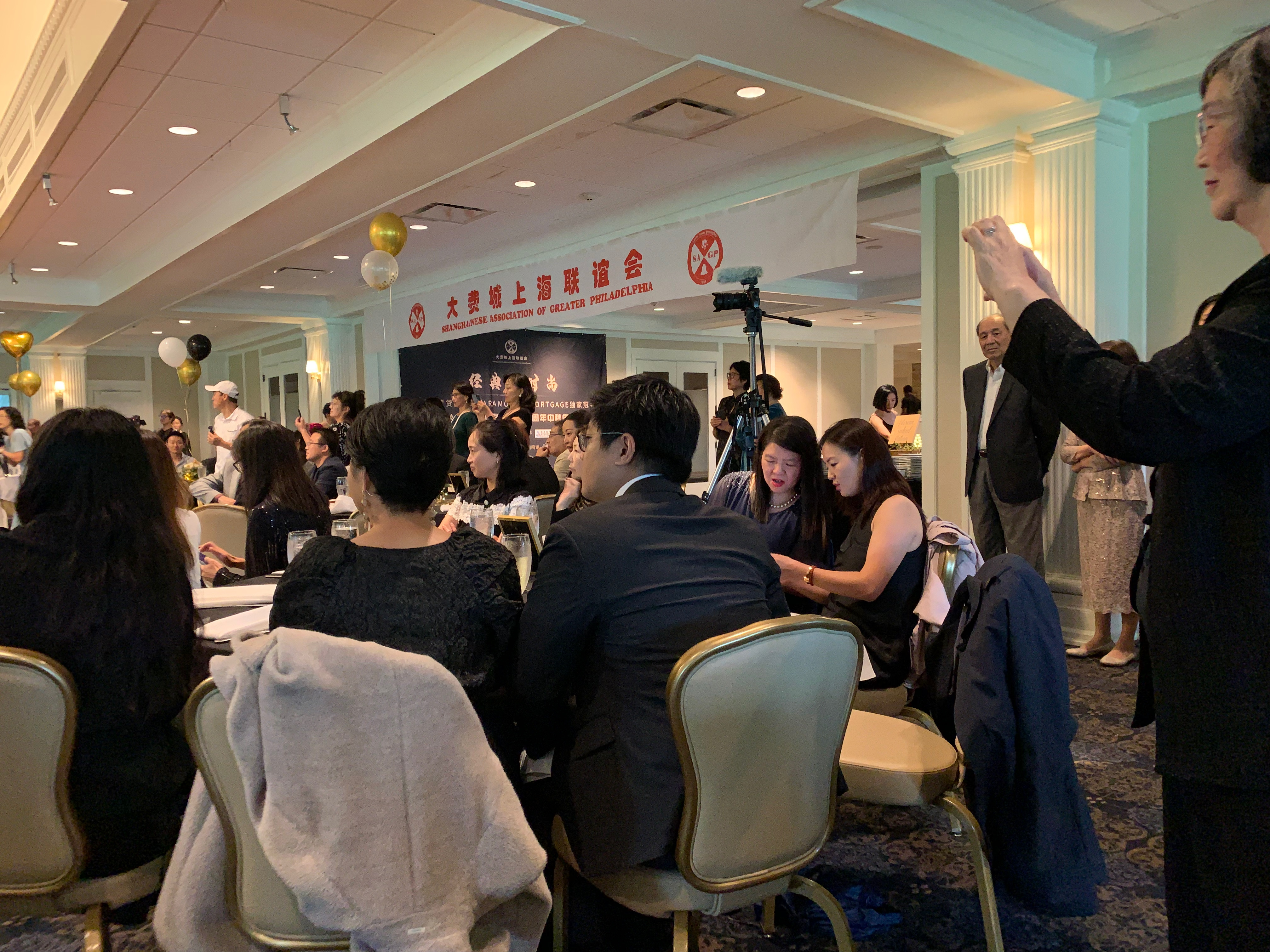
            On a rainy September afternoon at the Bluestone Country Club, in a ballroom surrounded by an empty golf course, the Shanghainese Association of Greater Philadelphia held its annual gala, and I was the only white person there.

            The agenda included music, singing, dancing, a fashion show, door prizes, and a buffet lunch. But overall, it was more like one big commercial. Since there was no English, my escort wife, born and raised in Shanghai, explained most of it to me, even though I figured out much of it myself.

            Once through the door, the first order of business was photography. Everyone, everywhere, was taking photos. On the path to the ballroom was a tripod mounted with a ringed light and a device that took and showed you five photos of yourself, then sent them to your phone. Long line for that.

            Next was a large, wall-mounted banner with the group’s name on it, in English and Chinese, and a hired photographer taking pictures for the group’s website. There was no formal line. Instead, you pushed your way forward in a competitive tussle.

            After that came the ballroom, with about 300 well-dressed people (told to wear black and white) mingling about and shooting with their phones.

            The proceeding began when a fit-looking man in a well-tailor suit addressed the crowd. Poised and confident, he had organized the event and helped secure a panoply of sponsors. At first, he welcomed the people. In short time, however, he pitched his real estate business and advised the group to connect with him on the Chinese app WeChat to learn about the newest real estate deals. He was an effective promoter of himself, and no doubt owned a significant piece of the area’s Chinese real estate market.

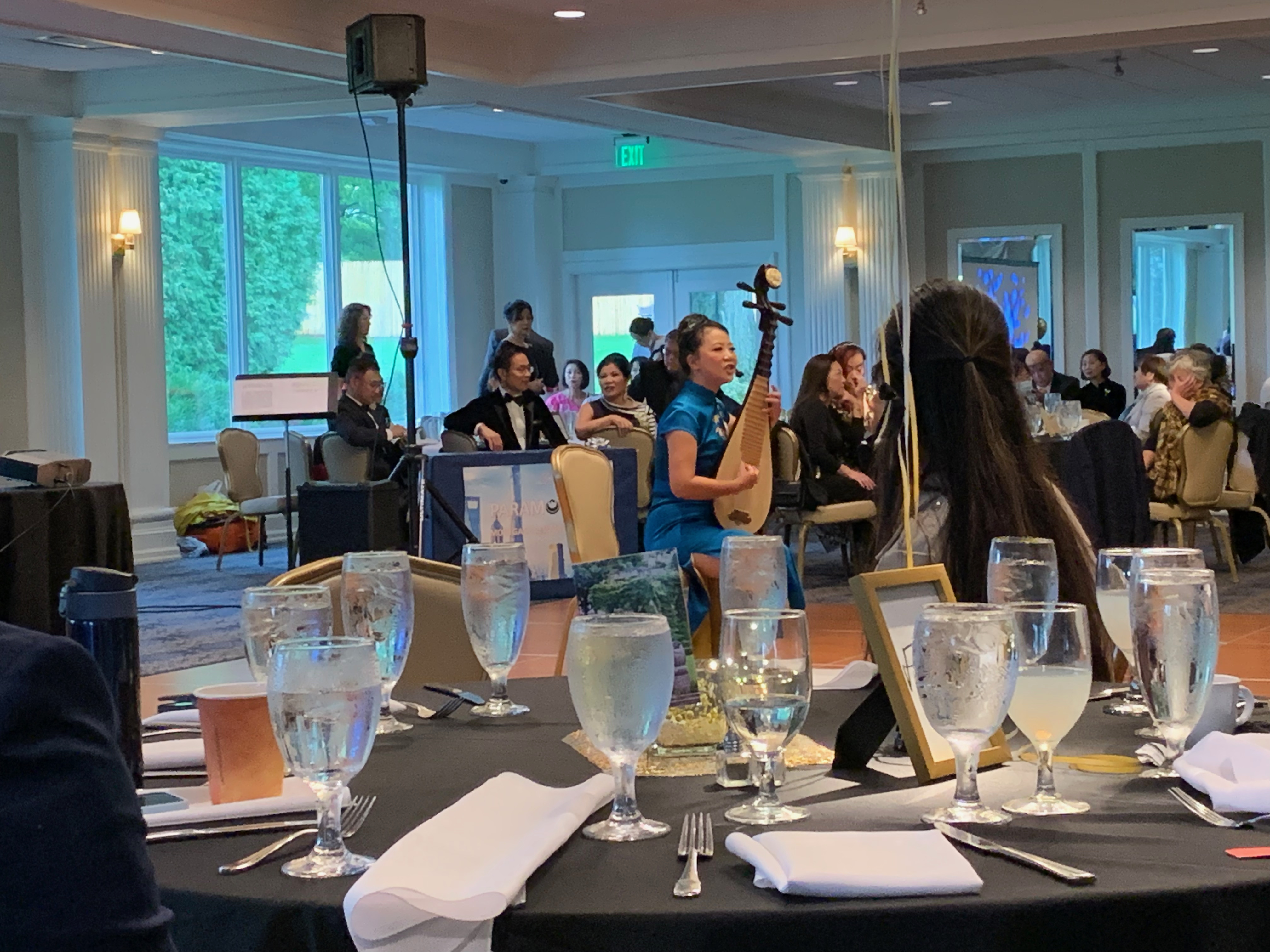
            He was followed by a musical performance, a woman in a traditional qi pao-style dress who sang and play an instrument called a pi pa, a sort of Chinese lute or guitar, pear-shaped with six strings. Aside from my wife, this was the only person at the party I knew, and I did not know her well. If fact, I hadn’t seen her for 20 years, and did not remember her name, if I ever knew it. My wife spoke to her first and addressed her as “lao ban,” a title of respect for a store owner. My wife was quickly advised by the lao ban that she no longer was a lao ban.

            There was a time, before streaming and serious Internet use, when my wife and I made regular visits to a bookstore and Chinese emporium owned by the former lao ban. It was on Race Street in Chinatown, a huge, two-story building filled with Chinese merchandise you could not get elsewhere. We went there often to rent Chinese language videos and buy a few books. Chinatown has developed a lot since then, with a more vibrant economy and new, more innovative entrepreneurs who displaced old-school, never-change Cantonese. Longtime establishments have been replaced with contemporary noodle houses, soup dumpling places, and dim sum joints. The lao ban, who had rented her huge building, probably was priced out of the market after Chinatown became hipper and the video and book market died. Where her business once stood, there is a two-tiered Asian food court.

            The lao ban, perhaps in her 60s, is now a musician and singer of Chinese opera. On this day the Bluestone Country Club had the perfect audience for her, but, unfortunately, an imperfect sound system. There was distressing feedback. The volume was too loud, and high notes came off like screeches. I felt bad for her as she played on. The feedback was fixed for the next act, but the system continued to deliver poor quality sound, which, I guess, the audience got used to. They cheered loudly for a young woman in a shiny, tight, blue-sequined jump suit who danced and sang a contemporary song called, “Give Me a Man at Midnight.” She was good, but I wanted to hold my ears. Others seemed more than content.

            Next, a contingent of trained amateurs took the floor and performed a waltz-like dance to the tune of Moon River. It was more like walking than dancing, but the women wore gorgeous gold dresses, and it was fun watching them. When it concluded, audience members were told where they, too, could get dance lessons.

            There was a fashion show, with women of various ages posing and strutting like runway models. This was followed by information on modeling classes. There was no entertainment related to banking, cosmetic surgery, or travel, but people pitched those services anyway.

            As the afternoon unfolded, I paid attention to language. I found it interesting that speakers addressing the crowd spoke Mandarin Chinese, the national language of China. But off stage, while chatting amongst themselves, they spoke Shanghai dialect. No one outside of Shanghai understands Shanghai dialect. It is spoken with pride by members of an exclusive group that considers its hometown the singular place in all of China for high style and hipness. To them, it is the epitome of elan, a better-than-New York equivalent of 26 million people. It has such appeal you must be born there to live there or get special permission to move there. The Shanghainese are a tribe, and they think highly of themselves. They have names for people who are not Shanghainese. And they have a name for their women, who are stereotyped as self-possessed, demanding, spoiled, and self-centered. It is both a polite and derisive term, a little like “Jewish American Princess.” The hard-to-handle women from China’s largest city are called “Shanghai little sisters.”

But back to the dialect, which I’m thinking helps to define Shanghai cool. While the dialect is substantially different from the national language, some alterations are slight. For example, the common Chinese greeting “ni hao” (literally: you good), was changed in Shanghai, for some reason, to “nong hao.” The common good-bye of “zai jian” (literally: see again) was changed to something that sounds like “zay way.” To decline an offer, the Chinese normally say “bu yao” (literally: don’t want). But the Shanghai residents slam those two syllables together, speed them up, and put a different sound at the front, saying “v-yow.”

Here is an example of how protective the Shanghai people are of their exclusive dialect. I was in the dessert line and the guy behind me struck up a conversation in English. He had come to the United States as a student in 1985 and trained as an engineer at Columbia.

“I guessed you’re confused by all this Shanghai dialect,” he said in a joking way.

            “Of course,” I said, “but I know a few words.”

            He looked at me as if that could not be true.

            Then I said the few words of Shanghai dialect I knew. Oddly, he repeated those words back to me in Mandarin. No, I said, I know the Shanghainese. And I repeated the words again, with him once again saying them in Mandarin, as if I were not allowed to speak that way or couldn’t possibly know what I was saying. Finally, I convinced him that I had gently penetrated the veneer of his beloved dialect. He smiled uncomfortably and shook his head. We both got dessert and parted.

So at the party, as the spoken word shifted effortlessly between a defining dialect and the linguistic standard, I thought about American English and concluded that there is nothing comparable to this in the U.S., no comfortable, communicative patois used in a secret way outside the button-down structure of society.  

Or is there? A question for another day.

            After the entertainment came lunch. When going to an affair such as this, one expects Chinese food. There was none. No chopsticks, either. The buffet was bread, salad, green beans, potatoes, pasta, pot roast, and salmon. The partygoers filled their plates high, without reluctance or aversion. I guess the country club chef didn’t offer a Chinese option, and that clearly was not a problem for this crowd.

            After about four hours, the party winded down. It was time to leave, and the rain was still heavy. We did not, however, get wet. Everyone received a well-built umbrella, courtesy of the Paramount Mortgage company, whose name appeared on the umbrellas in both Chinese and English.

            On the way out, the partygoers continued to define themselves as unique. You could hear lots of “zay ways,” but not a single “zai jian.” A group of young Shanghai little sisters, outfitted in fine dresses, pushed past me, seemingly arguing among themselves, or perhaps debating a point or two about the party, or maybe discussing where to go next. I didn’t understand a word of it, and I’m sure they took great comfort in that.

A Sephardic Jew: Why discriminate against this person?

19 Oct

emmanuelle chriqui

The man whom I will call the Martin Luther King of Israel has died at 93.

He was Rabbi Ovadia Yosef, a leader in politics and religion.

It is doubtful anyone else has compared him to the American civil rights leader, but that’s how I see it. Just as there is black and white in America, in Israel there is Sephardic and Ashkenazi. The Sephardim are the underdogs. Rabbi Yosef was their advocate and protector.

Rabbi Ovadia Yosef

Rabbi Ovadia Yosef

Most Americans think of Israeli Jews as homogenous. This is because most American Jews are of European descent, which makes them Ashkenazi. Overlooked and mostly out of sight in the U.S. are the Sephardim, who are Jews from the Middle East, North Africa and Spain. This group has more in common with Arab culture than with European culture, hence the dichotomy and the basis for discrimination.

It is dangerous for a non-Jew, such as myself, to write about the social fabric of Judaism, especially when the writer has never been to Israel and never witnessed the relationship between Sephardim and Ashkenazim.  So let it be known that I write with interest rather than authority.

It is of little consequence here, but a casual friend is a Sephardic American. He has never mentioned the word in my presence, nor has he ever discussed any difference between himself and any other Jew. His ancestors are from Morocco. His mother lives in France, is very refined, quite fashionable and appears wealthy. She reminds me of Jackie Kennedy. These things are all counter to the negative stereotype of the Sephardim, which I learned of only through television.

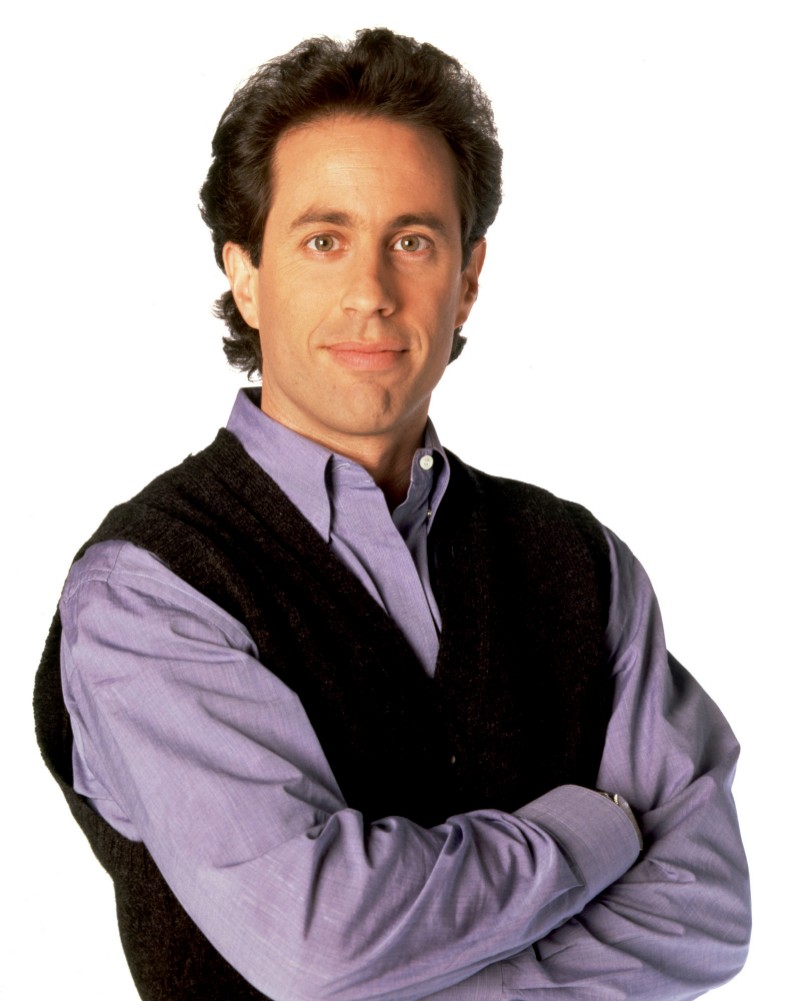
Jerry Seinfeld: Sephardic Jew

Jerry Seinfeld: Sephardic Jew

I wish I could remember the name of the film, or on which channel it appeared. I would link to it to see if you found it as shocking as I. It was shot in Israel and documented the perception of the Sephardim by the Ashkenazim. Some of the dialogue could have been overlaid on a film about white and black Americans.

For example, many Ashkenazi, in a nod to tolerance, said the Sephardim are hip and cool and fun; that they set trends and styles. Some said they have friends who are Sephardic. Still, in subsequent conversations, they said Sephardic Jews are mostly poor, crude, criminal and not so intelligent.

Clearly, social barriers have been set. This was confirmed for me when I read Rabbi Yosef obituary.

Other comments didn’t parallel the black-white struggle in America, like the disgust shown for the Sephardim who watch Arab movies.

Basically, the documentary illustrates how the one group considers the other inferior and beneath them. Overall, the impression was that the Sephardim were just too much like Arabs.

The irony here is that so were Moses, Abraham, Isaac, Jacob and David.

Indeed, recent genetic testing has shown that the Ashkenazim may be far off the Hebrew bloodline. It was originally thought that the Jewish communities in Europe originated with men and women from the Near East.  Now it has been shown genetically that the ancestral roots of the Ashkenazim are in the union of non-Jewish European women and traveling Jewish traders.

Although the comparison between blacks and whites in America is somewhat accurate – an Israeli court, for example, had to force the integration of Sephardic and Ashkenazi school children — this intra-Jewish problem has additional layers of complexity. Unlike in America, differences in religious practices also keep the Jewish groups apart.

I referred to Rabbi Ovadia Yosef as the Martin Luther King of Israel, but, unlike King, he was for school segregation in the court case I mentioned. Religion, it seems, was taught at the school in question, and Rabbi Yosef wanted only pure and accepted Sephardic doctrine taught to the children of his followers, not a diluted, blended brand taught in a mixed school.

Religion aside, the life and work of Rabbi Ovadia – like those of Dr. King — indicate the pervasive need of Homo sapiens to form tight groups of very like people, to preach group superiority and to categorize others – even those who could easily be accepted into the group – as inferior and unworthy of advancement. It shows the incredible need to hold back rather than lift up.

What is the basis for this need?

Limited resources? Limited positions of power? Intrinsic insecurity? General nastiness? The necessity to have enemies as a motivating force for survival and civilization building?

Because of their differences, and because of our shortcomings as a species, it seems almost understandable that there is tension between blacks and whites, Jews and Arabs (even thought they are both Semitic people), liberals and conservatives. But why does each group draw circles within their circles to set even more people apart?

How can we solve global conflict when the people on the north side of Chicago distrust those on the south side?

The Jews possess a unique place in history as one of the first cultures – perhaps the first – to take stock of itself and say, “We are barbarians. This is unacceptable.”

For now and always, the People of The Book have documented their epic struggle for the perfect, enlightened society. Through darkness and light, catastrophe and near destruction, triumph, dire warnings, dire consequences and rebirth, they have never ceased to strive with God and themselves.

One would think that by now such a people could get along with themselves; that such a people might actually be the ones to bring peace to the entire Earth.

Who better?

While we wait for a new prophet, I would hope that all will soon dispense with finding disgust over another person simply because of his taste in movies.

Rest in peace, Rabbi Ovadia Yosef.

By Lanny Morgnanesi


Danger – I’m talking about race (but also art)

26 Mar

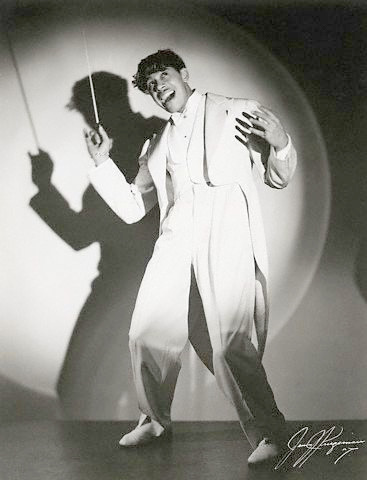
cab calloway-2

I sat down to write about creativity but will begin with race. I’ll get to creativity later.

Normally, race is a subject best avoided. Even good-intentioned statements can offend. I don’t mind offending, as long as I offend everyone. When I discuss race, I generally keep these three precepts in mind:

  • All people are basically the same.
  • Even so, likes prefer likes.
  • Whether acknowledged or not, every group thinks it is better than the other.

I’m told that, historically, each tribe of Native Americans referred to themselves as “the human beings” or “the people,” while the names they gave other tribes were epithets describing creatures who were less than human.

That’s us! Is it not?

Dividing us by race and setting us against each other seems like a cruel thing for the Creator to do, but I guess there was a reason for it. Giving us the capacity to enslave others, however, is too harsh to even remotely understand. That capacity is what rightfully gives racial issues their hypersensitivity.

I can wish everyone wasn’t so sensitive, but there is too much working against it.

While smart people don’t discuss race, I have to admire those who do. One is Bob Huber, a writer for Philadelphia Magazine. In the March edition of the magazine, he wrote a piece called, “Being White in Philly.”  In it he tells stories of race from a white perspective.

“Everyone might have a race story, but few whites risk the third-rail danger of speaking publicly about race, given the long, troubled history of race relations in this country and even more so in this city,” he wrote. “Race is only talked about in a sanitized form, when it’s talked about at all, with actual thoughts and feelings buried, which only ups the ante.”

So let’s talk!Philly Mag

After Huber’s article, many did. This was his intention. There were a number of public forums around town and the online version of the article – as of March 25 – had 6,292 comments.

The article, among other things, mentions how whites, upon entering a local convenience store, hold open the door longer for blacks than for whites in order not to offend them. Later, Huber quotes a Russian woman who thinks blacks do nothing but sit on their front porches smoking marijuana. It’s that kind of material.

In response, the only full-time African-American employee at Philadelphia Magazine wrote a counter piece for the Philadelphia Inquirer. She described her coworker’s message as: “black people are essentially what’s wrong with the city and that white people who live here are afraid of them.”

My test of the article’s validity is not its truthfulness but its honesty. Fair or unfair, right or wrong, the piece accurately describes how some white people feel. It would be dishonest to argue they don’t feel that way. Whether or not they accurately portray blacks is a totally different issue

I think it is good to know how people feel. I want to know how people feel about me, even when they don’t like me. My natural assumption is many will not like me, or at least think I am less that I am, certainly less than they are.

In the extreme, this may anger me, but I can live with it.

I understand that others may not, cannot and will not.

But that’s not why I’m writing. I’m writing about creativity. Mainly, I want to know if one race is more apt to be creative than another – specifically whether minorities are more willing and more capable than the majority in advancing art.

In the past I’ve had thoughts on this. They resurfaced recently when I heard a radio interview with a black record producer. By his own admission, this producer is not your normal black record producer. In order to set up a story about his style of producing, he told the show’s host that black artists create something then quickly leave it behind to create the next thing. White people, he said, go back and revisit what already has been created.

Then, in a twist, he said, “I’m that white guy.”

Twist aside, I saw truth in his stereotype, especially in the progress of music. By the time white bands, for example, took up the blues, black artists had left it way behind.

Shortly after this interview, PBS aired an American Masters episode called, “The Blues Brothers Band Remembers Cab Calloway.” The Blues Brothers movie, of course, clearly depicts the tendency for whites to revisit the old. More interesting was a specific story in the documentary about the legendary Cab Calloway.

John Landis, the movie’s director (white), told how he wanted Calloway (black) to sing his 1931 classic  “Minnie the Moocher” in the movie and to do it in the original style. When Calloway saw the music charts, he expressed disgust and said something like, “What the hell is this?”

He could not comprehend why anyone would want to put a near ancient rendition into a contemporary movie. Landis eventually talked him into it, but it was completely foreign to Calloway.

I was amazed at how closely this little story paralleled what the black record producer had said. The record producer might not fit the stereotype, but Cab sure did. I wondered just how deep this pattern went, or even if it were true (Little Anthony and the Imperials, after all, still perform their hits.)

One of the shockingly bad things about art in any form is that it so often is a copy of something done by an innovator. I believe it was Paul Gauguin (not a minority but definitely off the path) who suggested that there are only two kinds of artists: plagiarists and revolutionaries. It could be said that the plagiarists have a stake in the status quo while the revolutionaries want to destroy it.

Could this be the case with the white-black creative dichotomy described by the record producer and illustrated by Cab Calloway?

While few want to discuss race, I’d like to hear from people on this. Let’s forget about Philly Mag and the suppressed hostilities of whites for a while and talk about whether muses favor those who have been pushed outside the mainstream. What drives a person to originality and risk when so many others are content to stay stuck on what’s popular?

Is white innovation a rarity? Surely there are white revolutionaries. In a pinch I could name 10. (Pollock yes; Presley no.) Do white innovators have to try harder, or must they – unlike blacks – possess a genetic mutation or be social misfits?

I can’t speak first hand to this. I’m hoping others can. Please write.

By Lanny Morgnanesi

If the Republican Party were a person, Dorothy Parker would slap his face, both of them.

10 Feb


latino-obama-sign

Consider the case of the young man who hates his uncle and has always treated him dastardly. One day the uncle reveals that by living poor he was able to accumulated a small fortune. The young nephew then begins to shower the old man with kindness and attention.

For the uncle, it is easy to see that the nephew is a disingenuous louse. The real insult, however, is that the young man thought the uncle could be fooled.

The young man reminds me of the Republican Party.

Here is a party that, for the most part, staked out a very tough position against amnesty or general kindness for 11 million people living and mostly working in the United States without the legal right to do. It was a legitimate position, although it is one I considered unwise.

When President Obama was re-elected after winning 80 percent of the minority and ethnic vote, the Republican Party realized that the poor uncle they didn’t care much for was actually rich.

Now they want to be friends. Now they want legislation to assist the 11 million. Now they want those votes.

And, I guess, they don’t think the Hispanic population is intelligent enough or aware enough to see the hypocrisy.

That’s the real zinger.

Gov. Bob McDonnell, a Republican from Virginia, thinks the GOP can get those votes if it just changes its tone. That’s what reporter Thomas Fitzgerald wrote today in the Inquirer. Tone, rather than the choice of whom you truly represent in Congress, is what’s important.

Reality is always second to image.

When someone says, “People want to know we’re like them”  (which Republican Congressman Scott Perry said this weekend) it usually means “We’re not like them.” When someone says, “We can win the presidency. … We don’t need to fix the laws to make that happen (which Pennsylvania party chairman Rob Gleason said), it usually means they ARE trying to win the presidency by rigging the system.

A good rule in politics is to exercise caution and maintain skepticism.

I’m very curious to see if the GOP efforts to gain Hispanic support will work. Woody Allen once said that the lion will one day lie down with the lamb, but the lamb won’t get any sleep. That’s the kind of alliance this speaks of.

By Lanny Morgnanesi

A musical legacy: Black, proud, loud and wet

18 Mar

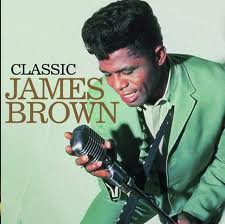
Hard work is to be admired, as is James Brown, the Hardest Working Man in Show Business.

There’s a new biography out on Brown, who was also known as the Godfather of Soul. The book is by RJ Smith and called, “The One: The Life and Music of James Brown.”

Dan DeLuca, in a review that appears today in the Philadelphia Inquirer, repeats an anecdote from the book illustrating the intensity of Brown’s performances. The story had the entertainer playing in Tbilisi, Georgia, in the former Soviet Union, where a swimming pool separated the audience from the stage. As the show peaked with the number, “Sex Machine,” Brown – at age 73 – leaped into the water. He sank, and band members jumped in after him.

Wet, the entire ensemble finished the show.

According to DeLuca, Brown would sweat so much on stage that band members couldn’t avoid sliding on the drippings. After shows, Brown was rehydrated with an intravenous hook up.

Brown was a perfectionist and very tough on his musicians. He’d fine them for playing the wrong notes, DeLuca reports. He wanted to be the best. After Elvis died, Brown was given a private viewing of The King and was heard to have said, “Elvis, you rat. You’re not number one anymore.”

The book apparently paints James Brown as self-centered (his hair was done three times a day) and non-empathetic. But he rose from poverty, took nothing and – from what I understand – gave a lot of money away to help children, lectured to school kids on the importance of education (he had little) and was a social activist credited with preventing riots after the assassination of Martin Luther King. (He agreed to a rare television concert the quelled anger and took people off the streets.)

He was patriotic, but bitter. Once asked to give advice to a rising Tiger Woods, Brown said, “Get him to understand how vicious this world is. Everything in this world disappears and vacates.”

Add to his many credits: Philosopher.

Class Warfare Parable

4 Feb

How many do you have?

Here is what I call a Class Warfare Parable, a simple little story that tries – and I think succeeds – in saying a lot about class. It appeared in a piece by syndicated columnist Leonard Pitts Jr., who heard it from one of his students.

This is it:

A rich white man sits with a poor white man and a poor black man at a table laden with cookies. The rich white man snatches all the cookies but one, then turns to the poor white man and says, “Watch out for that darky. I think he wants to take your cookie.”

Three stories of race

16 Jan

Martin Luther King

For Martin Luther King Day I’d like to write about race, in three vignettes.

The first is about a family outing to a New Jersey lake resort. I was 8 or so, and we were going to one of my favorite spots. As our car stood in line at the gate, I realized something was wrong. The car in front was holding things up. There was an argument between the gatekeeper and the vehicle’s occupants, who were black.

My father went out to see what was happening.

When he returned, he seemed a little different, a little upset; certainly more reserve.

“They weren’t allowed in because they aren’t members,” my father said.

“Are we members?” I asked.

“No,” he said, “but I think they are going to let us in.”

The incident seemed unimportant once we were inside, although my father talked to other relatives about it. As I grew up and understood more, I never forgot the combination of guilt, sadness and, was it shame? that I had seen on my father’s face that day.

My second little story is about the only tip I ever received while working summers at a pizza restaurant. I was 20, and so good at making pizzas they let me manage the place. As a manager, I would try to remember what people normally ordered. For example, there was a theatrical-looking black man with a pencil-thin mustache and a fedora who always called in for a garlic and anchovy pizza.

One busy Saturday night the other pizza guy didn’t show up. This was a take-out place and the whole front of the store was packed with people either picking up food or trying to place orders. It was noisy and chaotic. I was trying as fast as I could to get people out so there would be room for those coming in. As I pulled a garlic and anchovy pizza from the oven, I saw its owner walk in. I boxed the pie, gave it to the cashier and pointed to the man with the mustache, who was way in the back, behind rows of impatient white people.  He walked forward, paid and left.

At closing, the cashier pulled two bills from her pocket and handed them to me. “From the black guy with the mustache,” she said.

Nice gesture, but I didn’t understand its depth until I lived for a time in a black neighborhood in Washington, D.C. There was a deli next to my building that was always crowded with people – black people. It was nearly impossible for me to get a sandwich there. If someone behind the counter had handed me one as soon as I walked in, I would have been surprised and delighted. I would have thought better of mankind and the world and most definitely would have offered a tip.

And so, because of that, I better understood the man in the fedora.

The third story is one I don’t quite understand. I don’t understand the socio-economic forces at work. Perhaps someone can explain.

My aunt, now deceased, ran a dry cleaning business in Philadelphia and lived with her family above the shop. When she started, the neighborhood was white. That changed, but she stayed put. Years later I asked her son, my cousin, what it was like being the only white family for blocks and blocks. He said when the neighborhood first changed, everything was fine. The new people were good people, family people. Then they moved out, and the people who moved in destroyed everything.

 Those are my three stories about race. Taken together, what might they say about life in America and the quality of our humanness? Please share your thoughts.