Archive | Politics RSS feed for this section

My Celebrity Podcaster Plane Companion

7 Sep

(I don’t usually publish fiction here, but I’d like to share this short story. Please let me know what you think.)

By Lanny Morgnanesi

I hope this is worth it, stewing in an airport during a five-hours delay then, after freaking out to a supervisor, getting compensated with a first-class upgrade. Well, at least I’m sitting next to someone famous.

He is one of those conservative podcasters with a thousand million followers. Goes by the name Rook Arnold. He mostly visits college campus and debates short-sighted, overzealous students who think with their hearts instead of their heads, exhibiting poor reasoning skills and coming across as mildly comic. Rook Arnold asks them things they do not know and points out – somewhat effectively – that college is a sham and a waste of time, suggest they are dumb, and that he, Rook Arnold, who never went to college, is prepared to unleash a bevy of all-convincing facts that the rolling camera can easily record and make him look, to his legions of followers, heroic.

He has the window seat. I the aisle.

A major claim in many of his online clips is that systemic racism is NOT the reason blacks, comprising 13 percent of the population, commit 26 percent of all crimes and 51 percent of all murders. The reason is culture, he explains. Black students go a little nuts when he says this. I’ve always wanted to be there and ask him: What generates culture?

I guess I could ask him now. I mean, he’s sitting right next to me.

Best to wait for an opening.

He probably would call me a liberal, but I’m not. I can’t even remember pronouns let alone use them. I don’t care about abortion, for the selfish reason I’m unlikely at my age to get anyone pregnant. And regardless of your opinion on anything, I believe you should be able to speak freely and not suffer the wrath of those you offend. Liberals are so easily offended, plus, they are way too serious. I’m not. If someone like Rook Arnold tried to debate me, I’d probably make a joke.

“Do you even know who wrote the Constitution?” he would say.

“I do know who wrote the Constitution,” I would answer. “Many credit James Madison, who only came to the constitutional convention because he had a mistress in Philadelphia. He rarely showed up. One day an angry group told him to get to work and start writing. So, he told his valet, Henry Squib, to write the Constitution and mostly copy the one used by Massachusetts, which was good enough, he said. And that’s what happened. Henry Squib, a valet, wrote the Constitution while James Madison was boinking a floozy.”

While I don’t care about much, I am bothered by racism. I’m bothered on moral grounds, and because I think racism hurts everyone.  It creates a sub-stratum of people who are not permitted a proper education, who are not permitted to fully contribute to society, who are not eligible for loans to fix up their homes, whose businesses are ignored by white customers, who, with a nearly invisible hand, are kept separate, and who unleash a police response when they try to take what they feel is theirs or exercise rights that should be God given.  This kind of society is not optimized. It is costly. It is dangerous. It is nonproductive and stressful. It is one hand tied behind your back. An engine not running on all cylinders.

Conservatives like Rook Arnold speak against racism but claim it no longer exists. They contend that black people are fully protected by civil rights laws and can achieve anything to which they aspire. In a way, that’s true, but difficult. Achieving what you aspire is a longshot even for whites.

The pilot comes on and tells us our altitude and speed. The weather at our destination is sunny and pleasant, he says. Then Rook leans towards me and speaks.

“Looks like we got a DEI hire.”

From the pilot’s voice, he sounds black. Rook’s well-known opinion is that programs with rules or guidelines for Diversity, Equality, and Inclusion end up hiring the less qualified and even the unqualified.

This is my opening, but I don’t want to get on his bad side right away, so I laugh and say, “Don’t worry. These planes fly themselves.”

Drinks are served.

Then I say, “You know, I’m a lot older than you. We called DEI affirmative action. I’m sure there were and are bosses given quotas to fill, and that some bosses dropped their standards because they were lazy, in a rush, or didn’t care. But affirmative action – DEI – was designed as a prod to overcome a common reluctance to hire those who are different – not cut people breaks.”

He looks at me a little funny and starts to speak. Boldly, I cut him off, but he cuts back in.

“Race should not be a factor in hiring,” he says.

“Exactly,” I say. “There should be no advantage to being white. Ever hear the joke about the bank manager trying to hire a teller?”

“I don’t think so,” Rook says dismissively, looking at a magazine on his lap.

“Well, the manager tries out three candidates. At the end of the day, the cash drawer of one is $10 over. Another is $15 under. The third comes out perfect. Which person did he hire?”

“Tell me.”

“The one with the big tits. That’s a joke. In real life the answer is the white one. That’s why we have DEI.”

He puts the magazine aside.

“I’m the first to acknowledge past discrimination, denial of rights, segregation, Jim Crow, redlining … all that,” Rook said while ordering a second drink. “But it’s over. It’s over. We all need to move ahead together, without everything being tainted by race. Your problem is your age. You remember all the bad stuff and refuse to believe it’s gone.”

“Feelings and attitudes about people linger, even after laws change,” I say. “Laws don’t erase hate, and those who hate find ways around the laws.”

He’s silent. No debate. I don’t think he wants to do for free what he normally gets paid to do. Meanwhile, I continue.

 “In the mid-60s, my parents were taking me and my two sisters to a day resort in Jersey called Lake Lonnie. It may not be there anymore. There was a long line of cars trying to get in, but it moved quickly. When there was just one car ahead of us, the line stopped. They wouldn’t let the people in front of us in.”

“Yes, it happened,” Rook says. “That was yesterday.”

“Yeah, yesterday. So my father gets out of the car to investigate. He comes back and say they won’t let the people in because they aren’t members. I asked my father if we were members. He seemed disgusted. He said we were not members, but we’d get in, and we did.”

Rook put on a smirk.

“Of course, the people who didn’t get in were back. This was a different era. Today, the people denied entrance to Lake – what was it? – Lakota, would have …”

“Lonnie. Lake Lonnie.”

“The people denied entrance to Lake Lonnie would have sued, and come up with a huge settlement, more than they could expect to earn in a lifetime … maybe 10 lifetimes.”

“I guess you don’t see much of that anymore,” I say. “But on July 4th, I was back in Jersey, to the shore. Very crowded. Not an inch of sand unclaimed. I went down to the ocean, got my feet wet and walk 10 or so blocks. I could be wrong, but I didn’t see one black face. It was just like Lake Lonnie six decades earlier. Nothing had changed.”

Rook’s experience at debating uninformed college students made him quick to answer such questions.

“Culture,” he said. “Culture took them someplace else. In lots of cases, blacks continue to frequent the beaches they were restricted to during segregation. They prefer those places. Culture drives them to certain spots, just like it drives a disproportionate share of our population to commit murder, or for fathers to abandon families.”

“But what drives culture?” I ask. “Let’s switch to Jews. Why do Jews eat bagel?”

No quick answer this time, just a look of bemusement.

“A bagel is basically boiled dough,” I say. “There was a time in parts of Europe when Jews, who were barred from many trades, weren’t permitted to be bakers. So instead of baking bread, they boiled it. Often, it’s a negative, outside force driving culture.”

I don’t think Rook Arnold had heard this bagel story, and I assume he understood my implication that black crime and family abandonment are reactions — protective, defensive, vengeful, whatever – to unpleasantness put upon them by others. There are experts who study such things, with research, and data points, interviews, and intricate analysis, but even simple people know, even if they don’t admit it, that minorities face a rash of cruel and regular hardships. Comedian Chris Rock, who is black, sums it up perfectly when he tell his audience, “There’s not one white person here who would switch places with me – and I’m rich!”

Rook Arnold reacts to the bagel story with this: “My main argument, and I hope I can get this through to you, is that society today is, for the most part, just and fair. It does not hold back people who want to get ahead. Today, you bake what you want, bread, bagels, lasagna. It’s your free choice.”

“And yet Jews still eat bagels.”

With a hint of anger, Rook says, “We all eat bagels.”

Now I pause. I’ve been so busy talking I’ve not enjoyed or appreciated the comfort of first class. I guess the food will be along soon. I haven’t even looked around much. Nor have I seen my friend, a federal sky marshal on this flight. We’re both getting off in Denver for a hunting trip. He’s in coach.

“Sorry,” I say. “No more bagels.”

Rook shakes his head.

I say, “The students you debate, they often tell you poverty and the unjust incarceration of blacks cause the high black crime rate.”

“That’s right. And they are wrong,” he says.

“An ex-con I know – a white guy who committed armed robbery and is now getting his Ph.D in psychology — once told me half the guys in prison wouldn’t be there if they had been shown a shred of dignity on the outside. A person can live happily while poor, but not without dignity … not if he or she is routinely treated as a subhuman, as someone deserving of less than the average white man, as someone who isn’t wanted in that restaurant or golf club or hotel, or position of authority. In that situation, you either go crazy and kill yourself, maybe with drink or drugs, or you lash out … or you do both. Even as children, you go to broken down schools, with few books, dirty floors, clocks that don’t work, and the worst teachers. That’s a message. It carries meaning about what people think of you.”

“Well, some people don’t deserve dignity,” Rook Arnold said. “They father children, then leave. An astounding 64 percent of black children grow up in single-family homes. There’s no parenting, no guidance, no instruction for being a good, upstanding human being. These children grow up to be monsters.”

“Yes, I agree. If you treat someone like a monster, they become monsters.”

Rook’s body language was signaling that our conversation was over, and I don’t blame him.

“Can I tell you one more story?” I ask. “Then I’ll go to the restroom, come back, eat my meal, read a book and shut up.”

“One more. And that’s it. I actually have some work to do.”

“OK. There’s this NFL assistant coach. He was the first black football player at a small, rural, mostly agricultural college. Lots of students were from small towns. Aside from football, there were two things about him. He was good at math, and he washed his hands a lot. To earn pocket money, he tutored other students in math. One told him he had never met a black person before but was taught they were dumb and dirty. ‘But you’re not dumb and you’re not dirty,’ the student said. ‘So, I’ve got to think, what else have I been taught that’s a lie?’ That’s my story. Be mindful that it takes generations, if ever, for lies to dissipate. Now, I’m off to the restroom.”

“Thank you, Jesus,” Rook said.

Instead, I went back to coach and saw my friend, the sky marshal. We chatted briefly. I was back in my seat for dinner when my friend came into first class. He politely addressed Rook.

“Excuse me, sir,” he says. “I’m a federal marshal. May I see your boarding pass?”

“Why? What is this about?”

“And some identification, please,” the marshal says. “What is the reason for your trip and where is your final destination?”

Rook, under questioning, attracted the stares of his fellow passengers.

“I don’t have to answer these questions,” he says. “Do you know who I am.”

“I’m very sorry, but we’ve received some potentially threatening information about a passenger who fits your description. If you cooperate, this will be over in a few minutes. Please produce some identification, sir.”

“Are you accusing me of something?” Rook asks.

“No sir. We just want to check out a tip.”

“What kind of tip?”

“Just some identification, please.”

“What the hell is going on here?”

“Sir, if you don’t cooperate, I’m going to cuff you and take you to the back of the plane.”

This is when I step in.

“Look, I can vouch for this guy,” I say with confidence. “He’s all right. He’s famous. No threat to anyone. Could you please leave us alone so we can finish our meal?”

The marshal pauses and looks directly at me and then at Rook.

“Very well,” he says. “I’m sorry to have bothered you.”

And he walks away.

I shovel in some mash potatoes then turn to Rook.

“Dignity. A person just got to have it.”

Modeling a Country After a Shopping Destination

23 Oct

By Lanny Morgnanesi

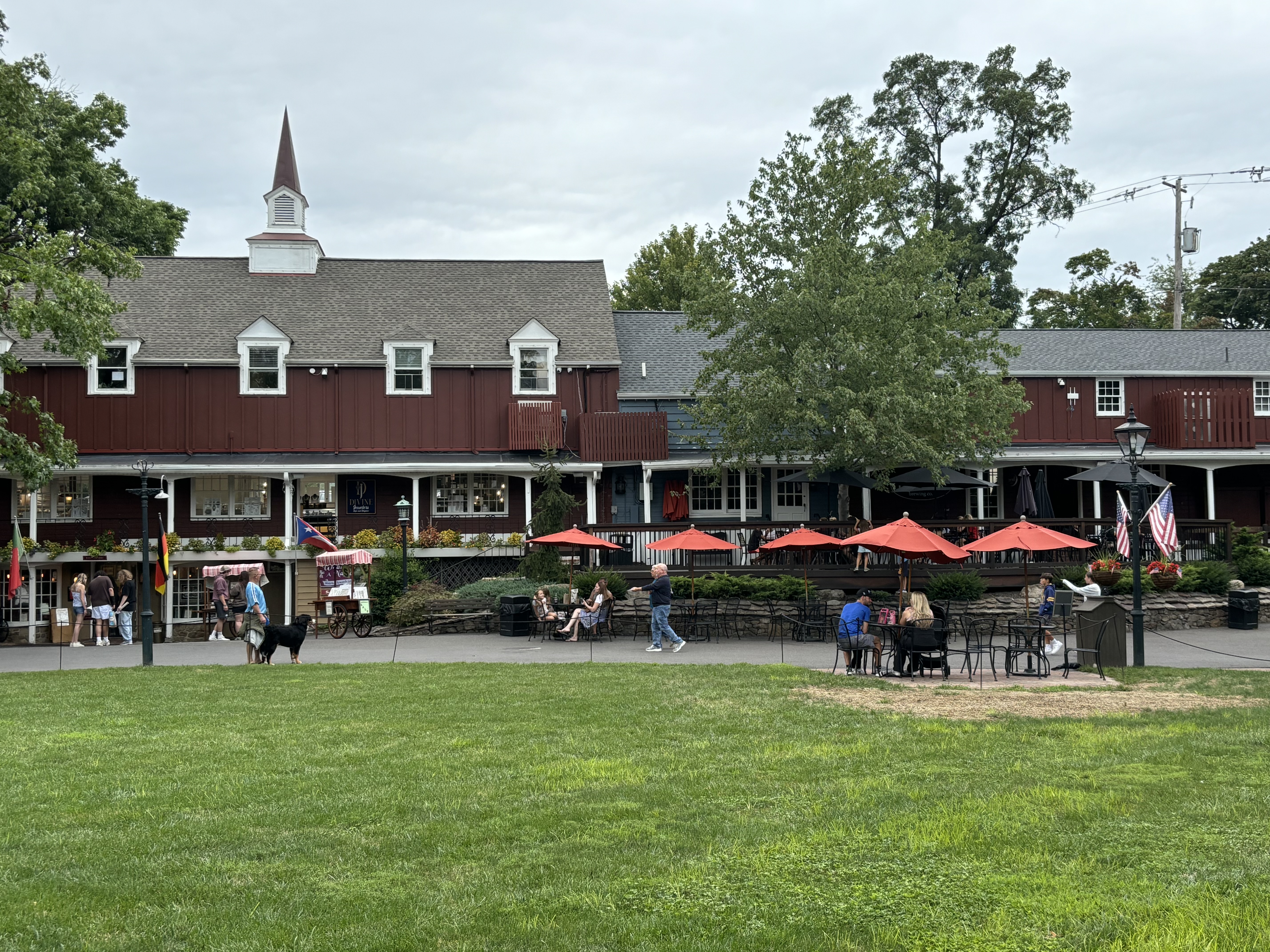
Near my home, in a place called Lahaska, there’s a tranquil spot of beauty and commerce called Peddler’s Village. It was built by a somewhat eccentric man named Earl Jamison. The village is spread over 42 acres. It has old-fashioned shops, restaurants, bars, lodging, even a carnival merry-go-round. The peddlers at Peddler’s Village peddle everything from clothes to hats to paintings to fresh pastry, popcorn, maple syrup, and beef jerky.

Part of the attraction is the artful landscaping. Jamison liked gardening, and when he was alive you could mostly find him at Peddler’s Village on his knees, tending to plants. That kind of attention and that kind of tradition has been passed on to others. The place looks great.

The summer day of my recent visit was pleasant, and everyone was having a good time. Parents, kids, babies, older couples, dogs. In this part of suburban Philadelphia and at Peddler’s Village, the crowd is mostly – what’s a good word? – Anglo. With a fair number of Asians. The people who walked the brick promenades seemed comfortable in their lives, safe, and secure. As I did. This was an enviable America.

This simple Saturday was starkly different from the America depicted in the political ads of Democrat Kamala Harris and Republican Donald Tump, both of whom want to lead a country they have extreme doubts about. During the broadcast of the July Olympics in Paris, Harris and Trump ran harsh ads designed to shock and get you to the polls. There was an inescapable onslaught of these ads. I couldn’t tell which America was worse, the one the Republicans blame the Democrats for, or the one the Democrats blame the Republicans for. It wasn’t much of a choice. Made me think horrible things about a country that, to me, seems all right.

Shoppers relaxing

The trump and the Republicans presented a nation ravaged by inflation and overrun with invading foreigners who bring in drugs and commit a wide assortment of crimes, including murder and rape. These same foreigners suck the money and life out of our social service and health systems, so there is little left for us. Kamala Harris, the Democratic candidate for president, is said to be dangerous and weak, a radical who clearly will destroy whatever is left of the America that they say once was great but obviously no longer is. The Democrats, for their part, cast Trump as a crude, weird, racist dictator whose speech and actions resemble Hitler’s.

What these ads showed and preached was nothing at all like the idyllic Peddler’s Village, where not even a trace of discontent could be found. And so I thought of my own life and happiness. As my wife shopped, I sat on a bench and enumerated the America I knew and appreciated, and that I think others would recognize, regardless of the horrors in the political ads.

In my America:

  • No one is shooting at me or dropping bombs on or near my house.
  • My home is nice, comfortable, and in good working order.
  • I have clean water and plenty of food.
  • The stores are filled with everything I could possibly need or want.
  • They take away my trash and sewage.
  • They take away the snow.
  • We have good hospitals and good doctors, and you can get appointments.
  • We have good schools.
  • The police protect us.
  • We are free to go where we want, when we want.
  • Contrary to what some people may prefer, we can say whatever we want.
  • We have a strong tradition where the rule of law prevails, and the legal system works.
  • We are allowed to invest our money in companies that can make us money.
  • Generally, you don’t have to bribe a public official to get something done.

I’ll stop there. I hope you can see the difference between what the presidential candidates are saying and what I am living.

Elsewhere, beyond me and beyond Peddler’s Village, there are people living lesser, unenviable lives. In these last few decades, inequality in America has bounded ahead in a rampage. There is nothing unusual about inequality in America, but it has gotten worse. For many there is food insecurity, job insecurity, little or no medical attention, poor or no housing, poor schools, high crime, discrimination and lack of opportunity. None of this was on display at Peddler’s Village.

Philosophers and do-gooders will say that in a country as rich as the United States, poverty is unnecessary. Others will say poverty is the self-inflicted disease of the shiftless and not something for government to fix. But in almost every society and culture, the natural, human tendency is for a strong and aggressive minority to acquire nearly all the wealth and broker all the power. Sometimes, this inevitable pattern is halted or reversed by uprising and revolution, but only for a period, and then the inexorable progression of the dominant human forces continues, and the once-again complacent majority – usually with a very worse-off minority substrata –allows its modest wealth to trickle up.

Therefore, it is difficult for a nation such as ours to eliminate poverty and establish of nation of Peddler’s Villages.

In my mind, eliminating poverty is not about giving money to the poor. Rather, it is about allowing the poor to be productive. This requires removing the often-invisible restraints and barriers holding them back, as well as reorienting a defeatist mindset and the established alternative culture of the outsider.

Not an easy thing to do. Maybe impossible. But for the sake of discussion, let’s see how much money is out there for the poor, as if we just wanted to give it to them, which of course we do not.

Forbes magazine says there are about 400 billionaires in the US. It says they are worth a total of $54,000,000,000,000 – that’s $54 trillion. (The entire federal budget in 2024 was about $6.5 trillion). The top five billionaires are:

Elon Musk — $244 billion

Jeff Bezos — $197 billion

Mark Zuckerberg — $181billion

Larry Ellison — $175 billion

Warren Buffett — $150 billion

If, in some crazy world that is not ours, we took 25 percent of the wealth away from the 400 billionaires and handed it to the 37 million people living in poverty, each would receive $36,000. I guess a family of three would get more than $100,000. That’s enough to start a small business, send the kids to college, or maybe get a mortgage on a house.

This is just fun with numbers and of no meaningful purpose when it comes to problem solving. It is for perspective only. A more practical solution to income inequality is a return to tax policies of the ‘50s and ‘60s that allowed for a more even distribution of the wealth.

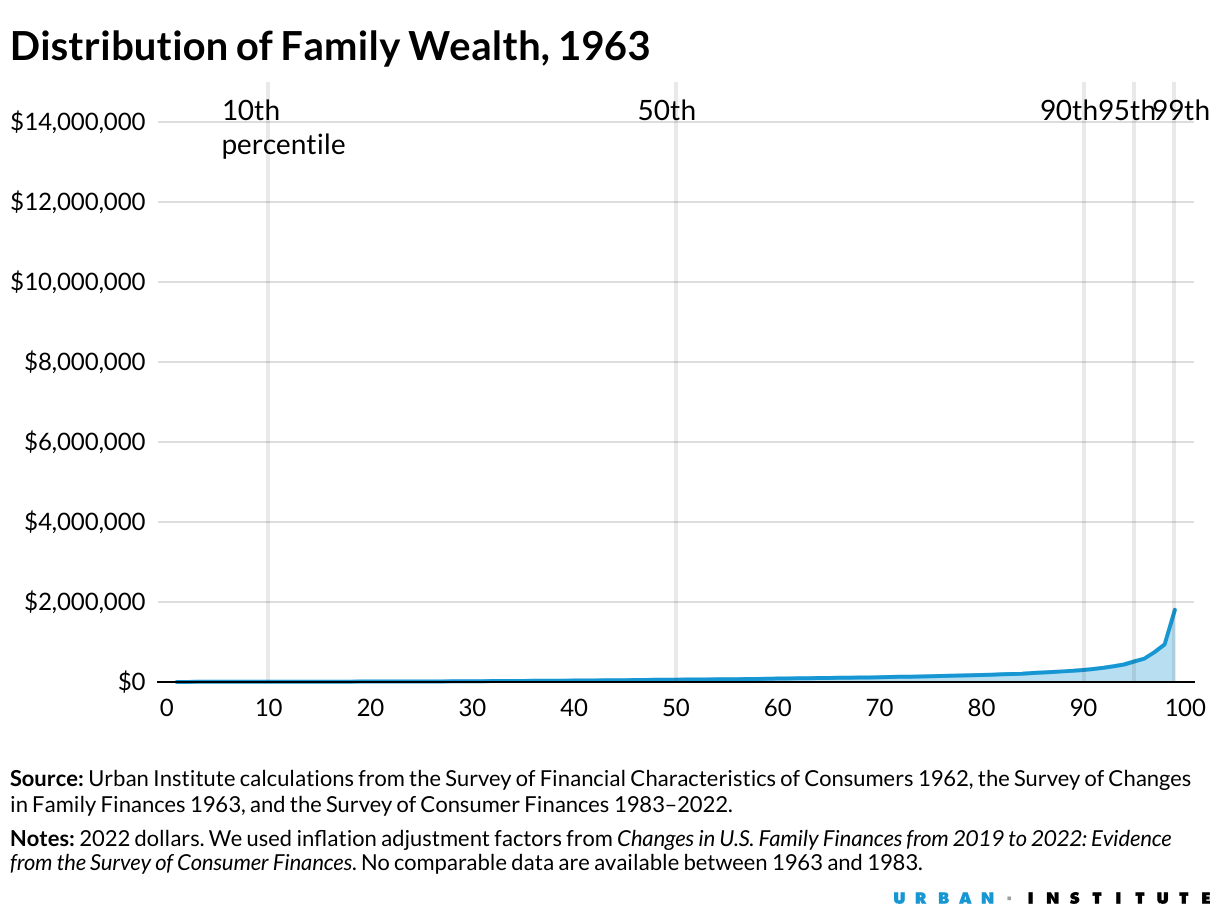
To illustrate the change, in 1963, the wealthiest families had 36 times the wealth of families in the middle class. By 2022, they had 71 times the wealth of those families. The top 10 percent now own about 70 percent of the nation’s wealth, with the bottom 50 percent owning 2.5 percent.

The charts below show how the money was spread out then, and how it is spread out now. The blue is the money. The poor are on the left. The rich are on the right. Most of us are in the middle.

If we can find the strength and courage to eliminate barriers to opportunity, and there is a redistribution of some wealth, without so much money sitting in the hands of so few, maybe there will be enough money to fix things up in our country. Maybe our crumbling cities can look like Dubai, or Shanghai, or Singapore. Maybe, if neighborhoods aren’t economic dead zones, they’ll be welcoming places and not fearful haunts to be avoided. With the proper changes, maybe escalators and streetlights will work. Maybe we will have fast trains, and wide, smooth roads, and bridges not in danger of collapsing, and JFK airport won’t be a 21st century embarrassment.  Maybe we can prop up Medicare and Social Security and have a good universal health care program. Maybe, state universities can be free. It’s not that we need free stuff, it’s that we’ve worked hard enough to get them, and that wide access to education and health care will result in a stronger, more productive country with greater participation by its population. With a vibrant, involved population, there will be great costs savings in law enforcement and prisons, mental health, public housing, all kinds of things. This is a great trade off.

New York City subway

I was disheartened when I heard of an American who returned home after living for a decade in Japan. “Nothing works here,” he said. “And the public bathrooms are disgusting.”  So let’s fix things up. Fix ‘em up good.

There is a theory that if you don’t repair a broken window in a building, the entire neighborhood will eventually collapse. If you do repair it, the entire neighborhood will keep itself up and thrive.

I want the latter for my neighborhood and my country. Why don’t others?

Visit the clean, the organized, the efficient, the beautiful Peddler’s Village and perhaps you will change your mind.

Falling arches and other cataclysmic changes

31 Jan

change

With sweat and angst, people struggle for years to change things, then suddenly the mighty fall simply because of changing tastes.

Powerful people and institutions use their power to create systems that sustain and protect them. But these systems always contain elements of their own destruction. They do not defend against the unexpected and the unlikely. So when that unforeseen wave rises, it crashes with the force of a tsunami.

Who could have anticipated that people would turn against McDonald’s hamburgers?

mcdonaldsIn 1994, the restaurant giant had sold 99 billion burgers – an unfathomable number. Then it stopped counting. The film Fast Food Nation cites a survey showing that 88 percent of people could identify the McDonald’s arches but only 54 percent could identify the Christian cross. Financially, the company is larger than the economies of many countries.

Yet the chaos has come.

Days ago, after only two years as McDonald’s CEO, Don Thompson announced he would step down. Profits in the last quarter dropped a precarious 21 percent. Sales have pretty much fallen or remained flat at all stores for 13 consecutive months.

McDonald’s didn’t change. We did.

“I don’t know a single person of my generation that eats at McDonald’s,” a man in his early 20s said. “When the older generations pass on, they’ll have no customers.”

People haven’t necessarily forsaken burgers. They just prefer the so-called “better burgers” at places like Five Guys and the Shake Shack, which this week had a highly successful public stock offering.

McDonald’s, with its top marketing pros, is trying to reverse the trend. Ads have changed to show that its food is actually real. Other changes must be in the works. It could turn things around and reinvent itself, but so far that hasn’t happened. If McDonald’s goes under it will leave a giant hole in the global economy. In its wake will be opportunity for others.

We are used to disruptive technologies destroying things like newspapers and video stores, but the technology related to burgers has not changed. Only taste and attitudes have changed.

Can you imagine if this happens in politics?

Political parties usually are quick to adapt. They are willing to give people what they want – or at least provide the appearance of this – in order to survive. Still, quick changes can alter much about the system.

Koch Brothers

Koch Brothers

In a political overhaul, what would happen to the conservative Koch brothers, who announced recently that their political network will spend about $900 million on the 2016 elections – more than the Republican and Democratic parties will spend.

If the political climate takes a dramatic shift, what will happen to this network, its money and its associated power, influence, special interest legislations and the intricate machinery that runs everything and keeps order? What will happen to all the other power networks? What will replace them? Will it be genuine or phony? Helpful or hurtful? Open or closeminded? Peaceful or warlike?

It was reported this week in the New York Times and elsewhere that a majority of the American public, including half of the Republicans, support government action to curb global warming. That news is bound to recast agendas in the 2016 congressional and presidential elections.

What else is coming? Lots, probably.

Young people aren’t buying homes; aren’t buying cars; aren’t living in the suburbs; aren’t using traditional banks. Maybe they will decide to stop using traditional politicians.

On a dark election night, a losing politician was heard to have said, “The people have spoken – the bastards!”

We may be hearing more of this. It’s something to think about as we eat a better burger in the back of a peer-to-peer driving service on the way to a friend’s apartment in the city.

By Lanny Morgnanesi

Something I recently learned

4 Jan

Rockefeller-finger

Former New York Governor Nelson Rockefeller, a presidential candidate and the grandson of one of the most successful capitalists in history, once commissioned Mexican artist Diego Rivera, a Marxist, to paint a fresco in the lobby of the RCA building in Manhattan. In that fresco Diego included a portrait of Lenin.

Rockefeller’s father, thoroughly embarrassed, had the artwork removed. With the money left over from the commission, Diego moved to other locations and painted the fresco over and over until his money ran out.

Artists Frida Kahlo and Diego Rivera

Artists Frida Kahlo and Diego Rivera

This incident is documented in a book by Richard Norton Smith called, “On His Own Terms: A Life of Nelson Rockefeller.” It also is shown in the 2002 Selma Hayek movie, “Frida.”

For younger readers who may not remember Rockefeller, he was the first divorcee to seek high office. He may or may not have been the first nationally known politician to die (at age 71) while in bed with a woman who was not his wife.

A Republican, Nelson was a big government spender and probably would not be accepted by his party today. He possessed enough courage and arrogance to flip the bird to a news photographer, as shown in the photo above.

By Lanny Morgnanesi

How long before the great income grab is reversed? Not long.

9 Mar

cbpp income inequality 2011

The first real understanding of my value as a worker came during a company Christmas party.

I was a young reporter for a family-owned media company. My fellow employees and I had already received the gift of a free turkey, and now there was this party, grand and lavish.

It was a time when newspaper margins were around 40 percent. Printing a newspaper was like printing money.

The party was held in a big banquet hall. Hundreds attended. There was a generous buffet, music, dancing and an open bar for the entire evening.

In general, the company did well by its employees. The founder was a tough, bull-headed union-buster, but when I worked there raises were given four times a year, the food in the cafeteria was subsidized and supervisors were honored at an annual dinner.

Upon the death of the old man, his four grown children took over. By chance, I was sitting with one at the Christmas party. She was somewhat shy but sincere when she said to our table, “All of you are responsible for making this company what it is. It would be nothing without you. My family owes everything to you. Our success is your success.”

Prior to that, I had seen myself as an expendable, replaceable cog.

But this co-owner, this daughter of an entrepreneurial risk-taker, was shifting my view. I hadn’t recognized it yet, but she knew that without workers a hundred printing presses could not produce a single paper.

Still, she was neither ready nor willing to change the rules and divide the profits among workers. That’s a different ideology, one totally alien to our system, one that threatens and offends.

Then I went to New York City and found out it wasn’t.

I was still learning the way of the world and on this visit to see friends I discovered how lawyers became partners.

My friends were a former reporter and her boyfriend lawyer. He didn’t go to dinner with us that Saturday night because he was working on an investment banking deal. He was trying to make partner.

When we met up later at a bar, he was in good spirits and had no complaints. As an explanation for missing dinner, he told me a joke: “Why do investment bankers love Friday? Because it is only two more work days until Monday.”

I envied his chance to become a partner. Now that I think of it, he probably was the first person I knew who was capable of using hard work to earn equity ownership in a company.

Why was law different from other professions? To begin with, there is no huge investment needed to start up, nothing like a printing press. Also, lawyers tend to see themselves as professional equals. And there probably is some precedent, a near-ancient tradition, of taking on partners rather than employees.

What’s more, it is easy for the good ones – those who bring in big clients — to leave and hang up their own shingles.

A factory worker doesn’t have that kind of leverage.

But if there exists a universal law of fairness, a standard morality for the value and worth of labor, then leverage shouldn’t be a factor.

Of course, there is no morality in the marketplace. If people will work for substandard wages, that is what you pay them. And so unions came to be.

Unions got their start in ancient Rome

Unions got their start in ancient Rome

We think of unions as a modern concept but the idea and practice go way back. The founders of Rome, in 753 B.C., may be partially to blame. As Rome grew and incorporated other provinces, the new citizens didn’t integrate. They stayed in their towns, kept their habits and traditions and failed to adopt a Roman identify. So an edict was issued requiring people to relocate to districts organized around trades. If you were a carpenter, you lived among all carpenters.

Ethnic differences faded.

Naturally, trade associations formed. It was a new unifier.

In time, these associations became quite powerful.

Even the kings of France had to contend with them. In an age when candles were the chief source of lighting and a significant expense in a large palace, money could be saved by letting them burn to the end.  Practical, but the guild in charge of candles wouldn’t allow it. It required that candles be replaced when half burned.

Unions in the modern era continue to be associated with self-serving, costly inefficiencies. Unlike the lawyers who must enrich their firms in order to become partners, unions too often weaken their companies, making workers liabilities rather than assets.

And companies today are quick to get rid of liabilities.

What unions are good at, however, is their ability to show management the true value of labor. By unifying the powerless, power is created. In speaking with one voice – “no we won’t work for poverty wages” – unions effectively alter the marketplace. They grant the common folk a degree of dignity and allow them to pursue happiness.

But with global competition so fierce, it has become impractical and unwise for unions to advocate uncompetitive practices. What they should advocate is efficiency, innovation, profit and partnership – true equity partnership. Unions gave us the weekend but if the incentive of partnership is applied (making Friday two work days until Monday) companies could get them back.

Would companies actually make their worker’s partners? Under the current climate, no. Even discussing the idea seems ridiculous and beyond farfetched.

But why?

In the golden age of unions – after resistance that included shooting strikers — companies decided there was enough growth and profit to meet the demands of organized labor. With profit in mind, there was a willingness to share. Henry Ford would benefit if he could keep cars rolling off the assembly line and meet the heavy demand.

And besides, workers with money buy things – like cars.

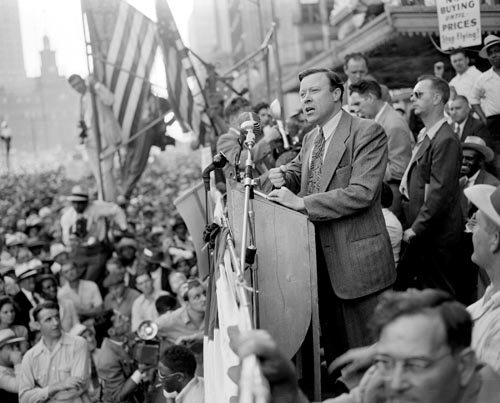
Walter Reuther knew the middle class fueled the economy.

Walter Reuther knew the middle class fueled the economy.

(There’s a great story about Walter Reuther, leader of the United Auto Workers, being shown an automated assembly line.  In a competitive dig, Henry Ford II asked him, “How are you going to get those robots to pay union dues?” Reuther retorted, “Henry, how are you going to get them to buy cars?”)

For the most part, the willingness to share is gone.

According to the Center for Budget and Policy Priorities and many other sources, a significant income gap between classes existed from the 1940s into the 1970s, but it did not grow. But after the early 70s and up to today, income concentration at the top increased dramatically. The last time the disparity was this great was prior to the Depression.

Various sources, including University of California at Santa Cruz Professor G. William Domhoff, in his blog “Who Rules America?,” report that in 2010 about 1percent of the U.S. population possessed 35 percent of the wealth. The top 20 percent had 89 percent, leaving the bottom 80 percent with 11 percent.

Also reported in various places, including the Los Angeles Times, is that from 1993 to 2012, income of the 1 percent rose 86.1 percent while income of the other 99 percent rose 6.6 percent.

As wealth became concentrated at the upper tier, billions in cash was stockpiled by American corporations.

In March, Forbes set the total at $1.45 trillion and listed the top 10 holders of cash, including:

Apple: $137 billion.

Microsoft: $68.3 billion.

Google $48.1 billion.

Pfizer $46.9 billion.

What changed?

For one, the labor market.

When Apple is ready to roll out a new iPhone, poor farmers in Katmandu drop their plows and fly to factories in Malaysia. This is not a rhetorical sentence.

Journalist Cam Simpson documents Apple’s labor supply chain in an incredible piece of investigative reporting for Bloomberg Businessweek.  His story tells how labor brokers fan out to the poor countries of Asia when Apple launches a new product. The people they find pay them for jobs and keep paying as the process continues. Often, they pay with borrowed money and go deeply in debt.

One was Bibek Dhong from Nepal. He paid a single broker the equivalent of six-months wages. The fee secured him a job in Malaysia with Flextronics, one of Apple’s chief suppliers. Before he could pay off his loans, production shifted to another country (better performance) and he lost his position.

His passport was held and he could not get home. He feared he would be arrested. Before he received help from Flextronics, he ran out of money and nearly starved.

Not exactly a union shop.

But as China has realized, when companies get richer, when commerce thrives, when corrupt leaders and their families amass great, visible wealth, expectations rise and workers lose their complacency. They demand more and often get it, until the factories move to a more accommodating country.

Sooner or later, corporations are going to run out of countries.

Sooner or later, a floor will form under the global labor market.  From there, workers will stand.

That’s when corporations are going to need a new plan.

And that’s why I’m suggesting one now.

In the U.S., people are finally waking up to the subtle yet systematic dismantling of the middle class, which has been occurring for decades. With less spending power, average families find it difficult or impossible to send their children to college – once the gateway to upward mobility. Those who do make it to college find it hard to get jobs when they graduate.

The bleakness and lack of opportunity, the malaise of our times, is truly settling in.

Books are being written with titles such as, “The War on the Middle Class,” “Screwed: The Undeclared War on the Middle Class,” and “The Betrayal of the American Dream.”

Income equality has become a topic in columns, blogs and editorial cartoons. The issue, once ignored, is now discussed by the president of the United States and the Pope. Billionaire Warren Buffett said that if class warfare truly exists, his class in winning. Even so, there are defections. One is global billionaire David Sainsbury, who calls for fairer wealth distribution through something called “progressive capitalism.”

To see inside this looming class crisis, look toward Seattle, the home of Boeing.

Timothy Egan, a Pulitzer Prize winning journalist and winner of the National Book Award, wrote an opinion piece in the New York Times Nov. 14 called, “Under My Thumb.” The title refers to Seattle’s position vis-a-vis Boeing.

Like many big corporations, Boeing hold jobs hostage as it demands and gets hefty tax breaks. As Egan points out, when anyone or anything shows resistance, companies like Boeing threaten to leave town.

Boeing is seeking concessions in exchange for keeping assembly of the new 777X jet in Washington State. For its part, the state of Washington provided a incentive package that included an $8.7 billion tax break, which Egan called the largest single state-tax giveaway in the nation’s history.

But Boeing also requires that workers accept cuts in pensions and health care benefits.

Unlike Washington, the workers said no.

Refusing to allow the “Walmartization of aerospace,” the machinists who would build the 777X turned down the offer by a 2-1 vote.

“I’m tired of being slapped in the face,” said John Gilman, who has worked at Boeing for nearly 40 years. “Building airplanes — it takes years of training and skill. The people who run this company used to understand that.”

In reaction to Egan’s piece, one reader commented, “This is just the beginning before Americans ‘storm’ any number of figurative ‘Bastilles.’ ”

Jump now, if you will, to the town of Richmond, California.

In Richmond, like most of the U.S., people were talked into taking home mortgages they couldn’t afford. When the housing bubble burst, they ended up owing more on their mortgages than their homes were worth.

Nothing unusual there.

What is unusual is the protective reaction, possibly unprecedented, taken by the town fathers on behalf of residents. Basically, they told the banks holding the bad mortgages to renegotiate the terms or Richmond would confiscate the properties through eminent domain.

Under this plan, the banks would receive 80 percent of each home’s current worth – much less than the original purchase price –and the town would reform the mortgages so owners can afford them.

Meanwhile, all across the country fast food workers are trying to nearly double their hourly wage to $15.

Not too long ago, the Occupy movement surprised everyone when it surfaced to protest almost everything. It stayed around much longer than anyone expected and started widespread discussion of the 1 percent and vast income disparities.

What else is out there waiting to bubble up? I sense there is a lot.

Nature and the human spirit, in time, tend to correct imbalances. I believe this correction has begun. When there is too much of one thing, the other thing comes.

And when the other thing comes, I hope we are ready for it. We might prepare by realizing that we all have a stake in each other’s well being, that each plays a role in the ultimate success of our society and that respect and dignity should be afforded to all. We are a tribe – we humans — and members of a tribe should look out for each other.

Right now we don’t.

I say, let’s act more like partners. Let’s all rise together.

That means valuing each other properly and recognizing that all roles are important, that we’d be in big trouble if one day no one wanted to pick up the trash.

Providing an equity interest to all workers – even a thin, thin sliver – is progressive and revolutionary. It may even be moral, wise and an effective business strategy. But for it to happen, something cataclysmic must occur, or the vision of something cataclysmic must appear.

In the meantime, it is likely that agendas will slowly change (perhaps preventing any cataclysm). This fall, for example, Bill de Blasio was elected mayor of New York after saying he would trim the gap between rich and poor.

Other politicians, in a discovering of new voting blocs, may decide to do the same and relieve the working poor of its distress, better balance wealth and create a more secure, just and – I think – more prosperous society.

A person with disposable income, after all, fuels the economy and is less of a burden on government.

Tax policy, a major cause of the wealth shift, also will have to change. An almost whimsical proposal comes from Robert Shiller, who on Dec. 8 received the Nobel prize in economics. To stop inequality from rising, he suggests raising taxes on the rich whenever their share of income starts to grow.

Should any of this actually happen, it won’t come solely out of true enlightenment. As always, it will come mostly as a way to preserve and protect – through concessions – the self-interests of the powerful. This is OK. It will come through changing market forces resulting from a shift in culture, attitudes, expectations and action. Those forces, nearly invisible now, seem to be coalescing. I don’t think they can be stopped.

When there is too much of one thing, the other thing comes. That’s the natural law.

Lanny Morgnanesi

Should Hershey and M&M make government policy?

19 May

candy sugar lips2

I came to understand how power could ravage the individual on the day candy bars increased in price and decreased in size.

As a 10-year-old I was willing to concede that prices could go up OR size could go down. But to have both occur at once struck me as unjust and criminal. This shocking and unexpected event remained with me and prepared me for later lessons in politics, morality, pragmatism, irrationality, the market place, self-interest and hypocrisy.

In some respect then, the price I paid for that under-sized Milky Way was worth it.

Thoughts of those days, when candy was so important, came back this morning when I read a piece by Jonathan Tamari in the Philadelphia Inquirer: “Not a sweet fight: Chocolate vs. sugar.”

It details the struggle between “Big Candy” and “Big Sugar” over pending legislation governing price supports for sugar. Currently, the price of domestic sugar is kept high by a policy that limits cheaper imports from countries such as Brazil and Mexico. “Big Candy,” which must pay the higher prices for sugar, wants the restrictions removed so the price of sugar will fall. “Big Sugar” wants to maintain the restrictions to protect U.S. farmers who grow sugar and to offset the subsidies paid to foreign growers by their governments.

CandyBoth sides claim their positions save jobs. Both sides claim their positions are best for the economy. One interesting claim by “Big Sugar” is that “Big Candy” won’t lower its prices even if the cost of sugar comes down.  Why does that sound so believable?

As I read on, my thoughts turned from candy – which I no longer eat much of – to the differences between governmental policy that is piecemeal and policy that is comprehensive.

In the United States, we generally govern the first way. The second way, while enviable, is much too difficult. For now, we leave that kind of governing to the politburo of the Chinese Communist Party, which has its faults and foibles and vast problems with corruption and oppression but is made up of engineers and technocrats who take the long view.

If Congress were to act properly and strategically, it wouldn’t joust over every important piece of legislation, with one kind of action chosen in one case and an opposing kind of action in another. Rather, all actions would be supportive of an effective strategy and plan.

So instead of deciding over “Big Candy” or “Big Sugar,” government   should decide if import barriers and supports as a rule are desirable or undesirable.

Figure out what works best and employ it everywhere where it works.

It’s called National Policy and we need it in every sector.

In the end, an unhappy child may have to pay too much for too little, or his teeth may rot because sweets are cheap and abundant, but if the chosen policy boosts the nation, creating jobs and wealth, then either outcome represents reasonable pain for ultimate gain.

By Lanny Morgnanesi

The lucrative tunnels of Gaza

18 Feb

gaza-tunnels


For those without it, money always seems to end up in the wrong hands.

A fool and his money are soon parted because there never will be a shortage of disreputable types willing to fleece the weak and unknowing. Writer Dorothy Parker said if you want to know what God thinks of money, just look at the people he gave it to. And the Bible itself, in Matthew 19-24, plainly and poetically states that heaven is not for the rich.

But while money has caused great misery in the world, it also has the remarkable, almost magical power of solving problems. It can literally break down barriers.

In the Middle East, in Gaza, there is a wall. On one side are people who need things they can’t get. One the other side are those things.

Due to the force and power of money, the wall and all its associated political obstructions have been circumvented.

They’ve been circumvented by tunnels, which in Gaza can make millions for their owners.

These outlaw entrepreneurs find the means to acquire the wood, concrete and excavation equipment needed to create 700-meter corridors of commerce. Some might even dig a tunnel by hand, even though it could be destroyed by Israeli bombs.

These tunnels are in the town of Rafah, which is split down the middle. Egypt controls one side; Israel the other. According to Bloomberg Businessweek, Gaza has 1.6 million people, with 40 percent living below the United Nations poverty line. Unemployment is at 31 percent.

Yet the tunnels can cause the economy to boom. Businessweek says that the tunnel system employs almost 15,000 and carries 75 percent of the good sold in the area.

One successful tunnel owner, Emad Shaaer, has family members on both side of the barrier, which greatly facilitates his business. Payment for his services vary. “Sometimes you got $200,000, and sometimes you got nothing,” he said.

Tunnel construction can cost about $200,000, but you only need $50,000 to get started. You don’t have to pay the labors and tunnel experts until the flow of goods starts.

Things became really good for the smugglers in 2007 when Hamas took control of Gaza from the Palestinian Authority. To punish Hamas and Gaza residents for taking a more radical stance, Israel closed the borders even tighter. If anything can make a smuggler rich it’s a tight border. But as success and profits grew, they attracted attention.

When Hamas realized how much money the tunnel owners were making, it began to tax the operations, raising an estimated $188 million annually. (Hamas denies this.) The local Gaza government also regulates the good that can be transported, outlawing all the things that make the most money. (Further outlawing what is already outlawed.)

Even so, it is doubtful the tunnels will go away. Taxes and regulations can be skirted. Or, maybe there is enough for both the tunnel owners and Hamas.

The only thing that can truly destroy the tunnel system is peace, a highly unlikely prospect. Still, it is possible that the day may come when there will be enough profit in peace that the power and force of money will have succeeded in making us civil.

In such a case, I would argue that the time has finally arrived to allow the rich into heaven.

By Lanny Morgnanesi


If the Republican Party were a person, Dorothy Parker would slap his face, both of them.

10 Feb


latino-obama-sign

Consider the case of the young man who hates his uncle and has always treated him dastardly. One day the uncle reveals that by living poor he was able to accumulated a small fortune. The young nephew then begins to shower the old man with kindness and attention.

For the uncle, it is easy to see that the nephew is a disingenuous louse. The real insult, however, is that the young man thought the uncle could be fooled.

The young man reminds me of the Republican Party.

Here is a party that, for the most part, staked out a very tough position against amnesty or general kindness for 11 million people living and mostly working in the United States without the legal right to do. It was a legitimate position, although it is one I considered unwise.

When President Obama was re-elected after winning 80 percent of the minority and ethnic vote, the Republican Party realized that the poor uncle they didn’t care much for was actually rich.

Now they want to be friends. Now they want legislation to assist the 11 million. Now they want those votes.

And, I guess, they don’t think the Hispanic population is intelligent enough or aware enough to see the hypocrisy.

That’s the real zinger.

Gov. Bob McDonnell, a Republican from Virginia, thinks the GOP can get those votes if it just changes its tone. That’s what reporter Thomas Fitzgerald wrote today in the Inquirer. Tone, rather than the choice of whom you truly represent in Congress, is what’s important.

Reality is always second to image.

When someone says, “People want to know we’re like them”  (which Republican Congressman Scott Perry said this weekend) it usually means “We’re not like them.” When someone says, “We can win the presidency. … We don’t need to fix the laws to make that happen (which Pennsylvania party chairman Rob Gleason said), it usually means they ARE trying to win the presidency by rigging the system.

A good rule in politics is to exercise caution and maintain skepticism.

I’m very curious to see if the GOP efforts to gain Hispanic support will work. Woody Allen once said that the lion will one day lie down with the lamb, but the lamb won’t get any sleep. That’s the kind of alliance this speaks of.

By Lanny Morgnanesi

Israel Loves Iran — and so can you!

2 Feb


Chuck Hagel, nominated for secretary of defense, was treated roughly this week by his former colleagues in the Senate. In part, it was because he appears not to be in complete lockstep with Israel and also because he has shown moderation in his position on Iran.

In the U.S. we hold a compendium of complex and diverse political views. Oddly, we are expected to be monolithic in our support of Israel. In some way, Hagel was treated like a traitor. I’m not sure why a single, blindly supportive position is required on Israel. If I had to guess, I’d say it’s because the Israeli lobby is smart, strong and well-funded, and because a large part of the American Christian community regularly muscles Congress on Israel because it wants to protect and maintain that country until it can be converted en masse.

If I’m wrong about that I apologize.

What I’m probably not wrong about is this: Opinion on Israeli policy is more divergent in Israel than in America.

Can you image buses traversing major American cities covered with the message: “Iranians we love you.”

People would probably go to jail for that.

There are, however, such buses in Israel, funded by Israelis who don’t feel hostile to Iran and believe the current talk of war is dangerous bombast.

While the buses are highly visible, the campaign for peace is mainly online. There are thousands of Facebook followers, and related Facebook sites from various people and countries pop up each day in support. It is something of a movement, a movement for peace in the face of impending war.

Its leader, graphic designer Ronny Edri, has told the people of Iran, “For there to be a war between us, first we must be afraid of each other, we must hate. I’m not afraid of you, I don’t hate you.”

His movement involves individual people creating posters of themselves with variations on the message: Israel loves Iran.

The posters are then placed on the Internet.

After a time, Iranians were creating their own posters saying: We love Israel.

Please hear the story straight from Edri’s mouth in a TEDs talk he gave. At the end of this 15-minute video you can see many of the wonderful posters of peace that people have made. Also, at the top of this page is a Youtube video from Edri.

Coverage of Edri, who served in the Israeli army, and the thousands of resulting posters has been on ABC and CNN, in the New York Daily News and the New Yorker magazine and in many, many international publications.

Consider becoming a part of this movement, or at least learning about it.

It seems people may not hate each other as much as their governments would like them to.

Maybe Chuck Hagel wouldn’t be such a bad secretary of defense after all.

By Lanny Morgnanesi

Those who benefit from Hillary Clinton (and others) should pay more to Washington

20 Jan

Hillary Clinton

Here is what I think is a logical, no-nonsense tax policy: Those who benefit most from the government should pay the most.

Let’s say I own land on which I plant corn for ethanol. If the government decides to restrict the importation of sugar cane – which if allowed kill my sales– then I am indebted to the government in a big way. I’m a Great Benefiter.

I should not be able to get off just by contributing to the political campaigns of the few congressional leaders who pushed my bill through. I should have to pay more for the actual government, since it is working directly for me. I’ve got to pay more salaries, more electric bills, more for everything that keeps it running.

The same would be true for Amgen, the largest biotech company in the world. The New York Times recently reported that a few paragraphs in the “fiscal cliff” legislation give Amgen a two-year delay on Medicare price restraints for a drug it makes. This was its second delay, God bless them. Amgen is willing to pay 74 Washington lobbyists to get what it wants, but is it willing to pay more in taxes?

It should be.

It’s a Great Benefiter.

I’m glad our 430-ship Navy protects the sea-lanes so I can purchase imported products. That, however, is only an indirect benefit. What about the people and companies who profit from safe shipping?

They’re Great Benefiters. Charge them!

A couple weeks ago there was a somewhat surprising article in Bloomberg Businssweek. Well, maybe not so surprising. It was about Secretary of State Hilary Clinton, but the headline was: “Secretary of Commerce.” The underline was, “How Hillary Clinton turned the State Department into a machine for promoting U.S. business.”

It begins by recounting her 79th visit overseas, which took her to the Czech Republic. She discussed foreign policy but also found time to ask Prime Minister Petr Necas to choose Westinghouse Electric for a nuclear plant contract worth $10 billion.

The article says she regularly makes personal pitches to world leaders on behalf of businesses.

What is that worth? Whatever it is, it’s a lot more than the $50,000 Westinghouse might later pay Hilary to speak for an hour at a corporate retreat.

Westinghouse needs to pay more.

So, have I come up with the answer to our budget and debt problems? All we need is some accountant to figure out what is owned, and for Congress to do the right thing and pass legislation that taxes the Great Benefiters. Of course, the Great Benefiters should have the option of not paying in exchange for the not benefiting. In such cases, the government would have to permit, say, an attack on Exxon tankers by Somalian pirates.

That is an option the Great Benefiters are unlikely to choose. Hence, we have found a way to balance the budget. See, things aren’t as bad as they seem.

By Lanny Morgnanesi