Tag Archives: Lanny Morgnanesi

Old Books Come Back to Life: Remember “Naked Lunch”?

1 Jun
Writer William Burroughs

Writer William Burroughs


The New York Review of Books sat on the table face up, showing the lead item about James Baldwin. This was odd, since Baldwin died a quarter century ago. No new books from him.

“As a writer of polemical essays on the Negro question, James Baldwin has no equals,” the review said.

The Negro question?

Oh. This was not new. This was old. It was a copy of the first edition of the New York Review of Books, reproduced on the 50th anniversary of the publication.  The Review was launched in 1963 as salve to a citywide newspaper strike. The most prominent authors of the day contributed. They did so on short notice and for no pay.

What a time that was!

Ideas and making a statement were more important than making money.

As a collective voice from the past now being read in the present, the Review of Books gives more than a few hints of intellectual unrest. The best minds of the day seemed to be laying the groundwork for a coming cultural break with convention and the status quo.

It’s right there, interwoven amidst the literature.

Those doing the writing were the avant-garde, and people listened to them. Looking over their names, it is difficult to recall writers today with reputations as large. Among the contributors were Norman Mailer, William Styron, Robert Penn Warren, Susan Sontag, Gore Vidal, Paul Goodman, Robert Lowell and Jules Feiffer.

If any group reflected the spirit of the times – or perhaps the coming spirit — this one did.

As did the books they reviewed.

Included was “Naked Lunch” by William Burroughs, the grandfather junkie to the Beat writers. “Naked Lunch” is perhaps one of the most unclassifiable novels in the English language. The story – often bizarre and fantastic — takes place inside the head of a man taking a drug cure from a quack. At one point in his career Burroughs would write his prose on paper, cut it up then randomly reassemble the pieces

“Naked Lunch” was reviewed by Mary McCarthy, whose books include “The Group” and “Birds of America.”

At the close of the review, she deals with the “pained question that keeps coming up like a refrain” – Why is this book being taken seriously?

Her answer is that for the first time in recent years, a really talented writer meant what he said.

This was the coming era.

Norman Mailer

Norman Mailer

Some of the celebrity reviewers, those with the larger personalities, were overly tough on their colleagues. Normal Mailer, always pugnacious, said “That Summer in Paris” by Morley Callaghan was “dim” and mostly without merit. One passage, however, saved the book, Mailer said, because it exposed the true character of novelist Ernest Hemingway, who two years earlier committed suicide.

The tale has Callaghan, who boxed in college, getting into the ring with the much larger Hemingway. F. Scott Fitzgerald was the timekeeper. In a round that went long, Callaghan flattened Hemingway. Fitzgerald blamed his poor time keeping.

“Oh, my God,” he said. “I let the round go four minutes.”

Hemingway, perhaps from the canvas, answered, “All right, Scott. If you want to see me getting the shit knocked out of me, just say so. Only don’t say you made a mistake.”

To me, this shows meanness and poor sportsmanship.
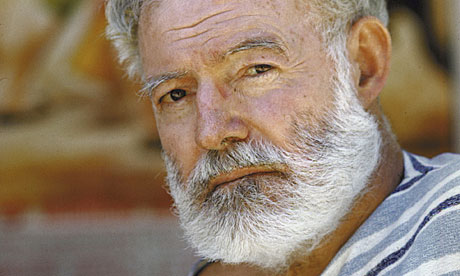
Was Hemingway a coward?

Was Hemingway a coward?

To Mailer, who also boxed, it led him to concluded, “There are two kinds of brave men. Those who are brave by the grace of nature, and those who are brave by an act of will. It is the merit of Callaghan’s long anecdote that the second condition is suggested to be Hemingway’s own.”

In essence, Mailer was calling Papa a closet coward, and he cited his suicide as evidence of this cowardice.

Then there was Gore Vidal. He described John Hersey’s book, “Here to Stay,” as  “dull, dull, dull.” Hersey was trying to invent something called “New Journalism,” which later would boost the careers of people like Tom Wolf and Hunter S. Thompson, but Vidal criticized him for cramming too many facts into his sentences.

John Updike is one of America’s best writers but Sir Jonathan Miller, a Cambridge graduate who did books, plays, movies and TV, said Updike’s “The Centaur” was “a poor novel irritatingly marred by good features.”
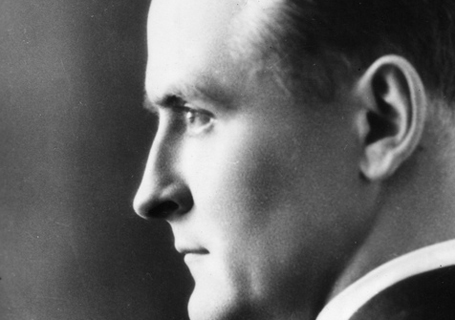
F. Scott Fitzgerald, poor at keeping time

F. Scott Fitzgerald, poor at keeping time

These reviews pretty much stuck to literature, but an unusual number referenced the Cold War and voiced the fear of imminent doom. It was hard to miss the Soviets. One reviewer discussed four books on the economy of our then-mortal enemy. Another reviewed Alexander Solzhenitsyn’s short gulag novel, “One Day in the Life of Ivan Denisovich.”

Robert Jay Lifton, in a review of a compilation called “Children of the A-Bomb,” said, “The thing we dread really happened in Hiroshima and Nagasaki. But the world resists full comprehension of this event, symbolizing massive death and annihilation.”

He and others suggested that faith in the future was fading, and that without change mankind’s time was limited.

Reviewer Lewis Coser said education and information no longer were the answer.

He called the well-informed person “a cheerful robot.”

“The increase of information may indeed have led, contrary to the belief of the Enlightenment, to a decrease in rationality,” he said.

A remarkably forward-looking book carried the harmless title, “The Exploration of Outer Space.” It written by A.C.B. Lovell and reviewed by James R. Newman. Both lauded the development of radio astronomy as a way to finally understand the composition of the universe.  They believed recent findings made it almost certain that other solar systems contained life and that future contact was possible.

Nuclear war: On everyone's mind in 1963

Nuclear war: On everyone’s mind in 1963

But there was darkness overlaying this optimism. The review expressed a grave fear that humans, if they don’t destroy themselves first, one day would destroy life on other plants, either deliberately or through contamination.

The review ends this way:

“”I myself do not find the prevailing space-race chauvinism and the threat to other planets as horrifying as the threat of global extermination. Nor do I derive consolation from the thought that if our managers turn the earth info a lifeless stone other forms of life will continue elsewhere in the universe. But I am impressed with Lovell’s deep sense of responsibility about life everywhere, and I wish there were many more scientists like him.”

And that’s the way it was in 1963.

Coming would be Dylan, hippies, communes, the counter-culture; Burn Baby Burn, Don’t Trust Anyone Over 30; a refusal to be bought and sold; hope I die before I get old.

 By Lanny Morgnanesi


Muhammad as Solomon: A better story

25 May

solomon1

Time gives and takes. It adds and subtracts. It creates things that didn’t exist and extinguishes things that did. So as a general rule I distrust history.

Take for example the story of King Solomon and the baby. Why would a respected wise man mediate a custody case by offering to executive the child? Who would recognize this as rational? And why would any woman – mother or not –agree to it?

The story doesn’t ring true. I sense something was lost in translation and time.

A better story of wisdom comes from the Muslim world. It could be an additive story, but it nevertheless makes more sense.

This is it:

The shrine at the Kaaba in Mecca existed in pre-Islamic days and even then was considered sacred. It is said to have been built by Abraham. Inside then and now is a rock that fell from heaven. Possibly a meteorite, it is considered a divine gift. A flash flood not uncommon in the Arabian desert destroyed the Kaaba in the seventh century. Leaders of Mecca’s tribes and clans work together and rebuilt it.

All went well until it came time to place the stone back in the temple. Each leader argued for the honor. When the discussion broke down and violence was threatened, someone said, “Let us then agree that the next person to come over that hill will be given the task of deciding.”

Along came young Muhammad, future prophet. Being an orphan who had been raised in poverty by Bedouins, he was of low standing among the tribes. But he was also considered neutral.

Muhammad was told the problem.

He thought about it, then secured a tarp of some sort or a large blanket. He put the stone in the middle and told each clan leader to grasp hold of an edge. Together, they carried the stone into the shrine.

True or not, this is a great story of wisdom and mediation. Perhaps more important from the standpoint of story telling, the stone foreshadows the Quran, which Muhammad used to bring divisive, violent, warring Arab tribes together.

Quran or no Quran, Bible or no Bible, prophet or no prophet, the absence of conflict doesn’t last long. Today, the Judeo-Christian world tends to think it is at war with the Muslim world. It doesn’t realize the larger war is actually within the Muslim world. As Abraham, Moses and Jesus failed to bring peace, so has Muhammad.

Human nature embraces the words of prophets then simultaneously rejects them. It has always been.

Author Leslie Hazelton

Author Leslie Hazelton

My interest in learning more about Muhammad and Islam was recently heightened by a well-written work entitled, “The First Muslim: the story of Muhammad.” Author Lesley Hazelton, a journalist and former psychologist, takes a unique and interesting approach to her narrative. Scholars might object, but the most fascinating thing about her book is the way she fills in the historic blanks with rational speculation based on a keen understanding of the human mind.

Another appealing feature is the way she has put together all the fascinating stories from Islamic history and culture, ones widely known in the Muslim world but mostly unknown to western Christians and Jews.

For the first time I learned that many Islamic rites pre-date Muhammad, including regular pilgrimages to Mecca.  I also learned that Arabs considered all scripture sacred and were respectful of all prophets. Furthermore, in a day when little was written down, Jews were honored as “the people of the book.”  Christians also had great influence, as the Byzantine Empire moved into the area.

Faith and beliefs all seemed to have melded together. That’s enviable.

Practices in Arabia had come close to the monotheism of Abraham. The idea of one powerful, all-knowing god was accepted. But in Arabia this god had secondary, sister deities that also were worshipped. Muhammad, in perhaps his most controversial move, wanted the sisters dethroned.

His truth, as revealed to him by the angel Gabriel, proclaimed that God was neither begotten nor a begetter; that there were no sister gods. In a way, this is purer than Christianity, with its trinity.

For me, the most remarkable aspect of Islam is the Quran, or Koran (Spelled accurately only in Arabic script). Let’s remember that Muhammad could neither read nor write. His revelations came at a time when memory, not books, held the history and literature of one’s culture. In fact, the literal meaning of the word “Quran” is “the recitations.”

Indeed, it was not written down in the prophet’s lifetime.

To allow memory to commit large amounts of information, it usually had to be in verse; poetic and alliterative, like a beautiful song. This is the Quran, passed onto the world by a former camel boy.

In the process of revelation, where does the human take over from the divine? How much wisdom, intellect and creativity is required of the human? How much did Muhammad have? Was it Gabriel’s truth but Muhammad’s poetry? Or did the angel do it all?

If Muhammad had a role, then he was more than a natural poet; he was a self-taught scholar with deep, strong knowledge of the Bible. It is said the Quran was meant to be a continuation or extension of the Bible; that a good portion is biblical tales or re-workings of the tales. Gabriel, of course, would know them. But how did Muhammad?

Like the carpenter’s son, he somehow overcame circumstances and acquired a wide and useful education. Maybe it was easier than we think. Without a system of schools and universities, maybe elders were required to pass along great stores of knowledge to the young. Throughout much of his life, Muhammad was an agent and mediator on long caravans up and down the Arabian peninsula. That’s a lot of time for doing nothing more than talking and absorbing. Learning.

Another interesting things about Muhammad and the Quranic revelations is they did not come all at once but over a period of more than two decades. When he needed something new, he fasted and mediated and went back up the mountain.

Sometimes he had to wait years. Other times inspiration came quickly.

It is said by some and disputed by others than on one occasion the verses he brought back were wrong and had to be recanted. It is alleged that he had been spoken to not by Gabriel but by the devil. These are the so-called Satanic Verses, which for a brief time are said to have re-legitimized the three sister gods.

After I finish with “The First Muslim,” I’m going to read a translation of the Quran. I’m certain to be surprised, and that what I read will be a departure from what I think I know or have heard.

Although purists believe Muhammad’s messages should not be read or spoken in any language other than Arabic, that seems to be changing. I received my English copy from two guys handing them out at the mall, a gift from whyislam.org.

My book was published in Istanbul and translated by Abdullah Yusuf Ali.

The name Abdullah, according to Hazelton’s book, means “servant of God.”

If we can get by the hate, the misunderstanding and the ignorance, there is much worthy to be learned about this culture.

Please listen to Ms. Hazelton speak on the Quran.

By Lanny Morgnanesi

Should Hershey and M&M make government policy?

19 May

candy sugar lips2

I came to understand how power could ravage the individual on the day candy bars increased in price and decreased in size.

As a 10-year-old I was willing to concede that prices could go up OR size could go down. But to have both occur at once struck me as unjust and criminal. This shocking and unexpected event remained with me and prepared me for later lessons in politics, morality, pragmatism, irrationality, the market place, self-interest and hypocrisy.

In some respect then, the price I paid for that under-sized Milky Way was worth it.

Thoughts of those days, when candy was so important, came back this morning when I read a piece by Jonathan Tamari in the Philadelphia Inquirer: “Not a sweet fight: Chocolate vs. sugar.”

It details the struggle between “Big Candy” and “Big Sugar” over pending legislation governing price supports for sugar. Currently, the price of domestic sugar is kept high by a policy that limits cheaper imports from countries such as Brazil and Mexico. “Big Candy,” which must pay the higher prices for sugar, wants the restrictions removed so the price of sugar will fall. “Big Sugar” wants to maintain the restrictions to protect U.S. farmers who grow sugar and to offset the subsidies paid to foreign growers by their governments.

CandyBoth sides claim their positions save jobs. Both sides claim their positions are best for the economy. One interesting claim by “Big Sugar” is that “Big Candy” won’t lower its prices even if the cost of sugar comes down.  Why does that sound so believable?

As I read on, my thoughts turned from candy – which I no longer eat much of – to the differences between governmental policy that is piecemeal and policy that is comprehensive.

In the United States, we generally govern the first way. The second way, while enviable, is much too difficult. For now, we leave that kind of governing to the politburo of the Chinese Communist Party, which has its faults and foibles and vast problems with corruption and oppression but is made up of engineers and technocrats who take the long view.

If Congress were to act properly and strategically, it wouldn’t joust over every important piece of legislation, with one kind of action chosen in one case and an opposing kind of action in another. Rather, all actions would be supportive of an effective strategy and plan.

So instead of deciding over “Big Candy” or “Big Sugar,” government   should decide if import barriers and supports as a rule are desirable or undesirable.

Figure out what works best and employ it everywhere where it works.

It’s called National Policy and we need it in every sector.

In the end, an unhappy child may have to pay too much for too little, or his teeth may rot because sweets are cheap and abundant, but if the chosen policy boosts the nation, creating jobs and wealth, then either outcome represents reasonable pain for ultimate gain.

By Lanny Morgnanesi

How soon before McDonald’s opens in an Arctic shore town?

12 May

Ice Age

As a child I was shocked to learn there were Ice Ages. My concern was they would return.

With the globe warming up, I no longer worry.

As an adult, I’ve always been of the mind that the Earth is cataclysmic, dynamic and without care for the creatures and life forms that inhabit it. Because of this, I haven’t spent much time trying to figure out what’s going on with the current variety of climate change. I’m not even sure I could.

It is clear to me, however, that today’s Earth will not be tomorrow’s Earth. Nature has never worked that way.

There aren’t many trees on the Mid-western plains of the United States because they once were under water. Humans or pre-humans walked out of Africa and into Europe because there was no Mediterranean Sea.

So now the ice is melting and temperatures are getting warmer. Surely, the great amount of carbon gases being produced by the dominant species is a contributor. But are there stronger, natural, cyclical factors at work?

Maybe. But I wouldn’t know.

Does it matter?

Human cultures seem unable and unwilling to actively and intentionally reverse things. It is possible the market place could do the job on its own when advances make clean energy more profitable than dirty energy. Until then, we will suffer the disadvantages.

Just as past civilization have migrated due to changing climate, we will, too.  The Earth won’t even flinch.

When the shock of the coming changes wears off, we should focus on the benefits. And there are benefits.

Temperature change chartThink about it this way: If you lived in an ice world and have fully adapted and someone says they could melt it for you, you’d say no. If you lived in a world without ice and someone says they could freeze it for you, you’d say no.

No one wants change, even if their butts are as cold as mountain snow. The good in change often is obscured by the status quo and a locked-in mindset.

Since we are changing, let’s look for the good that has been ignored.

  • We can grow wheat in Canada.
  • They’re making real estate again.
  • New tourist destinations are coming.
  • There will be new access to abundant minerals and resources.
  • You can ship goods across the top of the world and save bundles of money. (The once mythical Northwest Passage is real).

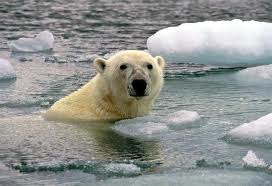
Polar bearUntil recently, I hadn’t heard anyone talk about such things. It would be rather insensitive in light of the many species losing their habitats and the wealthy losing their beachfront homes.

But it is being talked about now.

The Obama Administration this week released a national strategy for the Arctic in advance of a conference of eight polar nations, where temperatures are warming twice as fast as everywhere else.

“Our pioneering spirit is naturally drawn to this region for the economic opportunities it presents and in recognition of the need to protect and conserve this unique, valuable and changing environment,” the president said.

I think the key words are “economic opportunities.”

My experience is little gets done unless there is money to be made.

While the environmentalists moan, complain and argue about climate change (not necessarily bad), visionary entrepreneurs are jumping in an investing. They see the possibilities. From a strategic and security standpoint, the U.S. cannot let other countries – Russian, for example, which has miles of Arctic coasts – get ahead or dominate in the new, warmer world.

And it won’t.

It’s just a shame the kind of mobilization and investment that is about to occur couldn’t have been used to combat the climate change in the first place.

Then again, maybe it wouldn’t have worked. Maybe nature has its own plan and our CO2 really is not a factor. I wish there was a way to know.

Either way, I’ve finally stopped worry about the coming of a new Ice Age and having to wear animal fur 24 hours a day. I guess that is some consolation.

By Lanny Morgnanesi

How lazy people can save the world

21 Apr
From Bloomberg Businessweek

From Bloomberg Businessweek

We laughed when “Seinfeld” described itself as a show about nothing because we knew it was about everything. Now there is some thought that the way to solve the environmental crisis is to do nothing.

Let’s not laugh. It could fix everything.

This process, that involves nothing, was discussed in a Bloomberg Businessweek article called, “It’s Easy Being Green.” The key to it is something called default rules. The default rules take hold only when people do nothing. But first, governments, corporations or groups larger than the individual must act to set those pro-green defaults.

Each day we live with defaults, often not knowing they are there.

If you haven’t changed things on your cell phone or computer, they look and operate the way they do because of default settings – a ring tone or a screen saver or a folder icon. Your printer probably defaults to print on one side of a page.

Suppose each printer came with a default setting that printed to both side of the page?

According to Businessweek, Rutgers University imposed a double-sided default on all printers at that institution. After four years, it reduced paper consumption by more than 55 million sheets, which saved 4,650 trees.

That was one university.

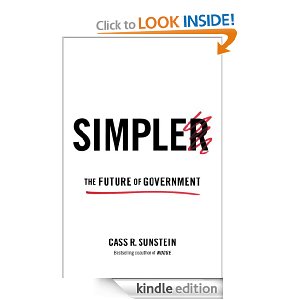
Book-SimplerShould we choose to make it so, the default system could be extensive. In two towns in Germany, 90 percent of the people use clean energy (wind, solar, etc.) because that is the default. If you want the less-expensive, less-clean power, you have to do something. You have to tell them to change it for you.

As shown, most don’t.

This natural tendency toward laziness, procrastination and acceptance can be exploited for good. It doesn’t restrict freedom. It just points everyone in the right direction. If they choose, they can turn around and go the other way.

Learn more about doing nothing to save the world by reading “Simpler: The Future of Government,” by Cass R. Sunstein.

By Lanny Morgnanesi