By Lanny Morgnanesi

On a rainy September afternoon at the Bluestone Country Club, in a ballroom surrounded by an empty golf course, the Shanghainese Association of Greater Philadelphia held its annual gala, and I was the only white person there.
The agenda included music, singing, dancing, a fashion show, door prizes, and a buffet lunch. But overall, it was more like one big commercial. Since there was no English, my escort wife, born and raised in Shanghai, explained most of it to me, even though I figured out much of it myself.
Once through the door, the first order of business was photography. Everyone, everywhere, was taking photos. On the path to the ballroom was a tripod mounted with a ringed light and a device that took and showed you five photos of yourself, then sent them to your phone. Long line for that.
Next was a large, wall-mounted banner with the group’s name on it, in English and Chinese, and a hired photographer taking pictures for the group’s website. There was no formal line. Instead, you pushed your way forward in a competitive tussle.
After that came the ballroom, with about 300 well-dressed people (told to wear black and white) mingling about and shooting with their phones.
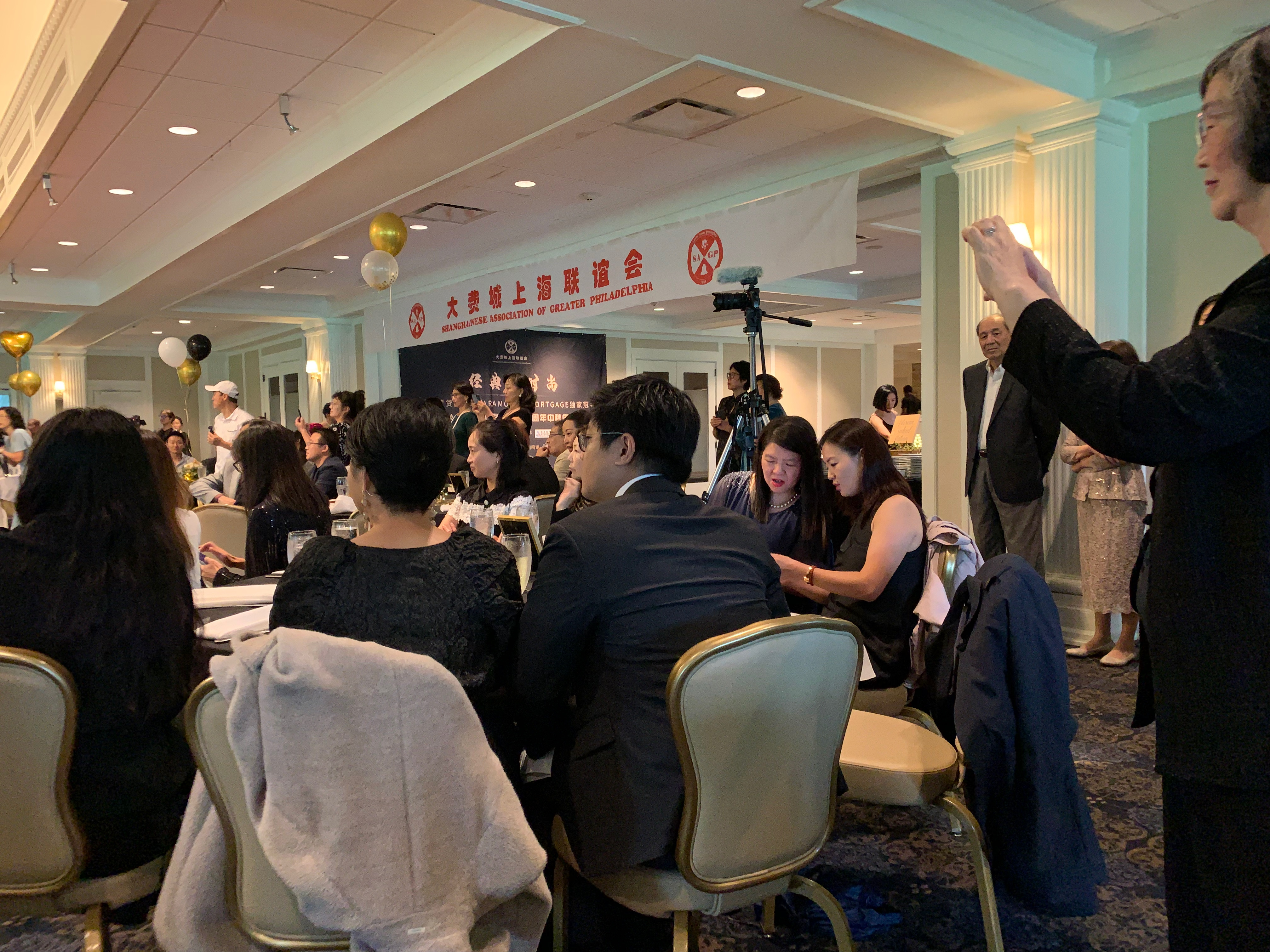
The proceeding began when a fit-looking man in a well-tailor suit addressed the crowd. Poised and confident, he had organized the event and helped secure a panoply of sponsors. At first, he welcomed the people. In short time, however, he pitched his real estate business and advised the group to connect with him on the Chinese app WeChat to learn about the newest real estate deals. He was an effective promoter of himself, and no doubt owned a significant piece of the area’s Chinese real estate market.
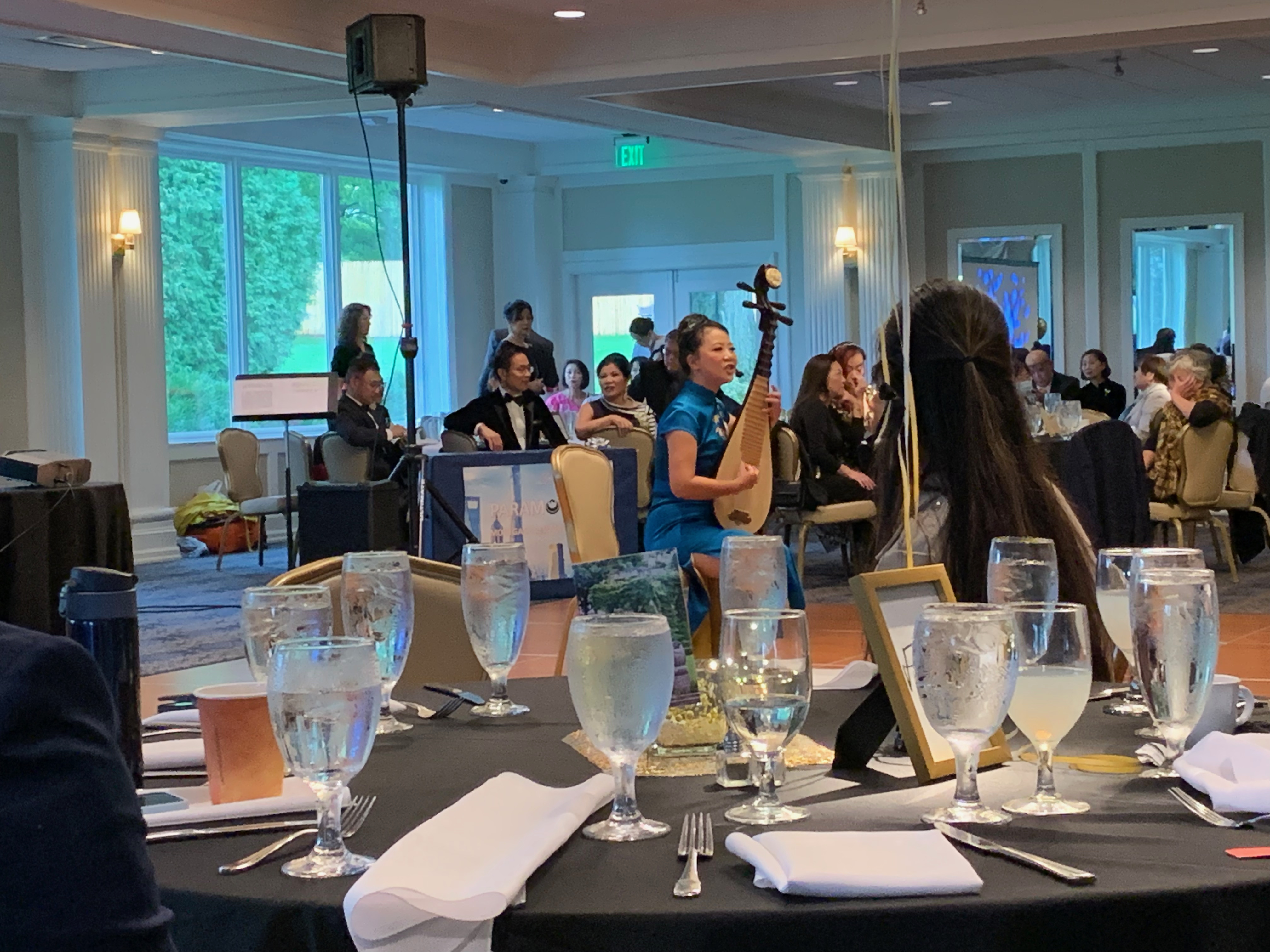
He was followed by a musical performance, a woman in a traditional qi pao-style dress who sang and play an instrument called a pi pa, a sort of Chinese lute or guitar, pear-shaped with six strings. Aside from my wife, this was the only person at the party I knew, and I did not know her well. If fact, I hadn’t seen her for 20 years, and did not remember her name, if I ever knew it. My wife spoke to her first and addressed her as “lao ban,” a title of respect for a store owner. My wife was quickly advised by the lao ban that she no longer was a lao ban.
There was a time, before streaming and serious Internet use, when my wife and I made regular visits to a bookstore and Chinese emporium owned by the former lao ban. It was on Race Street in Chinatown, a huge, two-story building filled with Chinese merchandise you could not get elsewhere. We went there often to rent Chinese language videos and buy a few books. Chinatown has developed a lot since then, with a more vibrant economy and new, more innovative entrepreneurs who displaced old-school, never-change Cantonese. Longtime establishments have been replaced with contemporary noodle houses, soup dumpling places, and dim sum joints. The lao ban, who had rented her huge building, probably was priced out of the market after Chinatown became hipper and the video and book market died. Where her business once stood, there is a two-tiered Asian food court.
The lao ban, perhaps in her 60s, is now a musician and singer of Chinese opera. On this day the Bluestone Country Club had the perfect audience for her, but, unfortunately, an imperfect sound system. There was distressing feedback. The volume was too loud, and high notes came off like screeches. I felt bad for her as she played on. The feedback was fixed for the next act, but the system continued to deliver poor quality sound, which, I guess, the audience got used to. They cheered loudly for a young woman in a shiny, tight, blue-sequined jump suit who danced and sang a contemporary song called, “Give Me a Man at Midnight.” She was good, but I wanted to hold my ears. Others seemed more than content.
Next, a contingent of trained amateurs took the floor and performed a waltz-like dance to the tune of Moon River. It was more like walking than dancing, but the women wore gorgeous gold dresses, and it was fun watching them. When it concluded, audience members were told where they, too, could get dance lessons.
There was a fashion show, with women of various ages posing and strutting like runway models. This was followed by information on modeling classes. There was no entertainment related to banking, cosmetic surgery, or travel, but people pitched those services anyway.

As the afternoon unfolded, I paid attention to language. I found it interesting that speakers addressing the crowd spoke Mandarin Chinese, the national language of China. But off stage, while chatting amongst themselves, they spoke Shanghai dialect. No one outside of Shanghai understands Shanghai dialect. It is spoken with pride by members of an exclusive group that considers its hometown the singular place in all of China for high style and hipness. To them, it is the epitome of elan, a better-than-New York equivalent of 26 million people. It has such appeal you must be born there to live there or get special permission to move there. The Shanghainese are a tribe, and they think highly of themselves. They have names for people who are not Shanghainese. And they have a name for their women, who are stereotyped as self-possessed, demanding, spoiled, and self-centered. It is both a polite and derisive term, a little like “Jewish American Princess.” The hard-to-handle women from China’s largest city are called “Shanghai little sisters.”
But back to the dialect, which I’m thinking helps to define Shanghai cool. While the dialect is substantially different from the national language, some alterations are slight. For example, the common Chinese greeting “ni hao” (literally: you good), was changed in Shanghai, for some reason, to “nong hao.” The common good-bye of “zai jian” (literally: see again) was changed to something that sounds like “zay way.” To decline an offer, the Chinese normally say “bu yao” (literally: don’t want). But the Shanghai residents slam those two syllables together, speed them up, and put a different sound at the front, saying “v-yow.”

Here is an example of how protective the Shanghai people are of their exclusive dialect. I was in the dessert line and the guy behind me struck up a conversation in English. He had come to the United States as a student in 1985 and trained as an engineer at Columbia.
“I guessed you’re confused by all this Shanghai dialect,” he said in a joking way.
“Of course,” I said, “but I know a few words.”
He looked at me as if that could not be true.
Then I said the few words of Shanghai dialect I knew. Oddly, he repeated those words back to me in Mandarin. No, I said, I know the Shanghainese. And I repeated the words again, with him once again saying them in Mandarin, as if I were not allowed to speak that way or couldn’t possibly know what I was saying. Finally, I convinced him that I had gently penetrated the veneer of his beloved dialect. He smiled uncomfortably and shook his head. We both got dessert and parted.
So at the party, as the spoken word shifted effortlessly between a defining dialect and the linguistic standard, I thought about American English and concluded that there is nothing comparable to this in the U.S., no comfortable, communicative patois used in a secret way outside the button-down structure of society.
Or is there? A question for another day.
After the entertainment came lunch. When going to an affair such as this, one expects Chinese food. There was none. No chopsticks, either. The buffet was bread, salad, green beans, potatoes, pasta, pot roast, and salmon. The partygoers filled their plates high, without reluctance or aversion. I guess the country club chef didn’t offer a Chinese option, and that clearly was not a problem for this crowd.

After about four hours, the party winded down. It was time to leave, and the rain was still heavy. We did not, however, get wet. Everyone received a well-built umbrella, courtesy of the Paramount Mortgage company, whose name appeared on the umbrellas in both Chinese and English.
On the way out, the partygoers continued to define themselves as unique. You could hear lots of “zay ways,” but not a single “zai jian.” A group of young Shanghai little sisters, outfitted in fine dresses, pushed past me, seemingly arguing among themselves, or perhaps debating a point or two about the party, or maybe discussing where to go next. I didn’t understand a word of it, and I’m sure they took great comfort in that.
 notebookm.com