Fran Lebowitz – a true New Yorker talking through the cheers and boos

31 Aug

Lebowitz portrait

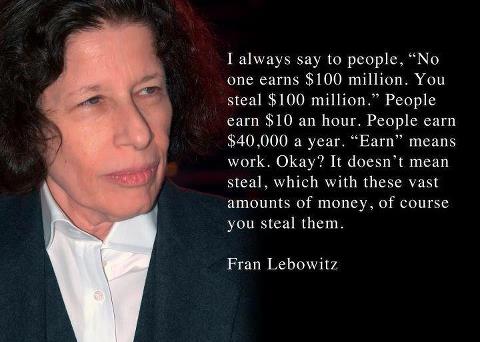
Fran Lebowitz is a comic writer who has a difficult time writing. So instead, she speaks.


She’s the quintessential New Yorker. She loves her town. She celebrates it and it celebrates her. Real New Yorker’s like people with opinions – brash, bold ones – and brash, bold opinions are Lebowitz’ chief currency.


Her Grade A conversation makes her popular and in demand. She’s simply fun to be around.


waverly signI never met her, but her charismatic magnetism is on display in a documentary entitled, “Public Speaking.” The film is directed by her friend, Martin Scorsese. Much of the footage is of Scorsese and Lebowitz sitting and talking in her hangout restaurant, The Waverly Inn in the West Village.


<iframe width=”560″ height=”315″ src=”//www.youtube.com/embed/uLceaQuFyQE” frameborder=”0″ allowfullscreen>


In the film, Lebowitz complains that New York has gotten boring. The grit and nastiness she liked disappeared when the city cleaned up to attract tourists. Especially sanitized was Times Square, an area Lebowitz says no self-respecting New Yorker ever visits.


A second trauma that damaged New York, she says, was the AIDS epidemic. The city’s great culture, especially the performing arts, existed in such a high state only because of the demanding and enthusiastic audiences, mostly gay. In her view, the audience is just as important, if not more important, than the performers. The old New York audiences knew every nuance of ballet, opera, all of it. They wouldn’t tolerate a single flaw, and the performers were aware of this. But the caliber of the audiences fell as thousands of gay New Yorkers died of AIDS. This, she said, devastating New York culture and all of the performing arts.

FranLebowitz-quote

Lebowitz has an interesting take on the gay rights movement. She said the best thing about being gay was you could avoid marriage and the military. Now, those benefits have been undone by foggy-headed reformers who were trying to do good.


The author of several books who has made countless public appearances, Lebowitz tells Scorsese of her most horrible experience on a stage. She was booed by over a quarter million people.


The setting was a massive rally of activists trying to convince leaders of the old Soviet Union to allow Jews (Lebowitz is one) to emigrate. Lebowitz was among the speakers who was asked to read a letter of appeal from one of thousands of oppressed Jews. But she also was asked to say a little something first.


Referring to a petition with thousands of signatures, she said something like:


“I expect the leaders of Russia to respond positively to these demands. I know I wouldn’t want this many Jewish women mad at me.”


And the boos rained down on her.


So be it. Nobody can take a joke anymore.

The theme of this blog at NotebookM is, “Speaking, because it is allowed.” What I love about Fran Lebowitz is she speaks. God bless her for that. And God bless Martin Scorsese for bringing us this film about her.


By Lanny Morgnanesi


Lebowitz Quotes


“Very few people possess true artistic ability. It is therefore both unseemly and unproductive to irritate the situation by making an effort. If you have a burning, restless urge to write or paint, simply eat something sweet and the feeling will pass.”


“Great people talk about ideas, average people talk about things, and small people talk about wine.”


“Romantic love is mental illness. But it’s a pleasurable one. It’s a drug. It distorts reality, and that’s the point of it. It would be impossible to fall in love with someone that you really saw.”


“All God’s children are not beautiful. Most of God’s children are, in fact, barely presentable.”


Big war, small peace – did Stephen Hawking really know the truth?

29 Aug

Cambridge3

I was waiting, so I picked up a book. Inside, just a few pages in, was a simple sentence with the power to uplift, encourage, and promote optimism.


It seemed to confirm the idea that there was light amid the dark; that somewhere below the horrid nature of mankind there was good trying to surface.

Sadly, that sentence – written as a statement of fact – is probably wrong. Oddly, its author is one of the world’s most intelligent men.


Hawking book jacket-bioThe book was “My Brief History,” the 2013 autobiography of physicist Stephen Hawking, the man in the wheelchair with the synthetic voice whose life is now a major motion picture called, “The Theory of Everything.”


The movie is more a love story than a science story. Still, its title comes from Hawking’s pursuit of a unified way of explaining all forces in the universe.

In the book, Hawking talks about his birth in Cambridge, England, home of one of the world’s greatest universities. His reason for being born in Cambridge is what uplifted me. His casual little sentence was a gentle piece of history I had never heard of; one of those marvelous pieces of information that suggests we maintain a small degree of civility even as we try to utterly destroy each other. It was like reading for the first time about the unofficial Christmas truce during World War I, when soldiers from both sides climbed out of the trenches, sang songs together, exchanged presents and even played soccer.


In Hawking’s case, the scene is World War II. The scientist said his family moved to Cambridge because the English and the Germans had agreed it was not to be bombed. Also under protection was Oxford, and in Germany the universities at Heidelberg and Goettingen.


I had never heard anything of the sort, but recognized that such an agreement could easily have been buried in the rubble of all the other destruction. Visualizing the leaders of these two warring countries shaking hands on this was heart-warming. I actually pictured them doing it.


But I guess even Hawking can get things wrong.


The fact-checking site Snopes.com said the agreement mentioned by Hawking had been an Internet myth. It’s likely to spread further now with Hawking’s book. Additional searches could not confirm the agreement.


Of course, Cambridge was without strategic value and bombs were precious, so it was much safer to be in Cambridge than in London. Hawking’s father probably moved the family there just to lessen the odds of being killed.


With many others doing the same, the myth of protection probably evolved and spread. I’m sure it made living in Cambridge a lot more comfortable.


Cambridge bombedMyth or not, in 2010 a BBC website ran a story on the 70th anniversary of the bombing of Vicarage Terrace in Cambridge. It has a woman named Barbara Wright remembering the incident. She was six. There’s a photo.


“Suddenly there was a huge noise,” she said. “The actual walls on either side came in and practically touched us.”


The story said nine people were killed in the attack, and that they were the first British civilian casualties of the war.


The fact that the myth exists even when there is proof that Cambridge was bombed shows the power of myth and the need to believe in good things.


If anyone can shed additional light on the myth, the truth, or Stephen Hawking, please comment. Perhaps the full story still remains to be told. Please don’t, however, write if you have info that the Christmas truce was a myth. Let’s at least leave that one in place. After all, they made a movie out of it.


The trailer is below, along with that for the new Hawking movie.


By Lanny Morgnanesi


<iframe width=”560″ height=”315″ src=”//www.youtube.com/embed/Salz7uGp72c” frameborder=”0″ allowfullscreen>


embed trailer

Hobos, happiness and the Big Rock Candy Mountain

24 Aug


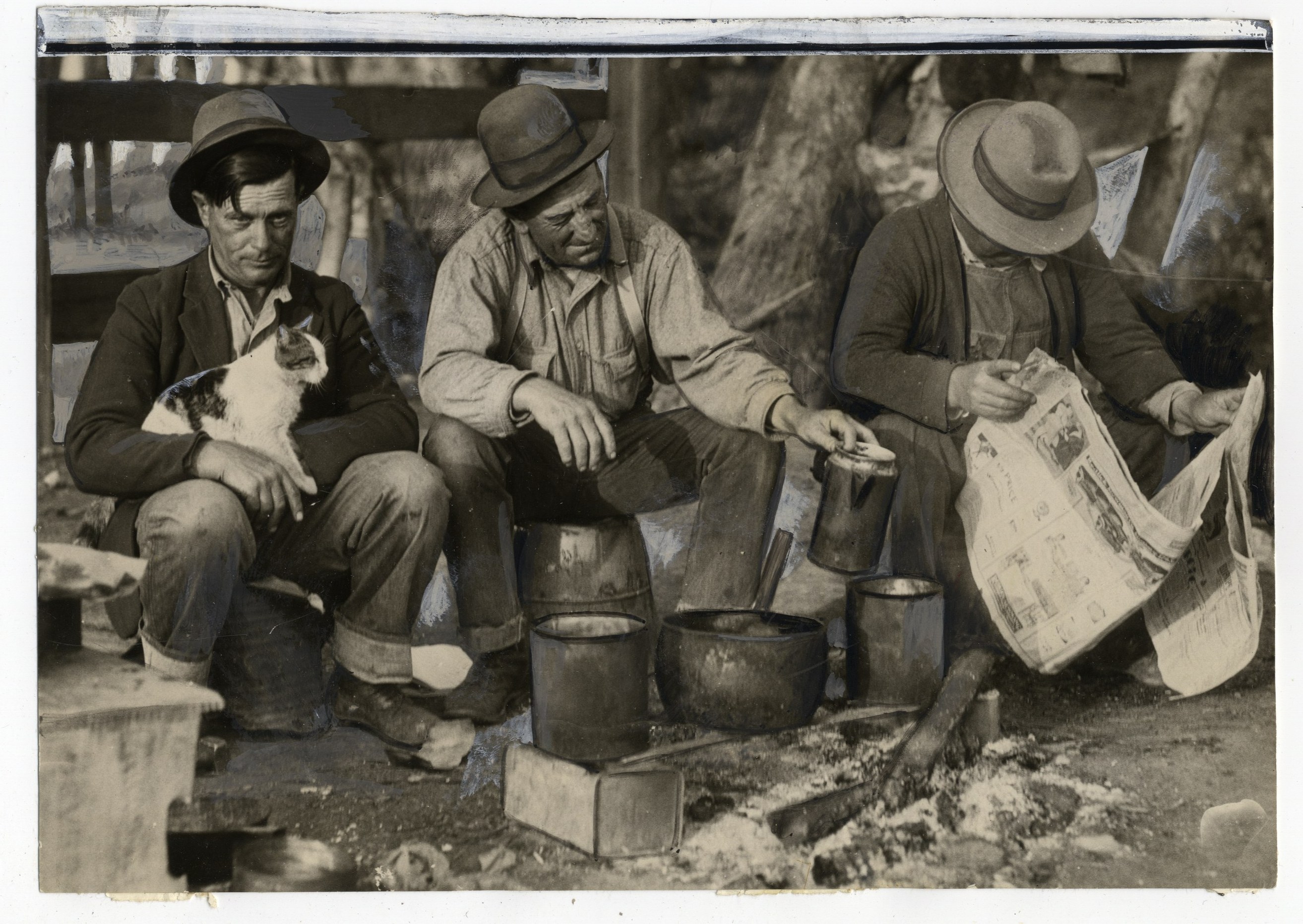
Hobos

I used to think “Big Rock Candy Mountain” was a children’s song. It’s not. It’s a song by and about hobos that someone made into a children’s song.


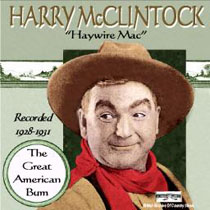
Harry McClintock, a hobo known as Haywire Mac, was the first to record it in 1928. It depicts a hobo’s paradise. You don’t see many hobos today but they were common and plentiful during the Depression.


The Coen brothers used the song in the movie, “Oh Brother Where Art Thou?” Recently, I watched the movie again on TV and gave a close listen to the lyrics of the song.


Harry-mcclintockIt describes a place where cops have wooden legs so hobos can out run them. The jails are made of tin so hobos can easily escape. On the Big Rock Candy Mountain, boxcars are always empty and lakes are filled with stew and whiskey. There are no short-handled shovels.


That’s the hobo’s idea of paradise.


After hearing the song, I though that if I were a hobo my paradise would have no cops and no jails. It would be a place where someone down on their luck could crawl out of their hole and make a good living; a place where even a hobo could be somebody.


What I failed to understand was that in my hobo paradise, a hobo would cease being a hobo. As I listened to the song again, it became clear that while hobos may want an easier life, they still want to be hobos.


Which raises the question: How true is this of other people and their lives?


Amidst our general hardship and discomfort, apart from our complaints and dissatisfaction with the small and the large, are we actually … happy?


As you think, consider this little story.


I once spent the Fourth of July at a country club. The fireworks were fantastic and the food was beyond good. There were hot dogs and hamburgers but also barbecued chicken and ribs, all you could eat. On a table the length of an interstate was an assortment of desserts.


In addition to bringing me, my host brought an African-American boy, about 12. He was from a Philadelphia neighborhood that was experiencing a rash of random shootings and killings. The little man was brought to the suburbs via a program designed to give poor children a break from the stresses of violence and poverty.

He was the only black person at the affair.


As I worked on my second helping of ribs, he sat with his head on the table, almost dozing off.


“Tell me,” I said. “Would you rather be here or home?”


He paused, apparently not wanting to seem ungrateful, then smiled and said, “Home.”


For him, happiness was the familiar, not the strange.


The familiar is comfortable and predictable. While I can’t document this, I have heard of a study showing that people, if given the chance to exchange all their problems and ills with the problems and ills of another person, would decline. If true, this is further evidence that no matter who we are, we like our lives.


Andy-Capp-Cartoon Pictures (1)It’s been said that England is defined by its class structure, and that people recognize and take pride in their station, be it high or low. They wear cloths and banners proclaiming their class – like the Jeff cap worn by the working-class cartoon character Andy Capp.


I don’t think we do that in America, but maybe I’m just blind to it. Either way, listening closely to “Big Rock Candy Mountain” has made me believe that America, for all its problems, is a land of contentment for both the haves and have-nots.


It’s so content that most don’t even vote.


While a peaceful populace has its advantages, it also has its dangers. Injustices are easily wrought upon the passive. Eventually, they create a destabilizing imbalance that will harm everyone – even their originators.


Income inequality is such an imbalance. In nations, stability and economic might are derived from a deep, viable, productive middle class, with a minimum of poverty and want. But when wealth is concentrated among the few, as has occurred in the U.S., the whole system is threatened because the many stop spending.


An alarm was sounded recently by Standard and Poor’s, the bond-rating company. It released a study showing that income inequality is responsible for a slowdown in the American economy. A headline on Fortune.com read:

More concentrated wealth means less spending than if money was spread to more people, according to a new report.


This realization, and others like it, is putting income inequality on the national agenda. Balance, to some degree, eventually will be restored. But it is because the elite acted, not the complacent.


I realize people get set in their ways; that they like routine and follow habits religiously. Still, there comes a point when routine is dispensed with in order to preserve dignity, honor and respect that were compromised by imbalance. At home, this happened in Ferguson, Missouri. Abroad, it happened in Gaza. The wise nation will avoid such flashpoints. More common is that they will act after the fact.


The better way, at least in the U.S., is self-action prior to the flashpoints.


We all need to get off the Big Rock Candy Mountain and take personal responsibility for our collective fate. Areas of concern are fairness, equal opportunity, equal treatment, social justice and civility. Legislation and tax policy must be designed for large segments of the population rather than small.


Key tools: Vocalization and voting.


Voting, real voting, is a powerful concept that has gone dormant in the U.S. We should try reviving it, just to keep the system fair and honest. Voting shows we are alive and paying attention.


There is nothing wrong with being happy and complacent. Complaisance, however, should never interfere with our ability to stop those who would chip away at our happiness.


Human rights, said Alexander Hamilton, are written “by the hand of the divinity itself.” They cannot, he said, “be erased or obscured by mortal power.”


By Lanny Morgnanesi


<iframe width=”420″ height=”315″ src=”//www.youtube.com/embed/JqowmHgxVJQ” frameborder=”0″ allowfullscreen>

On Breaking the Cycle of Hate in Gaza and Israel

5 Aug

Gaza rubble

Dangerous are the men and women with nothing to lose. Count the people of Gaza among them.


They will have the world burn and themselves with it. They are accustomed to death, to being trapped and hunted, and will die just to make a point.


Gaza is a place often described as an open-air prison. The people can’t leave. They are caged. What goes in and out is controlled. Not even a fish can be taken from the sea. The view of that sea can ease the claustrophobia, but only if one ignores the war ships on the horizon.


Mohammed Suliman, a Palestinian human rights worker in Gaza, compares the plight of his people to the Jews in the Warsaw ghetto. In the Huffington Post he writes:


“The besieged Jews of the Warsaw ghetto had a motto ‘to live and die in dignity.’ As I sit in my own besieged ghetto, I think how Palestinians have honored this universal value. We live in dignity and we die in dignity, refusing to accept subjugation.”


There is nothing unnatural in what the Gazans do. In their situation, most of us would do the same. We don’t realize that, and won’t admit to that, only because we can’t see ourselves living such a life, can’t even imagine that such a life exists.


If the Palestinians in Gaza were docile, their conditions would be better.

Gaza map2The blockade of Gaza is justified as way to combat Palestinian terrorism. And so in striking out at those who created the blockade, Gaza must face its own terror.


Israel says it will make Gaza pay an “intolerable price,” which it can. Hamas says it will destroy Israel, which it cannot.


Hamas, which rules Gaza, sends men into Israel with guns and bombs. It sends in barrages of largely ineffective missiles. In return, Israel destroys Gaza neighborhoods with jet fighters and missiles, effective ones.


The death toll is lopsided. In Gaza, schools, hospitals, homes and places of refuge are bombed. So-called “human shields” die rather than shield. Maternity hospitals become morgues.


What Israel sees as Palestinian terrorism, the Palestinians see as resistance. There is no common ground for negotiations. This lack of understanding is ironic, since the Hamas approach was used by Jewish freedom fighters in their battle for independence with Britain.


What both sides can understand, however, is the preponderance of hate and the need for vengeance and retribution. There is no thought or concern for humanity.


While American critics of Israel are being silenced with charges of anti-Semitism, and while real and vicious anti-Semitism grows in sympathetic Europe, I try to remember humanity.


I try to avoid the obscuring cloak of religion and see people simply as people and tragedy simply as tragedy. I ignore old scores but recognize the destructive dynamics of power and politics and the readiness to kill to maintain power.


I try to see the many victims of power, and the people who must rally around it for protection and as a way to secure the basic necessities of life.


With this kind of view, perhaps some answers can be found. Yet the situation grows increasingly complex.


There is new instability in the Middle East that is making matters worse. A growing number of Arab nations see Hamas and the Islamic movement as a threat. Like Israel, they want Hamas neutralized. And so these countries, mainly Egypt and Saudi Arabia, provide back channel support and momentum in the campaign against Gaza. In a way, we are witnessing a proxy war in the Sunni-Shiite fight for regional dominance, which is further complicated by an intra-Sunni rivalry.


As a result, hostility is layered upon hostility, making resolution much harder to achieve.


When the current war ends, Egypt, Israel and Saudi Arabia may find – to their disappointment — that Hamas actually is stronger. After absorbing such terrific blows, it may win concessions pushed by the United Nations and the international community. Some of the borders around Gaza could open.


With people being able to get TVs, medicine, motorbikes and much more of what they need and desire, a degree of calm and possibly optimism will set in. The intelligent thing for Israel and Egypt to do is to go beyond any negotiated settlement and open borders even wider and increase that optimism. They should rebuild schools, hospitals and neighborhoods. They should initiate cultural exchanges and promote commerce and trade.


Gaza should be made a decent place to live.


Regardless, some Palestinian fighters will continue their attacks, keeping Israel under threat. But slowly, very slowly, sympathy for Hamas could shift to a more accommodating faction. With hate and revenge so insidious, nothing short of a Gandhi-esque approach will work in Gaza. And it will take time.


As a big assist, America’s warlike attitudes in these conflicts must end. American Jewish organization and American Jews in general can and should play a part in a new peace initiative. Likewise, Christian organizations must seek to heal and stop seeing Arab progress as a threat to Biblical prophecy. All who value religion need to recognize the importance and necessity of brotherhood and the sanctity of life.


A continuation of current policy only guarantees resistance, rebellion, instability, unhappiness, death and a bankruptcy of our collective spirit.


Mohammed al-Banna, a Palestinian who in one morning lost nine of his in-laws, told the New York Times, “The aggression here is creating a new generation of youth who want revenge for all the crimes.”

There is no future in this. The cycle of hate and death needs to be broken. The outstanding question is: Who or what has the courage, stamina, patience, temperament and love of mankind to do it?

By Lanny Morgnanesi

A ball, a glove, and a measure of virtue

26 Jul

how_to_catch_a_fly_ball

“When you were a kid, could you catch a fly ball?”


A simple, direct question, but one with consequences.


I asked him to repeat it as a way to buy time for my response.


“When you were young, could you catch a fly ball?”


You’ll notice the question doesn’t probe into the deep levels of athleticism. It was not, “What was your batting average?” or, “Could you execute the double play?” Rather, it concerned a basic, essential skill that spoke to a young person’s place in the small world of his neighborhood.


Back when cars had grills, if a kid could catch a fly ball, he could be relied on. Catching a fly ball was evidence of a competency that earned respect and trust. The person who could catch a fly ball had the tools needed for living the young life. This was a steady person; someone confident, reasonably brave, thoughtful, and probably fair. A lad who could catch a fly ball usually had the ability to see clearly and act decisively.


You wanted this person by your side, like Kirk wanted Spock, like Ishmael wanted Queequeg, like the band wanted its brothers.


No 12-year-old ever said it like that. It wasn’t outwardly understood. But it hung over everything and was very real.


“Well, I caught some and I missed some,” I answered.


“So, basically, you could catch a fly ball?”


Actually, my baseball career was more of a continuum. I started lousy and got better. At its end, I satisfied myself. It was during the early days that I had doubts.


“Let me ask you a question,” I said. “Did you ever play against someone who tried out for the majors?”


“No.”


“Well I did,” and I told this story.


I was about 12. We were all small and he was big. His name was Sonny. He was a legend and we worshiped him. Sonny lived a couple neighborhoods over but one summer he started dating a girl on our street. This was the summer he tried out for the Phillies at hallowed Connie Mack Stadium. It was an event he had described to us in great detail. Since Sonny was around because of his girlfriend, he’d occasionally play with us.


One day on the sandlot I was in the outfield. Sonny came up to bat. On the first pitch he ripped a long, hard drive to center, where I was. I was deep, but when the bat cracked I went deeper. I tried to get under the ball but couldn’t. Finally, I dove, desperately. Somehow, the ball landed in my glove. A small miracle.


That was the final out and I went in. Sonny was coming out and he said to me in mock seriousness, “Hey kid! You robbed me of a homer.” I stuttered and apologized. “Sorry Sonny. I didn’t even know I had it.”


Then he smiled and said, “I’m just kidding. You did good out there. Keep playing like that.” He touched me on the head and ran to short.


“Cool story,” my inquisitor said. “It’s settled. We’ll say you could catch a fly ball.”


Then he pointed to the cover of a DVD he was about to loan me. It was the kid’s movie “Sandlot.”


“You’re him,” he said, showing me which character probably was most like me.


That’s what started this. A movie. Outwardly, it was not about competency, trust and virtue. Inwardly, it was, and I guess I passed the test – a test for 12-year-olds.


In adulthood, there is no gauge equivalent to a caught fly ball. The ancient Greeks spent much time discussing and analyzing noble qualities and the nature of virtue, defining it as excellence and goodness. But they were unsure if it could be taught or if it had to be naturally acquired. They saw it primarily as wisdom, from which all good things come. The Greeks knew a virtuous person when they saw one, yet failed to pass down a yardstick appropriate to our times.


Still, we can try to judge. I once worked with a man whose every action spoke of goodness. This was partly because he was selfless. We worked together in a country that didn’t hire janitors. With no allowance for rank, the regular staff was responsible for cleaning the office. Of course, no one did. The one exception was this senior gentleman, who by the simple act of dusting and mopping set himself apart from everyone else in the office.


This was a man of virtue.


The world really is not made for the virtuous. Before I met him, this virtuous man had served 10 years in solitary confinement for the crime of being an intellectual. In theory, identifying the virtuous so that they can lead and guide is wise; in practice, it is pointless. At least a time once did exist when small boys could look out over a diamond drawn in dust and know for sure who they could trust.


So how do you catch a fly ball? If you’d like to learn, follow these three steps:

  1. Gaze at the ball.
  2. Run.
  3. Adjust your speed so your gaze stays constant.


That advice comes from mathematics philosopher Gregory Wheeler. For a more instructive lesson from someone who is not a philosopher or a mathematician, watch this video. It could set you on the path to righteousness.

Lanny Morgnanesi

<iframe width=”560″ height=”315″ src=”//www.youtube.com/embed/1kLwkivjyD8″ frameborder=”0″ allowfullscreen>


Two quotes, one old, one new, about something that existed then and continues to exist now

12 Jul

Caradoc in Rome


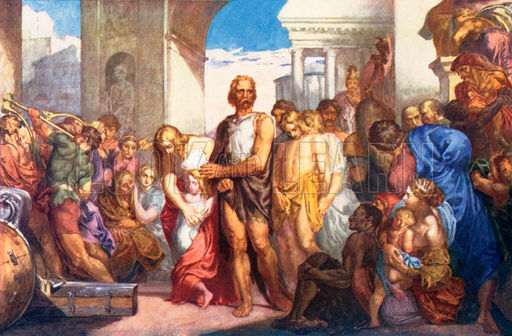
The first speaker is Caratacus, the British tribal leader who resisted the Roman invasion in 43 AD. He eventually became a prisoner of the Romans. After a convincing speech prior to his scheduled execution, his life was spared. Caratacus was so impressed by the city of Rome that, in amazement, he said this to his captors, who conquered and occupied Britain:


“And can you, then, who have got such possessions and so many of them, covet our poor tents?”


Goldman-Sachs-CEOThis second quote was said by Lloyd Blankfein, CEO of Goldman Sachs, a man whose job it is to make abnormal amounts of money in any and all ways possible and some that are not possible:


“Too much of the GDP over the last generation has gone to too few of the people… . It’s a very big issue and something that has to be dealt with.”


In both cases, the powerful have taken and then tried to exercise at least modest restraint to make things a little better. And so it continues.

By Lanny Morgnanesi

You’re nothing, but suddenly you’ve got what everyone wants

7 Jul

Venezuelan prostitutes


Without judging, blaming, or saying I wouldn’t do it, the standard model for business is that those who dominate the financial markets rig them in their favor. That’s really not a shocker. The shocker is that once in a great while something occurs in the market place that benefits those of little means.


Right now the beneficiaries of fate’s largess are the prostitutes of Puerto Cabello, Venezuela.


Not long ago, Venezuela was flush with petro-cash and acted brashly and boldly on the world scene. Under socialist President Hugo Chavez, Venezuela even helped 400,000 poor Americans pay their winter heating bills. Chavez, however, is dead and gone and the Venezuelan economy has all but collapsed. People can no longer find things like cooking oil and flour in their local stores.


Spared from this hardship are the prostitutes of Puerto Cabello. This has not so much to do with the sex trade as it does with the currency trade.


An article by Anatoly Kurmanaev in Bloomsberg Businessweek explains the scenario.


The Venezuelan currency is the bolivar, and it has taken a nosedive. The official exchange rate is 6.3 bolivars per dollar but the going rate on the street is 71 bolivars and climbing. Either way, dollars are very hard to get. The government restricts their circulation.


But foreign sailors, the primary customers of prostitutes in Puerto Cabello, a port town, pay in dollars. This means the prostitutes now possess the most sought-after item in the country. Currency traders seek them out and lavish them with bolivars in exchange for their dollars. This enables them to purchase whatever they want on the black market.


By the way, the prostitution is legal but the currency trading is not.


Sailors are charged a flat rate of $60 an hour. With the new market conditions, one trick is equal to the monthly wage of some people. But the prostitutes also book hotels and taxis for the visiting sailors. They charge them in dollars and pay for the rooms in bolivars. This increases their salary another 50 percent.


So here’s to the horizontalists of Puerto Cabello. I think they deserve this unexpected turn of events. No word yet on anyone rushing in to deny them their windfall. That’s noble. I sense in the United States the good times wouldn’t last long. If something the poor had became valuable it would be taken away. If a commodity as unwanted as, say, rat droppings was needed to make a new cancer drug, rich investors would quickly buy up the dropping rights at all the infested slums of major American cities, leaving the tenants unable to benefit from a sad condition turned bright.


On this score, the Venezuelan elite seem much better sports than their American counterparts. The extra money earned by the prostitutes, incidentally, goes for things needed by their families. But as a prostitute named Elena points out in the article, she still has to sell her body.


By Lanny Morgnanesi


(Photo by Vladimir Marcano /Bloomberg)

A minor indiscretion that went unnoticed

24 Jun

Hot tub blur

I live in a picture-postcard town with lots of shops on and off Main Street. The merchants come and go and recent openings include a waffle-and-ice cream emporium, two vap parlors and a store made up like a pharmacy that sells “medicinal” cold-pressed juice for $7 a bottle.


People around here keep up with the shops, but there’s one that everyone overlooks. Instead of being parallel to Main Street, it’s set at an angle. When you round the corner right before it, your line of sight is directed elsewhere.


No one ever looks in that window. I know because I sat in it with two blondes wearing bikinis.


That was years ago.


The story begins at the county courthouse in the center of town. I covered the government there as a reporter. The important offices were on the fifth floor and were guarded by two sentinels sitting at adjacent desks that formed a sort of barrier. The sentinels were young, blonde and attractive. They looked alike and both had the same first name.


For the sake of this story, let’s say it was Donna.


To secure information or to speak with the people running the county, reporters had to get past the two Donnas.


On a day when I needed something special, the two Donnas were in a good mood and complied. In exchange, they demanded something of me.


“Tomorrow, meet us on Main Street at noon. Bring cheese, crackers, pepperoni and your bathing suit. We’ll bring the wine.”


They would say no more. As I think about it now, I really didn’t need to know more.


The two Donnas showed up as promised and walked me to the store that sits at an angle. We made the little turn and they explained.


“Our friend is renting this now,” one of the Donnas said. “He asked if during lunch we could help with his new business. He wants us to sit in there,” and she pointed to a steaming, redwood hot tub in the window.


This was a government town and I was fairly well known by all the government officials. Most took lunch at the local restaurants and would be passing by. While there was great appeal to the idea of being immersed in hot water with two almost-identical women who had the same name, I worried about my reputation. This was a town where people talked. I didn’t want them to be talking about me, especially when my job was to talk about them.


“Oh, c’mon,” one Donna said.


“Oh, c’mon,” the other Donna said.


And so I went on.


They were relaxed but I was tense. I watched the window as people passed, waiting for that moment when some authority figure – maybe a judge — would pause, stop, turn, point and show utter disgust. After a glass of wine, the tension seemed to boil off.


We were having a good time and had forgotten the world. But after a while we grew concerned – perturbed – that not a single person had noticed us. How odd. In an effort to draw attention, we frolicked in a more pronounced way, and still nothing. We yelled and waved, but no one waved back.


Was it us?


No, it was the store.


Hot tubs were popular around this time, but the friend of the two Donnas went out of business in just a few months.


I learned a couple of important lessons from this. First, have fun while you can. Second, before you open a business, for god sakes do a little research.


By Lanny Morgnanesi

When the poor stop going to McDonald’s, we’re all in trouble

20 Jun

mcdonalds-meal

Businesses like Wal-Mart and McDonald’s haven’t been doing well.


People without a lot of money usually go to these places, but because they now have even less money, they’ve stopped going. When people who work at Wal-Mart and McDonald’s can no longer afford to shop and eat there, it’s a sure sign of a coming, broad-based financial decline.


It will affect us all, even the rich, who don’t amount to much if they can’t get the poor to give them money.


Reports show that the parade of U.S. customers into Wal-Mart fell 1.4 percent during the first quarter. That followed a decline of 1.8 percent in the prior year.

The discount retailer blamed the bad winter weather but also cited cuts in food stamps, higher payroll taxes and the increased cost of health care.


You know things are bad when Wal-Mart relies on the food stamp program to move product.


Walm-MartRecent U.S. sales at McDonald’s also have declined, by 1 percent. To lure back low-end customers, the burger behemoth increased its value menu, but that hurt profits even more.


What’s happening is the downward pressure on income is leading to downward pressure on sales.


Henry Ford used to pay his people well so they could buy cars. If Wal-Mart and McDonald’s have any sense, they and the other minimum-wage shops will copy this strategy. Not doing so will have consequences. It could turn the U.S. into another Japan – the bad one, not the good one.


Japan was once the globe’s supreme economic power. It made and sold great products while setting new standards for manufacturing. Flush with cash, Japanese investors bought up billions in prime New York real estate, and nearly everything else. During this period, in the mid-80s, I visited Hawaii, which seemed more like Japan. Japanese tourism and culture were so strong that hippie beach bums peddling sailing lessons had to learn Japanese.


Then came the bust, the swoon and massive disinflation. It began around 1990. People in the U.S. don’t understand disinflation. It’s when prices fall and fall and fall and still no one buys anything. The economy becomes comatose. Seems impossible, until you look at Japan, where disinflation has been a cruel fact of life for a couple decades.


According to Bloomberg Businessweek, one contributor to Japan’s disinflation is falling wages. The recent habit of businesses there, as in the United States, is to avoid hiring full-time workers and instead contract with temporary workers who earn less and have no job security. These temps now make up about 40 percent of the Japanese work force. They are paid about 38 percent less than full-time workers.


The financial and social divide between the two kinds of workers has grown and is causing multiple calamities. For example, no one wants to marry a temp. This depresses birthrates and is making Japan a nation of elderly people. Banks won’t give temps mortgages, which doesn’t encourage building. These and other negative trends cascade and the country stagnates.


In the current era, U.S. corporations have reaped huge profits from selling to the developing world. But those markets, at least to some degree, are cooling and maturing. The bread-and-butter American markets may have to be revived in order to maintain profits. That could require a higher minimum wage and more opportunity for the middle class. The government and the business community finally are waking up to this.


The Great Cure for so much – including crime and falling education standards — is to put money back in the hands of traditional spenders. For a time, greed will blind us to this reality. Then the cash register stops ringing and we see.


Wal-Mart and McDonald’s — and all the other places where you can work full-time and not earn a living — now see. Each is probably afraid to take the first big step. Sooner or later someone has to, otherwise that first big step will be involuntary and it will send us over a cliff.


Think about the return of the 25-cent McDonald’s hamburger. Think about taking the family out for one on a very special night, maybe once every couple of months. That disinflation, and it will make 15 percent inflation seem like good times.


Now, we wait.


By Lanny Morgnanesi

Like Ben Stiller, he felt the pain of an unfortunate act. Unlike Ben, he couldn’t discuss it.

9 Jun

franks_and_beans

The Ben Stiller movie, “There’s Something About Mary,” was on the other night and it reminded me of Bill Foley.


Bill Foley was a reporter who always carried a notebook and pen. He needed them for work but also because he couldn’t talk. When you asked Bill a question, he’d pull out the notebook and write his answer. Often, it was only a word or two. Usually, it was funny.


Because of throat cancer, Bill had his voice box removed.


Everyone assumed he could not utter a sound. Through odd personal circumstance, however, I learned this was not true.


It happened while we both were in the men’s room at the Florida Times-Union in Jacksonville. As we stood side-by-side at the urinals, I noticed Bill was in a hurry. Upon closing up, he – like Ben Stiller’s character in “There’s Something About Mary” — caught the frank-N-beans between the teeth of his zipper. And just like Ben, but not as loud, he let out a sound of agony and helpless distress.


The Stiller character, comically, was unable to free himself. Bill quickly fixed things and exited.


And there I was, with a secret to share: Bill Foley can’t talk but when it’s necessary he can moan! I tried being discreet and limited in my telling of the tale, but the worst got the best of me and the story spread. I never heard back from Bill and don’t know if my disclosure ever made it to his ears, which worked just fine.


Bill was a wonderful, witty columnist. Some knew him before the operation. I didn’t. I knew him only from his column, his actions and his laconic, handwritten retorts.


For a quiet guy, he brought lots of personality to the newsroom. I remember the time when lunches were being stolen from the office refrigerator. Members of the Refrigerator Users Group – RUG – went on a tear, sending out threatening memos and edicts to all possible suspects and devising multiple strategies of defense. Bill’s running commentary on the crisis was hilarious and ultimately silenced RUG.


It was pleasant to think of him again.


He died in 2001 at age 62 after working in newspapers for 40 years. I left the Times-Union in 1993 and never read his obit. I looked it up today.


Among other things, it said that, “Mr. Foley had written columns about generations of visionaries, bootleggers, politicos and hapless saps whose exploits helped shape the city.”


It said, “His wry humor and precise, staccato language attracted a following of readers that ranged from schoolchildren to corporate executives.”


It mentioned that he had played catch with Hank Aaron and spent time in Cuba with Che Guevara.


It didn’t mention Ben Stiller, frank-N-beans or “There’s Something About Mary.” For that I am grateful. I’m also grateful that Mr. Stiller, via his one-of-a-kind performance, was able to bring back some nearly forgotten memories of a man who could say a whole lot with so very little.


By Lanny Morgnanesi

<iframe width=”420″ height=”315″ src=”//www.youtube.com/embed/7cm0FZtlcxc” frameborder=”0″ allowfullscreen>