Something I recently learned

4 Jan

Rockefeller-finger

Former New York Governor Nelson Rockefeller, a presidential candidate and the grandson of one of the most successful capitalists in history, once commissioned Mexican artist Diego Rivera, a Marxist, to paint a fresco in the lobby of the RCA building in Manhattan. In that fresco Diego included a portrait of Lenin.

Rockefeller’s father, thoroughly embarrassed, had the artwork removed. With the money left over from the commission, Diego moved to other locations and painted the fresco over and over until his money ran out.

Artists Frida Kahlo and Diego Rivera

Artists Frida Kahlo and Diego Rivera

This incident is documented in a book by Richard Norton Smith called, “On His Own Terms: A Life of Nelson Rockefeller.” It also is shown in the 2002 Selma Hayek movie, “Frida.”

For younger readers who may not remember Rockefeller, he was the first divorcee to seek high office. He may or may not have been the first nationally known politician to die (at age 71) while in bed with a woman who was not his wife.

A Republican, Nelson was a big government spender and probably would not be accepted by his party today. He possessed enough courage and arrogance to flip the bird to a news photographer, as shown in the photo above.

By Lanny Morgnanesi

On Christmas letters and the many lives we live

26 Dec

Christmas Letter

The age-old question asked again: What is a life?

  • Is it working and dying?
  • Is it working, loving and dying?
  • Is it creating?
  • Is it destroying?
  • Is it accumulating great wealth, then giving that wealth away?
  • Is it joy?
  • Is it sorrow?
  • Is it discovery?
  • Is it about spiritualism and seeking?
  • Is it daily, incremental, almost immeasurable contributions to society that in the aggregate serve an unknown purpose and take civilization toward its unknown destination?

If you read Christmas letters, it almost seems as if life is an uneventful routine interrupted by vacations. In these letters, trips to Cancun and Jackson Hole are the highlights. Without them existence seems to be a neutral purgatory.

The Christmas letters I receive are well written, well intended and appreciated. Their authors give more time to holiday correspondence than I do. I look forward to them and recognize that they are general updates, not soul-revealing confessionals or philosophic tracts.

Then why do I see these vacant holes? What I’m probably seeing in the lives of others are my own disappointments.

There are studies showing that as people approach the end of their careers, they have this regret: I worked too hard and didn’t spend enough time enjoying life.

My regret is the opposite: I enjoyed life too much and didn’t work hard enough.

SontagOn the couch, enjoying life and not working, I recently saw a documentary on the late Susan Sontag, a writer of considerable note who was one of those strong, powerful voices of the 60s and 70s. She would use her intellect to arouse and shock; to awaken people from their slumber and begin a dialogue.

In the Nancy Kates documentary “Regarding Susan Sontag,” we see a person who from a young age was obsessed with knowing everything, filtering it with her perspective, then sharing it.

She wrote fiction, took photos and made movies, but was best known for her essays – her true voice. Ms. Sontag had many serious lovers and nearly all these relationships involved not just romance but art and creativity. In every way, at every turn, Susan Sontag was about learning and expressing herself.

That’s a life, but a hard one lesser beings to live.

We all can’t be like Susan Sontag, but to bring purpose and meaning to live – if not to our Christmas letters — we can find one thing that we enjoy and do it over and over again until it approaches perfection.

That’s a life, one that turns routine into bliss.

Jiro OnoA master’s of this approach is an 89-year-old man named Jiro Ono. He owns a tiny, 10-seat restaurant at an underground subway stop in Tokyo. By almost all accounts, he is the greatest sushi chef in the world. His remarkable life and work are explained in the film “Jiro Dreams of Sushi,” directed by David Gelb.

The film starts slow and then builds. At first, it let’s you think that making sushi amounts to little more than grabbing fish and rice and melding them together with four or five motions of the hands. Deeper into the film, you see the intense, complex process that leads up to this final step. And it becomes clear that Jiro, as he approaches retirement, views each day as a gift that affords him yet another chance to better himself. When he says his apprentices must work 10 years before learning anything, you believe him.

“I’ll continue to climb, trying to reach the top,” he says. “But no one knows where the top is.”

As I viewed the marvelous film, I considered it one big metaphor on finding life’s calling regardless of class or stature.

There is a third approach to life and purpose that I’d like to discuss, and in a direct contradiction to my earlier statements on Christmas letters, it was in a Christmas letter that I found it.

The letter writer was a research scientist who had been a friend since high school. At the time, I was living abroad and out of touch with everyone. The letter updated me on a jarring ordeal through which my friend went. It led me to tears. I don’t have the letter in hand and cannot duplicate the emotional impact that was carried by the straight-ahead prose. So I will just state the basic facts.

My friend detailed the journey of her young daughter, who after becoming violently ill was diagnosed with a brain tumor. She covered the many surgeries, the ups and downs, the fear and scares and the small hopes. And then at the end, she expressed the incredible joy and elation of her ultimate Christmas present – that all traces of the tumor had finally been removed and that her daughter would grow up to live a normal life.

Could it be that the most meaningful life is one where you battle against the things set on destroying you?

WAR AND CONFLICT BOOK ERA:  KOREAN WAR/AID & COMFORTI once heard a former soldier discuss how sharp his senses became when he was placed in a combat zone. He said he was aware of everything around him, from a breeze shifting the leaves of a tree to the sun easing through a cloud. These heightened sensations were necessary to stay alive, but they also acted as an addictive drug and brought on a great high. He said that only while facing death could he fully experience life. When he returned home, safe and unthreatened, the sensations faded. He felt as if he had lost some godly power and slipped into depression.

The true life then may be one of basic survival.

When I posed my question about life at the outset, I didn’t intend to answer it, or even come close. Rather, I wanted to review a few possibilities. If you found something you can use, all the better. Writing this helped me sort a few things out on an intellectual level. On a practical level, I’m not so sure.

But as a result, I guess I have written a Christmas letter. And I didn’t even have to go to Cancun.

Merry Christmas to all. The best of the New Year, and the best of life.

By Lanny Morgnanesi

I am an Etruscan!

14 Dec

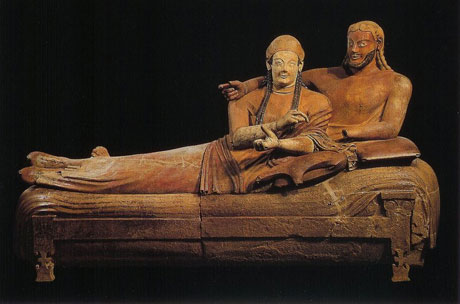
Etruscans_couch

In the year 800 BC, you could earn a king’s fortune by making something good, perhaps with new materials or a new technique, putting it on a ship, sailing it around the Mediterranean, the Adriatic and the Black Sea, and either trading it or selling it.

Most of us don’t think of inter-cultural commerce when we think of 800 BC. It’s more likely we think of benighted barbarians. Of course, we’d be wrong.

In the 4.5 billion year history of the world, 800 BC is like yesterday. Much of what was done then is still being done today. (Look at the button on your shirt. It’s 5,000 years old.) What is sad is that we don’t know as much about that time as we should.

Etruscan_Map01_fullThere was an early civilization back then that excelled at trading, culture, technology and wealth accumulation. Comparatively little is know of them. They were the Etruscans, and I’m one of them.

If your ancestors are from the Tuscany region of Italy, where the Etruscans lived, you might call yourself Italian. But I’m finding that more and more people in this category are starting to classify themselves as Etruscans – the civilization that pre-dated Rome and for a time coexisted with Rome; the civilization from which Rome borrowed and then moved ahead, absorbing and eliminating its once great rival.

Much of what we do know of the Etruscans comes from the ancient writings of Greeks and Romans, who had nothing good to say about them — a sure sign of envy and jealousy. The Greeks and Romans criticized the extravagant Etruscan lifestyle, the culture’s public display of affection between men and women, and a then unprecedented equality between the two sexes.

That’s quite a culture.

At a recent party I spoke to an Etruscan friend of mine, Franca. She was born in Florence, in the Tuscany region. In a heavy Italian accent, she started talking about her ancestors and how everything that made Rome great was taken or learned from the Etruscans.

She scoffed at the Roman warriors who battled in chariots.

“Chariots were designed by the Etruscans for women,” she said.

Franca is a rare human being who by chance became my friend. She’s a marvelous storyteller. She knew Pavarotti before he became famous. He used to cook for her in his tiny New York apartment. But that’s another story.
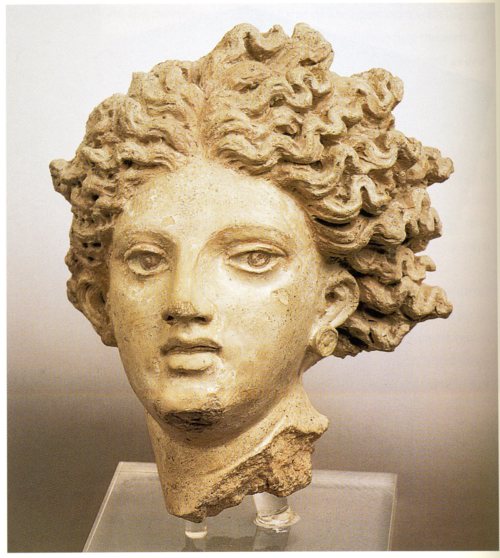
Etruscan sculptureWhile I had been aware that Franca was a fan of the ancients – she has a ring made from a coin that predates Christ — I didn’t know until this party that her son, a college president in Switzerland, spends every summer digging at an Etruscan excavation site. He is an expert on these people. I’m unsure if he taught Franca or if Franca taught him.

The discoveries at Etruscan sites come mainly from the findings within elaborate burial tombs of the rich. The Etruscan elite had the habit of building tombs that were detailed copies of their aboveground homes. The tombs were filled with domestic items of all kinds as well as great art objects and jewelry.

This provides a window into the culture, but it is heavily curtained.

The problem with unlocking all the mysteries of the Etruscans is that their writing did not survive. They had their own language and their own script, but they wrote on linen, which was easily ravaged by time. Some Etruscan writing had been found on metal and stone, but it just wasn’t enough.

Then came the mummy.

There often are quirks, mistakes and random or unusual acts that end up having a profound effect on history. This mummy is one of them.

I learned of it not from Franca but from a Time-Life book called, “Etruscans: Italy’s Lovers of Life.” The story, with many twists, begins in the late 1840s when a Croatian noble named Mihael de Barc visited Alexandria, Egypt. It was there that he bought himself a genuine mummy.

de Barc took his treasure to a home he had in Vienna, and put it on display. For some unknown reason, he found it necessary to slowly, over time, unwrap the mummy. By his death in 1859, he had completely unwrapped it.

Stay with me, please. I’m getting to the Etruscan part.

An executor put the exposed corpse and the bandages – which contained indecipherable writing — in separate cases and shipped them to the National Museum in Zagreb. In 1891, someone figured out that the unraveled linen actually was an Etruscan book.

The only way to explain this is to assume that an exiled Etruscan had once settled in Egypt and a mummy-maker grabbed one of his books to use on a client.

As mummification preserved the body, it also preserved the linen.

This chain of events, so far-fetched it could never pass for fiction, has given the world the only surviving Etruscan book. And still we don’t know enough.

Whenever I read more about these ancient yet modern people, my fasciation grows. The Etruscans called themselves by a name not used by others. To them, they were the Rasna or Rasemma. The Greeks called them Tyrrhenoi (from which we get the Tyrrhenian Sea). It was the Romans who called them Etrusci or Tusci (from which we get Tuscany).

They were great engineers, known for their roads and ambitious irrigation projects. Skeletal remains show they were exceptional dentists. (The design of the bridgework found in the mouths of tomb cadavers is still used today.) Their great wealth was the result of their talent at metalworking and the fact that they controlled vast deposits of copper, iron ore and tin, the largest in that area of the world. This was the stuff that went on their ships and gave them the foundation for one of the Western world’s greatest early civilization.

If only they had written on something more substantial than linen.

Anyway, I’m optimistic more information will be forthcoming. Franca’s son is sure to keep digging, so I may know more by the next party. But I doubt they will ever find another mummy that’s a book.

By Lanny Morgnanesi

Censorship and the self-righteous now target restaurants

26 Nov

???????????????????????????????

On a day when at least one college president was pressured to apologize for saying something rational, a minor story appeared about angry people trying to censor a restaurant.

Within just a few days, possibly while another person was making a forced apology, a second report of restaurant censorship appeared. What this means is that the movement to shut the traps of the dumb, the smart and the mediocre has reached a new and dangerous low.

While sporadic, disarrayed and multi-headed, the censorship movement is highly effective. Its practitioners sacrifice freedom for all as a way to secure kindness for all – which ends up being not so kind. Their popularity has grown with their intolerance, but God help them if they get between a hungry person and their food.

conflict-kitchen-storefrontNot going down easily is a Pittsburgh takeout joint called Conflict Kitchen. It shutdown after death threats, but has since reopened. More than 200 people – God bless them all – rallied on its behalf, singing and twisting verse from John Lennon: “All we are saying . . . is give food a chance.”

The Conflict Kitchen – little more than a kiosk – serves food from countries in conflict with the United States. Since opening in 2011, owners Jon Rubin and Dawn Weleski have prepared culinary items from nations such as Afghanistan, North Korea, Iran, Cuba and Venezuela.

The food is wrapped in paper containing information about the country’s culture and politics. The restaurant claims not to take a position but wants to present the positions of countries we may be biased against. Jon and Dawn also hold public forums to facilitate discussions.

When the Conflict Kitchen began serving Palestinian food in October, there were complaints from the Jewish Federation of Greater Pittsburgh, the B’nai B’rith and other groups. The restaurant closed after police received a letter with death threats against it, but it has since reopened. A police investigation continues.

Meanwhile, out in Colorado, a fellow named Pete Turner has vowed to keep open his Mexican-style restaurants in the face of community protests. Again, the complaint is not about food but about words, in this case a single word.

Pete has been operating restaurants for 20 years and has six in Boulder and Denver. It is only recently that his trouble began.

The trouble is about the name of his restaurants: Illegal Pete’s.

It is felt by the protesters that the “I-Word” is offensive and hurtful and should be removed.

Pete’s inspiration for the name came in several forms. It’s a literary reference, he said, to a bar in a novel he read as a college student. It also pays homage to anti-heroes and the counter-culture, honors the nonconformist streak of his father (also named Pete) and keeps his own name out there as well.

Pete recently attended a community meeting with his detractors. He listened politely. Several days later, he announced he would not change the restaurant’s name.

I admire his guts.

You can’t please everyone and it’s ridiculous to try. You also can’t guarantee a person a totally inoffensive day, unmarred by an indelicate word, picture, conversation, hint or suggestion. Life as a whole is offensive. Isn’t that abundantly clear? We are an aggressive, acquisitive, violent and murderous species. Must we use the proper words in the course of our murdering?

I don’t think Pete was trying to offend, but if people are free to offend, at least we will know where they stand. To me, this is preferable to having people hide their feelings and seem like something they are not.

Sometimes all we need to do is shake our heads and continue walking – or eat somewhere else.

Milton Guevara, the Salvadoran general manager of an Illegal Pete’s in Boulder, took what I think is the right “c’est la vie” attitude. He said, “I’m Hispanic, and I’m very proud to be. People come to us because they love our food . . . The name doesn’t mean anything.”

In the end, if someone is providing you with good food, how can you not like and appreciate them? If you’ve got to picket, I say picket those who can’t cook.

By Lanny Morgnanesi

In the Old West, without GPS, if they wanted you, they’d find you

16 Nov

Cormac McCarthy

Everyone knows we’re being tracked. You leave a trail with credit cards, cell phones, cookies and social media. Cameras take pictures at traffic lights.Auto dealers hide GPS devices on the cars they sell. Even U.S. passports have a chip embedded in them.

But in the Old West, in the days of the horse and buggy – mainly because of the horse and buggy – it also was easy to track people. People back then left tracks, the old-fashion kind.

Blood MeridianI point this out after reading Cormac McCarthy’s 1985 novel, “Blood Meridian or the Evening Redness in the West.” In it, a band of characters travels endlessly across vast expanses of plains, desserts and mountains. They always seem to find each other. Their enemies always seem to find them, and they their enemies.

There are some major skills involved here, as Cormac suggests. But the basics are hard to miss. In today’s times, we forget about giveaways like smoke from a cook fire, dung and urine from animals and humans, the simple imprint of foot, hoof and wheel. Either way, it’s pretty much a sure thing that after crossing the dessert everyone is going to end up at the well or creek. A great place to wait for your prey.

While it is frightening to think that today’s phones reveal where we are and where we went, it’s also a scary thought that you could ride or walk for days and nights, in the heat and cold, possibly without water and food or even clothes, across the harshest terrain, and the person trailing you will find you and kill you in the most brutal fashion.

This lesson, among others, I learned from Cormac McCarthy and the book they call his masterpiece.

No country posterIf you don’t know McCarthy from his many novels – almost all of them filled with horrific violence – then you might know him from the films made from his books. Perhaps the most famous is “No Country for Old Men,” which in 2007 won the Academy Award for Best Picture.

Some see McCarthy as the equal or near equal of Faulkner. While I was amazed by “No Country for Old Men,” I’m embarrassed to say I had overlooked McCarthy, then and even after. I only came to know him after briefly watching a so-so TV movie with an unfamiliar name – one I don’t even remember — and hearing several pieces of brilliant dialogue.

I admire a good sentence and these were unlike anything I’ve heard on TV – with the possible exception of “True Detective.” They came from deep within some dark, mysterious, knowing soul.

I checked and found they came from Cormac McCarthy. And so I went on to read “Blood Meridian.”

If you read it, or even just look at it, you’ll notice some things right off. First, there are no quotation marks (even when there are quotes). Cute, but only idiosyncratic. Next, there are all these words you won’t understand because they are archaic and rarely appear anywhere. Doubly troubling are the passages in un-translated Spanish – the common tongue of Cormac’s characters, who are American, Mexican and Native American.

But the most obvious and disturbing thing about McCarthy is the violence. Nearly every page is covered in blood. I recall thinking that while the writing was terrific, the plot line had to come from a thoroughly sick and disturbed mind.

Glanton gang
Then I began to listen closer to the tone, attitude and motif phraseology of his characters. I came to realize this was not made up. This was all true. It was history, and the writer must have relied heavily on journals and first-hand accounts.

While McCarthy is not in the habit of discussing his work, I searched for confirmation of my theory and found it on good old Wikipedia:

The majority of the narrative follows a teenager referred to only as “the kid,” with the bulk of the text devoted to his experiences with the Glanton gang, a historical group of scalp hunters who massacred Native Americans and others in the United States–Mexico borderlands from 1849 to 1850 for bounty, pleasure, and eventually out of sheer compulsion . . . .


. . . McCarthy conducted considerable research to write the book. Critics have repeatedly demonstrated that even brief and seemingly inconsequential passages of Blood Meridian rely on historical evidence. The Glanton gang segments are based on Samuel Chamberlain‘s account of the group in his memoir My Confession: The Recollections of a Rogue, which he wrote during the latter part of his life. Chamberlain rode with John Joel Glanton and his company between 1849 and 1850.


Unlike many people, I try not to look for meaning in creative work. Beauty alone is enough for me, and “Blood Meridian” is beautiful. The best art is an open presentation of depth that allows the consumer to add the meaning. It really doesn’t come with it.

Still, my favorite parts of the book are the philosophical pronouncements of the character known as “the judge.” I sense he sounds a lot like Cormac McCarthy at a cocktail party. The judge accepts violence. In total, what the book does for me is calm my frustration at man’s inhumanity, convincing me – if only for a short time – that violence is NOT inhuman, but rather perfectly and intrinsically human.

I’ll end with a passage and invite comment.

“It makes no difference what men think of war, said the judge. War endures. As well ask men what they think of stone. War was always here. Before man was, war waited for him. The ultimate trade awaiting its ultimate practioner. That is the way it was and will be. That way and not some other way.”

Lanny Morgnanesi

Where did everyone go? “Baby Bust” affects both prison population and college enrollment

9 Nov

Prison

Someone once told me if you build a prison, it will fill up. Conversely, if a prison is full, criminals will be let out.

From this it is easy to conclude that a person who normally would be free might get locked up, and a person who normally would be jailed might go free.

Both are frightening thoughts. Neither says much about justice.

Prison pop worldMore frightening is the widely known but often ignored fact that the United States puts more people behind bars than any other nation. That figure is about 2 million.

The U.S. population has increased by about one-third since 1980, but the federal prison population has grown by about 800 percent.

Yet we still call ourselves the land of the free.

So it goes. I wish I understood why. I wish there was someone who could explain these problems and come up with a method to reverse them.

Well, sometimes things reverse themselves.

A recent story that was basically overlooked said that the federal prison population has declined by 4,800 inmates. This is the first decline in a decade. And it turns out that the populations in state and county lockups have been dropping for the past five years.

“Our new projections anticipate that the number of federal inmates will fall by just over 2,000 in the next 12 months — and by almost 10,000 in the year after,” said Attorney General Eric Holder “This is nothing less than historic.”

Fine, but no one explained why.

Prison poulation-WikiIt is doubtful our government has the ability to stop crime. Government can take credit for it, but that doesn’t mean it’s true. After crime dropped years ago, improvements in law enforcement were credited. Later, under the category of Freakanomics, it was determined that the drop in crime occurred about 18 years after the legalization of abortion. This means that there was was less crime because fewer criminals were born.

It was that simple.

Abortion may not be behind these new figures, but fewer criminals being born may be.
A running demographic trend called the “baby bust” has now caused a decline in the number of young adults, the same people who commit most crimes. A bad economy, it seems, affects childbirth, and the economy hasn’t been good for quite some time. It is said that the recession of 2008 alone resulted in a half million fewer births.

I’m familiar with the baby bust because I’ve seen its impact on higher education. With fewer students of college age, enrollments are declining at colleges and universities across the nation.

“They can’t go to college if they haven’t been born,” one educator explained.

Birth ratesIn 1900, Mark Twain looked for some linkage between crime and education and said, “Every time you close a school, you have to build a jail.” While the reserve could be true, new colleges aren’t needed right now because of the enrollment decline. But because of the savings from the decline in prison population – the feds spend $80 billion a year on incarceration — money could be available to help students with tuition.

What a great nation ours would be if, like some others, we made it easy and cheap for young people to get an education. But we still would have the empty prisons and we’ll need to figure out what to do with them.

Maybe we can just let them rot. They can become sad displays of a culture that with a blind eye created and nourished the darker side of humanity. But a demographic bump doesn’t permanently correct a problem. So a better idea might be to turn the prisons into factories, which will improve the economy, which will increase the birth rate, which will create more crime, which will require more prisons. At that point, we can close the factories, open the prisons, and wait for economy to go bad and the birth rate to drop again.

That sounds so right it has got to be wrong. But I’m not hearing much better from the experts. Do you think we can put a little pressure on them? Or should we just wait until everything fixes itself? Actually, this seems much more likely.

By Lanny Morgnanesi

Why a normal person joins the Islamic State

26 Oct

Islamic State

In order to defeat an idea, you have to understand it.

Here’s an idea:

Millions of people who share a common heritage but live in different countries can unite under a single, benevolent ruler, with a single legal code that is fair and just, with common goals and a common view of the world. All will be treated equally; all will be protected. There will be no more bullying by dictators, thugs and secret police. There will be no more corruption. Factions will be unified. Life will be holy. There will be jobs and prosperity for all. The artificial borders imposed by outsiders will disappear. The very rich countries will now have to share with the poor countries.

This idea creates an entirely new world. It creates paradise.

The Islamic State of the Levant promises this to Muslims. It is why people leave their homes and go fight for it, and why towns welcome the rebels.

This is the idea that must be understood.

In America, we are prone to depicting enemies as psychopathic killers and leaving it at that. Rarely do we apply reason and ask: Why are so many people, normal people, following psychopaths?

Islamic State-mapPower-hungry monsters will always exist, but to a large extent they must earn the consent of the people in order to rule. The ambitions of most people rarely exceed the simple desire to raise and care for a family. If people think the monsters can help them do this, then the monsters will take on the appearance of saviors and be allowed to lead.

In nations where it is easy to raise and care for a family, this flirtation with monsters is incomprehensible. Nevertheless, it is real.

The monsters in Iraq and Syria now number about 30,000. The Iraqi army is almost 10 times larger. It is not the size of the fighting force that makes the Islamic State of the Levant strong. It is its idea of an enviable path through the chaos, tyranny and fragmentation within the Muslim world.

Much has been written about the rebels we know as ISIS, but almost none of it explains the group’s remarkable growth and success. The exception is a recent New York Times article by David D. Kirkpatrick, who did a simple thing. He went to Tunisia and asked people why they sympathize with ISIS.

Sufian Abbas, 31, a student sitting at a street café, must have given Kirkpatrick a look of disbelief before he answered with his own question, “Don’t you see it as a source of pride?”

Beheadings of innocent people a source of pride? No. The Tunisians believe the accounts of atrocities are fabrications of western media.

“The Islamic State is a true caliphate, a system that is fair and just, where you don’t have to follow somebody’s orders because he is rich or powerful,” said a fellow named Ahmed. “It is action, not theory, and it will topple the whole game.”

Kirkpatrick said people who have left Tunisia for ISIS territory often email friends and describe a better life. It is noteworthy that a good number of those attracted to the movement are unemployed and not particularly religious.

One who is religious and an ultraconservative said, “If I am going to get arrested and beaten here anyway, I might as well go where I can have an impact.”

The good news is that some Tunisians have returned home with reports that ISIS has not created paradise, that promises are false and joiners may be forced to do things against their will.

More will realize this, but by the time they do the Islamic State will have controlled more territory and be in a position to exert more force against the people who no want to give consent.

And this is why we must understand the idea of ISIS and come up with a better one — and soon. It must be a practical and convincing idea, one applicable to the culture. At all costs, we must avoid a rough and forceful attempt to sell western style democracy to Muslims. This will work about as well as ham at a bar mitzvah.

The big myth is that the world wants to be like us. Strategically, this kind of thinking gets us nowhere. It is much better to accept the undiscovered truth that other cultures can be with us without being like us.

Let’s begin at that point. From there I believe we can make progress.

By Lanny Morgnanesi

Greatness under my nose – the legacy of Smarty Jones is literally within my grasp

17 Oct

Smarty Jones (3 of 5)

I was in the same room this week with a gold trophy from the Kentucky Derby and a silver trophy from the Preakness. The woman who owns them complained that she was forever polishing the silver one. It tarnishes so easily, she said.

She must use a lot of muscle because the shine was spectacular. The etched-in name of the winning horse was easy to read: “Smarty Jones.”

Smarty Jones (4 of 5)Smarty was indisputably the most popular horse of his era. I knew his story well because I was a newspaper editor in 2004 when this local three-year-old became the first undefeated horse since Seattle Slew to win the Derby. He went on to win the Preakness but came in second at Belmont after three jockeys and their horses ganged up on him and ran him down in the backstretch.

What I didn’t know was his owner lives down the street from me.

While she is a well-known figure in horse racing and has been written about widely, I’m not going to mention her name as a polite gesture to a neighbor.

But I will say she is a wonderful woman who loves talking about her favorite horse. Clearly, she is down to earth. Smarty won her more than $7 million (not counting the stud fees from the last 10 years) yet she hasn’t hired anyone to shine his trophies.

Smarty Jones (1 of 5)My neighbor knows the story of Smarty is a great tale of unexpected triumph. With little coaxing she will tell you every aspect of it.

  • How John Servis, Smarty’s able trainer, got the job after his predecessor was murdered.
  • How Smarty nearly killed himself when he hit his head on a starting gate, knocking himself out, losing blood and nearly going blind.
  • How the horse’s spunk and personality drew thousands of newcomers to racing, increased TV viewership of racing and garnered the owner sacks and sacks of fan mail, which on occasion she sits down and re-reads.

One of her best stories is about stopping into a market to buy Folgers coffee. Smarty had already won two legs of the Triple Crown and she had used her Visa for hotel rooms at the two events, meals for gangs of people and food and beverages for celebratory parties. So there wasn’t enough on it to buy the coffee. Visa, the company that sponsors the races her horse won, had cut her off.

The 129th Preakness StakesLater, during a VIP affair at the Belmont, she met a bunch of Visa execs and told them of her embarrassment at the market. As a consolation, they offered her a credit card with no limit, which she turned down, and a can of Folgers, which she accepted.

My neighbor won’t be hanging around the neighborhood much longer. She is bound for Florida and her horses. I wish her well and look forward to seeing her again. Still, I wonder who is going to polish the trophies while she’s gone.

By Lanny Morgnanesi

With so many in “deep poverty,” mere poverty is almost like the middle class

29 Sep

Philly poverty

If one of us, or many of us, falls behind, way behind, is it the responsibility of those ahead to pull up the less fortunate, the unfortunate and all those whom fortune has woefully forsaken?

Those living in and around Philadelphia should be giving this serious thought. In this city, the name of which means brotherly love, the economy, the culture, the dynamics, the thoughts and the ideals are too weak to sustain the population. What exists there represents gross failure.

A new report says that 12 percent of Philadelphia residents live in something called deep poverty. Sadly, the times have forced us to look beyond mere poverty, which in Philadelphia is 26 percent.

The city, which I live outside of, ranked highest in deep poverty when compared to the nation’s 10 biggest cities. Nearby Camden, across the river in New Jersey, is not among the biggest and wasn’t ranked. But it has a deep poverty rate of 20 percent and a poverty rate of 43 percent.

From my little cloister, that’s difficult to even imagine.

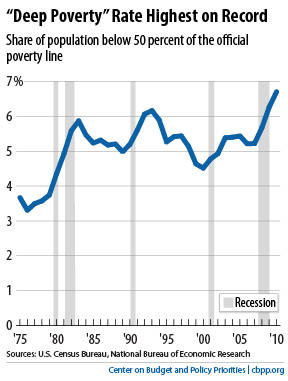
Deep poverty chartAll these figures come from the U.S. Census’ 2013 American Community Survey, which was recently released.

By definition, a family of three is in poverty if it lives on $20,000 a year. In deep poverty, three survive on $10,000 a year.

In terms of sheer numbers, there are 184,000 people in Philadelphia who are clinging to its lowest rung. Alfred Lubrano, a staff writer for the Inquirer, said that’s about the size of cities like Tallahassee, Florida or Salt Lake City, Utah.

It strikes me as being post-apocalyptic.

But I almost never go to the neighborhoods were the 184,000 live. Camden to me is like Mars.

Still, I can’t help feel as if people like me have somehow failed those in deep poverty, even though many have failed themselves.

In any group, on any place in the world, there are people who do well and people who do not. There are those who need no help and there are the helpless. Now and in the past, however, social units like Native-American tribes or New England colonies or even extended families would try to lift up those that some might describe as laggards. They would do so simply because the unit was a unit and felt responsible for its members. To some degree, we do this in America. We have networks of social services, we have churches and synagogues, and we have government.

Lubrano, the Inquirer reporter, interviewed a Philadelphia women in deep poverty. She is 42 years old, separated with three children ages 7 to 17. Born into an Irish-Italian family, she had dropped out of high school and worked as a cashier. According to Lubrano, she fell into depression and was unable to work. So the government provided her with disability payments of $8,880 a year.

This is a nice gesture, but not a solution to the problem.

So what is? With so many types of poverty, there probably would have to be an assortment of solutions, and even then many couldn’t be reached or helped or encouraged. But it’s for certain a studied, intelligent approach would reduce Philadelphia’s Tallahassee-size problem to perhaps a problem the size of Lost Springs, Wyoming, or Bozeman, Montana.

I lack the training, depth and insight of a social engineer, but one thing I’d like to see in every poor neighborhood is a “Factory of Last Resort.” Employment would be open to all those in poverty and deep poverty who are looking for an out. They would manufacture a mundane but useful item, like brooms or soap. These factories probably would operate at a loss, but there would be incentives to keep loses to a minimum and inch toward profitability. Included with the job would be access to health clinics, day care, a dining hall and dorms.

We would be building the equivalent of an urban kibbutz.

After a time, management positions would go to employees who exhibit leadership skills, the ones who have learned and blossomed from the experience. Awakenings often come with restored dignity.

Those of us who are doing well would be encouraged to buy the brooms and soap as a sign of support. It would be a way for all of us to make our cities whole again and to keep humanity human.

And then, should we want to, we can safely and happily visit the once great and now great-again places like Camden, which spawned RCA Records and Campbell Soup. And the City of Brotherly Love can free itself from the embarrassing irony of its name. It can return to its Quaker roots of service, justice, community, self-improvement and independence.

I love a good city. This would give us more of them.

By Lanny Morgnanesi

Nearly every physicist in the world will insist that you – yes, you — have married a movie star, earned millions of dollars and lived in an exotic locale. They know you’ve done this – even if you don’t –because their research proves it. Strangely, this is what science has come to, and it’s bunk.

18 Sep

Quantum

Basic science once was easy. Now it’s difficult for even scientists, and those who pretend to understand it probably don’t.


There is no logic to it. Nothing in the observable world compares to it. Metaphors can no longer explain it. Wild imagination is required just to discuss it.


In ancient times, when there was a lunar eclipse, people would say their god ate the moon and later vomited it up. Don’t laugh. The stories our scientists tell today also sound like fables.


Consider this standard, nearly universal tenant of science:


We cannot predict what a particle will do because it actually does everything while inhabiting a multitude of universes.


What this means on a larger scale is that each one of us has married a movie star, become a millionaire and done nearly everything else that is possible to do — and maybe more. We just didn’t do it in the single universe we wake up to every day. We did it somewhere else.


There is no word yet on how to jump our consciousness to those other universes, where clearly we are having a lot more fun.


Rather than just accept such ideas, which evolve from a desperate, almost ruthless attempt to boil science down into a single theory of everything, I take the position that human being are incapable of fully understanding what exists and how the universe works.


It’s a concession few are willing to make, but I have made it.


To their credit, scientists keep trying to figure it all out. The problem is, they try too hard.


In the time-honored tradition of changing the facts to fit the theory, scientists – mainly physicists — make their single-theory equations work by adding 10 or more dimensions to the four we know. They have pushed the limits of logic by describing a key component of matter as having only two dimensions while at the same time saying it seems to have only one. Perhaps most interesting but hardest to accept is that the theory assumes our universe is one of many universes and that the history we know is but one occurrence of infinite occurrences, meaning all things in all ways have happened.


Yes, you have driven a Lamborghini and owned a house in the South of France.


Only by assuming such things can a single theory work.


Feynman quoteModern physics used to be about spheres revolving around a central core of matter. The planets revolved around a sun; electrons around their nucleus. Big and small objects sort of worked the same.


The catastrophe of science began when it was determined that big and small did not work the same. Things were far more complex than a bunch of balls circling around other balls.


Scientists who longed for a single theory could not live with this duality of big being different from small. And so they struggled for a theory that would handle both. These theories only worked with 10 or 11 dimensions, with vibrating strings replacing atoms, with everything having not one life but a history of every possible life.


There actually is an assortment of these theories. And, mathematically, they all work – which I think means they can predict what is observed or sort of observed. In the new science, you really can’t observe anything.


Any scientist reading this will know I am not one of them. For the past several decades, however, I have tried keeping up with their progress. I’ve enjoyed and felt comfortable with Einstein’s theories of special and general relativity. They were complex and not entirely in line with what we experience in life, but scientists found believable ways to explain them using stories of clocks on trains and twin space travelers.


Next came quantum mechanics, which defied all logic and seemed impossible and ridiculous but could not be proven wrong. Then, when physicists started trying to unify theories on the four forces of nature (gravity, electromagnetism and the weak and strong forces of the atom), a big mess started to accumulate and I could not keep up.


But recently, I checked back to see if anything sensible had developed. I picked up the book, “The Grand Design” by Stephen Hawking (the guy in the wheelchair) and Leonard Mlodinow (a physicist at Caltech). Like any survey of science for the layman, it starts off good.


The authors even make jokes about their profession.


stephen-hawkingAbout all those new dimensions, they say: “Ten dimensions might sound exciting, but they would cause real problems if you forgot where you parked your car.”


They included cartoons. One is of a woman introducing two men saying, “You both have something in common. Dr. Davis has discovered a particle which nobody has seen, and Prof. Higbe has discovered a galaxy which nobody has seen.”


The authors easily convey the genius of such minds as Richard Feynman (who in his spared time played bongos at a strip club), John Conway (the creator of a simple game that seems to explain the workings of God) and so many others.


But they also let on that few if any of today physicists really understand the things they expect us to believe.


Indeed, Feynman, a quantum god, once said that no one understands quantum mechanics. He described is as “nature as She is — absurd.”


Niels Bohr, a quantum pioneer, said that anyone who does understand quantum mechanics would be shocked by it.

It’s difficult to find a concise explanation of quantum mechanics, but author and theoretical physicist Sean Carroll said the theory tells us that what we can observe about the world is only a tiny subset of what actually exists.


Einstein recognized the importance and power of quantum theory while admitting an inner voice told him it was not the real thing.


Neils quoteI have this same problem. Something tells me that without elegance, logic and relative simplicity, a theory cannot be correct. The strange, counter-intuitive ideas of science, these mathematical attempts to explain what we are not yet capable of knowing, are earnest and hard-fought attempts to penetrate the impenetrable. They are not, however, for me.


I prefer to put in with Aristotle, who didn’t need to test, measure or even observe. If he could think it through and see the sense of it, he accepted it. If it explained the world and what he knew of it, that was enough.


Science is a marvel, but so are the philosophers and poets – so many of them ancient Greeks – who could explain the unseen and unknown without so much as a microscope. They were intuitive and in touch with the creation and they just knew.


That’s what I’m waiting for. A new Aristotle. A philosopher who just knows.


And even then, what is explained will be far short of reality. It will be a beautiful metaphor that we can grasp, glorify and use; one that will enable us to carry on in a long harmonic march toward the greater understanding of ourselves.


But I remained convince that the truth, the ultimate theory, is just not for us to know. We were created for another reason, a reason that will never be revealed. Something or someone else, a force not of this world, has the job of knowing. Tough luck for us.


The best part, however, is that few but me will admit it, and that the search continues. The search is good. It keeps us alive and gives us meaning, even if it takes us in circles.


As the biblical proverb says:


“It is the glory of God to conceal a matter; to search out a matter is the glory of kings.”


By the way, there are a few scientists who have come around to thinking their colleagues are dead wrong on quantum mechanics. For more, read this.

By Lanny Morgnanesi