If the Republican Party were a person, Dorothy Parker would slap his face, both of them.

10 Feb


latino-obama-sign

Consider the case of the young man who hates his uncle and has always treated him dastardly. One day the uncle reveals that by living poor he was able to accumulated a small fortune. The young nephew then begins to shower the old man with kindness and attention.

For the uncle, it is easy to see that the nephew is a disingenuous louse. The real insult, however, is that the young man thought the uncle could be fooled.

The young man reminds me of the Republican Party.

Here is a party that, for the most part, staked out a very tough position against amnesty or general kindness for 11 million people living and mostly working in the United States without the legal right to do. It was a legitimate position, although it is one I considered unwise.

When President Obama was re-elected after winning 80 percent of the minority and ethnic vote, the Republican Party realized that the poor uncle they didn’t care much for was actually rich.

Now they want to be friends. Now they want legislation to assist the 11 million. Now they want those votes.

And, I guess, they don’t think the Hispanic population is intelligent enough or aware enough to see the hypocrisy.

That’s the real zinger.

Gov. Bob McDonnell, a Republican from Virginia, thinks the GOP can get those votes if it just changes its tone. That’s what reporter Thomas Fitzgerald wrote today in the Inquirer. Tone, rather than the choice of whom you truly represent in Congress, is what’s important.

Reality is always second to image.

When someone says, “People want to know we’re like them”  (which Republican Congressman Scott Perry said this weekend) it usually means “We’re not like them.” When someone says, “We can win the presidency. … We don’t need to fix the laws to make that happen (which Pennsylvania party chairman Rob Gleason said), it usually means they ARE trying to win the presidency by rigging the system.

A good rule in politics is to exercise caution and maintain skepticism.

I’m very curious to see if the GOP efforts to gain Hispanic support will work. Woody Allen once said that the lion will one day lie down with the lamb, but the lamb won’t get any sleep. That’s the kind of alliance this speaks of.

By Lanny Morgnanesi

Israel Loves Iran — and so can you!

2 Feb


Chuck Hagel, nominated for secretary of defense, was treated roughly this week by his former colleagues in the Senate. In part, it was because he appears not to be in complete lockstep with Israel and also because he has shown moderation in his position on Iran.

In the U.S. we hold a compendium of complex and diverse political views. Oddly, we are expected to be monolithic in our support of Israel. In some way, Hagel was treated like a traitor. I’m not sure why a single, blindly supportive position is required on Israel. If I had to guess, I’d say it’s because the Israeli lobby is smart, strong and well-funded, and because a large part of the American Christian community regularly muscles Congress on Israel because it wants to protect and maintain that country until it can be converted en masse.

If I’m wrong about that I apologize.

What I’m probably not wrong about is this: Opinion on Israeli policy is more divergent in Israel than in America.

Can you image buses traversing major American cities covered with the message: “Iranians we love you.”

People would probably go to jail for that.

There are, however, such buses in Israel, funded by Israelis who don’t feel hostile to Iran and believe the current talk of war is dangerous bombast.

While the buses are highly visible, the campaign for peace is mainly online. There are thousands of Facebook followers, and related Facebook sites from various people and countries pop up each day in support. It is something of a movement, a movement for peace in the face of impending war.

Its leader, graphic designer Ronny Edri, has told the people of Iran, “For there to be a war between us, first we must be afraid of each other, we must hate. I’m not afraid of you, I don’t hate you.”

His movement involves individual people creating posters of themselves with variations on the message: Israel loves Iran.

The posters are then placed on the Internet.

After a time, Iranians were creating their own posters saying: We love Israel.

Please hear the story straight from Edri’s mouth in a TEDs talk he gave. At the end of this 15-minute video you can see many of the wonderful posters of peace that people have made. Also, at the top of this page is a Youtube video from Edri.

Coverage of Edri, who served in the Israeli army, and the thousands of resulting posters has been on ABC and CNN, in the New York Daily News and the New Yorker magazine and in many, many international publications.

Consider becoming a part of this movement, or at least learning about it.

It seems people may not hate each other as much as their governments would like them to.

Maybe Chuck Hagel wouldn’t be such a bad secretary of defense after all.

By Lanny Morgnanesi

Those who benefit from Hillary Clinton (and others) should pay more to Washington

20 Jan

Hillary Clinton

Here is what I think is a logical, no-nonsense tax policy: Those who benefit most from the government should pay the most.

Let’s say I own land on which I plant corn for ethanol. If the government decides to restrict the importation of sugar cane – which if allowed kill my sales– then I am indebted to the government in a big way. I’m a Great Benefiter.

I should not be able to get off just by contributing to the political campaigns of the few congressional leaders who pushed my bill through. I should have to pay more for the actual government, since it is working directly for me. I’ve got to pay more salaries, more electric bills, more for everything that keeps it running.

The same would be true for Amgen, the largest biotech company in the world. The New York Times recently reported that a few paragraphs in the “fiscal cliff” legislation give Amgen a two-year delay on Medicare price restraints for a drug it makes. This was its second delay, God bless them. Amgen is willing to pay 74 Washington lobbyists to get what it wants, but is it willing to pay more in taxes?

It should be.

It’s a Great Benefiter.

I’m glad our 430-ship Navy protects the sea-lanes so I can purchase imported products. That, however, is only an indirect benefit. What about the people and companies who profit from safe shipping?

They’re Great Benefiters. Charge them!

A couple weeks ago there was a somewhat surprising article in Bloomberg Businssweek. Well, maybe not so surprising. It was about Secretary of State Hilary Clinton, but the headline was: “Secretary of Commerce.” The underline was, “How Hillary Clinton turned the State Department into a machine for promoting U.S. business.”

It begins by recounting her 79th visit overseas, which took her to the Czech Republic. She discussed foreign policy but also found time to ask Prime Minister Petr Necas to choose Westinghouse Electric for a nuclear plant contract worth $10 billion.

The article says she regularly makes personal pitches to world leaders on behalf of businesses.

What is that worth? Whatever it is, it’s a lot more than the $50,000 Westinghouse might later pay Hilary to speak for an hour at a corporate retreat.

Westinghouse needs to pay more.

So, have I come up with the answer to our budget and debt problems? All we need is some accountant to figure out what is owned, and for Congress to do the right thing and pass legislation that taxes the Great Benefiters. Of course, the Great Benefiters should have the option of not paying in exchange for the not benefiting. In such cases, the government would have to permit, say, an attack on Exxon tankers by Somalian pirates.

That is an option the Great Benefiters are unlikely to choose. Hence, we have found a way to balance the budget. See, things aren’t as bad as they seem.

By Lanny Morgnanesi

A Buddhist would have no trouble with this

17 Jan

Chinese labor camps

It could be argued that all experiences are good ones.

Philosophically, we could say that if God is good and great then all our burdens are worthwhile and purposeful. We can even learn to like what we hated.

Last week in a bar I told a story of one of the worse nights of my life. I told the story with verve, delight and nostalgia. I got laughs. I was glad to tell it; glad it happened; glad to learn from it. For the first time I realized I was glad to have this piece of film on my reel.

It is too personal to tell here, so I won’t. Its importance is not in the sharing but in reminding me that the misery of each moment carries within it a miraculous value.

It was more than the bar story that forced this revelation. There was also a news story about China. The report said China might dismantle its system of labor camps.

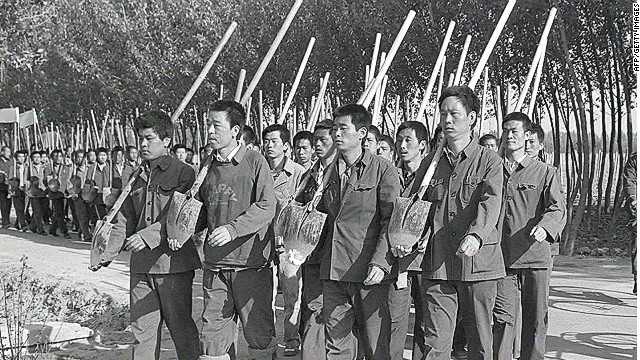
I have no idea what a modern Chinese labor camp is like, but I’m familiar with the tradition of locking up political prisoners and trying to “re-educate” them. I’ve known many people who were victimized by this system during the Cultural Revolution of the 1970s. Some were driven to suicide or to the brink of it.

During this period, all schools were shut and an entire generation of young people was sent to the countryside to labor on farms. Some were considered “red,” or part of the revolution. Others were labeled “black,” or counter-revolutionary. For them it was harsher. They were watched closely and always under suspicion.

While all worked together, the “blacks” were more like prisoners and the “reds” more like guards.

From a first-hand witness I heard a story of a young woman – a “black” – who was laboring in mud. To keep the dampness out of her cloth shoes she put in newspapers. When everyone returned to their rundown barracks, a “red” youth noticed the newspaper inside this woman’s shoe contained a picture of Mao Zedong.

For that show of disrespect she was beaten.

But like myself in the bar story, this was a time of youth. The times contained moments of ultimate value.  Lasting friendships (even between blacks and reds) were forged. These “sent-down” youth, in some respects were very free. They grew up and learned about themselves and others. There is joy in that.

Which is why many Chinese from that generation – those living both in China and in the United States – visit these former labor camps while on vacation. It’s a for-real trend, and they visit with fondness and to share old times with comrades. They take smiling photos of themselves standing near the squalor they thought would be a permanent part of their lives. (Modernization hasn’t changed everything.)

What they went through is far, far, far from my so-called worse night. Yet they have reacted as I did. Their moments carried something and will occupy a peaceful part of their memories.

I don’t claim to truly understand this, and the exceptions must be legion. Even so, there clearly is something to this idea that all experience is good. And so my new goal is not to wait 30 years for warm nostalgia but to live fully and happily in the present.

To accomplish that in even a small measure would be exquisite.

By Lanny Morgnanesi


Something I recently learned

9 Jan

Chilean dogs

There are millions of free-roaming dogs in the South American nation of Chile, and many have allied themselves with protesting students who tangle daily with police.

The dogs march when the students march; attack when the students attack. They take blasts from police water hoses (which they seem to like), growl angrily at police and sometime bite them. When police sirens sound, the dogs run to greet them.

For the last 18 months or so, students have been protesting the state of the school system. According to the Associated Press, the protesters claim public schools provide a poor education, private universities are too expensive and the interest on education loans is too high.

A few of the dogs have been turned into Internet celebrities. One is Blacky, who has 7,000 “likes” on Facebook.

“Dogs are super-loyal,” said one 17-year-old. “They stand with the people and I think they support the students.”

By Lanny Morgnanesi

Gun control is too simple; an even easier solution is needed

30 Dec

Gun control-Obama


If Americans eat an incredible number of hamburgers, is it fair and safe to say that Americans like hamburgers?

Probably so.

If Americans shoot and kill an incredible number of Americans, is it fair and safe to say Americans like to shoot and kill Americans?

Probably not.

So what do we say?

I want to describe the phenomena here but the precise words elude me.

We can say Americans have a propensity to shoot and kill other Americans. Or they have a tendency, or are apt to. Proclivity. Predisposition. Propensity. Penchant. Inclination.

None of these words work. None of them say it.

Only the statistics do.

Take Iceland. According to the New York Times, statistics show that Icelanders do not like, and do not have a tendency or propensity, to shoot and kill other Icelanders. On average, 30 out of every 100 Icelanders have firearms, but figures show that in a recent year no Icelander shot and killed another.

The Norwegians are similar. There are an average of 30 firearms for every 100 resident of Norway, yet there were only two homicides with these weapons in a year’s time.

Other countries with very low rates of firearm homicides are Slovenia, Luxembourg, Hungary and Estonia.  Yes, these are small countries, so the number of deaths naturally is low, but so is the rate of deaths per 100,000. That rate in Norway, for example, is 0.5; in Slovenia it is 0.1.

The New York Times statistics say that in the U.S., where there are an average of 89 firearms per 100 people, the yearly death toll is 9,960. The firearms death rate is 3.2 per 100,000 people.

One country that seems to exceed the U.S. in animosity toward itself is nearby Mexico. While there are only about 15 guns per 100 people in Mexico, Mexicans shoot and kill 11,309 Mexicans in a year. That’s a rate of 10 deaths per 100,000.

I don’t know whether we have influenced our neighbors to the south, but we haven’t done so to our neighbors in the north. Canada has a lot of guns, about 31 per 100 people, but Canadians have kill only 173 people, a rate of 0.5.

So, for me the question is this: Can gun control legislation stop hateful, angry, maladjusted, blood-thirsty people from killing? If it is true we “like” to shoot and kill other Americans, will legislation stop this?

Certainly. But does it get to the heart of the problem, which is the “like?”

Years ago during a period of high inflation, when wage and price controls were being debated, a frustrated economist told me, “When the pot boils over on the stove, you don’t hold down the lid. You lower the burner.”

Gun control legislation tries to hold down the lid. I’d prefer we lower the burner. I guess this amounts to social engineering of some sort, which is always dangerous, risky and inexact. But I’m curious if anyone has studied the cultures of Iceland and Norway and Canada to find out what makes people different there. I’d really like to know.

I tend to think the American system, with its roots in merit and competition, has pressures and stresses and failures that other nations don’t have, and because we are so used to them – like a fish in water – we are not even aware they exist. They do, however, influence how we treat each other.

Merit and competition, I find, are good things. Not so much failure.

Is there a way to prevent abject failure? Is there a way to keep people off the street and in homes; out of prison and productive; with a job that ensures a life of reasonable dignity?

Our tendency to shoot and kill each other tells us things about our society that we like to ignore. I wish we would stop this. I wish we would face ourselves and correct ourselves and better ourselves.

It’s possible we may find out the secret solutions are relatively simple.

A man who taught for several decades in prisons did an informal study of the students who returned to him and those who did not. He found a correlation between recidivism and marriage. Every single ex-con who married when he got out never came back. The results were conclusive and definitive.

That’s pretty simple.

Let’s try something like that. A wife/husband, a job and an apartment.

To some who would shoot you just as soon as he would look at you, that equates to paradise. Paradise, I would guess, is the answer to just about everything.

By Lanny Morgnanesi


When Truman Capote seduced Marlon Brando

28 Dec

brando-1

One of the great classics of entertainment journalism is a 1957 piece called, “The Duke in His Domain.” It appeared in the New Yorker and was written by Truman Capote. The subject was actor Marlon Brando.

I read the article for the first time this week. It made me realize that, although I have been in journalism for many years, I’ve been doing it all wrong. Little Truman, God bless him, had been doing it all right. This is not a testament to his skill as a writer but rather the way he approached his craft.

Capote laid Brando bare.

In the portrayal, the normally reticent and reclusive actor was not a shimmering Hollywood star but a flawed man who could be seen from all sides and angles; a man who revealed much of his soul. In the 50s, entertainment journalism was not done this way. This piece was revolutionary; a precursor to something called The New Journalism.

Brando hated the article and wanted to kill Capote. Yet it was Brando who voluntarily revealed all … talking endlessly into the night, canceling meetings so he could continue the gabfest, not wanting to stop.

All the while, for almost six hours, Capote never took a note. Therein, I believe, lies the secret to great journalism.

It doesn’t take a reporter long to learn that the best material often comes at the end of an interview, when the notebook is put away and you are walking toward the door. I call it the Columbo Effect.  The person being interviewed relaxes and opens up, trying to build on the uneasy rapport established while the notebook was out.TrumanCapoteA_800_0

In a way, gathering information without taking notes is something of a con. In the Brando interview, the actor indeed felt that Capote was not working. Capote thought this was absurd. The interview was conducted in a hotel in Kyoto, Japan, while Brando was making the film “Sayonara.” Why would Capote make such a journey if his intention were just to socialize?

Long ago, when I was a student, I met a tough reporter who toiled in the pre-computer era. He was aware that people would talk casually and unguarded and then insist the conversation was off the record. That’s why he firmly and emphatically told all his sources, “When you talk to me you’re talking into a typewriter.”

Capote didn’t say this to Brando. It would have been fairer to do so.

The story behind the “Duke in his Domain” is an intriguing one.  It is documented in the Nov/Dec issue of the Columbia Journalism Review by writer Douglas McCollam. He does a fantastic job explaining the events of more than a half-century ago.

Over the years there has been much speculation about how Capote got his story, but two key elements seem to be alcohol – Truman got Marlon drunk – and the fact that Capote baited Brando by sharing his story of an alcoholic mother, a story very similar to Brando’s.

“I didn’t trick him,” Capote later said. “We simply swapped stories.”

But I’m convinced that the results were only achieved because Capote carried not a pen, not a notebook, not a tape recorder. He claims to have had what some call a photographic memory.

Capote, who broke literary ground with the so-called nonfiction novel, “In Cold Blood,” is said to have taken no notes while researching this book on the brutal murder of a Kansans family in 1959. After interviews, however, he would type up his mental notes.

There was a time when I was working in a situation where those around me would have objected to note taking, so I tried to train my mind like Capote said he trained his. I had no special skill for it. If there were a good quote that I wanted to preserve, I would have to say it over and over again in my head. When I had the chance, I’d use a scrap of paper to write down one or two words to help me remember it.  The one-or-two-word method also was used to record the facets of the story as it unfolded.

It was difficult work, but as time went on I got better at it.

Even so, my technique was totally incapable of producing anything like the detailed, full picture in “The Duke in His Domain.” The story has long quotes and conversations and captures incredible moments. Here is one, as Brando talks about his mother moving in with him.

“I thought if she loved me enough, trusted me enough, I thought then we can be together, in New York; we’ll live together and I’ll take care of her …. I tried so hard. But my love wasn’t enough …. And one day, I didn’t care anymore. She was there. In a room. Holding onto me. And I let her fall. Because I couldn’t take it anymore – watch her breaking apart, in front of me, like a piece of porcelain. I stepped right over her. I walked right out. I was indifferent.”

I can see where a reporter could reconstruct sentences like these, keeping the sense of the message while taking license over the choice of words. That’s how I view Capote’s technique.

Brando, however, said this: “That little bastard’s got total recall. Every goddamn word, he remembered.”

For all journalists and journalism students, I recommend reading “The Duke in His Domain.” For myself, I’ll be thinking a lot about the huge gap between notebook and non-notebook journalism. I’ve become convinced that the latter, even without precise quotes, might render the truer story.

By Lanny Morgnanesi

A Christmas lament: Arrivederci to all that was great and is lost

26 Dec

I belong to something called the Societa Romana Di Mutuo Soccorso, which is based in Trenton, N.J., the tired, failing city of my birth.

The name in English means the Roman Society for Mutual Aid. Until a few years ago, the group’s meeting minutes were recorded and read in Italian. That changed, along with everything else in Trenton. Today, the society’s name is misspelled all over the Internet, a sad state of affairs for a once noble organization.Roman Hall

The Roman Society is a fraternal group whose members have ancestral roots in Rome and its surrounding provinces. Founded by 13 men in 1896, its primary purpose was to provide sick and survivor benefits. The society’s motto is the applicable but mildly unoriginal, “One for all and all for one,” which sounds less cliché in Italian: “Uno per tutti e tutti per uno.”

Dues originally were 50 cents a month. More than a century later, they are $25 a year. This is quite a deal, especially if you attend the Christmas party, which is free.

When you walk into the party, as I did a few weeks ago, there is red and white wine on the tables, along with fresh Italian bread. The first course is always Italian wedding soup. Then a salad. Next is the big favorite: two kinds of pasta, served home style. One has a red sauce, the other a white. Everyone eats both. For entrees there is a choice of roast chicken, veal Parmesan or fish.

The tradition was that one week earlier there would be a party for the children and grandchildren of members. This also was free. The food was simple – hot dogs – but there was a magician, a very impressive Santa and a respectable gift for every child, like a basketball, a nice truck or a doll.

In the summer, there is a free picnic, a feast of near excess that goes far beyond the humble burger.

When I first became a member at my father’s urging, it was a mystery to me how $25 a year could cover all this. Then I learned that the sustaining element of the Societa Romana was something called the Roman Hall. It was what made the society great and of consequence.

The hall dates to 1938. Back then the nation had yet to whip the Great Depression, but the society and it 300 members had more than $14,000 in the bank. For such a time and for such an organization, this was an incredible sum. Seeing an opportunity, two members, Dr. Albert Moriconi and Sylvester Stella, decided the money should be used to allow Italians to do what Italians do best: cook.

And so the society, with its own money and its own labor, built the Roman Hall, a meeting place, restaurant and banquet facility. It was built in the Chambersburg section, a Trenton neighborhood filled with supportive Italians. The building is there still. It’s the Italians that have gone.

For many years the Roman Hall did well. Renovations and expansions were common. As a child I remember hearing people say with delight and anticipation, “We’re going to the Roman Hall tonight!” My family moved out of Trenton when I was young so I don’t have early memories of the place. When I grew up, however, I had the urge to return and erase this blank spot.

I visited shortly after the release of the film, “The Godfather.” I was home from college and living in a Philadelphia suburb with my parents.  My goal was a good meal but more importantly I wanted to experience some of the dripping Italianness I had seen in the Coppola film.

While I didn’t bump into any mobsters, the food and service were first-rate. The building – large, with many rooms — was brilliant white on the outside with black trim. The exterior was somewhat boxy but attempted a Romanesque style. The interior was heavy on columns, statues, gilded mirrors and chandeliers.

After I joined the society, it felt cool to be a member of an organization that owned something like the Roman Hall. I’d take my friends there for dinner, use my discount card and say only half in jest that I was a part owner.

Of course, I’d walk around like I was.

One of the reasons I joined the society was because my father said the hall paid dividends to members who held shares, that with each year you gained more shares, and that when a father died his member son would get his shares.

It seemed like a good investment.

But best of all were the Christmas parties.

They were lively, even though most attendees were very old. There wasn’t much going on except for talk, but this talk generated such energy. Much of it was about old times in the old neighborhood, Chambersburg. I would attend with my father, now 93, and mother, my wife and son, and sometimes my sisters’ families.

Often, there were people at our table we didn’t know. Still, after names and old addresses were exchanged, near ancient connections were always found.

“I knew your great-aunt,” a white-haired woman might say. “She lived down the street from the bakery, near the grocery store. Your grandmother was Cecelia. I knew her. She made great biscotti.”

One man asked where my family originally came from.

“My father’s father is from Perugia, in Umbria,” I said.

“You’re a Mountain Lion,” he responded. “A Mountain Lion.”

“What do you mean?”

“Your family is from the area around Monte Leone – the Lion Mountain. That makes you a Mountain Lion. You’re very stubborn and very strong. You will not let life defeat you.”

Pieces of information like that made the parties fun and deepened my identity; made me feel more complete.

Still, underlying all this frenetic chitchatting was an understated sadness. Chambersburg, home to the Italian culture, with modest but well-kept townhouses, great restaurants and bakeries, had somehow evaporated. People moved away as they prospered and became real Americans. Bankers, doctors, lawyers, politicians, publishers, commercial pilots. There was no longer a need to huddle together for protection. The immigrants and children of immigrants now could make it on their own.

As they did, something of inestimable value was lost.

What had been Italian transformed into something Hispanic.

Still, some refused to give up. They stayed.

“I was mugged for the fourth time last week,” a frail, wiry woman told me without a trace of fear in her voice. “They took my purse.”

Part of the problem with crime is the lack of good jobs in Trenton. It was once an industrial town with a broad manufacturing base. The dominant presence was the John A. Roebling mill that produced wire rope. The city was so proud of itself that on a bridge across the Delaware River it erected a huge sign proclaiming: TRENTON MAKES, THE WORLD TAKES.

I cannot recall ever seeing such a pronounced, public boast by a city. I certainly cannot recall one that remained so public so long after it ceased to be true.

In Jersey, an amusing pastime is to update, add to, or parody the slogan with something like: WHAT TRENTON USES, THE WORLD REFUSES.

But when Trenton thrived, the money earned by Trentonians helped support local businesses, including restaurants like the Roman Hall. Its three banquet rooms – for groups of 55, 160 and 300 – were places where Italians and non-Italians celebrated joyful events.  Like many restaurants in Chambersburg, the Roman Hall had a reputation outside the city. It fed the likes of George H. W. Bush, Larry Holmes, Derek Jeter and an assortment of famous governors and senators. We lost out on Sinatra, who went down the road to Creco’s, perhaps the best of the Chambersburg restaurants.

I’m not sure what’s there now, but it’s not Creco’s.

When people stopped coming to the Roman Hall, the society tried different approaches to keep it going. None worked. Members debated over what to do. Some couldn’t stomach the idea of a sale. Others said it should have been done years ago. As the talk continued, things got worse. In 2009 a buyer was sought and found and the Roman Hall, as the Roman Hall, was no more.

It was replaced by something more fitting for the times: a Hispanic nightclub called the Infinity Lounge. The society holds the mortgage, so the detachment is not yet one hundred percent complete. I’m unsure if that is a consolation or a concern.Infinity Lounge

As might be expected, the Infinity Lounge has its critics. At a city council meeting there were complaints of loud music, public urination, unruly crowds and sex acts. On an Internet site, one person complained of vacant storefronts being plastered with posters for the Infinity and other “ghetto nightclubs.”

At the council meeting, Antonio Martinez, a lawyer for the club owner, defended the Infinity saying the neighborhood had been a “ghost town” and now life had been restored. He added that the Roman Hall never had a chance, that it existed only because it was being propped up.

“That restaurant survived because it was funded by the society of Roman Hall … otherwise it would have closed years ago,” he said.

He didn’t realize it was the hall that was supposed to prop up the society.

For the last three years or so, the society’s Christmas party was held at a place in suburban Trenton called Cedar Gardens.  The name is grander than the building, which resembles a down-at-the-heels relic from the 60s. The food was not bad, but the much-loved red and white pasta was no longer homemade fettuccine. It was penne and rigatoni from a box.

Another casualty was the children’s party.

Decisions on the fate of the Roman Hall were made at the hall during monthly meetings of the society. Before the working sessions there was always free pasta and beer. Throughout my membership I only went to one or two meetings. The hall is about an hour’s drive from my house and I couldn’t get there in time after work. Also, I guess the interest was never very strong. The society was really run by an old guard with ties to Trenton. As a Pennsylvanian, I felt like an outsider.

In addition, I somehow thought the Roman Hall would always be there.

Now that it’s over, now that the Roman Hall has lost its flesh and has been reduced to stories and memories, I wish I had been more involved. Maybe I could have found a real estate speculator to invest in the area. Much of dilapidated Philadelphia is coming back, with a strong interest in forgotten neighborhoods.

Why not Trenton?

I actually like the row houses in the blocks surrounding the Roman Hall. If they were fixed up, if the restaurants came back, the neighborhood would be ideal for employees of the one vibrant industry left in Trenton, state government.

In recent decades, the forces of decline have taken hold of so much that was enviable and worthwhile. Sure, we moved out of the city on our own, but – naively — we didn’t know that would destroy it.

Could it be that we deserved all the good things then and don’t deserve them now? Could it be that we wanted them then and really don’t want them now?

Either way, it troubles me how we casually watched it all go away. There was no fight. Was there even a way to win?

In science there is a concept called entropy, a gradual tendency toward disorder. A college professor told me time was the path on which entropy travels. Living today, in an eclipse, one can easily believe that. Little gets better. Instead, it unravels and decays.

Entropy.

But if science shows us anything, it shows us nature favor the cyclical. This leaves the possibility that the macro entropy of our cities, our economy and our culture will halt and reverse. Rebirth and growth might lie ahead.

With respect to the cities, the trend has already started. Young people like the urban culture, even with its grit and danger. They are moving back. Our cities may one day be great again, reverting back to the creative founts of thought, energy and commerce that would never be squandered or abused.

I can see it.

It just a shame that it won’t happen in time for next year’s Christmas party at the Societa Romana Di Mutuo Soccorso.

 –By Lanny Morgnanesi

Grand Dad was a Communist

8 Dec

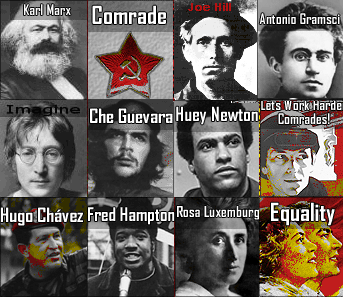
Comrades Some Republicans say President Obama is a Communist. He’s not much of a Communist.

For real Communism consider Earl Browder, an ultimate Red Stater who took orders from Stalin and was covertly followed by both the FBI and the KGB. On the Communist party ticket, he ran twice for president against FDR. He made the cover of Time magazine. At the time, Browder’s popularity had been fueled by turmoil of the Great Depression.

While people may have understood and even respected him during those years, times did change. In changing times, his surviving family members mostly had to live uncomfortably with this unusual legacy, or else hide from it.

Granddaughter Laura Browder decided to write about it. But first she had to learn about it.

A professor of American studies at the University of Richmond, Browder had authored a book on the radical 1930s but always maintained her family’s privacy. Until recently, she hadn’t venture too deeply into the past of Earl Browder, a man she knew as a quiet visitor on Thanksgivings. Now she is probing his life and parting decades of silence.

“I was struck by the impossibility of finding definitive answers to the mysteries of the past and the desperate importance of trying anyway,” she wrote in a Nov. 23 issue of The Chronicle of Higher Education.

At Syracuse University, she found a trove of archival material that Earl Browder, then broke, had sold. Among his papers were family letters and photos, including a picture of Laura’s father as a child, posing in shorts while holding a real sickle and a real hammer.

Her father told her he had no recollection of the photo.

I wish Laura Browder luck with her project and hope it brings her family closer while promoting an understanding of things we don’t understand.

Her piece in the Chronicle made me ponder the idea of Communism in general, how its advocates went from philosophy to revolution, to inspired hope, to authoritarian brutality, to controlling half the world, to creating great fear and insecurity in the U.S., to finally becoming an utter failure and an almost laughable concept.

Oddly, it remains vital enough to be used as a political smear.

During the later part of the Cold War, the American preoccupation with Communism made me want to observe it. So I took a job in China, working as a low-level editor in the English language section of the government’s top news agency, Xinhua. On the plane over I spoke to a party man returning home.

His English was good. So was his suit. He was sharp and intelligent. Dapper and cool. He said he preferred a system where the government looked out for its people.

“You don’t seem the type that needs looking after,” I said.

“That’s true,” he answered. “I can take care of myself. I can survive under any system. But I have a brother. Without Communism he would be lost.”

I guess it’s a comforting idea to think one can never be lost.

My very first real reaction to upclose Communism was equally comforting. I walked into my office on the first day and an elderly Chinese woman handed me a fat envelope filled with cash. She said it was my pay for the month.

“But I haven’t done anything yet,” I said.

“You will.”

“Suppose I run away?”

“You won’t.”

Another good thing about Communism back in the mid-80s was you didn’t pay rent, or you paid very little. For the Chinese, almost all they earned was disposable income. I knew a young guy who blew his entire month’s salary on payday and managed to make it to the end of the month.

Under old Communism – as opposed to the new, market-based variety —  the Chinese didn’t worry about finding a job. One was assigned. That was good, unless the job was in some wasteland 2,000 miles from home and it was something you didn’t want to do. A woman I knew studied the Portuguese language in college and upon graduation was sent to Brazil to be a foreign correspondent. She knew nothing of journalism.

Things were easiest for those friendly with party bosses, even the minor ones. Conversely, offending a party boss could destroy your life, especially if the boss was a bad Communist. Where I worked, we knew who the bad and good Communists were. The bad Communists used their positions to get ahead and destroy their enemies. The good Communists volunteered to work holidays and cleaned the office (there were no janitors). The so-so Communists loved them.

In those days, powerful Communists used influence to get two-room apartments (a quantum leap from one room) and to score beer during summer shortages. Today they use influence to take over companies and become multi-millionaires.

Irony has yet to strike American Communists. Without power, influence or temptation they can remain pure. In the video below, Glenn Beck interviews an avuncular old man who probably resembles Laura Browder’s grandfather. For 40 years he has been the head of the American Communist Party, an organization about as visible as bad breath. He almost gets the best of Beck. Then the Communist, in an inadvertent knock against private property, takes a sip of Glenn Beck’s water. Watch Beck react.

 –By Lanny Morgnanesi

Cloaking a bright holiday in darkness

28 Nov

The little catch phrase I use as the top of this blog is, “Speaking, because it is allowed.”

The phrase carries some irony for me because I believe society discourages uncomfortable speech and attempts to silence it.

There are two basic kinds of offensive talk. The first is false; the second true.

Regarding the first: Lies hurt, and large numbers take great offense when someone slurs a race or a people. For me, I prefer it when everyone fully expresses themselves. It reveals their hearts.

Regarding the second: The truth often hurts more than the lies, especially if it reveals us as monsters.

One such truth is the genocide by Americans of Native Americans.

Last week a University of Texas journalism professor named Robert Jensen published an opinion piece about Thanksgiving. In the Daily Texan, his university’s newspaper, he associated the holiday with this genocide and implicated our founding fathers.

Reacting quickly, UT president Larry R. Faulkner wrote the Houston Chronicle a letter in which he calls Jensen “a fountain of undiluted foolishness on issues of public policy.” He was “disgusted” by Jensen’s article, he added.

In his article, Jensen quotes several U.S. presidents in a grand show of ill will toward Native Americans. He has Theodore Roosevelt saying, “I don’t go so far as to think that the only good Indians are dead Indians, but I believe nine out of ten are, and I shouldn’t like to inquire too closely into the case of the tenth.”

Jensen later asks: “How does a country deal with the fact that some of its most revered historical figures had certain moral values and political views virtually identical to Nazis?”

I hope all good and informed American know that perhaps 30 million buffalo were slaughtered by white hunting parties (some sitting in trains) in an attempt to deny food to the Plains Indians. I find that as haunting as gas chambers.

This is our heritage, uncomfortable as it is.

Professor Jensen deserves credit for bringing forth what usually is unspoken.

I suggest we all follow his example in these times when it can be done. If we do, we may develop the courage to continue when and if society tries to ensure that it can’t.

–By Lanny Morgnanesi