How lazy people can save the world

21 Apr
From Bloomberg Businessweek

From Bloomberg Businessweek

We laughed when “Seinfeld” described itself as a show about nothing because we knew it was about everything. Now there is some thought that the way to solve the environmental crisis is to do nothing.

Let’s not laugh. It could fix everything.

This process, that involves nothing, was discussed in a Bloomberg Businessweek article called, “It’s Easy Being Green.” The key to it is something called default rules. The default rules take hold only when people do nothing. But first, governments, corporations or groups larger than the individual must act to set those pro-green defaults.

Each day we live with defaults, often not knowing they are there.

If you haven’t changed things on your cell phone or computer, they look and operate the way they do because of default settings – a ring tone or a screen saver or a folder icon. Your printer probably defaults to print on one side of a page.

Suppose each printer came with a default setting that printed to both side of the page?

According to Businessweek, Rutgers University imposed a double-sided default on all printers at that institution. After four years, it reduced paper consumption by more than 55 million sheets, which saved 4,650 trees.

That was one university.

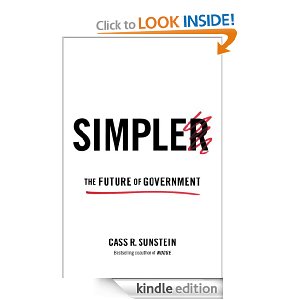
Book-SimplerShould we choose to make it so, the default system could be extensive. In two towns in Germany, 90 percent of the people use clean energy (wind, solar, etc.) because that is the default. If you want the less-expensive, less-clean power, you have to do something. You have to tell them to change it for you.

As shown, most don’t.

This natural tendency toward laziness, procrastination and acceptance can be exploited for good. It doesn’t restrict freedom. It just points everyone in the right direction. If they choose, they can turn around and go the other way.

Learn more about doing nothing to save the world by reading “Simpler: The Future of Government,” by Cass R. Sunstein.

By Lanny Morgnanesi

Biker/Writer Shares Experiences With Fracking

14 Apr
Author Seamus McGraw

Author Seamus McGraw

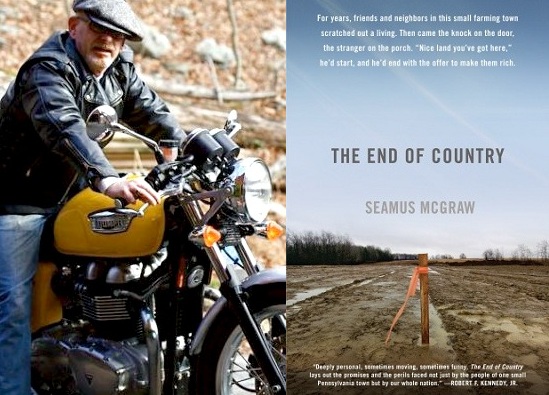
I recently attended one of those events where an author discusses his or her work in an intimate setting. From the outset, it was clear this would be interesting. After all, how many writers show up in leather pants, leather jacket, a Triumph T-shirt, shaved head, goatee and with a bike out front?

Upon entering the room, he placed a can of Drum tobacco and a pack of Zig-Zag papers on the table in front of him. He didn’t smoke during the talk, but he did roll. His best points were made while gesturing with the unlit fag.

After 45-minutes, he excused himself to go outside and feed his habit.

Lunch was served, but he said his lunch would be coffee. Do you have any?

He said he was a liberal but that 90 percent of liberals are idiots.

In the middle of the talk, he invited us – and anybody, for that matter – to a huge barbeque he holds every year.

Seamus McGraw-book coverThe man’s name is Seamus McGraw.

I’m embarrassed to say I did not read his book, but I will.

It’s about fracking.

Fracking is the common term for hydraulic fracturing, which is used to extract oil and gas from shale. It does so through a horizontal drilling process that pumps large amounts of water and chemicals, under extreme pressure, into the shale. The shale shatters and the gas and oil are released.

Fracking has put a glut of natural gas on the market and kept prices low.  It has caused coal-fired power plants to shift to the cleaner, cheaper natural gas. Most unexpectedly and perhaps most important, it will help the United States become energy independent in the coming decade.

It also may poison life forms that dwell near the drilling sites, or maybe even beyond them.

When Seamus is asked, “Are you for or against fracking?” he answers, “Yes.”

His book is, “The End of Country: Dispatches from the Frack Zone.” Those who read it said they didn’t see evidence of any leather-clad biker in it. Maybe the book is where he goes to hide.

Seamus failed at college, early careers and several marriages. He stumbled into journalism and writing, became successful, and then looked for a way to stumble out of it.

Around that time someone knocked on the door of his home in northeastern Pennsylvanian and offered him money for the fuel underneath it. He signed the papers and decided, “OK, one more book.”

What resulted got him attention, so now there is another book coming. It is on conversations about climate change — how we talk about it. Seamus believes that in politics and life we are divisive because we self-polarize. He said we are too blind or to stubborn to learn that under the surface we often believe the same things. His goal is to get to the point where we recognize this, and then move on to fixing our problems. Top on his list would be a national energy policy.

Seamus, soon to be 55, is a supreme raconteur. He seems incredibly knowledgeable on almost every subject. And, of course, his presentation is unique.

After his talk, I wished I could have seen him ride out of there. Unfortunately, I missed that. I guess I’ll have to wait until his next book.

Lanny Morgnanesi

In some lives, comfort and peace are luxuries

6 Apr


Margaret Smith -- from the New York Times

Margaret Smith — from the New York Times

A story today in the New York Times by Dan Barry tells how an 89-year-old Delaware woman was kidnapped, placed in the trunk of her car for two days, them dumped in an overgrown cemetery of weeds and sand. No food, no water. The dramatic part is how she crawled out of that cemetery on bloodied hands and knees.

“I’d stop for a few minutes, then start crawling again,” said Margaret E. Smith.

Author Eudora Welty

Author Eudora Welty

The woman, who has a heart problem, survived to calmly tell her story.

In many ways, the incident reminds me of a short piece of fiction by Eudora Welty called, “The Worn Path.” Written in 1941 and first published in the Atlantic, this classic piece is about the all-day journey of an elderly woman who walks through a forest, up and down hills, across a creek on a log, through barbed wire and through thorns.

As she walked, she’d talk to herself.

“I in the thorny bush,” she said. “Thorns, you doing your appointed work. Never want to let folks pass—no, sir. Old eyes thought you was a pretty little green bush.”

Only in the end do you learn it was a regular walk to town for her grandson’s medicine, and she had no money to pay for it.

Quite a moving tale and, I’ll bet, based on a true person, a person like Margaret E. Smith, who comes from a town called Slaughter Neck, something right out of a Eudora Welty story.I only recent read “A Worn Path.” I picked up an anthology and there it was. I would suggest you read it. It’s a lesson in determination and hard living, and how for many people routine is nothing more than the everyday torture of life.

By Lanny Morgnanesi

Shocking disclosure: TV is Free!

31 Mar

Retro TV

It’s hard to remember old technology. That includes devices popular just a few decades ago.

I was surprised that there are people today who don’t know TV is free.

I tried explaining broadcasting and networks to a younger person who had a difficult time with the concept. He only knew that TV came through a cable. He didn’t know that a significant portion of what is on cable also travels through the air and that with something called an antenna it can be brought onto a screen and viewed.

For free.

And because cable can deteriorate data, the broadcast signal actually is clearer, like a higher high definition.

Old tech

Old tech

This lost knowledge of pre-cable TV is being used by at least one business to draw attention to its product – an antenna. In a full-page newspaper ad made to look like news, the ad’s headline reads: “Public gets Free TV with no monthly bills.”

The “story” that follows says the announcement is being made by CompTek, a company whose phone lines, it adds, are ringing off the hook.” The ad list all the Philadelphia area zip codes that can get free TV, and urges people living there to immediately call CompTek.

It’s highly deceptive, but not really a lie. It fails to mention that every zip code can get free TV, as long as it’s within the range of a broadcast.

“Philadelphia area residents who call the Toll Free Hotlines before the 48-hour order deadline to get Clear-Cast can pull in Free TV channels with crystal clear digital picture and no monthly bills,” the ad says.

“Clear-Cast” is the antenna. No mention that other companies sell them and don’t have a 48-hour order deadline. No price for Clear-Cast is listed in the large ad.

After a hike several months ago in my cable rate, I cut the cord in protest and bought a new-technology antenna. I wanted to save money but also had a spare laptop to connect to the TV for Netflix and other Internet TV.

The new antennae are not like the rabbit ears of old. You can buy them for the roof of your house if you want, but the more popular kind go inside the home. They come in several shapes. Mine is from RCA. It is square and flat and black, about the size of an iPad.  I think I paid $40. All you do is connect it to the TV.

New tech

New tech

Well, that’s not all you do. After you connect it, you have to program it on the TV and allow it to locate nearby signals. It takes a few minutes. The TV runs a sequence of all available channels and grabs the one in your area.

I had hoped to get signals from Philadelphia and New York, but my reach was not that strong. New York was out. Big disappointment.

Still, I found myself running the sequence several times to see if I could capture more. It reminded me of fishing. You hit the button on the remote and then wait and watch the screen for a catch. I actually captured more signals the more I ran the sequence. But this doesn’t mean you can watch all these channels, nor does it mean the position of the antenna can stay the same for all.

Just as people used to move the rabbit ears around to get a good signal, the new antenna has to be moved, depending on the station you want to receive. I generally have two positions. One gets about two-thirds of the signals, the other pulls in the remaining one-third. It is bothersome to have to get up and move the device, but you get used to it.


Weather and atmosphere seem to be factors. Sometimes the signals are strong and you get everything. Sometimes a few are weak and they conk out or break up. There are a few you almost never get.

It’s not perfect, but it is a big savings over a monthly cable bill that usually runs toward $150. What I like least is there is no program guide. You may be watching a movie but there is no way to check its title or which actors appear. You don’t know when it will be over or what is coming on next.

And, of course, there is no DVR or On-Demand. You’ll have to use a connected computer to help get around this.

And just a reminder, you won’t be getting any cable stations – no CNN, or Comedy Central or TBS or ESPN. You get only broadcast channels on networks such as ABC, CBS, NBC, FOX and PBS, plus local stations.

Unlike old TV, most networks broadcast their main channel and a couple supplemental ones. The supplements usually aren’t high definition and the programing is second-rate. Still, there are old movies, old shows and plenty of cooking and fitness demonstrations to watch.

So if you didn’t know, now you do: TV IS FREE.

By Lanny Morgnanesi


Danger – I’m talking about race (but also art)

26 Mar

cab calloway-2

I sat down to write about creativity but will begin with race. I’ll get to creativity later.

Normally, race is a subject best avoided. Even good-intentioned statements can offend. I don’t mind offending, as long as I offend everyone. When I discuss race, I generally keep these three precepts in mind:

  • All people are basically the same.
  • Even so, likes prefer likes.
  • Whether acknowledged or not, every group thinks it is better than the other.

I’m told that, historically, each tribe of Native Americans referred to themselves as “the human beings” or “the people,” while the names they gave other tribes were epithets describing creatures who were less than human.

That’s us! Is it not?

Dividing us by race and setting us against each other seems like a cruel thing for the Creator to do, but I guess there was a reason for it. Giving us the capacity to enslave others, however, is too harsh to even remotely understand. That capacity is what rightfully gives racial issues their hypersensitivity.

I can wish everyone wasn’t so sensitive, but there is too much working against it.

While smart people don’t discuss race, I have to admire those who do. One is Bob Huber, a writer for Philadelphia Magazine. In the March edition of the magazine, he wrote a piece called, “Being White in Philly.”  In it he tells stories of race from a white perspective.

“Everyone might have a race story, but few whites risk the third-rail danger of speaking publicly about race, given the long, troubled history of race relations in this country and even more so in this city,” he wrote. “Race is only talked about in a sanitized form, when it’s talked about at all, with actual thoughts and feelings buried, which only ups the ante.”

So let’s talk!Philly Mag

After Huber’s article, many did. This was his intention. There were a number of public forums around town and the online version of the article – as of March 25 – had 6,292 comments.

The article, among other things, mentions how whites, upon entering a local convenience store, hold open the door longer for blacks than for whites in order not to offend them. Later, Huber quotes a Russian woman who thinks blacks do nothing but sit on their front porches smoking marijuana. It’s that kind of material.

In response, the only full-time African-American employee at Philadelphia Magazine wrote a counter piece for the Philadelphia Inquirer. She described her coworker’s message as: “black people are essentially what’s wrong with the city and that white people who live here are afraid of them.”

My test of the article’s validity is not its truthfulness but its honesty. Fair or unfair, right or wrong, the piece accurately describes how some white people feel. It would be dishonest to argue they don’t feel that way. Whether or not they accurately portray blacks is a totally different issue

I think it is good to know how people feel. I want to know how people feel about me, even when they don’t like me. My natural assumption is many will not like me, or at least think I am less that I am, certainly less than they are.

In the extreme, this may anger me, but I can live with it.

I understand that others may not, cannot and will not.

But that’s not why I’m writing. I’m writing about creativity. Mainly, I want to know if one race is more apt to be creative than another – specifically whether minorities are more willing and more capable than the majority in advancing art.

In the past I’ve had thoughts on this. They resurfaced recently when I heard a radio interview with a black record producer. By his own admission, this producer is not your normal black record producer. In order to set up a story about his style of producing, he told the show’s host that black artists create something then quickly leave it behind to create the next thing. White people, he said, go back and revisit what already has been created.

Then, in a twist, he said, “I’m that white guy.”

Twist aside, I saw truth in his stereotype, especially in the progress of music. By the time white bands, for example, took up the blues, black artists had left it way behind.

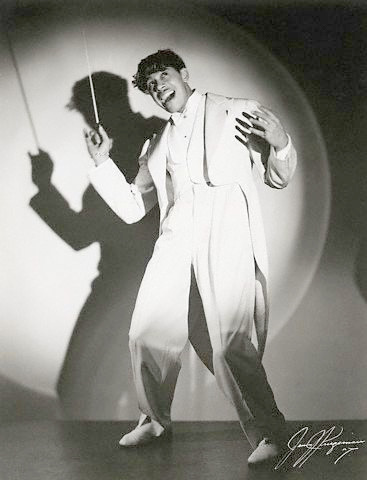
Shortly after this interview, PBS aired an American Masters episode called, “The Blues Brothers Band Remembers Cab Calloway.” The Blues Brothers movie, of course, clearly depicts the tendency for whites to revisit the old. More interesting was a specific story in the documentary about the legendary Cab Calloway.

John Landis, the movie’s director (white), told how he wanted Calloway (black) to sing his 1931 classic  “Minnie the Moocher” in the movie and to do it in the original style. When Calloway saw the music charts, he expressed disgust and said something like, “What the hell is this?”

He could not comprehend why anyone would want to put a near ancient rendition into a contemporary movie. Landis eventually talked him into it, but it was completely foreign to Calloway.

I was amazed at how closely this little story paralleled what the black record producer had said. The record producer might not fit the stereotype, but Cab sure did. I wondered just how deep this pattern went, or even if it were true (Little Anthony and the Imperials, after all, still perform their hits.)

One of the shockingly bad things about art in any form is that it so often is a copy of something done by an innovator. I believe it was Paul Gauguin (not a minority but definitely off the path) who suggested that there are only two kinds of artists: plagiarists and revolutionaries. It could be said that the plagiarists have a stake in the status quo while the revolutionaries want to destroy it.

Could this be the case with the white-black creative dichotomy described by the record producer and illustrated by Cab Calloway?

While few want to discuss race, I’d like to hear from people on this. Let’s forget about Philly Mag and the suppressed hostilities of whites for a while and talk about whether muses favor those who have been pushed outside the mainstream. What drives a person to originality and risk when so many others are content to stay stuck on what’s popular?

Is white innovation a rarity? Surely there are white revolutionaries. In a pinch I could name 10. (Pollock yes; Presley no.) Do white innovators have to try harder, or must they – unlike blacks – possess a genetic mutation or be social misfits?

I can’t speak first hand to this. I’m hoping others can. Please write.

By Lanny Morgnanesi

The lives we lead are not our own: Why privacy is valued

14 Mar


Privacy

Aton Chekhov, in one of his most famous stories, pauses from character development to discuss privacy.

The passage comes in “The Lady with the Pet Dog,” about a young woman and an older man having an adulterous affair that they have kept secret.

“The personal life of every individual,” he wrote, “is based on secrecy, and perhaps it is partly for that reason that civilized man is so nervously anxious that personal privacy should be respected.”

That was written in 1899, long before the act of “liking” something would send data on your habits and behavior to thousands of marketers. The Internet has become a place where we share its wonders and benefits in exchange for our privacy. We do so either without complaint, or else unknowingly.

Chekhov didn’t have to worry about such things. Nevertheless, he studied the nature of the private life and believed “every man led his real, most interesting life under cover of secrecy as under cover of night,” and that everything in the open was false.

A person who, for career or avocation, looks closely at something will share this notion. For as they investigate one thing they invariably see other things not meant to be seen.  Investigate the assassination of President Kennedy and find that there is a cult in Texas wearing underwear made of aluminum foil. I made that up. Real examples would be stranger.

Last night I read the Chekhov passage on privacy. This morning in the newspaper I noticed stories about:

  • A “cannibal cop” convicted of conspiracy to abduct, roast and eat women.
  • An ex-principal charged with possessing child porn.
  • A bookkeeper who stole nearly $650,000 from her employer over several years.

This was just one section in one newspaper in one day.

I agree with the Russian writer that we don’t project much truth in our daily comportment, but it is a little frightening to think that people we consider normal  harbor great inner darkness. Perhaps it’s the complexity of our DNA and the innumerable variations of its structure that produce humans destined to act or think in so many different ways that there is no normal and that everything imaginable – and unimaginable – gets covered.

We are going to be learning a lot more about this, what with cameras everywhere now and odd folks freely indulging themselves on the never private Internet.

All of us are bound to long for the days when those phony exteriors Chekhov spoke of hid the harsh truth of our species.

By Lanny Morgnanesi

A land once overcrowded now builds cities for no one

9 Mar


Struggling to sell real estate. -- NEW YORK TIMES PHOTO

Struggling to sell real estate. — NEW YORK TIMES PHOTO


A Chinese casino dealer from Vancouver called about an investment. He said vacation homes in China’s tropical Hainan Island, off the southeast coast, were selling for 600,000 yuan or about $92,000. A friend of his bought 16.

China once had no room for its people. Dingy one-room apartments were the norm. That was 25 years ago. Today, there is housing galore. There is so much housing that many cities are completely empty.

Shiny, modern, architecturally splendid ghost towns.

They’ve been built for no one.

According to a report on CBS’s 60 Minutes, these empty new cities are being constructed at a rate of 20 or more a year.

The ghost towns – the name used for them by the Chinese – are not modest. They are grand, with rows of skyscrapers. Many resemble Manhattan.

Why are they being built?

They are being built because people like my friend and his friend are willing to buy them whether they are empty or not. People want to buy them because they see housing as a sure investment, with prices – because of massive speculation – going up and up and up, as if there will be no end to it.

To a smaller extent, this happened in the U.S. Remember? Homeowners all thought they were rich, or would be soon. A bubble was created, and it burst, causing the recession of 2008. The thought of easy money (the easier it looks the harder it hooks) causes people in both the West and the East to lose all reason. But how in God’s name can someone look upon an empty city, knowing that many other empty cities exist, and think real estate is a good investment?

How can developers get financing for these cities? How can an economy that not long ago could not feed its people sustain such ridiculous, irresponsible and wasteful practices? It strains my mental capacity to come up with answer.

But I feel confident of this: Soon there will be great hell to pay.

As the high price of wheat caused an Arab Spring, a drop in housing prices could cause revolt and even revolution in China. I see it as that serious. Average people have invested entire fortunes that will most certainly be lost. Chaos will follow, but it won’t bring back the money.

The Chinese government has tried to cool the housing market and stop the wild speculation. Recently, it said it would apply a 20 percent tax on the sale of investment homes. The New York Times photo at the top of this post shows people struggling to sell their properties after they learned of the new tax.  The Times also reported that couples are getting divorced as a way to skirt the tax and have two people claim residence in two houses.

Some China experts say crafty people will find ways to avoid the tax or the government will end up ignoring it.

So, the frenzied buying of homes is not likely to stop soon. It’s like a contagious disease. Even I would like to have a $92,000 vacation home on lovely Hainan Island if it will be worth $200,000 in a year or so. But if I can control myself and wait a little longer, I might be able to get it for $10,000 – or maybe two for 10.

In a country of 1.3 billion people, I’ll probably have the Hainan beach all to myself. A ghost beach is so much better than a ghost town.

By Lanny Morgnanesi

Murder under my nose: How I made an innocent man look guilty

26 Feb

Justice

One afternoon last week a coworker sat down next to me and I focused on his shirt.

“Were you wearing that this morning?” I asked.

“I was,” he said.

This innocuous exchange revived in me a memory of murder. It brought back a decades-old crime and thoughts of an innocent man I wanted to put behind bars because someone said he changed his pants at lunch.

Circumstance, no matter how incriminating, should never be mistaken for truth. This I have learned.

The incident occurred at a newspaper where I was an editor. Our building was adjacent a large parking lot. At the far end of the lot, away from the building, was a patch of grass and some picnic tables.

No one but Janice used them.

Janice was a 26-year-old secretary who would sunbathe at lunch, lying on one of the tables.  Her meal would be a salad from the Burger King across the street. She’d drive over there, get the salad, then come back and park her car near the picnic tables.  The keys were left in the car and the sound system was turned up so she could hear it while taking in the sun.

A guy she was dating worked in the advertising department of the newspaper, but word was their relationship was coming undone. Janice planned to head north that weekend to visit a Canadian football player friend. But on Friday, before she left, she planned to talk with the old boyfriend and explain things.

She never did because she went missing. After a few days her body was found in the woods near a river. She had been stabbed about 40 times. Bloodstains were found on the parking lot near the picnic tables.

When word got out, everyone at work huddle together to cry, grieve, commiserate and ask why. I was the editor on the story and had to put aside personal feelings. I informed my coworkers that reporters would be interviewing them to find out if they had witnessed anything odd in the past few days and to learn what they knew about Janice.

The boyfriend was there. He looked terrible. He hadn’t slept or shaved for days. He seemed a wreck. Normally, his hair was perfectly coiffed in what could be called “disco” style. Now it was all mussed.

He took me aside and said, “I’m sorry, but I can’t talk to you about Janice. I just can’t.” He shook as he spoke.

I told him it was his decision to talk or not talk, but I asked him what he meant by “can’t talk.”

He was quiet for a moment then said, “Let’s go into an office.”

We did, and he shut the door.

“The thing is,” he said nervously. “The thing is . . . if I talk about Janice, if I tell you the story of Janice … the real story … she’ll come off looking like” – and he paused – “the devil.”

At that exact moment I decided I was alone in a locked room with a murderer.

Over the next few days, the reporters and editors worked feverishly to find Janice’s killer. The boyfriend is always a suspect and much of our findings were pushing us toward him.

The jealousy motive was clearly present. But there was more. A colleague told us that on the day of the murder the boyfriend had been wearing a pair of brown pants in the morning and in the afternoon had change to black.

Witnesses from outside the paper were coming forward. One was a hairdresser who said she had been driving past our building around the time of the murder and saw a man and a woman at the end of the parking lot. The man was raising and lowering his arm in the direction of the woman, she said. Being a hairdresser, she said she couldn’t help notice the man’s hair. She said it was neat and styled, like the hair of men who frequented discos.

When we spoke to the police, they suggested we could be onto something. It was odd, however, that they never wrote down anything we said.

Meanwhile, the boyfriend found it difficult to come to work. Janice had been well liked. This was not true of him. Now, popularity was a moot issue. He was being looked upon as the most horrid of creatures.

That did not change, although it should have.

Everyone at the paper, me more than anyone, was stunned when police arrested a 16-year-old high school dropout and charged him with the murder.

The boy, who hung out at the Burger King, recently got his driver’s license and wanted his parents to buy him a car. They refused. He liked Janice’s car, a hot black number that he’d see when she drove in to buy her salads. He decided he wanted it and followed her on foot to the newspaper parking lot across the street.

While she was on the table sunning, he got in the open car and was preparing to take it. She challenged him. He pulled the knife and stabbed her repeatedly. He put the body in the trunk and drove away with his prize.

All this happened in broad daylight, on a heavily traveled road, outside a building that employed hundreds of people, including journalists trained to observe and photograph news.

I don’t think any of us ever apologized to the boyfriend. In the face of rock solid evidence to the contrary, a few continued to believe he committed the crime.

Not long after the arrest, the largest fire in the area’s history broke out. A Kmart warehouse the size of several football fields was fully engulfed in flames and smoke. It was massive. The scene looked like World War II. The newspaper sent someone up in an airplane to shoot the fire, and the dramatic photo ran across six columns in the paper.

A copy of that day’s paper with the huge fire picture was on my desk when I arrived at work. There was a note attached. It was note I’ll never forget; a very short note that was very long on black humor; a note full of hurt.  Somewhere I must have it in my archives, but I’m not sure where. It was from the boyfriend, and this is what it said:

“Honest to God. I didn’t do this.”

The boyfriend eventually resigned from the newspaper. Years later, on Valentine’s Day, the murderer hanged himself in prison.

The whole episode is something I think about from time to time, especially when a colleague has innocently and maybe for no good reason changed an article of clothing in the middle of the day, or at least I or someone else thought he did.

 By Lanny Morgnanesi

Something I recently learned

20 Feb

Library of Congress 12

The Library of Congress, the keeper of everything, is in the process of archiving more than 170 billion tweets. Some of them may be yours.

The lucrative tunnels of Gaza

18 Feb

gaza-tunnels


For those without it, money always seems to end up in the wrong hands.

A fool and his money are soon parted because there never will be a shortage of disreputable types willing to fleece the weak and unknowing. Writer Dorothy Parker said if you want to know what God thinks of money, just look at the people he gave it to. And the Bible itself, in Matthew 19-24, plainly and poetically states that heaven is not for the rich.

But while money has caused great misery in the world, it also has the remarkable, almost magical power of solving problems. It can literally break down barriers.

In the Middle East, in Gaza, there is a wall. On one side are people who need things they can’t get. One the other side are those things.

Due to the force and power of money, the wall and all its associated political obstructions have been circumvented.

They’ve been circumvented by tunnels, which in Gaza can make millions for their owners.

These outlaw entrepreneurs find the means to acquire the wood, concrete and excavation equipment needed to create 700-meter corridors of commerce. Some might even dig a tunnel by hand, even though it could be destroyed by Israeli bombs.

These tunnels are in the town of Rafah, which is split down the middle. Egypt controls one side; Israel the other. According to Bloomberg Businessweek, Gaza has 1.6 million people, with 40 percent living below the United Nations poverty line. Unemployment is at 31 percent.

Yet the tunnels can cause the economy to boom. Businessweek says that the tunnel system employs almost 15,000 and carries 75 percent of the good sold in the area.

One successful tunnel owner, Emad Shaaer, has family members on both side of the barrier, which greatly facilitates his business. Payment for his services vary. “Sometimes you got $200,000, and sometimes you got nothing,” he said.

Tunnel construction can cost about $200,000, but you only need $50,000 to get started. You don’t have to pay the labors and tunnel experts until the flow of goods starts.

Things became really good for the smugglers in 2007 when Hamas took control of Gaza from the Palestinian Authority. To punish Hamas and Gaza residents for taking a more radical stance, Israel closed the borders even tighter. If anything can make a smuggler rich it’s a tight border. But as success and profits grew, they attracted attention.

When Hamas realized how much money the tunnel owners were making, it began to tax the operations, raising an estimated $188 million annually. (Hamas denies this.) The local Gaza government also regulates the good that can be transported, outlawing all the things that make the most money. (Further outlawing what is already outlawed.)

Even so, it is doubtful the tunnels will go away. Taxes and regulations can be skirted. Or, maybe there is enough for both the tunnel owners and Hamas.

The only thing that can truly destroy the tunnel system is peace, a highly unlikely prospect. Still, it is possible that the day may come when there will be enough profit in peace that the power and force of money will have succeeded in making us civil.

In such a case, I would argue that the time has finally arrived to allow the rich into heaven.

By Lanny Morgnanesi