Archive | History RSS feed for this section

The NRA Votes … do you?

21 May

By Lanny Morgnanesi

The bumper sticker said something like, “I’m the NRA and I vote.”

It was similar to messages from an assortment of special interest groups on both the left and right. It could have been Planned Parenthood or the American Association of Retired People or the teachers unions.

No mater what the group, the intention is to express political power. What is obvious but unstated is this: People who get off the couch to vote have influence because most people don’t vote.

Democracy, after all these years, has never quite caught on. We’re happy it’s there, like an exercise machine in the basement, but don’t mind that it has gathered substantial dust.

Our country started out more as an aristocracy than a democracy. The leaders, including George Washington, were land speculators who owned hundreds of thousands of acres on the other side of the Allegheny Mountains. As long as the British controlled things, that land was essentially worthless.

So the aristocrats started filling the heads of artisans and common workers with ideas of democracy and revolution. They actually gave them guns and taught them to kill the British. After proving victorious, the artisans and common workers still had the guns and still had ideas of democracy – even though they remained obligated to tip their hats when passing a gentleman.

But throughout the land they formed Democratic Societies, which were looked upon by the elite like the American Communist party was looked upon in the 1950s.

The Democratic Societies, run by armed individuals, were frightening.

Historian John Ferling, in “A Leap in the Dark: The Struggle to Create the American Republic,” says James Madison reacted by designing the Constitution to preserve liberty while making it extremely difficult to bring about substantial change.

Ultimately, in the long run, the group once referred to by Washington as the “grazing multitudes” settled back and continued grazing (if you don’t count the Civil War).

Now, for the most part, they don’t even vote.

Requiring photo IDs to vote, as is done now in my home state of Pennsylvania, will mean even fewer voters.

At times, winning high office seems more about collecting money than votes. Had Madison put that in the Constitution, the Democratic Societies might have taken up arms again.

We don’t need anybody to take up arms today. But like the NRA and Planned Parenthood, the AARP and the teachers unions, we really should vote. Democracy must be preserved before it truly withers away, or, like the exercise machine, someone puts it out in the trash.

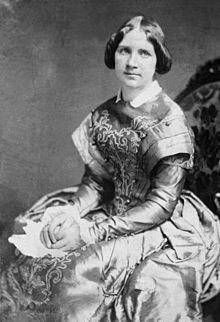
More popular than the Beatles: A 19th Century Swede

28 Mar


These guys were nothing, compared to ...

There were superstar performers long before mass media and one of them was named Jenny Lind.

Jenny was known as the “Swedish Nightingale.” She came to the U.S. on a whirlwind tour in 1850 after retiring from European opera at age 29. Her American promoter was P.T. Barnum, who created such a stir that 30,000 people went to New York harbor to greet Jenny’s ship.

... the Swedish Nightingale

Because of the great demand for tickets, Barnum would auction them off. They would go for as high as $20 – an incredible price in 1850. By comparison, a ticket to see the Beatles in 1964 on the main floor at the Atlantic City Convention Center cost $3.90.

At some Lind concerts, a few very rich music lovers (or perhaps speculators) would offer to buy up every seat in the house. Barnum wouldn’t sell, claiming all should get a chance.

On her American tour, Jenny personally earned $350,000. She gave it all to charity. The Beatles never did that. Neither did Barnum.

Because of the illogical and unreasonable American response to Jenny, the term “Lind mania” was coined, and a songwriter named W.H.C. West composed a satirical piece entitled, “The Jenny Lind Mania.” Today there would be Internet memes and YouTube parodies about Jenny.

I learned about Jenny last Sunday when some of the songs she did on her American tour were performed by three-time Tony nominee Judy Kuhn, who appeared in Pennsylvania at a pops concert with the Bucks County Symphony.

Maestro Gary S. Fagin told stories about Jenny and the sensation she caused.

History tells us that P.T. Barnum was a master showman and probably could sell $20 tickets to watch of piece of stale cake. Still, it is hard to believe he could do what he did without the tools of TV or radio or even photographs in newspapers. It must be that people, with or without technology, on occasion enter into fits of collective madness. We clearly have a weakness for it. It must satisfy something in our nature.

There was no harm, I don’t think, when people went to see Jenny Lind. There was harm, however, when nearly everyone in American, rich and poor, wise and stupid, went out and bought homes they could not afford. That weakened a nation. An entire species was weakened when in the last century much of Europe, the rich and the poor, the wise and the stupid, embraced fascism, war and the lethal scapegoating of Jews.

Clearly, things can get horridly bad.

Hearing about Jenny Lind at the concert, I wondered what humans are capable of. I thought about the relativity of good sense, the fragile veneer of morality and the protean quality of religion. I should have just enjoyed the music. Instead I thought about the monster within me.

Not a good evening.

Yeah, Yeah, Yeah.

Remember the Poor Immigrant

5 Mar

A zip-lock bag with a small rock inside for weight was tossed onto my lawn today. In my neighborhood, this is a standard method of advertising lawn services. What was not so standard was the pamphlet inside, which in part read: “Teofilo Sanchez Landscaping.”

I have friends who argue that immigrants, both legal and illegal, are a drain on taxes and the economy. While I really don’t know anything for sure, I always argue back that immigrants, legal and illegal, will provide the boost we need to restart our economy, and that they will become the next great wave of entrepreneurs.

It seems to me that it doesn’t take too long before a hired lawn guy earning minimum wage (or less) realizes that if he saves enough money for a mower and a truck, he can be the boss.

For all I know, Teofilo Sanchez is a Fortune 500 exec whose family came across on the Mayflower. But I will assume he is not. I will assume he is part of the new wave. I will assume that my theory (which required no insight or imagination) is coming true. I will assume that more and more marketing will target this new demographic, that the people in it will buy more houses and cars, that more will enter college, become wealthy, enter politics and lead.

This story has been repeated so many times it is a cliché. Why then is it so difficult to remember?

A truly great performance

12 Feb

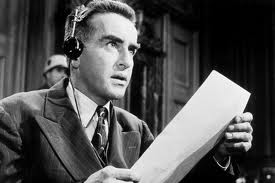
Montgomery Clift in "Judgment at Nuremberg".

Each time this year, TCM – the cable movie channel – presents, “31 Days of Oscar.” I happened to have tuned in when it was showing the 1961 film, “Judgment at Nuremberg.” I had never seen it. From the beginning, it was easy to tell this film is not only very good, it is very special and unique, with a strong, unusual perspective and a universal message.

I had been expecting anti-German propaganda.

Directed by Stanley Kramer, the film is studded with stars: Spencer Tracy, Burt Lancaster, Marlene Dietrich, Montgomery Clift, Judy Garland – even a young William Shatner pops up. The story is about the post-war trials in Germany. Top Nazis have already been prosecuted, and the film focuses on the trial of three judges who approved Nazi-ordered sterilizations (read castrations).

What motivated me to write this post, however, was Montgomery Clift.

His performance on the witness stand as a not-very-intelligent sterilization victim overwhelmed me with its power.

I was never a fan of Monti’s, who looks very different in this film. I had seen him play roles like soldiers and boxers and never felt they were right for him.

As the sad little witness, frightened and damaged, he is incredible. His screen time is a mere 12 minutes.

Please watch. (the first minute or so is missing)

Here is the interesting part, as reported on the Internet Movie Database site: Clift was having an extremely difficult time remembering his lines, so the director told him to ad lib, and that his confusion would ad to the confusion the character was going through under cross examination.

God did that work.

Clift usually cut his hair short after each movie, and didn’t make another until it grew back. In this film, there was no time for it to grow back.

The 16th Century’s version of the Colbert Report

27 Jan

“A prince never lacks legitimate reasons to break his promise.”
Niccolo Machiavelli


I’ve made a lot of assumptions in my life, like thinking a rich man can get into heaven. Then I do something as simple as reading the Bible and learn he can’t.

Another assumption of mine was that Niccolo Machiavelli, author of “The Prince,” was a heartless cutthroat who would do anything to get ahead. “The ends justify the means” is how high school teachers summarize the book’s message. I recently read it (way too late) and don’t think that’s in there. To me, Machiavelli is a man whose spirit is wounded and disappointed by humanity’s inability to be human.

He recommends extreme harshness as a way to attain and keep power, but this comes across as a combination of satire and sarcasm. Machiavelli was the Colbert Report of his day, but no one seems to have gotten the joke.

At the end of “The Prince” the writing turns true and the author sadly pleads, begs even, for a savior who can unite and free Italy from foreign rule. Tears practically drip off the page.

I would love to hear from one other person who sees this great man as I. Without some small affirmation I’ll have to assume I am wrong.