Archive | History RSS feed for this section

The Black Death, a killer of 20 million, had its good points

7 Feb

black-death

Being the progeny of immigrants, I’m sympathetic to their cause. Still, I’m convinced large-scale, legal immigration has hastened the withering of the middle class.

There have been other causes, including changes in tax policy and the global economy. But I was surprised to learn recently how significant an impact immigration had on the downward spiral of wages.

With thousands and thousands of Baby Boomers leaving the work force for retirement, wages should be going up. That’s the simple law of supply and demand. Immigration, however, has provided a counter balance and prevented this. Indeed, opening the borders sometimes seems like a purposeful antidote designed to help labor-intensive corporations. This is mostly likely why the U.S. Chamber of Commerce is a strong advocate of robust immigration.

Congress, perhaps responding to appeals by business, has frequently and consistently raised the level of legal immigration. In 1965 it was at 290,000 annually. Today it is about 1.1 million. This is legal immigration, and it is four times higher than any other country.

how-many-is-too-manyPhilip Cafaro, author of “How Many Is Too Many? The Progressive Argument for Reducing Immigration Into the United States,” gives a thorough accounting of all this in a recent edition of the Chronicle of Higher Education.

Cafaro sites studies by Harvard University economist George J. Borjas, a leading authority on the economic impact of immigration. Borjas found that in the 70s and 80s, a 10 percent increase in the number of workers in a given field decreased wages there by 3.5 percent. A more recent study showed that such an increase reduced wages of African-Americans by 4 percent, lowered their employment rate by 3.5 percent and increased their incarceration rate by almost one percent.

It’s good at least that today there is a great deal of talk about the withering middle class. Even Republicans now recognize it will be a critical issue in the 2016 presidential race. In an attempt to get in front of the issue, candidates like Jeb Bush are already saying they want to reverse the trend, although they provide few details.

If politics were not a factor, a solution could be easily found.

The strong post-war middle class in the U.S. was created primarily by tax policy. This policy was heavily graduated, meaning you paid a lot more if you made more a lot more. That policy no longer exists. Returning to it would easily restore the middle class, but it is unlikely the Republican Congress will choose this route.

Jeb-bushThere is, however, a consensus that a middle class, if one is desired, must be created, otherwise there will only be rich and poor. One was created in Europe during the 14th and 15th centuries. Unfortunately, the creative force was the Black Death — the bubonic plague that may have killed one out of every three Europeans (about 20 million). With the labor force devastated, there was upward pressure on wages and the ability of farmers to earn a much better living. Some reports say farm income increased by 50 percent.

In addition to creating the middle class, the plague often is credited with spawning the cultural rebirth known as the Renaissance.

The Black Death is a high price to pay for a middle class, even if it is accompanied by a renaissance. Changes in the tax and immigration policies might be a better way. But because government move in micro increments, this is unlikely. Any significant change probably will have to come through some unseen, forced hand.

If this is true, let’s hope it’s a kind one.

By Lanny Morgnanesi

I am an Etruscan!

14 Dec

Etruscans_couch

In the year 800 BC, you could earn a king’s fortune by making something good, perhaps with new materials or a new technique, putting it on a ship, sailing it around the Mediterranean, the Adriatic and the Black Sea, and either trading it or selling it.

Most of us don’t think of inter-cultural commerce when we think of 800 BC. It’s more likely we think of benighted barbarians. Of course, we’d be wrong.

In the 4.5 billion year history of the world, 800 BC is like yesterday. Much of what was done then is still being done today. (Look at the button on your shirt. It’s 5,000 years old.) What is sad is that we don’t know as much about that time as we should.

Etruscan_Map01_fullThere was an early civilization back then that excelled at trading, culture, technology and wealth accumulation. Comparatively little is know of them. They were the Etruscans, and I’m one of them.

If your ancestors are from the Tuscany region of Italy, where the Etruscans lived, you might call yourself Italian. But I’m finding that more and more people in this category are starting to classify themselves as Etruscans – the civilization that pre-dated Rome and for a time coexisted with Rome; the civilization from which Rome borrowed and then moved ahead, absorbing and eliminating its once great rival.

Much of what we do know of the Etruscans comes from the ancient writings of Greeks and Romans, who had nothing good to say about them — a sure sign of envy and jealousy. The Greeks and Romans criticized the extravagant Etruscan lifestyle, the culture’s public display of affection between men and women, and a then unprecedented equality between the two sexes.

That’s quite a culture.

At a recent party I spoke to an Etruscan friend of mine, Franca. She was born in Florence, in the Tuscany region. In a heavy Italian accent, she started talking about her ancestors and how everything that made Rome great was taken or learned from the Etruscans.

She scoffed at the Roman warriors who battled in chariots.

“Chariots were designed by the Etruscans for women,” she said.

Franca is a rare human being who by chance became my friend. She’s a marvelous storyteller. She knew Pavarotti before he became famous. He used to cook for her in his tiny New York apartment. But that’s another story.

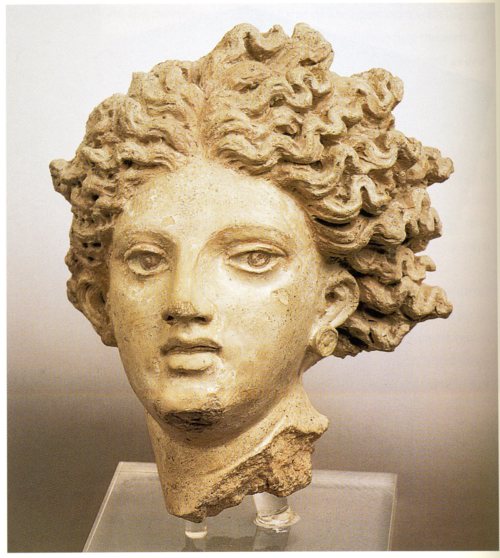
Etruscan sculptureWhile I had been aware that Franca was a fan of the ancients – she has a ring made from a coin that predates Christ — I didn’t know until this party that her son, a college president in Switzerland, spends every summer digging at an Etruscan excavation site. He is an expert on these people. I’m unsure if he taught Franca or if Franca taught him.

The discoveries at Etruscan sites come mainly from the findings within elaborate burial tombs of the rich. The Etruscan elite had the habit of building tombs that were detailed copies of their aboveground homes. The tombs were filled with domestic items of all kinds as well as great art objects and jewelry.

This provides a window into the culture, but it is heavily curtained.

The problem with unlocking all the mysteries of the Etruscans is that their writing did not survive. They had their own language and their own script, but they wrote on linen, which was easily ravaged by time. Some Etruscan writing had been found on metal and stone, but it just wasn’t enough.

Then came the mummy.

There often are quirks, mistakes and random or unusual acts that end up having a profound effect on history. This mummy is one of them.

I learned of it not from Franca but from a Time-Life book called, “Etruscans: Italy’s Lovers of Life.” The story, with many twists, begins in the late 1840s when a Croatian noble named Mihael de Barc visited Alexandria, Egypt. It was there that he bought himself a genuine mummy.

de Barc took his treasure to a home he had in Vienna, and put it on display. For some unknown reason, he found it necessary to slowly, over time, unwrap the mummy. By his death in 1859, he had completely unwrapped it.

Stay with me, please. I’m getting to the Etruscan part.

An executor put the exposed corpse and the bandages – which contained indecipherable writing — in separate cases and shipped them to the National Museum in Zagreb. In 1891, someone figured out that the unraveled linen actually was an Etruscan book.

The only way to explain this is to assume that an exiled Etruscan had once settled in Egypt and a mummy-maker grabbed one of his books to use on a client.

As mummification preserved the body, it also preserved the linen.

This chain of events, so far-fetched it could never pass for fiction, has given the world the only surviving Etruscan book. And still we don’t know enough.

Whenever I read more about these ancient yet modern people, my fasciation grows. The Etruscans called themselves by a name not used by others. To them, they were the Rasna or Rasemma. The Greeks called them Tyrrhenoi (from which we get the Tyrrhenian Sea). It was the Romans who called them Etrusci or Tusci (from which we get Tuscany).

They were great engineers, known for their roads and ambitious irrigation projects. Skeletal remains show they were exceptional dentists. (The design of the bridgework found in the mouths of tomb cadavers is still used today.) Their great wealth was the result of their talent at metalworking and the fact that they controlled vast deposits of copper, iron ore and tin, the largest in that area of the world. This was the stuff that went on their ships and gave them the foundation for one of the Western world’s greatest early civilization.

If only they had written on something more substantial than linen.

Anyway, I’m optimistic more information will be forthcoming. Franca’s son is sure to keep digging, so I may know more by the next party. But I doubt they will ever find another mummy that’s a book.

By Lanny Morgnanesi

In the Old West, without GPS, if they wanted you, they’d find you

16 Nov

Cormac McCarthy

Everyone knows we’re being tracked. You leave a trail with credit cards, cell phones, cookies and social media. Cameras take pictures at traffic lights.Auto dealers hide GPS devices on the cars they sell. Even U.S. passports have a chip embedded in them.

But in the Old West, in the days of the horse and buggy – mainly because of the horse and buggy – it also was easy to track people. People back then left tracks, the old-fashion kind.

Blood MeridianI point this out after reading Cormac McCarthy’s 1985 novel, “Blood Meridian or the Evening Redness in the West.” In it, a band of characters travels endlessly across vast expanses of plains, desserts and mountains. They always seem to find each other. Their enemies always seem to find them, and they their enemies.

There are some major skills involved here, as Cormac suggests. But the basics are hard to miss. In today’s times, we forget about giveaways like smoke from a cook fire, dung and urine from animals and humans, the simple imprint of foot, hoof and wheel. Either way, it’s pretty much a sure thing that after crossing the dessert everyone is going to end up at the well or creek. A great place to wait for your prey.

While it is frightening to think that today’s phones reveal where we are and where we went, it’s also a scary thought that you could ride or walk for days and nights, in the heat and cold, possibly without water and food or even clothes, across the harshest terrain, and the person trailing you will find you and kill you in the most brutal fashion.

This lesson, among others, I learned from Cormac McCarthy and the book they call his masterpiece.

No country posterIf you don’t know McCarthy from his many novels – almost all of them filled with horrific violence – then you might know him from the films made from his books. Perhaps the most famous is “No Country for Old Men,” which in 2007 won the Academy Award for Best Picture.

Some see McCarthy as the equal or near equal of Faulkner. While I was amazed by “No Country for Old Men,” I’m embarrassed to say I had overlooked McCarthy, then and even after. I only came to know him after briefly watching a so-so TV movie with an unfamiliar name – one I don’t even remember — and hearing several pieces of brilliant dialogue.

I admire a good sentence and these were unlike anything I’ve heard on TV – with the possible exception of “True Detective.” They came from deep within some dark, mysterious, knowing soul.

I checked and found they came from Cormac McCarthy. And so I went on to read “Blood Meridian.”

If you read it, or even just look at it, you’ll notice some things right off. First, there are no quotation marks (even when there are quotes). Cute, but only idiosyncratic. Next, there are all these words you won’t understand because they are archaic and rarely appear anywhere. Doubly troubling are the passages in un-translated Spanish – the common tongue of Cormac’s characters, who are American, Mexican and Native American.

But the most obvious and disturbing thing about McCarthy is the violence. Nearly every page is covered in blood. I recall thinking that while the writing was terrific, the plot line had to come from a thoroughly sick and disturbed mind.

Glanton gang
Then I began to listen closer to the tone, attitude and motif phraseology of his characters. I came to realize this was not made up. This was all true. It was history, and the writer must have relied heavily on journals and first-hand accounts.

While McCarthy is not in the habit of discussing his work, I searched for confirmation of my theory and found it on good old Wikipedia:

The majority of the narrative follows a teenager referred to only as “the kid,” with the bulk of the text devoted to his experiences with the Glanton gang, a historical group of scalp hunters who massacred Native Americans and others in the United States–Mexico borderlands from 1849 to 1850 for bounty, pleasure, and eventually out of sheer compulsion . . . .


. . . McCarthy conducted considerable research to write the book. Critics have repeatedly demonstrated that even brief and seemingly inconsequential passages of Blood Meridian rely on historical evidence. The Glanton gang segments are based on Samuel Chamberlain‘s account of the group in his memoir My Confession: The Recollections of a Rogue, which he wrote during the latter part of his life. Chamberlain rode with John Joel Glanton and his company between 1849 and 1850.


Unlike many people, I try not to look for meaning in creative work. Beauty alone is enough for me, and “Blood Meridian” is beautiful. The best art is an open presentation of depth that allows the consumer to add the meaning. It really doesn’t come with it.

Still, my favorite parts of the book are the philosophical pronouncements of the character known as “the judge.” I sense he sounds a lot like Cormac McCarthy at a cocktail party. The judge accepts violence. In total, what the book does for me is calm my frustration at man’s inhumanity, convincing me – if only for a short time – that violence is NOT inhuman, but rather perfectly and intrinsically human.

I’ll end with a passage and invite comment.

“It makes no difference what men think of war, said the judge. War endures. As well ask men what they think of stone. War was always here. Before man was, war waited for him. The ultimate trade awaiting its ultimate practioner. That is the way it was and will be. That way and not some other way.”

Lanny Morgnanesi

Two quotes, one old, one new, about something that existed then and continues to exist now

12 Jul

Caradoc in Rome


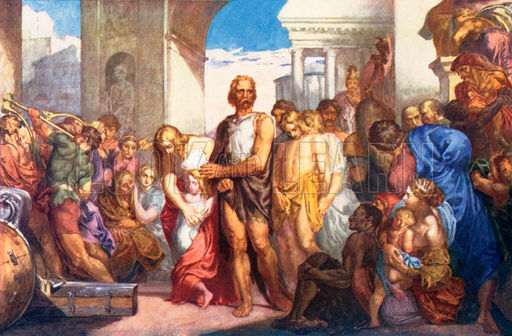
The first speaker is Caratacus, the British tribal leader who resisted the Roman invasion in 43 AD. He eventually became a prisoner of the Romans. After a convincing speech prior to his scheduled execution, his life was spared. Caratacus was so impressed by the city of Rome that, in amazement, he said this to his captors, who conquered and occupied Britain:


“And can you, then, who have got such possessions and so many of them, covet our poor tents?”


Goldman-Sachs-CEOThis second quote was said by Lloyd Blankfein, CEO of Goldman Sachs, a man whose job it is to make abnormal amounts of money in any and all ways possible and some that are not possible:


“Too much of the GDP over the last generation has gone to too few of the people… . It’s a very big issue and something that has to be dealt with.”


In both cases, the powerful have taken and then tried to exercise at least modest restraint to make things a little better. And so it continues.

By Lanny Morgnanesi

How long before the great income grab is reversed? Not long.

9 Mar

cbpp income inequality 2011

The first real understanding of my value as a worker came during a company Christmas party.

I was a young reporter for a family-owned media company. My fellow employees and I had already received the gift of a free turkey, and now there was this party, grand and lavish.

It was a time when newspaper margins were around 40 percent. Printing a newspaper was like printing money.

The party was held in a big banquet hall. Hundreds attended. There was a generous buffet, music, dancing and an open bar for the entire evening.

In general, the company did well by its employees. The founder was a tough, bull-headed union-buster, but when I worked there raises were given four times a year, the food in the cafeteria was subsidized and supervisors were honored at an annual dinner.

Upon the death of the old man, his four grown children took over. By chance, I was sitting with one at the Christmas party. She was somewhat shy but sincere when she said to our table, “All of you are responsible for making this company what it is. It would be nothing without you. My family owes everything to you. Our success is your success.”

Prior to that, I had seen myself as an expendable, replaceable cog.

But this co-owner, this daughter of an entrepreneurial risk-taker, was shifting my view. I hadn’t recognized it yet, but she knew that without workers a hundred printing presses could not produce a single paper.

Still, she was neither ready nor willing to change the rules and divide the profits among workers. That’s a different ideology, one totally alien to our system, one that threatens and offends.

Then I went to New York City and found out it wasn’t.

I was still learning the way of the world and on this visit to see friends I discovered how lawyers became partners.

My friends were a former reporter and her boyfriend lawyer. He didn’t go to dinner with us that Saturday night because he was working on an investment banking deal. He was trying to make partner.

When we met up later at a bar, he was in good spirits and had no complaints. As an explanation for missing dinner, he told me a joke: “Why do investment bankers love Friday? Because it is only two more work days until Monday.”

I envied his chance to become a partner. Now that I think of it, he probably was the first person I knew who was capable of using hard work to earn equity ownership in a company.

Why was law different from other professions? To begin with, there is no huge investment needed to start up, nothing like a printing press. Also, lawyers tend to see themselves as professional equals. And there probably is some precedent, a near-ancient tradition, of taking on partners rather than employees.

What’s more, it is easy for the good ones – those who bring in big clients — to leave and hang up their own shingles.

A factory worker doesn’t have that kind of leverage.

But if there exists a universal law of fairness, a standard morality for the value and worth of labor, then leverage shouldn’t be a factor.

Of course, there is no morality in the marketplace. If people will work for substandard wages, that is what you pay them. And so unions came to be.

Unions got their start in ancient Rome

Unions got their start in ancient Rome

We think of unions as a modern concept but the idea and practice go way back. The founders of Rome, in 753 B.C., may be partially to blame. As Rome grew and incorporated other provinces, the new citizens didn’t integrate. They stayed in their towns, kept their habits and traditions and failed to adopt a Roman identify. So an edict was issued requiring people to relocate to districts organized around trades. If you were a carpenter, you lived among all carpenters.

Ethnic differences faded.

Naturally, trade associations formed. It was a new unifier.

In time, these associations became quite powerful.

Even the kings of France had to contend with them. In an age when candles were the chief source of lighting and a significant expense in a large palace, money could be saved by letting them burn to the end.  Practical, but the guild in charge of candles wouldn’t allow it. It required that candles be replaced when half burned.

Unions in the modern era continue to be associated with self-serving, costly inefficiencies. Unlike the lawyers who must enrich their firms in order to become partners, unions too often weaken their companies, making workers liabilities rather than assets.

And companies today are quick to get rid of liabilities.

What unions are good at, however, is their ability to show management the true value of labor. By unifying the powerless, power is created. In speaking with one voice – “no we won’t work for poverty wages” – unions effectively alter the marketplace. They grant the common folk a degree of dignity and allow them to pursue happiness.

But with global competition so fierce, it has become impractical and unwise for unions to advocate uncompetitive practices. What they should advocate is efficiency, innovation, profit and partnership – true equity partnership. Unions gave us the weekend but if the incentive of partnership is applied (making Friday two work days until Monday) companies could get them back.

Would companies actually make their worker’s partners? Under the current climate, no. Even discussing the idea seems ridiculous and beyond farfetched.

But why?

In the golden age of unions – after resistance that included shooting strikers — companies decided there was enough growth and profit to meet the demands of organized labor. With profit in mind, there was a willingness to share. Henry Ford would benefit if he could keep cars rolling off the assembly line and meet the heavy demand.

And besides, workers with money buy things – like cars.

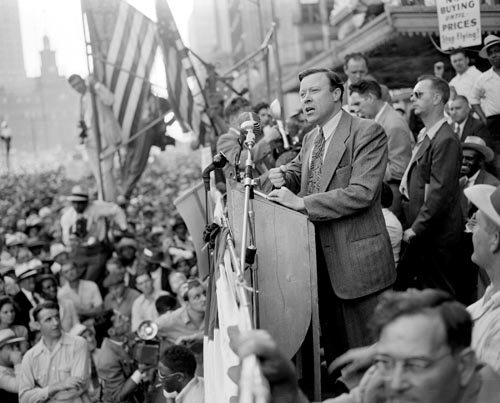
Walter Reuther knew the middle class fueled the economy.

Walter Reuther knew the middle class fueled the economy.

(There’s a great story about Walter Reuther, leader of the United Auto Workers, being shown an automated assembly line.  In a competitive dig, Henry Ford II asked him, “How are you going to get those robots to pay union dues?” Reuther retorted, “Henry, how are you going to get them to buy cars?”)

For the most part, the willingness to share is gone.

According to the Center for Budget and Policy Priorities and many other sources, a significant income gap between classes existed from the 1940s into the 1970s, but it did not grow. But after the early 70s and up to today, income concentration at the top increased dramatically. The last time the disparity was this great was prior to the Depression.

Various sources, including University of California at Santa Cruz Professor G. William Domhoff, in his blog “Who Rules America?,” report that in 2010 about 1percent of the U.S. population possessed 35 percent of the wealth. The top 20 percent had 89 percent, leaving the bottom 80 percent with 11 percent.

Also reported in various places, including the Los Angeles Times, is that from 1993 to 2012, income of the 1 percent rose 86.1 percent while income of the other 99 percent rose 6.6 percent.

As wealth became concentrated at the upper tier, billions in cash was stockpiled by American corporations.

In March, Forbes set the total at $1.45 trillion and listed the top 10 holders of cash, including:

Apple: $137 billion.

Microsoft: $68.3 billion.

Google $48.1 billion.

Pfizer $46.9 billion.

What changed?

For one, the labor market.

When Apple is ready to roll out a new iPhone, poor farmers in Katmandu drop their plows and fly to factories in Malaysia. This is not a rhetorical sentence.

Journalist Cam Simpson documents Apple’s labor supply chain in an incredible piece of investigative reporting for Bloomberg Businessweek.  His story tells how labor brokers fan out to the poor countries of Asia when Apple launches a new product. The people they find pay them for jobs and keep paying as the process continues. Often, they pay with borrowed money and go deeply in debt.

One was Bibek Dhong from Nepal. He paid a single broker the equivalent of six-months wages. The fee secured him a job in Malaysia with Flextronics, one of Apple’s chief suppliers. Before he could pay off his loans, production shifted to another country (better performance) and he lost his position.

His passport was held and he could not get home. He feared he would be arrested. Before he received help from Flextronics, he ran out of money and nearly starved.

Not exactly a union shop.

But as China has realized, when companies get richer, when commerce thrives, when corrupt leaders and their families amass great, visible wealth, expectations rise and workers lose their complacency. They demand more and often get it, until the factories move to a more accommodating country.

Sooner or later, corporations are going to run out of countries.

Sooner or later, a floor will form under the global labor market.  From there, workers will stand.

That’s when corporations are going to need a new plan.

And that’s why I’m suggesting one now.

In the U.S., people are finally waking up to the subtle yet systematic dismantling of the middle class, which has been occurring for decades. With less spending power, average families find it difficult or impossible to send their children to college – once the gateway to upward mobility. Those who do make it to college find it hard to get jobs when they graduate.

The bleakness and lack of opportunity, the malaise of our times, is truly settling in.

Books are being written with titles such as, “The War on the Middle Class,” “Screwed: The Undeclared War on the Middle Class,” and “The Betrayal of the American Dream.”

Income equality has become a topic in columns, blogs and editorial cartoons. The issue, once ignored, is now discussed by the president of the United States and the Pope. Billionaire Warren Buffett said that if class warfare truly exists, his class in winning. Even so, there are defections. One is global billionaire David Sainsbury, who calls for fairer wealth distribution through something called “progressive capitalism.”

To see inside this looming class crisis, look toward Seattle, the home of Boeing.

Timothy Egan, a Pulitzer Prize winning journalist and winner of the National Book Award, wrote an opinion piece in the New York Times Nov. 14 called, “Under My Thumb.” The title refers to Seattle’s position vis-a-vis Boeing.

Like many big corporations, Boeing hold jobs hostage as it demands and gets hefty tax breaks. As Egan points out, when anyone or anything shows resistance, companies like Boeing threaten to leave town.

Boeing is seeking concessions in exchange for keeping assembly of the new 777X jet in Washington State. For its part, the state of Washington provided a incentive package that included an $8.7 billion tax break, which Egan called the largest single state-tax giveaway in the nation’s history.

But Boeing also requires that workers accept cuts in pensions and health care benefits.

Unlike Washington, the workers said no.

Refusing to allow the “Walmartization of aerospace,” the machinists who would build the 777X turned down the offer by a 2-1 vote.

“I’m tired of being slapped in the face,” said John Gilman, who has worked at Boeing for nearly 40 years. “Building airplanes — it takes years of training and skill. The people who run this company used to understand that.”

In reaction to Egan’s piece, one reader commented, “This is just the beginning before Americans ‘storm’ any number of figurative ‘Bastilles.’ ”

Jump now, if you will, to the town of Richmond, California.

In Richmond, like most of the U.S., people were talked into taking home mortgages they couldn’t afford. When the housing bubble burst, they ended up owing more on their mortgages than their homes were worth.

Nothing unusual there.

What is unusual is the protective reaction, possibly unprecedented, taken by the town fathers on behalf of residents. Basically, they told the banks holding the bad mortgages to renegotiate the terms or Richmond would confiscate the properties through eminent domain.

Under this plan, the banks would receive 80 percent of each home’s current worth – much less than the original purchase price –and the town would reform the mortgages so owners can afford them.

Meanwhile, all across the country fast food workers are trying to nearly double their hourly wage to $15.

Not too long ago, the Occupy movement surprised everyone when it surfaced to protest almost everything. It stayed around much longer than anyone expected and started widespread discussion of the 1 percent and vast income disparities.

What else is out there waiting to bubble up? I sense there is a lot.

Nature and the human spirit, in time, tend to correct imbalances. I believe this correction has begun. When there is too much of one thing, the other thing comes.

And when the other thing comes, I hope we are ready for it. We might prepare by realizing that we all have a stake in each other’s well being, that each plays a role in the ultimate success of our society and that respect and dignity should be afforded to all. We are a tribe – we humans — and members of a tribe should look out for each other.

Right now we don’t.

I say, let’s act more like partners. Let’s all rise together.

That means valuing each other properly and recognizing that all roles are important, that we’d be in big trouble if one day no one wanted to pick up the trash.

Providing an equity interest to all workers – even a thin, thin sliver – is progressive and revolutionary. It may even be moral, wise and an effective business strategy. But for it to happen, something cataclysmic must occur, or the vision of something cataclysmic must appear.

In the meantime, it is likely that agendas will slowly change (perhaps preventing any cataclysm). This fall, for example, Bill de Blasio was elected mayor of New York after saying he would trim the gap between rich and poor.

Other politicians, in a discovering of new voting blocs, may decide to do the same and relieve the working poor of its distress, better balance wealth and create a more secure, just and – I think – more prosperous society.

A person with disposable income, after all, fuels the economy and is less of a burden on government.

Tax policy, a major cause of the wealth shift, also will have to change. An almost whimsical proposal comes from Robert Shiller, who on Dec. 8 received the Nobel prize in economics. To stop inequality from rising, he suggests raising taxes on the rich whenever their share of income starts to grow.

Should any of this actually happen, it won’t come solely out of true enlightenment. As always, it will come mostly as a way to preserve and protect – through concessions – the self-interests of the powerful. This is OK. It will come through changing market forces resulting from a shift in culture, attitudes, expectations and action. Those forces, nearly invisible now, seem to be coalescing. I don’t think they can be stopped.

When there is too much of one thing, the other thing comes. That’s the natural law.

Lanny Morgnanesi

Is the mother of invention dead?

11 Jun

pots2

It has been said that in very ancient times a person with bad teeth would die. Disease didn’t kill them. Starvation did. Apparently, there was no soft food. All this changed with the invention of pottery, allowing for the cooking of soups and stews.

While I tend to think tooth-less early man would tenderize his meat with a rock before starving, or just eat berries, I nevertheless brought up the pot as a life-saving invention while speaking to a millennial.

Millennials are members of a generation that greatly mourns the passing of the American age and the lost opportunities that went with it.

“I wish it were as easy now as it was back when they had the first pot,” he said. “Nothing was invented so almost anyone with a good idea could change the face of history.  You didn’t need a Ph.D. in nuclear science. You didn’t have to know a lot. All you needed was a good idea and you’d be famous.  How hard could it have been to invent something like the pot?”

I argued that coming up with the idea for a pot when there were no such things as pots required more than an idea, that strong vision and imagination was needed.

“Well, I’m not saying I could have invented the pot, but you do see my point, don’t you? I mean, what did it take to invent the wheel? Anyone could have done it. Or even fire. These people didn’t go to school. The field was wide open. Nowadays, it requires too much. Too much has already been invited; too much is known.”

I felt bad because he and perhaps many others were victimized by the times; their creativity stifled by a bad economy and the aggressive, eager multitudes in developing countries. Still, he made me wonder just how hard or easy it might have been to invent the pot.

The usual case is that most people are blind to innovation. They just can’t see possibilities outside of normal routine. There are, however, a few who do. After first being treated like loons and maniacs, they eventually win over the tribe and move society forward.

But I guessing it is likely that pottery and even the wheel may have been discovered by accident, in multiple places, at multiple times. These were things waiting to happen. In that respect, I can sympathize with the millennial.

I tried thinking of something relatively simple that has changed people’s lives in that past 100 years or so. Sliced bread? Air in tires? The ballpoint pen? There must be something. Nothing really hit me, although I’m certain it is there. If someone reading can think of it, please comment and let me know.

In the meantime, I think my millennial friend is just going to have to become a nuclear scientist, or something of that sort – and if he’s to change the world he still will need an incredibly creative, open, unfettered mind.

By Lanny Morgnanesi


Old Books Come Back to Life: Remember “Naked Lunch”?

1 Jun
Writer William Burroughs

Writer William Burroughs


The New York Review of Books sat on the table face up, showing the lead item about James Baldwin. This was odd, since Baldwin died a quarter century ago. No new books from him.

“As a writer of polemical essays on the Negro question, James Baldwin has no equals,” the review said.

The Negro question?

Oh. This was not new. This was old. It was a copy of the first edition of the New York Review of Books, reproduced on the 50th anniversary of the publication.  The Review was launched in 1963 as salve to a citywide newspaper strike. The most prominent authors of the day contributed. They did so on short notice and for no pay.

What a time that was!

Ideas and making a statement were more important than making money.

As a collective voice from the past now being read in the present, the Review of Books gives more than a few hints of intellectual unrest. The best minds of the day seemed to be laying the groundwork for a coming cultural break with convention and the status quo.

It’s right there, interwoven amidst the literature.

Those doing the writing were the avant-garde, and people listened to them. Looking over their names, it is difficult to recall writers today with reputations as large. Among the contributors were Norman Mailer, William Styron, Robert Penn Warren, Susan Sontag, Gore Vidal, Paul Goodman, Robert Lowell and Jules Feiffer.

If any group reflected the spirit of the times – or perhaps the coming spirit — this one did.

As did the books they reviewed.

Included was “Naked Lunch” by William Burroughs, the grandfather junkie to the Beat writers. “Naked Lunch” is perhaps one of the most unclassifiable novels in the English language. The story – often bizarre and fantastic — takes place inside the head of a man taking a drug cure from a quack. At one point in his career Burroughs would write his prose on paper, cut it up then randomly reassemble the pieces

“Naked Lunch” was reviewed by Mary McCarthy, whose books include “The Group” and “Birds of America.”

At the close of the review, she deals with the “pained question that keeps coming up like a refrain” – Why is this book being taken seriously?

Her answer is that for the first time in recent years, a really talented writer meant what he said.

This was the coming era.

Norman Mailer

Norman Mailer

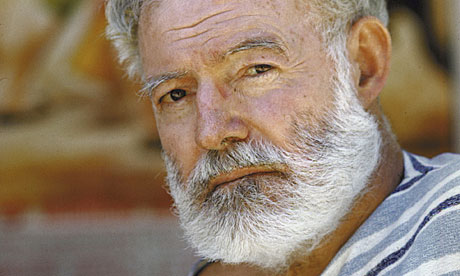
Some of the celebrity reviewers, those with the larger personalities, were overly tough on their colleagues. Normal Mailer, always pugnacious, said “That Summer in Paris” by Morley Callaghan was “dim” and mostly without merit. One passage, however, saved the book, Mailer said, because it exposed the true character of novelist Ernest Hemingway, who two years earlier committed suicide.

The tale has Callaghan, who boxed in college, getting into the ring with the much larger Hemingway. F. Scott Fitzgerald was the timekeeper. In a round that went long, Callaghan flattened Hemingway. Fitzgerald blamed his poor time keeping.

“Oh, my God,” he said. “I let the round go four minutes.”

Hemingway, perhaps from the canvas, answered, “All right, Scott. If you want to see me getting the shit knocked out of me, just say so. Only don’t say you made a mistake.”

To me, this shows meanness and poor sportsmanship.

Was Hemingway a coward?

Was Hemingway a coward?

To Mailer, who also boxed, it led him to concluded, “There are two kinds of brave men. Those who are brave by the grace of nature, and those who are brave by an act of will. It is the merit of Callaghan’s long anecdote that the second condition is suggested to be Hemingway’s own.”

In essence, Mailer was calling Papa a closet coward, and he cited his suicide as evidence of this cowardice.

Then there was Gore Vidal. He described John Hersey’s book, “Here to Stay,” as  “dull, dull, dull.” Hersey was trying to invent something called “New Journalism,” which later would boost the careers of people like Tom Wolf and Hunter S. Thompson, but Vidal criticized him for cramming too many facts into his sentences.

John Updike is one of America’s best writers but Sir Jonathan Miller, a Cambridge graduate who did books, plays, movies and TV, said Updike’s “The Centaur” was “a poor novel irritatingly marred by good features.”

F. Scott Fitzgerald, poor at keeping time

F. Scott Fitzgerald, poor at keeping time

These reviews pretty much stuck to literature, but an unusual number referenced the Cold War and voiced the fear of imminent doom. It was hard to miss the Soviets. One reviewer discussed four books on the economy of our then-mortal enemy. Another reviewed Alexander Solzhenitsyn’s short gulag novel, “One Day in the Life of Ivan Denisovich.”

Robert Jay Lifton, in a review of a compilation called “Children of the A-Bomb,” said, “The thing we dread really happened in Hiroshima and Nagasaki. But the world resists full comprehension of this event, symbolizing massive death and annihilation.”

He and others suggested that faith in the future was fading, and that without change mankind’s time was limited.

Reviewer Lewis Coser said education and information no longer were the answer.

He called the well-informed person “a cheerful robot.”

“The increase of information may indeed have led, contrary to the belief of the Enlightenment, to a decrease in rationality,” he said.

A remarkably forward-looking book carried the harmless title, “The Exploration of Outer Space.” It written by A.C.B. Lovell and reviewed by James R. Newman. Both lauded the development of radio astronomy as a way to finally understand the composition of the universe.  They believed recent findings made it almost certain that other solar systems contained life and that future contact was possible.

Nuclear war: On everyone's mind in 1963

Nuclear war: On everyone’s mind in 1963

But there was darkness overlaying this optimism. The review expressed a grave fear that humans, if they don’t destroy themselves first, one day would destroy life on other plants, either deliberately or through contamination.

The review ends this way:

“”I myself do not find the prevailing space-race chauvinism and the threat to other planets as horrifying as the threat of global extermination. Nor do I derive consolation from the thought that if our managers turn the earth info a lifeless stone other forms of life will continue elsewhere in the universe. But I am impressed with Lovell’s deep sense of responsibility about life everywhere, and I wish there were many more scientists like him.”

And that’s the way it was in 1963.

Coming would be Dylan, hippies, communes, the counter-culture; Burn Baby Burn, Don’t Trust Anyone Over 30; a refusal to be bought and sold; hope I die before I get old.

 By Lanny Morgnanesi


Muhammad as Solomon: A better story

25 May

solomon1

Time gives and takes. It adds and subtracts. It creates things that didn’t exist and extinguishes things that did. So as a general rule I distrust history.

Take for example the story of King Solomon and the baby. Why would a respected wise man mediate a custody case by offering to executive the child? Who would recognize this as rational? And why would any woman – mother or not –agree to it?

The story doesn’t ring true. I sense something was lost in translation and time.

A better story of wisdom comes from the Muslim world. It could be an additive story, but it nevertheless makes more sense.

This is it:

The shrine at the Kaaba in Mecca existed in pre-Islamic days and even then was considered sacred. It is said to have been built by Abraham. Inside then and now is a rock that fell from heaven. Possibly a meteorite, it is considered a divine gift. A flash flood not uncommon in the Arabian desert destroyed the Kaaba in the seventh century. Leaders of Mecca’s tribes and clans work together and rebuilt it.

All went well until it came time to place the stone back in the temple. Each leader argued for the honor. When the discussion broke down and violence was threatened, someone said, “Let us then agree that the next person to come over that hill will be given the task of deciding.”

Along came young Muhammad, future prophet. Being an orphan who had been raised in poverty by Bedouins, he was of low standing among the tribes. But he was also considered neutral.

Muhammad was told the problem.

He thought about it, then secured a tarp of some sort or a large blanket. He put the stone in the middle and told each clan leader to grasp hold of an edge. Together, they carried the stone into the shrine.

True or not, this is a great story of wisdom and mediation. Perhaps more important from the standpoint of story telling, the stone foreshadows the Quran, which Muhammad used to bring divisive, violent, warring Arab tribes together.

Quran or no Quran, Bible or no Bible, prophet or no prophet, the absence of conflict doesn’t last long. Today, the Judeo-Christian world tends to think it is at war with the Muslim world. It doesn’t realize the larger war is actually within the Muslim world. As Abraham, Moses and Jesus failed to bring peace, so has Muhammad.

Human nature embraces the words of prophets then simultaneously rejects them. It has always been.

Author Leslie Hazelton

Author Leslie Hazelton

My interest in learning more about Muhammad and Islam was recently heightened by a well-written work entitled, “The First Muslim: the story of Muhammad.” Author Lesley Hazelton, a journalist and former psychologist, takes a unique and interesting approach to her narrative. Scholars might object, but the most fascinating thing about her book is the way she fills in the historic blanks with rational speculation based on a keen understanding of the human mind.

Another appealing feature is the way she has put together all the fascinating stories from Islamic history and culture, ones widely known in the Muslim world but mostly unknown to western Christians and Jews.

For the first time I learned that many Islamic rites pre-date Muhammad, including regular pilgrimages to Mecca.  I also learned that Arabs considered all scripture sacred and were respectful of all prophets. Furthermore, in a day when little was written down, Jews were honored as “the people of the book.”  Christians also had great influence, as the Byzantine Empire moved into the area.

Faith and beliefs all seemed to have melded together. That’s enviable.

Practices in Arabia had come close to the monotheism of Abraham. The idea of one powerful, all-knowing god was accepted. But in Arabia this god had secondary, sister deities that also were worshipped. Muhammad, in perhaps his most controversial move, wanted the sisters dethroned.

His truth, as revealed to him by the angel Gabriel, proclaimed that God was neither begotten nor a begetter; that there were no sister gods. In a way, this is purer than Christianity, with its trinity.

For me, the most remarkable aspect of Islam is the Quran, or Koran (Spelled accurately only in Arabic script). Let’s remember that Muhammad could neither read nor write. His revelations came at a time when memory, not books, held the history and literature of one’s culture. In fact, the literal meaning of the word “Quran” is “the recitations.”

Indeed, it was not written down in the prophet’s lifetime.

To allow memory to commit large amounts of information, it usually had to be in verse; poetic and alliterative, like a beautiful song. This is the Quran, passed onto the world by a former camel boy.

In the process of revelation, where does the human take over from the divine? How much wisdom, intellect and creativity is required of the human? How much did Muhammad have? Was it Gabriel’s truth but Muhammad’s poetry? Or did the angel do it all?

If Muhammad had a role, then he was more than a natural poet; he was a self-taught scholar with deep, strong knowledge of the Bible. It is said the Quran was meant to be a continuation or extension of the Bible; that a good portion is biblical tales or re-workings of the tales. Gabriel, of course, would know them. But how did Muhammad?

Like the carpenter’s son, he somehow overcame circumstances and acquired a wide and useful education. Maybe it was easier than we think. Without a system of schools and universities, maybe elders were required to pass along great stores of knowledge to the young. Throughout much of his life, Muhammad was an agent and mediator on long caravans up and down the Arabian peninsula. That’s a lot of time for doing nothing more than talking and absorbing. Learning.

Another interesting things about Muhammad and the Quranic revelations is they did not come all at once but over a period of more than two decades. When he needed something new, he fasted and mediated and went back up the mountain.

Sometimes he had to wait years. Other times inspiration came quickly.

It is said by some and disputed by others than on one occasion the verses he brought back were wrong and had to be recanted. It is alleged that he had been spoken to not by Gabriel but by the devil. These are the so-called Satanic Verses, which for a brief time are said to have re-legitimized the three sister gods.

After I finish with “The First Muslim,” I’m going to read a translation of the Quran. I’m certain to be surprised, and that what I read will be a departure from what I think I know or have heard.

Although purists believe Muhammad’s messages should not be read or spoken in any language other than Arabic, that seems to be changing. I received my English copy from two guys handing them out at the mall, a gift from whyislam.org.

My book was published in Istanbul and translated by Abdullah Yusuf Ali.

The name Abdullah, according to Hazelton’s book, means “servant of God.”

If we can get by the hate, the misunderstanding and the ignorance, there is much worthy to be learned about this culture.

Please listen to Ms. Hazelton speak on the Quran.

By Lanny Morgnanesi

Grand Dad was a Communist

8 Dec

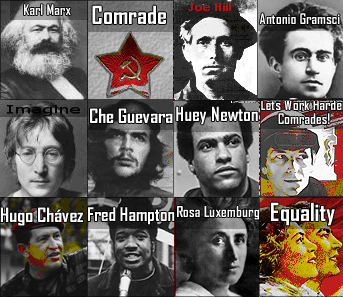
Comrades Some Republicans say President Obama is a Communist. He’s not much of a Communist.

For real Communism consider Earl Browder, an ultimate Red Stater who took orders from Stalin and was covertly followed by both the FBI and the KGB. On the Communist party ticket, he ran twice for president against FDR. He made the cover of Time magazine. At the time, Browder’s popularity had been fueled by turmoil of the Great Depression.

While people may have understood and even respected him during those years, times did change. In changing times, his surviving family members mostly had to live uncomfortably with this unusual legacy, or else hide from it.

Granddaughter Laura Browder decided to write about it. But first she had to learn about it.

A professor of American studies at the University of Richmond, Browder had authored a book on the radical 1930s but always maintained her family’s privacy. Until recently, she hadn’t venture too deeply into the past of Earl Browder, a man she knew as a quiet visitor on Thanksgivings. Now she is probing his life and parting decades of silence.

“I was struck by the impossibility of finding definitive answers to the mysteries of the past and the desperate importance of trying anyway,” she wrote in a Nov. 23 issue of The Chronicle of Higher Education.

At Syracuse University, she found a trove of archival material that Earl Browder, then broke, had sold. Among his papers were family letters and photos, including a picture of Laura’s father as a child, posing in shorts while holding a real sickle and a real hammer.

Her father told her he had no recollection of the photo.

I wish Laura Browder luck with her project and hope it brings her family closer while promoting an understanding of things we don’t understand.

Her piece in the Chronicle made me ponder the idea of Communism in general, how its advocates went from philosophy to revolution, to inspired hope, to authoritarian brutality, to controlling half the world, to creating great fear and insecurity in the U.S., to finally becoming an utter failure and an almost laughable concept.

Oddly, it remains vital enough to be used as a political smear.

During the later part of the Cold War, the American preoccupation with Communism made me want to observe it. So I took a job in China, working as a low-level editor in the English language section of the government’s top news agency, Xinhua. On the plane over I spoke to a party man returning home.

His English was good. So was his suit. He was sharp and intelligent. Dapper and cool. He said he preferred a system where the government looked out for its people.

“You don’t seem the type that needs looking after,” I said.

“That’s true,” he answered. “I can take care of myself. I can survive under any system. But I have a brother. Without Communism he would be lost.”

I guess it’s a comforting idea to think one can never be lost.

My very first real reaction to upclose Communism was equally comforting. I walked into my office on the first day and an elderly Chinese woman handed me a fat envelope filled with cash. She said it was my pay for the month.

“But I haven’t done anything yet,” I said.

“You will.”

“Suppose I run away?”

“You won’t.”

Another good thing about Communism back in the mid-80s was you didn’t pay rent, or you paid very little. For the Chinese, almost all they earned was disposable income. I knew a young guy who blew his entire month’s salary on payday and managed to make it to the end of the month.

Under old Communism – as opposed to the new, market-based variety —  the Chinese didn’t worry about finding a job. One was assigned. That was good, unless the job was in some wasteland 2,000 miles from home and it was something you didn’t want to do. A woman I knew studied the Portuguese language in college and upon graduation was sent to Brazil to be a foreign correspondent. She knew nothing of journalism.

Things were easiest for those friendly with party bosses, even the minor ones. Conversely, offending a party boss could destroy your life, especially if the boss was a bad Communist. Where I worked, we knew who the bad and good Communists were. The bad Communists used their positions to get ahead and destroy their enemies. The good Communists volunteered to work holidays and cleaned the office (there were no janitors). The so-so Communists loved them.

In those days, powerful Communists used influence to get two-room apartments (a quantum leap from one room) and to score beer during summer shortages. Today they use influence to take over companies and become multi-millionaires.

Irony has yet to strike American Communists. Without power, influence or temptation they can remain pure. In the video below, Glenn Beck interviews an avuncular old man who probably resembles Laura Browder’s grandfather. For 40 years he has been the head of the American Communist Party, an organization about as visible as bad breath. He almost gets the best of Beck. Then the Communist, in an inadvertent knock against private property, takes a sip of Glenn Beck’s water. Watch Beck react.

 –By Lanny Morgnanesi

Cloaking a bright holiday in darkness

28 Nov

The little catch phrase I use as the top of this blog is, “Speaking, because it is allowed.”

The phrase carries some irony for me because I believe society discourages uncomfortable speech and attempts to silence it.

There are two basic kinds of offensive talk. The first is false; the second true.

Regarding the first: Lies hurt, and large numbers take great offense when someone slurs a race or a people. For me, I prefer it when everyone fully expresses themselves. It reveals their hearts.

Regarding the second: The truth often hurts more than the lies, especially if it reveals us as monsters.

One such truth is the genocide by Americans of Native Americans.

Last week a University of Texas journalism professor named Robert Jensen published an opinion piece about Thanksgiving. In the Daily Texan, his university’s newspaper, he associated the holiday with this genocide and implicated our founding fathers.

Reacting quickly, UT president Larry R. Faulkner wrote the Houston Chronicle a letter in which he calls Jensen “a fountain of undiluted foolishness on issues of public policy.” He was “disgusted” by Jensen’s article, he added.

In his article, Jensen quotes several U.S. presidents in a grand show of ill will toward Native Americans. He has Theodore Roosevelt saying, “I don’t go so far as to think that the only good Indians are dead Indians, but I believe nine out of ten are, and I shouldn’t like to inquire too closely into the case of the tenth.”

Jensen later asks: “How does a country deal with the fact that some of its most revered historical figures had certain moral values and political views virtually identical to Nazis?”

I hope all good and informed American know that perhaps 30 million buffalo were slaughtered by white hunting parties (some sitting in trains) in an attempt to deny food to the Plains Indians. I find that as haunting as gas chambers.

This is our heritage, uncomfortable as it is.

Professor Jensen deserves credit for bringing forth what usually is unspoken.

I suggest we all follow his example in these times when it can be done. If we do, we may develop the courage to continue when and if society tries to ensure that it can’t.

–By Lanny Morgnanesi