Archive | Entertainment RSS feed for this section

How “The Bear” Made Me Appreciate My Restaurant Education

22 Aug

(ALL NAMES HAVE BEEN CHANGED TO PROTECT THE GUILTY)

         By Lanny Morgnanesi

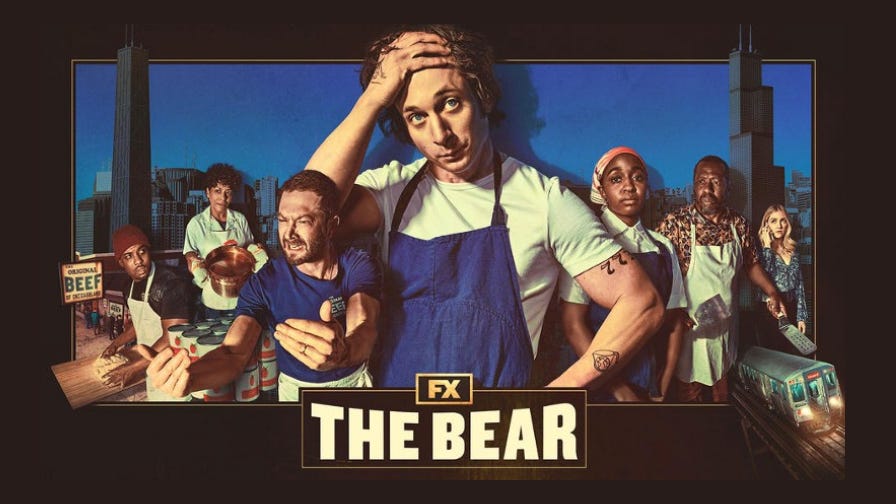
         When I first tuned into the FX/Hulu TV show called The Bear, which just concluded its third season, I had no idea it was about a restaurant. Actually, it’s about two restaurants. Season One opens in a popular but gritty eatery best known for its Italian beef sandwich. Season Three ends in a classy, upscale joint (run by the same people) where the food on each plate is equal in size and weight to a Snickers. The Chicago-based series is about many things, including the obsession with perfection. But it is also about restaurant culture, a culture I was exposed to from age 15 to 22; a culture that I liked, appreciate, and understood. It was more than a culture; it was an education, one that was rare and unique.

         And it all came rushing back after watching The Bear.

         As a teen, I was unaware of myself. I knew I was not especially athletic, or especially smart, or especially funny. Other than that, I was blank. I didn’t know my quirks and idiosyncrasies, and assumed I didn’t have any. Early awareness, however, began developing after I took a job washing dishes at a place I’ll call De Luca’s, a small suburban restaurant that mostly served pizza, hoagies, steak sandwiches, and pasta dishes.

At De Luca’s, dishes were washed by hand, in a triple sink, with one empty, one having sudsy water, and one having a rinsing solution. On my first day, I found myself appalled that a fellow dishwasher was dumping sauce-covered dishes right into the sudsy water, turning it red, meaning all other dishes, even cleaner ones, would have to be washed in a tomato broth. Although I was the least experienced person at the restaurant, with no stake whatsoever in its management, I insisted that the saucy dishes be rinsed in the open sink before being placed in the soapy water, and I took it upon myself to change the soapy water at regular intervals.

On a busy Saturday, I expressed panic when the senior chef and consiglieri, the uncle of the owner that every called “Uncle,” tried dropping a large stack of saucy dishes into my sink. I stopped him abruptly and told him I needed to rinse them first. He looked at me with one eye and said, “OK Mr. Clean.” From then on, Uncle always called me Mr. Clean.

         Next in my restaurant education, I was forced to ponder the conflict between morality and capitalism. It centered primarily on the quantity and quality of certain ingredients.

Between lunch and dinner, the dishwashers helped making meatballs. There was a set recipe to follow, and it included what I thought was an overabundance of breadcrumbs. I was outraged and started calling them bread balls. Clearly, the customer was being cheated (although they did taste good). Later, I was shocked to learn that on All You Can Eat Pizza Night, less than half the regular portion of cheese was used. What shocked me more was that no one cared. Furthermore, we were instructed to cut the lunchmeat paper thin. There were some complaints, but only because it took longer. All this led me to feel like an abnormal outlier, a crusading do-gooder that no one listens to. Then, the Uncle restored my confidence in mankind.

When I was cutting salami for hoagies, he happened to walk by with one of the managers. He saw what I was doing, paused, and looked around the table where I was working. He looked on a nearby shelf. He picked things up and looked underneath then. His head went left and right. The manager standing by his side asked, “Is something wrong?” Uncle answered, “I was just looking for the razor you use to cut this salami.”

         Salvation. I was not alone. Morality and fairness can at least be a minority voice in capitalism. Humanity had been saved.

         De Luca’s owner, let’s call him Tony De Luca, did have his moments of generosity. At Christmas, every employee – even lowly dishwashers — received a gift, a nice one. And every supplier, the truck driver or whoever it was that brought in the cartons of canned tomatoes, the heavy sacks of flower, the produce, received a fifth of whiskey. Once a year, Tony, a member of the Kiwanis service club, would donate hundreds of hoagies for the club to sell at its fundraiser. My young mind thought: Wouldn’t it be better to not do these things and instead make the meatballs meatier? Ultimately, I concluded, with no evidence, that what appeared like generosity  was actually business decisions with a positive financial return; that goodness and kindness had only a little to do with it.

         Thus was my early grounding in American capitalism and the world of commerce.

         Next came my realization that common-sense rules, made sacrosanct and beyond question, had their purpose.
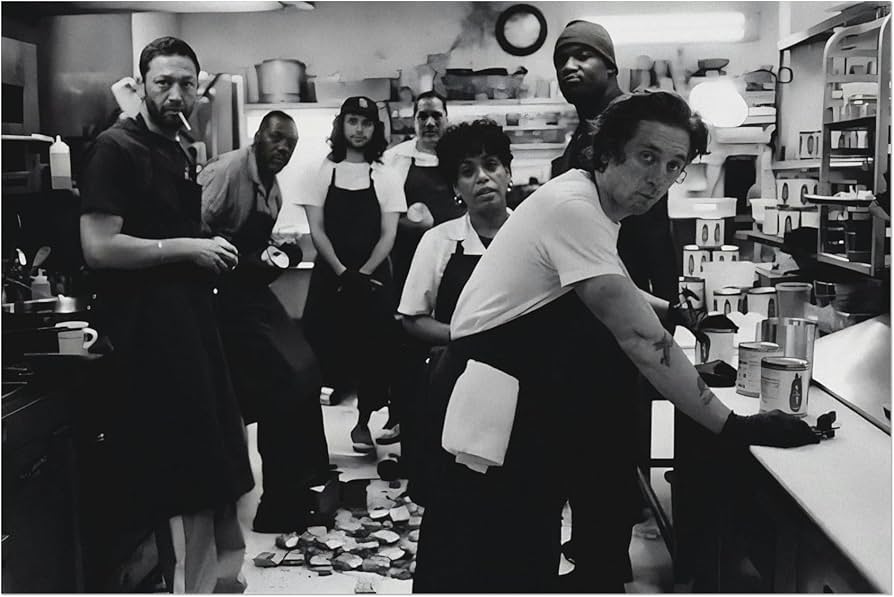
         Growing up, I don’t recall being faced with rules that couldn’t be bent or challenged. But in the restaurant business, such rules existed, and while they meant more work for me, I considered them logical and important. I was more than willing to comply.

         Three of those rules were:

  1. Break down all boxes before putting them in the Dumpster.
  2. When putting new supplies on shelves, rotate the old stock to the front.
  3. Do not leave the restaurant at night until it is thoroughly cleaned.

These rules, never written down, showed me people, even obstreperous ones, can be compliant in the interest of building a great institution or even a great civilization. This was an important lesson for a guy who had too many opinions of his own.

         As a person who read books and intended to go to college, I felt superior to most of my restaurant co-workers. So, when they showed flashes of intelligence, as they often did, it caught me off balance. Once I was asked by a manager if I could operate a certain food processor. I said I could not, and he walked away. That’s when a guy named Freddy, who would spend his life in restaurants, told me, “You never say no. Say yes, and when they take you to the machine, say this one is a little different than the one you used. Ask him to show you the basics, and then teach yourself how to use the machine. You’re smart enough to do that.”

         Basically, Freddy was telling me the adage, “Fake it until you make it,” which I hadn’t yet heard.

         The educational level of De Luca workers was shown in their limited vocabulary, but some knew more than they let on. I recall a manager named Leon scolding a waitress, saying, “You know what your problem is? You’ve got ASS-mosis. Every time your ass sees a chair, it sits down.” After that, I had to assume he was familiar with the scientific process of osmosis, and Gpd knows what else.

         Another vocabularic surprise came from a waitress who, during this period, might be described as “hard.” Rita used to hang out with her gang, drinking, smoking, and intimidating people on their “turf” behind a shopping center. She and I talked once about a De Luca’s employee who was fired. “The guy was a real jerk off,” Rita said, using a term often applied to people you don’t like. But then she added, “I mean he was literally a jerk off. He’d call you into the backroom and when you got there, he’d be stroking it.”

         Writers and scholars often confuse the words “literally” and “figuratively,” but Rita, a young hoodlum, got it right.

         De Luca’s was filled with thought-provoking characters and innumerable personalities. There was Ralph, who today would be persona non grata for his incessant use of sexual innuendo and inappropriate quips. We all thought he was funny, and – sorry — he was. Each year on the Wednesday before Thanksgiving, he’d kindly tell every waitress, “Have a good holiday, but don’t get too much bird.”

         Then there was Sidney, the brother of the owner’s wife. He was the kind of person only a relative would hire. Sidney fancied himself a tough, with-it guy who had learned everything from the streets. In truth, he was of genuine low intelligence, with a mumbled, tortuous way of speaking. He was difficult to understand, but he liked to talk. When he talked to me, I listened politely and just nodded my head.

Sidney took a liking to an obese young waitress with a clever mind and, unlike him, good verbal skills. She took to him, too, and they paired up for life – a short life. She died of kidney failure. He died trying to stop a robbery in progress.

         I remember a Jewish guy who started working several years after I started. For some reason, he told us to call him Bean. He had shoulder-length hair and spoke like a Malibu surfer. One day, for a reason I cannot recall, I was contemplating the meaning of the Yiddish word “shiksa.” I didn’t know if it was a reference to all gentile woman, or just used to disparage them. During a slow period, I asked Bean, “What’s a shiksa?” Bean thought a moment, then pointed to a cute blonde waitress wearing a short skirt and showing cleavage. “You see her? That’s a shiksa.”

         Funny story. Even funnier is he married her.

         There was a pecking order at De Luca’s, with some holding high status and some holding low. Luther was one of high status. These were the ‘60s, and Luther was a full-blow hippie living the counterculture life. He was sarcastic and smart and knew things. At 19 or so he left home, married a hippie chick, got his own rundown apartment, plastered the walls with the covers of Rolling Stone magazine, and began working the grill at De Luca’s.

         There was something about him, an air of mystery, or of danger, and he was treated like a celebrity by the other workers. Years later he came out as gay. Even later, he died of AIDS.

Old and young got along at De Luca’s. There was a middle-aged guy, Nico, who had been working lots of overtime.  To perk himself up, he borrow some methamphetamine from a high school student working as a waitress.  Then he borrow more, and more. I recall him up on the platform making pizzas on a busy Saturday night and the waitress who loaned him the drugs laughing loudly. “Look at Nico,” she said. “He’s speeding his ass off.” I just thought he was working fast.

         Jocularity was always a part of work. A running joke or gag or bit would circulate and be repeated for weeks, until it was overused, dropped, and another gag adopted. There was a period when everyone called each other “cuz” – meaning cousin. Cuz this, cuz that. Hey cuz, get over here. Cuz, they are waiting for you. “Cuz” was used affectionately, to express like-mindedness, or ironically, to suggest strong disagreement. In cases of the later, the mock would sometime be answered with a sneering, “I’m not your cousin.”

 I forgot what followed the “cuz” craze, but I was glad when it ended.

         At De Luca’s, we were not all family, but we were close. Over time, we grew together, sharing large parts of lives. That happened with me and one of the partner’s daughters, let’s call her Melissa, who sometimes worked as a hostess.

         When I first met Melissa, she was probably (hard to remember) 17. I may have been 19. Melissa was a special project. She was being groomed by her father, Nicholas, and Tony De Luca for the world of Show Business. She was their investment, and they expected a large payout. Several days a week, her father would shuttle her off to New York for dance, singing, and acting lessons. To protect their investment, Nicholas and Tony sheltered Melissa from boys, keeping her too busy to have time for them and directing her down a path they could not follow.

But one New Year’s Eve, everyone within and even without the De Luca circle was going to a huge party at a local night club. Melissa begged to be included. As a compromise, possibly as a controlled experiment, her brother-in-law (who also worked at the restaurant), enlisted me as her date. I was happy to oblige.

         On New Year’s Eve, fresh through the door of the club, Melissa, whom I don’t believe ever drank, started doing shots. One after the other after the other. She was drunk in no time. After a dance or two, she grabbed me and led me out to my car. Then she jumped on me like a feverish cat. It was quite exciting. In the midst of that pleasure came a disturbing thought: I could loss my job. Worse, I could destroy Nick and Tony’s investment and they’d murder me.  Neither possibility helped the mood.

         Fortunately or unfortunately, there was a bang on my car door. It was the brother-in-law, who ordered us back into the night club. Yes, a controlled experiment.

         In the aftermath, Melissa and I dated a little. On Saturday nights after closing, her father would finish up the bookkeeping while we’d wait in the car and neck. That was fun. But the most fun came for me one Saturday evening at a place called Paulie’s Starlite Ballroom, which was more of a bar than a ballroom. Saturday was a work night for me, Melissa and her father. However, an arrangement had been made that after closing, we would go to Pauli’s and Melissa, even though she was underage, would perform. And we did just that. I didn’t quite know what to expect, and I didn’t anticipate anything special, and nothing special happened. Even so, the simple experience of it, once I comprehended it, gave me a Sinatraesque feeling that put me on a cloud and transformed me into something I never thought I could be, even if it was only in my imagination.

 There I was. Nineteen years old. At 2 a.m. Inside Paulie’s Starlite Ballroom. Being served shots and beers – for free. With my girlfriend up on a stage looking and singing like an angel.

         Who was I? Obviously, someone very cool.

         All from a humble beginning as a restaurant dishwasher.
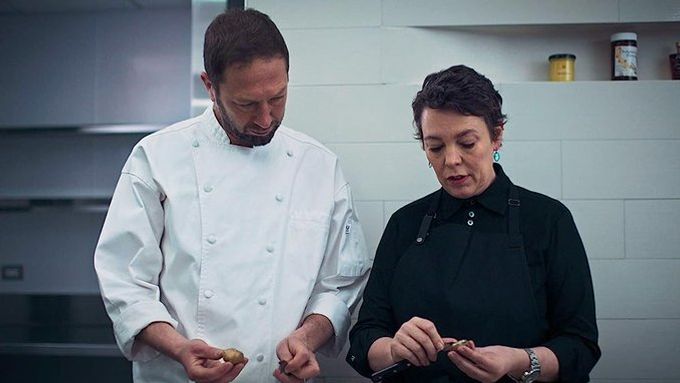
         When I watch The Bear, with all its gut-wrenchingly realism, I sometimes tear up. I did that during the Third Season’s finale, about the closing of a famous Chicago restaurant. There is a “funeral dinner” held to honor the restaurant, and restaurant people from all over town attend. When they filmed this scene, they included verité-like testimony from actual chefs. Toward the end, Olivia Colman, the actress playing the owner of the closing restaurant, gives a speech. She says of all the years and all the food, the one thing she will never forget are the people.

         I was jubilant on my final day at De Luca’s. By then I was an assistant manager making pizzas. As I prepared to depart, there was no sadness, no melancholy, no regret. I just wanted to get the hell out of there, knowing that I would never again have to spend hot summers standing in front of two 450-degree ovens. My new destination was the University of Missouri, where I would earn a master’s degree in journalism. I looked so forward to a future where I would do something important and serve people who were hungry for news and information – not food.

         But having now watched The Bear, I realize everything I’ve done since De Luca’s has been impacted by De Luca’s, and that my memories of Tony and Uncle and Bean and Freddy and Luther and Sydney and sweet Melissa and all the others are much stronger than of any professor at Missouri, or of any high dignitary I covered as a journalist. I also realized that the invisible energy and palpable excitement that invades and dominates a packed restaurant on a Saturday night, even to someone washing dishes, is indescribable, euphoric, and almost impossible to duplicate.

         One final note.

         In the early ‘80s, about a decade after I last saw Melissa, I was walking through the lounge at an Atlantic City casino. There was a stage and on it was a band fronted by an attractive, stylish woman. It was my old girlfriend, and she saw me. When the number ended, she ran off the stage to hug and kiss me. The audience watched and, God bless them, applauded.

Speaking, and only a few understanding … well, a few meaning 26 million

28 Sep

By Lanny Morgnanesi

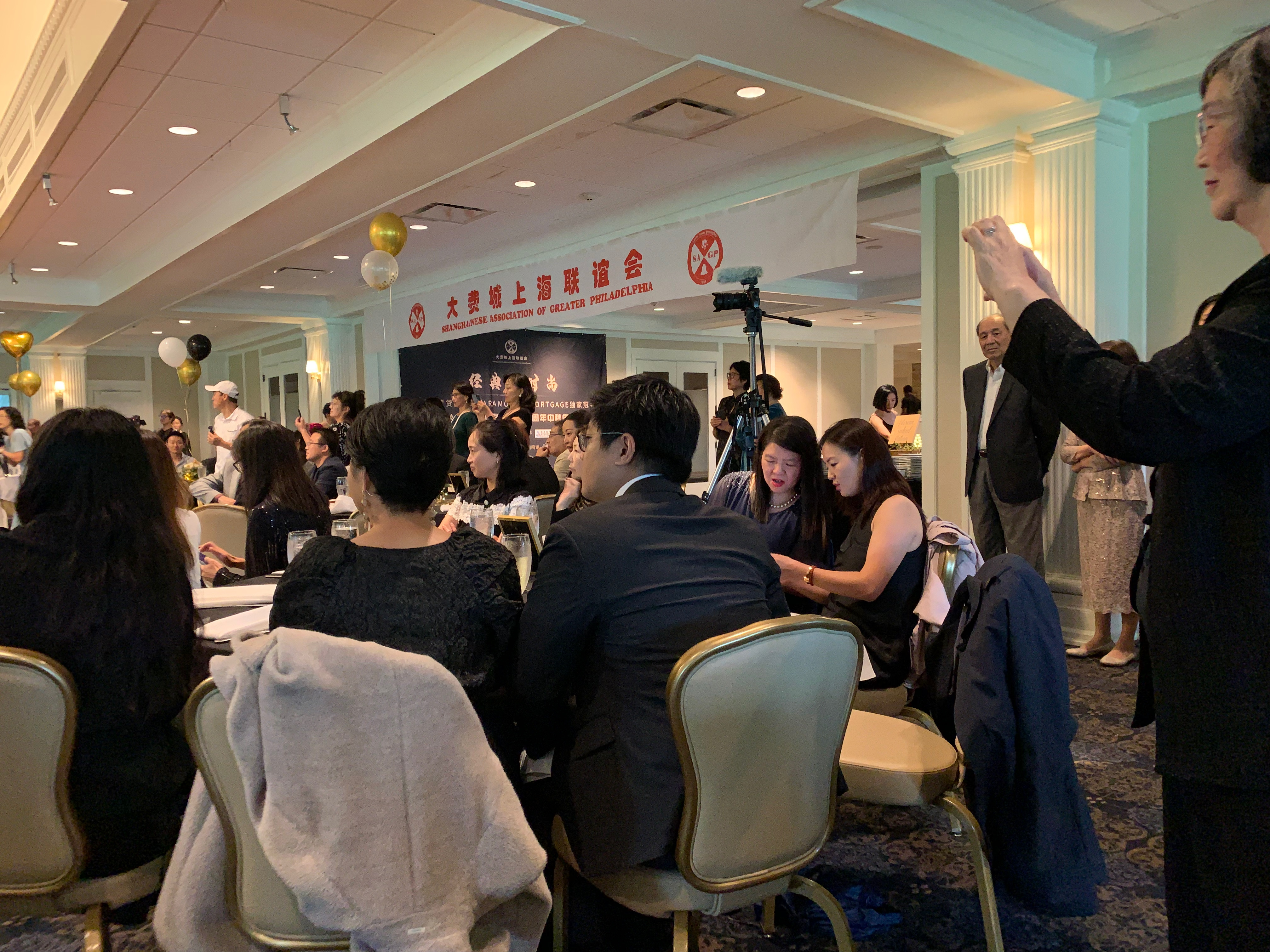
            On a rainy September afternoon at the Bluestone Country Club, in a ballroom surrounded by an empty golf course, the Shanghainese Association of Greater Philadelphia held its annual gala, and I was the only white person there.

            The agenda included music, singing, dancing, a fashion show, door prizes, and a buffet lunch. But overall, it was more like one big commercial. Since there was no English, my escort wife, born and raised in Shanghai, explained most of it to me, even though I figured out much of it myself.

            Once through the door, the first order of business was photography. Everyone, everywhere, was taking photos. On the path to the ballroom was a tripod mounted with a ringed light and a device that took and showed you five photos of yourself, then sent them to your phone. Long line for that.

            Next was a large, wall-mounted banner with the group’s name on it, in English and Chinese, and a hired photographer taking pictures for the group’s website. There was no formal line. Instead, you pushed your way forward in a competitive tussle.

            After that came the ballroom, with about 300 well-dressed people (told to wear black and white) mingling about and shooting with their phones.

            The proceeding began when a fit-looking man in a well-tailor suit addressed the crowd. Poised and confident, he had organized the event and helped secure a panoply of sponsors. At first, he welcomed the people. In short time, however, he pitched his real estate business and advised the group to connect with him on the Chinese app WeChat to learn about the newest real estate deals. He was an effective promoter of himself, and no doubt owned a significant piece of the area’s Chinese real estate market.

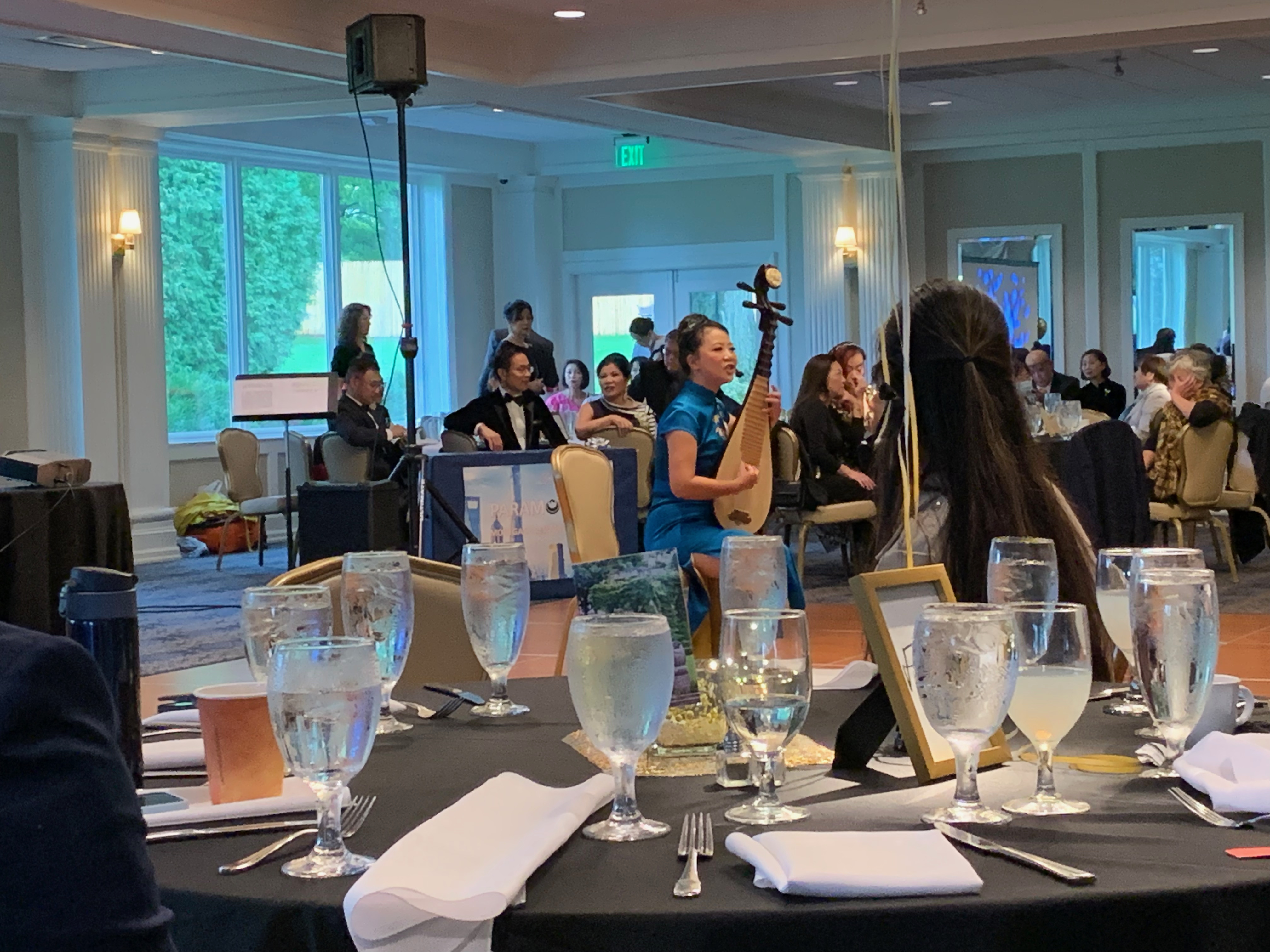
            He was followed by a musical performance, a woman in a traditional qi pao-style dress who sang and play an instrument called a pi pa, a sort of Chinese lute or guitar, pear-shaped with six strings. Aside from my wife, this was the only person at the party I knew, and I did not know her well. If fact, I hadn’t seen her for 20 years, and did not remember her name, if I ever knew it. My wife spoke to her first and addressed her as “lao ban,” a title of respect for a store owner. My wife was quickly advised by the lao ban that she no longer was a lao ban.

            There was a time, before streaming and serious Internet use, when my wife and I made regular visits to a bookstore and Chinese emporium owned by the former lao ban. It was on Race Street in Chinatown, a huge, two-story building filled with Chinese merchandise you could not get elsewhere. We went there often to rent Chinese language videos and buy a few books. Chinatown has developed a lot since then, with a more vibrant economy and new, more innovative entrepreneurs who displaced old-school, never-change Cantonese. Longtime establishments have been replaced with contemporary noodle houses, soup dumpling places, and dim sum joints. The lao ban, who had rented her huge building, probably was priced out of the market after Chinatown became hipper and the video and book market died. Where her business once stood, there is a two-tiered Asian food court.

            The lao ban, perhaps in her 60s, is now a musician and singer of Chinese opera. On this day the Bluestone Country Club had the perfect audience for her, but, unfortunately, an imperfect sound system. There was distressing feedback. The volume was too loud, and high notes came off like screeches. I felt bad for her as she played on. The feedback was fixed for the next act, but the system continued to deliver poor quality sound, which, I guess, the audience got used to. They cheered loudly for a young woman in a shiny, tight, blue-sequined jump suit who danced and sang a contemporary song called, “Give Me a Man at Midnight.” She was good, but I wanted to hold my ears. Others seemed more than content.

            Next, a contingent of trained amateurs took the floor and performed a waltz-like dance to the tune of Moon River. It was more like walking than dancing, but the women wore gorgeous gold dresses, and it was fun watching them. When it concluded, audience members were told where they, too, could get dance lessons.

            There was a fashion show, with women of various ages posing and strutting like runway models. This was followed by information on modeling classes. There was no entertainment related to banking, cosmetic surgery, or travel, but people pitched those services anyway.

            As the afternoon unfolded, I paid attention to language. I found it interesting that speakers addressing the crowd spoke Mandarin Chinese, the national language of China. But off stage, while chatting amongst themselves, they spoke Shanghai dialect. No one outside of Shanghai understands Shanghai dialect. It is spoken with pride by members of an exclusive group that considers its hometown the singular place in all of China for high style and hipness. To them, it is the epitome of elan, a better-than-New York equivalent of 26 million people. It has such appeal you must be born there to live there or get special permission to move there. The Shanghainese are a tribe, and they think highly of themselves. They have names for people who are not Shanghainese. And they have a name for their women, who are stereotyped as self-possessed, demanding, spoiled, and self-centered. It is both a polite and derisive term, a little like “Jewish American Princess.” The hard-to-handle women from China’s largest city are called “Shanghai little sisters.”

But back to the dialect, which I’m thinking helps to define Shanghai cool. While the dialect is substantially different from the national language, some alterations are slight. For example, the common Chinese greeting “ni hao” (literally: you good), was changed in Shanghai, for some reason, to “nong hao.” The common good-bye of “zai jian” (literally: see again) was changed to something that sounds like “zay way.” To decline an offer, the Chinese normally say “bu yao” (literally: don’t want). But the Shanghai residents slam those two syllables together, speed them up, and put a different sound at the front, saying “v-yow.”

Here is an example of how protective the Shanghai people are of their exclusive dialect. I was in the dessert line and the guy behind me struck up a conversation in English. He had come to the United States as a student in 1985 and trained as an engineer at Columbia.

“I guessed you’re confused by all this Shanghai dialect,” he said in a joking way.

            “Of course,” I said, “but I know a few words.”

            He looked at me as if that could not be true.

            Then I said the few words of Shanghai dialect I knew. Oddly, he repeated those words back to me in Mandarin. No, I said, I know the Shanghainese. And I repeated the words again, with him once again saying them in Mandarin, as if I were not allowed to speak that way or couldn’t possibly know what I was saying. Finally, I convinced him that I had gently penetrated the veneer of his beloved dialect. He smiled uncomfortably and shook his head. We both got dessert and parted.

So at the party, as the spoken word shifted effortlessly between a defining dialect and the linguistic standard, I thought about American English and concluded that there is nothing comparable to this in the U.S., no comfortable, communicative patois used in a secret way outside the button-down structure of society.  

Or is there? A question for another day.

            After the entertainment came lunch. When going to an affair such as this, one expects Chinese food. There was none. No chopsticks, either. The buffet was bread, salad, green beans, potatoes, pasta, pot roast, and salmon. The partygoers filled their plates high, without reluctance or aversion. I guess the country club chef didn’t offer a Chinese option, and that clearly was not a problem for this crowd.

            After about four hours, the party winded down. It was time to leave, and the rain was still heavy. We did not, however, get wet. Everyone received a well-built umbrella, courtesy of the Paramount Mortgage company, whose name appeared on the umbrellas in both Chinese and English.

            On the way out, the partygoers continued to define themselves as unique. You could hear lots of “zay ways,” but not a single “zai jian.” A group of young Shanghai little sisters, outfitted in fine dresses, pushed past me, seemingly arguing among themselves, or perhaps debating a point or two about the party, or maybe discussing where to go next. I didn’t understand a word of it, and I’m sure they took great comfort in that.

The origin of Johnny Four Fingers

6 Apr

Nicknames

By Lanny Morgnanesi

On Facebook, I saw posts listing 10 people “I’ve met,” with one being a lie. I decided to play and put up these 10.

  1. Johnny Four Fingers
  2. Frank “Two Meatballs” Ferretti
  3. Bing Bang Ciao
  4. Joey Lollipops
  5. Pauli “Rembrandt” Scungeel
  6. Spinach Face Tommy
  7. Tony Loud Cry
  8. Pasquale “Dog Shoes” Maroni
  9. Vincent Steam Breath Bug Eyes
  10. Nathan the Nickel

Then I realized the more curious readers might want to know how these men got their names. So here at NotebookM I’ve decided to provide that information.

Johnny Four Fingers – As a child, his big hands prevented him from reaching inside a soda machine to steal Cokes. So he used his father’s power saw to remedy that.

Frank “Two Meatballs” Ferretti – Always thin, his grandmother said she’d give him a quarter if he gained weight. To look heavier, he stuffed a meatball into each cheek.

Bing Bang Ciao – Upon leaving a drinking establishment, he would always bang his left fist on the bar, then bang his right, then say good night.

Joey Lollipops – He robbed a corner store but took only candy.

Pauli “Rembrandt” Scungeel – The best forger in Brooklyn.

Spinach Face Tommy – Chronic acne.

Tony Loud Cry – A rival gang caught him and threatened to cut off his testicles and shove them up his rectum. His lament was heard three blocks away.

Pasquale “Dog Shoes” Moroni – The heat went out at a cheap motel where he was staying with a hooker. He took her fake fur and fashioned it into slippers.

Vincent Steam Breath Bug Eyes – He survived a garroting, but it was not pretty.

Nathan the Nickel – He lived on Fifth Street, as opposed to Nathan the Dime, who lived on 10th.

The Quiet Presence of Celebrity

17 May

PPM-blur

By Lanny Morgnanesi

A man who sold millions of records in his lifetime and entertained hundreds of thousands sat on his guitar case on the sidewalk in front of the funeral parlor. He was about three hours from his New York home and may have been waiting for an Uber to the train station. Everyone else either went home or got in their cars for the procession to the cemetery. They walked by him and around him. He seemed old, frail and alone.

The funeral was for my friend, who was also his friend. The deceased was accomplished but not famous. This was not a celebrity funeral. It took place in a quiet suburban town. About 150 people attended.

My friend had been many things in life, most notably a newspaper man. As a journalist he met famous people. He eventually struck up a friendship with a trio of folk singers who were wildly famous in the 60s and even after. The group was so well-known it popularized Bob Dylan songs in a way Dylan never could. As I entered the narrow hallway of the funeral parlor, I saw the musician, one of the two surviving members of the trio, trying to make his way through the crowd. Even at 80 he was recognizable to me. He was being unceremoniously jostled, as was I, but with a guitar in hand and extra age on his body he was finding it difficult to maneuver. I waited for people to treat him in some special way, to acknowledge him and greet him, but at that moment no one did. He eventually made his way to a room off from the viewing area where there was coffee and snacks.

After an hour or so, the service began. All seats were taken. People were standing. A few more chairs were brought in and the singer managed to get one near me. He sat down precariously. The hand holding his guitar was shaking.

The famous folk trio he belonged to broke up in 1970 and thereafter would frequently reunite, perform and even record. Years ago, my friend wrote a lyric about the Irish-English conflict and sent it to him. The performer wrote music for it, and his trio recorded the song – Fair Ireland – in 1990. After three eulogies, the singer took the microphone, talked about our friend, and sang Fair Ireland. His shaking hand had settled.

The song opens with the verse:

They build bombs and aim their pistols in the shadow of the cross
And they swear an oath of vengeance to the martyrs they have lost
But they pray for peace on Sundays with a rosary in each hand
It’s long memories and short tempers that have cursed poor Ireland

It ends with:

So we’re left with retribution it’s the cycle of the damned
And the hope becomes more distant as the flames of hate are fanned
Who will listen to the children for they’re taught to take their stand
They say love and true forgiveness can still heal fair Ireland
Only love and real forgiveness can still heal fair Ireland

There was gentle applause. The singer retook his seat, and the service ended.

I imagine that after a life of intense fame and a loss of privacy, achieving semi-anonymity in old age is welcome. Nonetheless, I felt deep sorrow for the entertainer, possibly a carryover from the sorrow I felt for my friend, but still altogether different. I fully understand that generations pass, that what once was popular fades, and that value and esteem can evaporate. But there is this hope that dignity remains intact. Seeing the musician alone, sitting on his guitar case, waiting for something, I wanted to offer him a ride as a way to preserve his dignity. That would have meant leaving my place in the funeral procession, so I didn’t do it.


From my car window I could see he was weary, worn and sad. In his early years, he had traveled the world. He married and then divorced. He had two children. There was a problem with alcohol and drugs. In the 70s he was arrested on a sex charge but pardoned by the president of the United State. I wouldn’t have felt so bad if he had just come down from New York with a friend, anyone, younger or just as old. It didn’t matter. Just someone there for support.

He most certainly has people in New York. I only wish I could have seen one. To me, that would have made his past life more meaningful, more joyful. As the long funeral procession pulled away, I was at least happy that my departed friend, highly successful, had his success elevated by intense love and caring. In the end, he was not alone, and had never been alone. This, one learns, is the enviable life.


The Old Myths Have Faded; New Ones Are Needed

11 Apr


Homer

Homer, the blind poet


Zeus, most powerful of the Olympic gods, is the protector of guests. Remember this when you sit down at diner with enemies.


An ancient Greek tradition requires you to be hospitable to all who visit under your roof, be they friends or enemies. This honored and revered tradition is known as Xenia. If a guest is not treated properly, Zeus could intervene on their behalf.

abduction-of-helen

The abduction of Helen

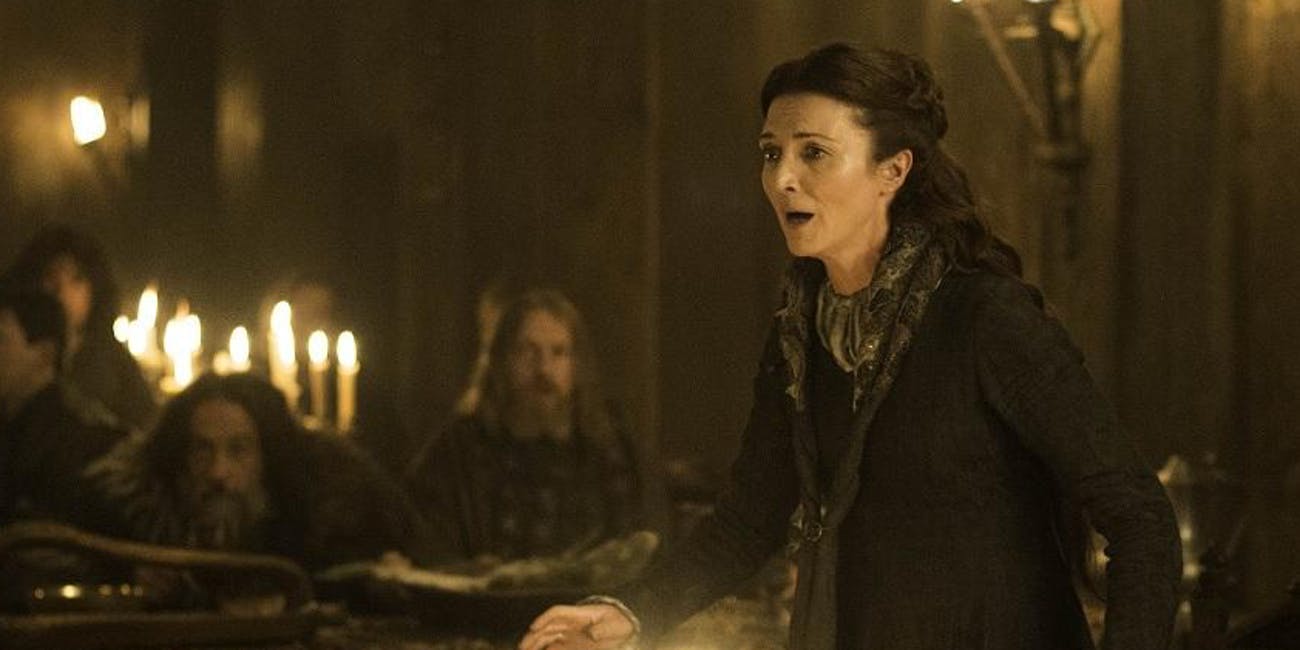
Paris of Troy ignored Xenia and ignited a war when he ran off with Helen, the wife of his Greek host.  In recent times, a ghastly violation of Xenia was depicted in the famous Red Wedding episode of Game of Thrones, where all guests were slaughtered.

Red-wedding

Shock at the Red Wedding

Xenia and other intricate facets of ancient Greek culture come down to us through myths. The myths are extensive and far reaching. They involve great heroics, tales of morality, flawed character, the foibles of gods and humans, desire, lust, misjudgment and so much more.  The myths also help explain the world and how it got here.

Pillars-of-hercules

A statue honoring Heracles and his pillars

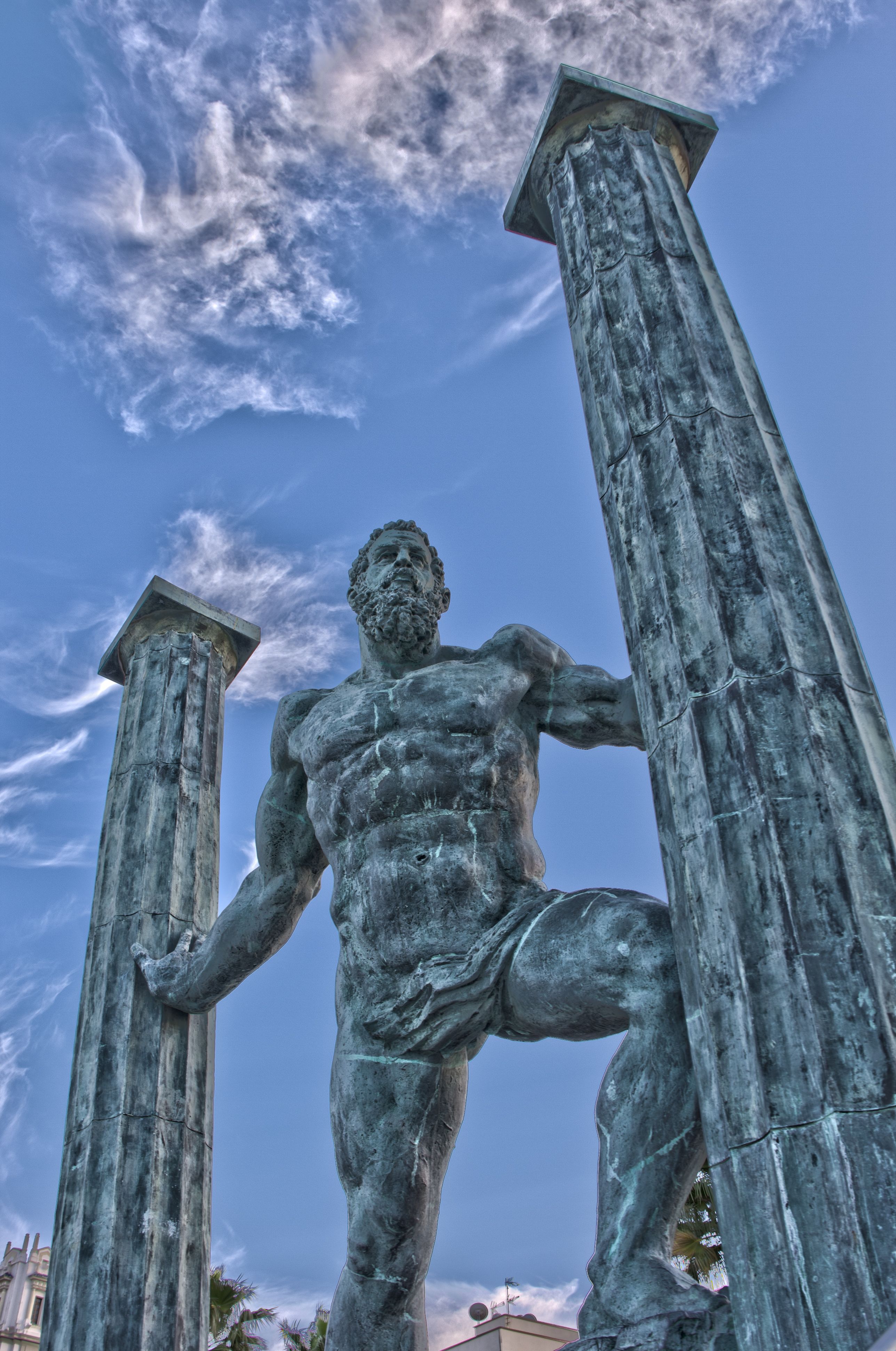
For example, it was Heracles (aka Hercules) who connected the Mediterranean Sea with the Atlantic Ocean. While traveling to the end of the known world, he reached an impasse. Rather than climb a mountain,  he broke though one and created a narrow strait to the ocean, leaving what we know today as the Pillars of Hercules. From ancient Greek stories we learn how peacocks got their colorful tails, why once-white ravens are now black, and how two people, told by the gods to build a small ark, repopulated the world after a great flood by tossing over their shoulders stones that turned into men and women.

Fight-between-lapiths-andcentaurs

Drunken centaurs creating havoc

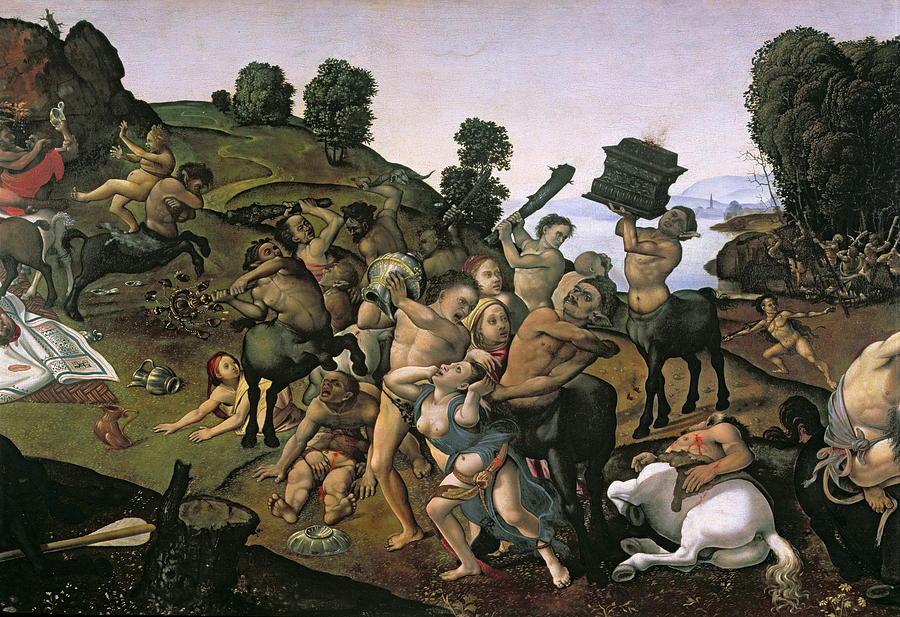
The importance of these myths to Greek culture, and later to Roman and European culture, is shown by the art they inspired. A piece of  pottery from the 6th century B.C. shows Bellerophon destroying the fire-breathing Chimera. A first century Roman sculpture is of baby Heracles strangling a viper sent by Hera to kill him. A 16th century painting by Piero Di Cosimo vividly captures the drunken centaurs creating violence at a wedding feast.


That artists desire to retell these stories speaks of their value, even if we don’t understand that value today. While every culture has its stories and myths, the Greek myths are undeniably special. Their depth and originality is unmatched. They took root in multiple cultures and have  persisted over centuries. When we watch Wonder Woman and Gal Gadot, we are being entertained not so much by Hollywood but by the ancient Greeks.

Wonder-woman

The warrior Amazons were a Greek creation

As I now reread some of these tales, I sense a current vacuum in contemporary western culture. With no disrespect to Gal Gadot, or Jason and the Argonauts, or Brad Pitt as Achilles, I don’t believe the legacies of Greek mythology are doing for America what the original myths did for Greece. I don’t think they educate, inspire and set a correct path for us. And I don’t think anything has effectively replaced them.


Meanwhile, we are being pulled apart by forces like politics, race and class.


In truth, the detailed and fabulous Greek legends never fully unified the Greeks. The Greek city states were almost constantly at war with each other. Yet there is something strong, powerful and wise about using engaging stories to teach people what they are and what they should be. That someone or some group was willing to do this speaks to the inner essence of a humanness that, without help, is prone to chaos. The goal of the storyteller, of course, is to civilize.

Moses

Moses leading his people

The Hebrew prophets had this intention when they wrote and compiled scripture for an uncultured, barbaric tribe. To a great extent, those prophets succeeded and the western world, thriving today in commerce and replete with interaction and exchange, is a reflection of their efforts. Even so, the impact of scripture is waning and its messages, like the Greek tales, are being lost or forgotten. What’s needed now are new insights, new stories, new guideposts. It is time for a 21st century Homer, a modern Moses, a fresh light cutting through an old fog – a Greek revival, of sorts, if you will.


Our biggest problem is we have forgotten what we are and what we can be. Teaching this anew,  we can first understand ourselves, then respect and value ourselves. Once we develop true self-respect and visualize a purpose, we can, as individuals, extend respect and dignity to others. Building a culture around respect and dignity will not only strengthen us, it will unify us. And it may do so in ways the Greeks never imagined.


So let the stories be told. Let the heroes flourish. Let us see virtue and valor prevail. Let us know all the things that lead to failure, disrepute and disfavor so a place is reserved for harmony and peace and a new meaning is brought to life.


By Lanny Morgnanesi


Acting like you’re famous and wishing you were: The Million Dollar Quartet

3 Sep

million-dollar-quartet2

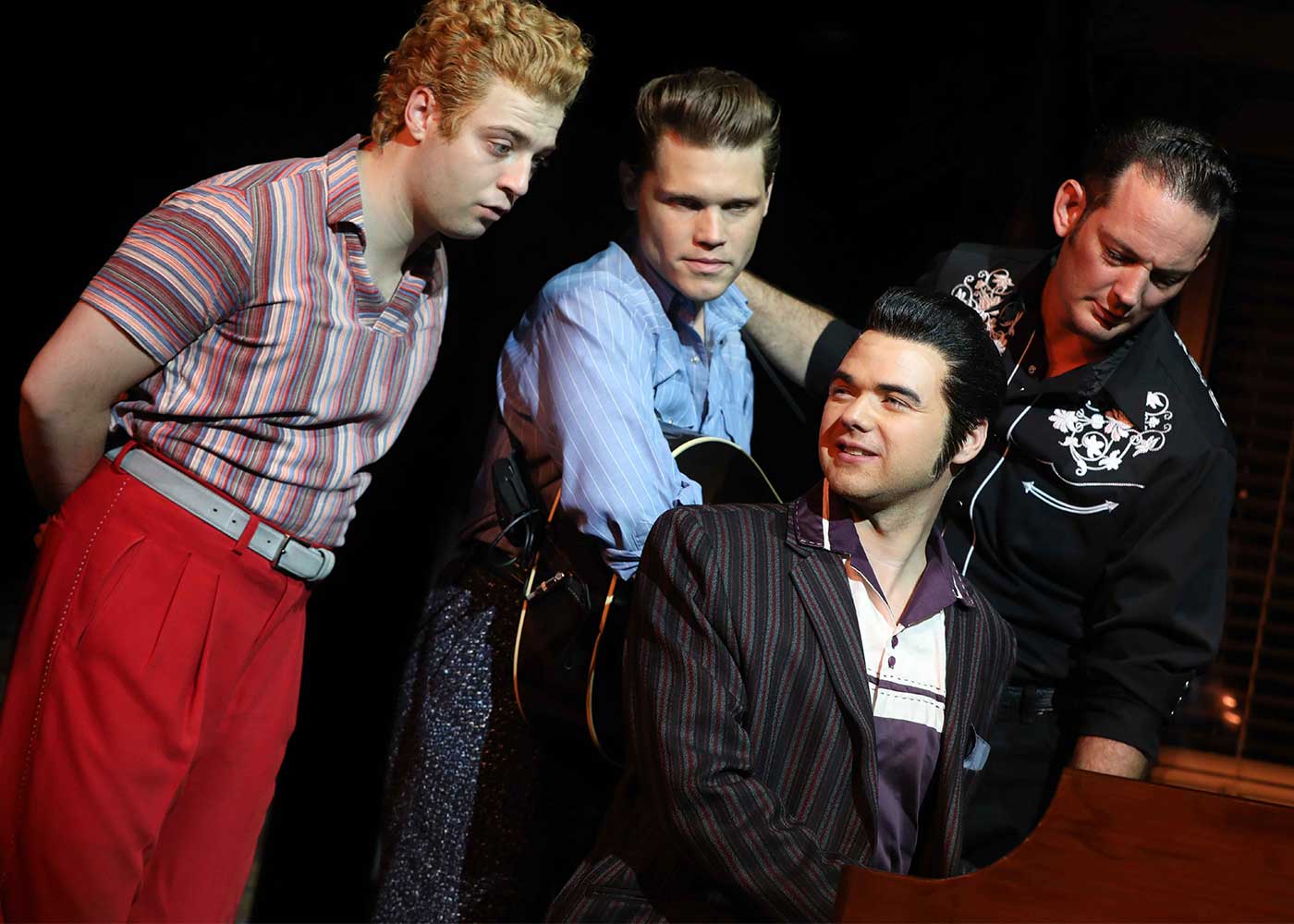
Actor/musicians (from left) Brandyn Day as Jerry Lee Lewis, John Michael Presney as Carl Perkins, Ari McKay Wilford as Elvis Presley and Sky Seals as Johnny Cash

If you’ve been to a minor league baseball game, you know it’s tame fun with a hint of sadness. What’s sad is that many of the wildly ambitious and talented players will never hear the roar of a real crowd or get the glory that accompanies fame.

For me, the experience is similar to seeing a Broadway show at a regional theater. The one difference is that on good nights the actors at a regional theater do hear the roar, a sound satisfying beyond money. Still, after the curtain falls, you’re in a bar wearing street clothes and looking normal and someone asks what you do for a living and you’re afraid they’ll laugh if you say you are currently performing on stage as Elvis Presley.

At the Bucks County Playhouse this weekend in New Hope, Pennsylvania, I saw not only Elvis but actors portraying Johnny Cash, Jerry Lee Lewis and Carl Perkins. This 50s-era group of rock and roll royalty once came together by chance at a small recording studio called Sun Records. For a few brief hours on Dec. 4, 1956, they formed what came to be known as the Million Dollar Quartet.

Million-Dollar-Quartet-hits-high-note-at-Bucks-County-Playhouse

That was the show I saw, “Million Dollar Quartet.” It was based on the recordings the four made under the guidance of legendary producer Sam Phillips. When I walked into the theater my first impression was that the set, a recreation of Sun Records, looked really good. Knowing little about what I was to see and hear, I was even more impressed when a Playhouse employee announced that all music would be live and performed by the actors on stage. Nothing had been prerecorded.

As I waited for the show to start, I assumed the audience would be kind but not overly enthusiastic, mainly because it was a very old audience. More than a few people had walkers and canes and I wasn’t feeling too good myself. When the music started playing – there are 22 numbers in the show – I was relieved that the reaction was, if not effusive, at least respectable.  The performances, however, were so good that younger people might have been up and hollering. Even so, I was confident the people who created the show were experts at pacing and that we weren’t supposed to really let go until the end. This turned out to be true.

A few points in general about the show, which continues thru September 29: Johnny Cash didn’t look much like Johnny Cash and Jerry Lee Lewis came off too much like Harpo Marx, but as a regional show is was worth the ticket price. As one of those so-called jukebox musicals, songs dominated over plot. A minimal story line involved Sam Phillips’ struggle over whether to sell out to RCA; Johnny Cash’s worry about telling Sam he was leaving Sun for Columbia Records; and Carl Perkins’ anger at Elvis for recording his song, “Blue Suede Shoes.”

milliondollarquartet_originalphotoresizedjpg

From left, the real Jerry Lee Lewis, Carl Perkins, Elvis Presley and Johnny Cash

In the end, everyone came together in mutual respect, understanding and friendship. This fresh harmony allowed the actors to finish in concert style with three strong numbers. Right before the concert, there was a touching bit that probably doesn’t sound touching if written about. Sam Phillips, the record producer, asks the four boys to pose for what he says will be an historic photo. They pose, Sam shoots, and the actual photo the real Sam Phillips took on Dec. 4, 1956 comes down from the ceiling. Everyone claps. Some tear up.

The concert consisted of  “Hound Dog” by Elvis, “Ghost Riders In the Sky” by Cash and “See You Later Alligator” by Perkins. These numbers were clearly full-tilt/high energy and the crowd, some with walker assists, finally got on its feet and went nuts. After “Alligator,” the boys proudly marched off stage and Sam Phillips urged us to demand an encore, which we already were doing.

The boys came back. They ripped it up and shook the house with Jerry Lee Lewis doing “Whole Lotta Shakin.” Sam Phillips, who so far had only dialogue and narration, coolly pulled out a harmonic and gave an incredible mouth organ solo.

It all ends, and we cheer loudly. This was the best part because you could see the actor/musicians break character, glance at each other in unexpected ways and silently say with expressions of delight and satisfaction, “Seems like we did pretty good tonight.”

The loving reception gave them hope that even if they are in the minors now, one day soon they could be called up.

By Lanny Morgnanesi

Oh, Oh, Oh … Christ was a Jew!

25 Jan

Christ

A certain American president is dominating 90 percent of what we see, hear, and discuss, so I’ve decided to write about a somewhat anonymous but highly unusual person I’ll call Melvin.


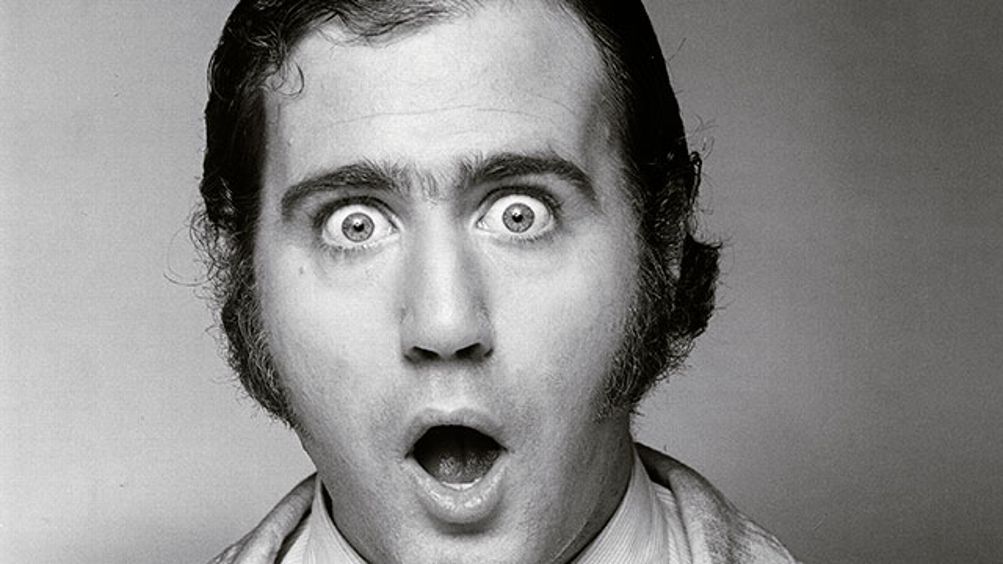
Melvin was intelligent. He did his undergraduate work at MIT and was studying veterinary medicine when I roomed with him and another vet student at a large university. Melvin is difficult to describe. I like to think he was Andy Kaufman before Andy Kaufman was Andy Kaufman. His life was a performance, not on stage, just walking around. The difficulty with Melvin, like Andy, was understanding the purpose and meaning of his performances.

Andy_Kaufman

For example, I could hear Melvin in his room when he had women over. During climax, he would always shout, “Christ was a Jew!”


After a time, I asked why he said this. He probably was employing his distinctly odd sense of human when he answered, in complete deadpan, “What else would you possibly say?”


I always suspected he was mimicking a character from a William Burroughs novel or some equally obscure place.


As a vet student, Melvin studied much more than I did. One evening, I was in the living room of our campus townhouse entertaining two women friends. He had a test the next day and was upstairs with his books. He obviously needed a break, and he took one in performance mode.


Melvin came running down the steps, frantic, dressed in cutoff jeans, no shirt, no shocks, no shoes. It looked like he was sweating. He carried a beat up old guitar.


“I’m on in 10 minutes,” he said to the three of us in a panic, “and I can’t play a thing.”


Then he ran to a window, opened it and jumped out.


Andy Kaufman couldn’t have done better.

brokenglasses

But the best of his bits occurred when I and our third roommate walked him to a house where he was to meet a blind date. We wanted to see what she looked like and stood nearby as he knocked on her front door. When she opened it, we could see she had an exquisite body. It was rare and perfect in every way. She was not, however, attractive. My recollection is she had a slight resemblance to Richard Nixon.


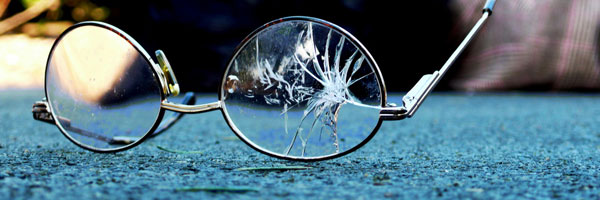
Melvin looked at her and excused himself for a moment. He walked to the street and, with a rather demonstrative gesture, threw his glasses under the wheel of a passing car. Melvin then looked at me and the other roommate and said, in a tone of old movie contempt, “So long, suckers.”


He went back to the house, went inside, and wasn’t seen again for three days.


I’m certain that by the end of the three days the young woman who looked like Nixon knew almost certainly that Christ, indeed, was a Jew.


Now isn’t that better than Donald Trump?

Donald Trump

By Lanny Morgnanesi


Is Democracy Sick?

14 Oct


With the Russians continuing to mess with us, it might be time to consider an alternative system of government. Perhaps Plato can guide us.


A $1.5 million mistake! Do you just let it go?

15 Feb

Golden-nugget-dealer

I once made a painful mistake and was absolved. Recently, a much larger mistake was made by an Atlantic City casino. It, too, was absolved.

I considered my absolution reasonably fair. I’m not sure about the Golden Nugget’s.

It would be nice to know what others think, so please keep reading.

I was in college when I committed my blunder (neither my first nor my last). My classmates were finishing their final exam in political science when I realized I was supposed to be there. Upset and perplexed, I ran to the class and arrived as everyone was leaving. With exceptional humbleness I told the professor what happened and apologized, repeatedly.

His reaction stunned me: He laughed.

“You’ve had an ‘A’ all semester. Forget it.”

And so I wondered if the folk at the Golden Nugget were equally stunned – or more so — this week when their mistake was wiped clean by the State Superior Court of New Jersey.

golden-nugget-buildingAccording to the Associated Press, the case dates to 2012 and a game of mini-baccarat. Fourteen players who had been betting $10 a hand suddenly up their bets to $5,000 and won 41 straight hands. Their total winnings were $1.5 million.

The court, ruling in favor of the Golden Nugget, ordered them to give it back.

They didn’t cheat. They broke no rules.

What they did was notice that the cards being dealt had not been shuffled. As the cards came off the deck, they showed a consistent, predictable pattern. The players took advantage of this pattern to win.

The dealer was not shuffling the cards because the decks were supposed to have been pre-shuffled by the manufacturer. The cards came from a Kansas City company that admitted its error in court.

The judge’s ruling said New Jersey’s Casino Control Act requires that cards be shuffled. Since they were not, the mini-baccarat play was illegal, unauthorized and therefore void.

The court ordered the 14 players to return their winnings, minus their original bankrolls.

Years ago when I learned I had screwed up, I was willing to accept the consequences. Naturally, I felt that the Golden Nugget should accept its loss, or at least go get the $1.5 million from the company – Gemaco — that didn’t shuffle the cards. (They reached an undisclosed settlement.)

I changed my mind when I learned more about the case. Now I don’t know what to think.

The additional details and background came from the website Cardplayer.com.

It seems that back in 2012 a lower court actually ruled in favor of the gamblers. It was willing to award them their winnings – which they had not fully collected. The Golden Nugget suspected it was being scammed and paid out only $500,000. The 14 gamblers were forced to hold the rest in chips.

The gamblers, all of Asian descent, were not happy with this first ruling. They wanted more than their winnings. They wanted damages and made allegations of illegal detention and racial discrimination.

The owner of the casino, Texas billionaire Tillman Fertitta, said he would gladly pay the $1.5 million if all other charges were dropped. The 14 gamblers refused.

Now they have lost, and most likely will appeal.

Even for a guy who got As in political science, I’m not sure who is right or wrong; who is being fair or unfair. I’d like to hear from others on how they would rule.

The one resounding thought I’m left with is this: If I had been playing mini-baccarat and the cards started showing a pattern, would I have been smart enough to take advantage of this, or would I have been kicking myself for the rest of my life for missing the opportunity?

A final footnote: Gemaco, the company that didn’t shuffle the cards for the Golden Nugget, once manufactured cards for the Borgata that had flaws on the side. Ten-time World Series of Poker champion Phil Ivey was dealt those cards. He noticed the flaws and used them to win $9.6 million.

Lanny Morgnanesi

Get me out of this prison!!!!

27 Jan

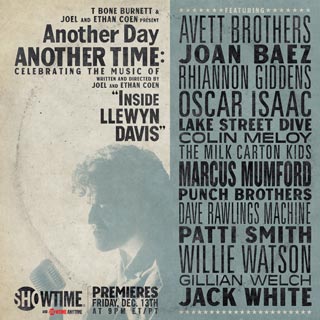
Another Day, Another Time the Music of "Inside Llewyn Davis" Another Day-Another Time

Mull over, if you will, these few lines from a Woody Guthrie song:

It takes a worried man, to sing a worried song

It takes a worried man, to sing a worried song

I’m worried now, but I won’t be worried long

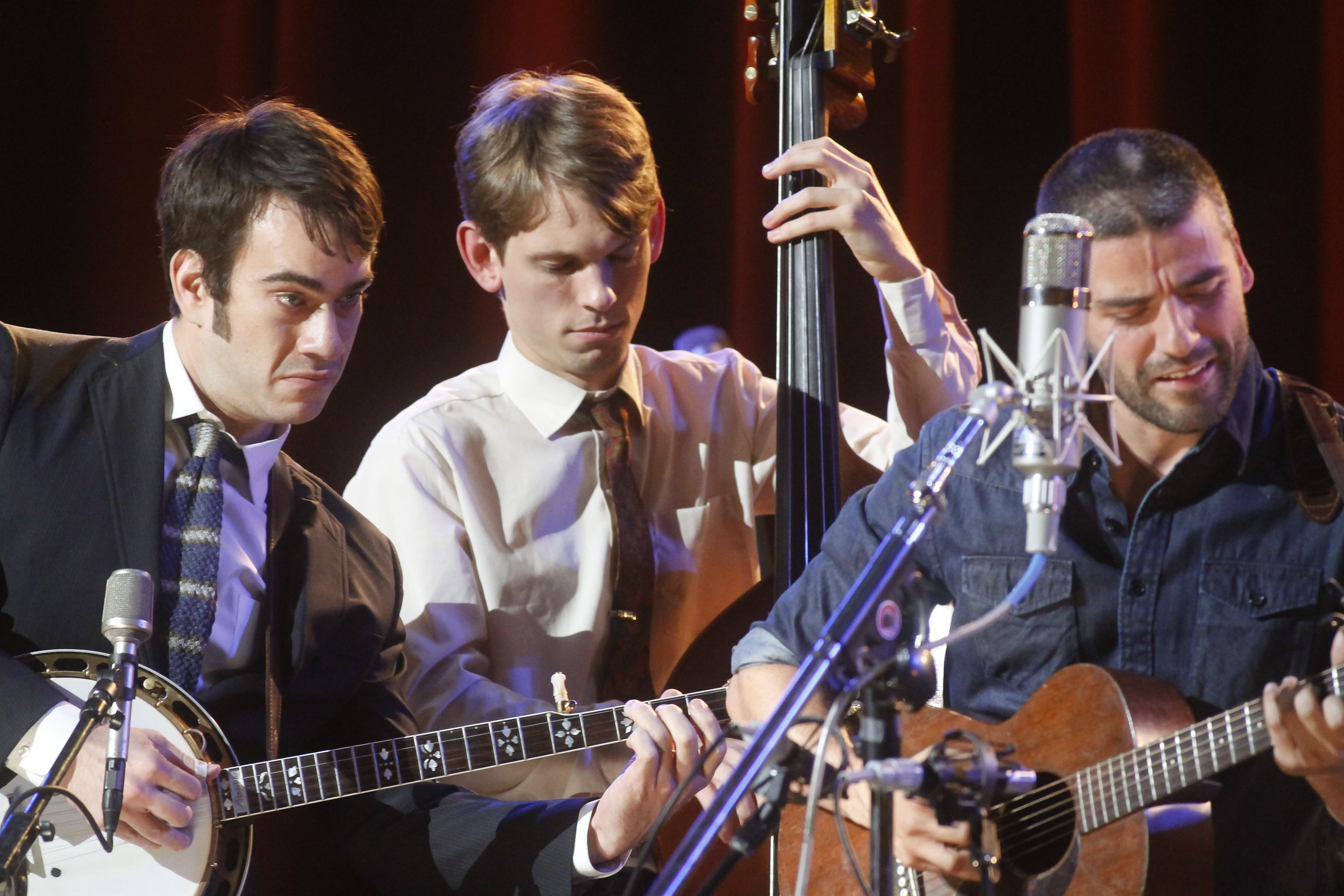
You’ll hear a bit of that tune in a documentary called, “Another Day, Another Time.” The film, embedded below, features mostly folk and old tyme American music. Producer T. Bone Burnett got a bunch of very fine musicians together to celebrate the traditional approach to music, and the movie gives us both on stage and off stage performances.

As I watched it, enjoying every note, I realized a preponderance of the songs were about imprisonment and the destruction of individuals by authority. There were songs like:

  • Hang me, Oh Hang me
  • The Midnight Special
  • The Auld Triangle
  • House of the Rising Sun
  • Worried Man Blues

Spanning decades, these songs continue to touch people, which is why they prevail. They reach something inside us. You don’t have to be a criminal or a con to appreciate them. As I listened to all these prison songs, it came to me that so many of us, whether we have been in a cell or not, must fell imprisoned.

I believe it’s these feelings that keep such songs with us and inspire new ones.

Johnny Cash is famous for his “Folsom Prison Blues,” where a man convicted of killing someone “just to watch him die” longs for freedom and is incensed every time a train filled with free people passes near his cell. The song is so convincing many believe Cash served time in Folsom. Not so. He wrote the song while in the Air Force, stuck at a base in Germany and longing to once again be his own man.

So the song was a metaphor for him, and for us.

Why do we feel this way? Where do our shackles come from? More important, how can we get rid of them?

Although Woody Guthrie wrote about the imprisoned Worried Man, he also wrote “This Land is Your Land” – which joyfully describes a vast, beautiful country and the unfettered right we have to travel it. In the documentary, Dave Rawlings, Gillian Welch and Willie Watson do a number called “I Hear Them All,” and combine it with “This Land.”

They received the loudest applause when they sung this Guthrie verse:

There was a high wall there that tried to stop me

A sign was painted said “Private Property”

But on the backside it didn’t say nothin’


This land was made for you and me.

Maybe we’d all be happier if we, too, focused on the back of the sign. Our minds have put us in prison. It is up to our minds to get us out. The freedom and expression of music will help, as will the film, “Another Day, Another Time.”

By Lanny Morgnanesi