Archive | Culture RSS feed for this section

When technology kills art

29 Jan

"The Artist"

Chaplin

I never thought much about how technology can create art forms until I saw Laurie Anderson perform. I never thought much about how technology can destroy art forms until I saw “The Artist.”

In the movie, a popular star of the silent screen refuses to make talking pictures. He does so for artistic reasons. His protests aside, the studio and public really don’t want him anymore.

He’s out of work; out of a career; out of a life.

Laurie Anderson

The film’s main character is endearing, but vain and maybe not even a real artist. He is certainly not Chaplin, a historically great performer who for a time also refused to make talkies.

The old and new film mediums required such different skills. The new forced actors to give up almost everything. How could Chaplin, such a master, abandon everything he knew simply because someone invented a new machine? How does a person at the utter and absolute top of his craft retire an art form that not only made him rich and famous but defined him to the world?

It’s nearly impossible.

More important, how is it that the art consuming public allows a great art form to be retired?

Things Chaplin did are still being done by mimes and clowns and dancers and comedians. But they are not being done in such a concentrated fashion and they are not being delivered to such a mass audience.

I find this sad, as I found “The Artist” sad.

Still, the work of tech-art pioneers like Laurie Anderson makes me feel good, which is at least some compensation.

Invariably, if you give an artist a new form of expression, he or she will use it to create something so exciting that people will turn away from the past.

Ancient technologists, in pre-historic times, learned to make paint-like materials and then decorated caves with them. Since then, and perhaps even before, technology and art have been forever linked.

No one can really fault that. In a way, it’s life affirming.
Should hit men get medals?

26 Jan

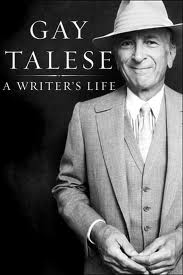
Author Gay Talese

Mafioso Bill Bonanno


Like many Americans, and certainly many Italian-Americans, I have a mild fascination with the Mafia. So when I came across an old copy of Gay Talese’s “Honor Thy Father,” I started reading it. Talese was an early and very successful practitioner of something called The New Journalism. Now it’s just called writing, but it caused a big stir in the ‘70s.

The book was one of the first to take a human look at Mafioso, specifically Bill Bonanno, whose father was a New York don. Talese provides a somewhat sympathetic look at the Mafia. Talese says this about Bill:

When he went to ROTC camp, and later into military service with the Army Reserves, he was trained in the technique of legal killing. He learned how to use a bayonet, how to fire an M-1 rifle, how to adjust the range finder of a cannon in a Patton tank. He memorized the United States military code, which in principle was not dissimilar from the Mafia’s, emphasizing honor, obedience, and silence if captured. And if he had gone into combat and had killed several North Koreans or Chinese Communists he might have become a hero. But if he killed one of his father’s enemies in a Mafia war, where buried in the issues was the same mixture of greed and self-righteousness found in all the wars of great nations, he could be charged with murder.

In the post-Soprano age, I’m curious how people might react to such a statement. Please comment. Was Talese accurate in his analysis, or was he trying to sell a revisionist image of beastly men?

By the way, if you would like to sample a shorter-form piece by Gay Talese, I suggest: “Frank Sinatra has a cold,” said to be the best piece of non-fiction ever published in Esquire magazine.

Three stories of race

16 Jan

Martin Luther King

For Martin Luther King Day I’d like to write about race, in three vignettes.

The first is about a family outing to a New Jersey lake resort. I was 8 or so, and we were going to one of my favorite spots. As our car stood in line at the gate, I realized something was wrong. The car in front was holding things up. There was an argument between the gatekeeper and the vehicle’s occupants, who were black.

My father went out to see what was happening.

When he returned, he seemed a little different, a little upset; certainly more reserve.

“They weren’t allowed in because they aren’t members,” my father said.

“Are we members?” I asked.

“No,” he said, “but I think they are going to let us in.”

The incident seemed unimportant once we were inside, although my father talked to other relatives about it. As I grew up and understood more, I never forgot the combination of guilt, sadness and, was it shame? that I had seen on my father’s face that day.

My second little story is about the only tip I ever received while working summers at a pizza restaurant. I was 20, and so good at making pizzas they let me manage the place. As a manager, I would try to remember what people normally ordered. For example, there was a theatrical-looking black man with a pencil-thin mustache and a fedora who always called in for a garlic and anchovy pizza.

One busy Saturday night the other pizza guy didn’t show up. This was a take-out place and the whole front of the store was packed with people either picking up food or trying to place orders. It was noisy and chaotic. I was trying as fast as I could to get people out so there would be room for those coming in. As I pulled a garlic and anchovy pizza from the oven, I saw its owner walk in. I boxed the pie, gave it to the cashier and pointed to the man with the mustache, who was way in the back, behind rows of impatient white people.  He walked forward, paid and left.

At closing, the cashier pulled two bills from her pocket and handed them to me. “From the black guy with the mustache,” she said.

Nice gesture, but I didn’t understand its depth until I lived for a time in a black neighborhood in Washington, D.C. There was a deli next to my building that was always crowded with people – black people. It was nearly impossible for me to get a sandwich there. If someone behind the counter had handed me one as soon as I walked in, I would have been surprised and delighted. I would have thought better of mankind and the world and most definitely would have offered a tip.

And so, because of that, I better understood the man in the fedora.

The third story is one I don’t quite understand. I don’t understand the socio-economic forces at work. Perhaps someone can explain.

My aunt, now deceased, ran a dry cleaning business in Philadelphia and lived with her family above the shop. When she started, the neighborhood was white. That changed, but she stayed put. Years later I asked her son, my cousin, what it was like being the only white family for blocks and blocks. He said when the neighborhood first changed, everything was fine. The new people were good people, family people. Then they moved out, and the people who moved in destroyed everything.

 Those are my three stories about race. Taken together, what might they say about life in America and the quality of our humanness? Please share your thoughts.

Free speech and blogs

8 Jan

Author Lori Andrews

A cynic might say that blogging is something you do if you want to get fired from your day job. More and more, opinions from blogs are being used by employers to dismiss employees. And more and more, the courts are dealing with these cases, trying to determine the bounds and limits of free digital speech.

In the Currents section of today’s Sunday Inquirer, this topic is discussed by Lori Andrews, author of “I Know Who You Are and I Saw What You Did: Social Networks and the Death of Privacy.” Ms. Andrews will be lecturing Thursday night at the National Constitution Center n Philadelphia (call for reservations at 215-409-6700).

Read her piece here.

On Kerouac

7 Jan

I had a small op-ed piece published yesterday in the Philadelphia Inquirer on Jack Kerouac.  I invite all to take a look. Please comment and criticize.

Author Jack Kerouac

When fear blinds

31 Dec

Here is an interesting passage from a Bloomberg Businessweek story about Hollywood’s battle with online piracy. It’s the kind of thing we’re used to reading. If only we could apply the lessons learned to the present.

The magazine said:

The late Jack Valenti, president of the Motion Picture Association of America, warned the [congressional] committee, “The VCR is to the American film producer and the American public as the Boston Strangler is to the woman home alone.”

Home video is now Hollywood’s most profitable business.”

A scheme for making politics civil

26 Dec

I consider my local congressman a friend, even if I don’t agree with all his party’s policies. I’m especially opposed to its extreme wing, which at present seems to dominate. Its traditional philosophy is sound and sensible but was retired sometime ago.

When I saw my local congressman at a Christmas party, we both bemoaned the state of the nation, the ineffectiveness of Congress and the horrid, incivility of politics. In a fit of frivolity, my friend the congressman suggested I run against him. He said we could both vow to wage a polite, positive campaign.

On the hustings, in full public view, we could hug and ask about each other’s families.

Such a campaign would surely get us viral national press coverage and perhaps start a moment that would alter, if ever so slightly, the face of politics.

I, of course, wouldn’t have a chance of winning.

He, with his organization, experience and a redistricting that went squarely in his favor, would kill. No bother. My goal, and part of his, would be to establish a template for a rational, thoughtful campaign that would seriously address the issues. There would be no pandering, and no ripping the other person or distorting his views.

We wouldn’t go big with discovered evidence that one of us may have, at one point in our lives, been mean to a dog.

We issue complements and acknowledge each other’s intelligence, competence, moral character and desire to help the nation.

If publicity came, it could rally people around us and have other candidates make the same pledge.

It is a very tempting idea. If I were a self-sufficient man, and I am not, I would quit my job and surely do it. It would bring inner satisfaction and an authentic sense of purpose.

I worry about our nation, our people, our economy, our will, our unity and our place in the world. This plan, hatched with laughs at a party, would take me off the sidelines and allow me to at least do something about all that.

A nice dream.

Thoughts on a Christmas morning.

25 Dec

What would our country be like today if the teachings of Jesus were truly part of our cultural life? For a moment, let’s not complicate things with religion and divinity. Just think of the teachings. Would we allow high unemployment and poverty? Would our economy flourish or sink? Would Christian equality fetter the ambitious? Would a refusal to make war result in a stronger nation or a vulnerable, perhaps occupied nation? Would we all be happier and at peace with ourselves, even if we had to live with less? Maybe living with less is the secret to happiness.