By Lanny Morgnanesi
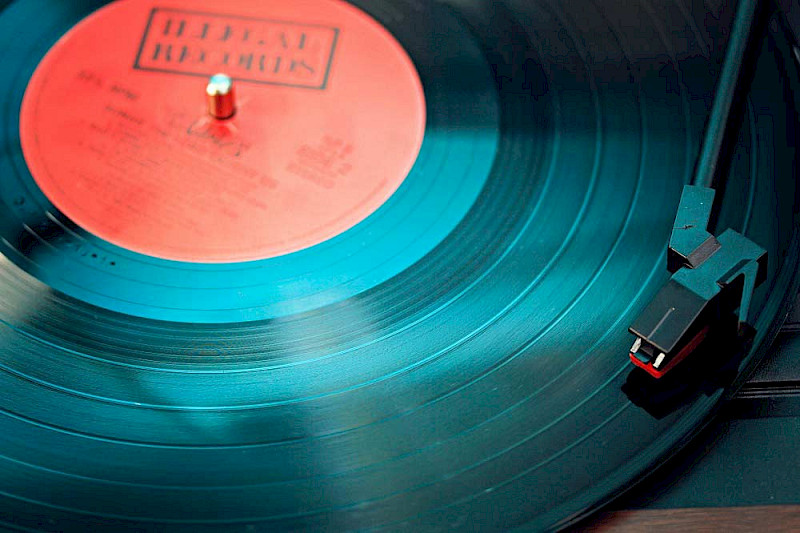
Today’s young hipsters just love their vinyl records. In my day, we had music on cassettes, but we also loved vinyl. At a party, we’d stack them up on the turntable and just let them go. Meanwhile, everyone at the party would just let themselves go.
There was one particular party where an inebriated fellow, let’s call him Dave, snuck off to a dark room with a young woman he was not especially attracted to or even fond of. And the vinyl played.
When the party ended in the early morning, the woman – nicknamed “The Pillow” — was gone, but he remained in a stupor on the floor, barely able to raise his head.
“Have fun?” I asked Dave. His answer, in the form it took, was unexpected and seemed to introduce a new type of metric not usually associated with the activity in which he had been engaged.
“Three sides of a record,” he said with a slur. “The Pillow blew me for three sides of a record.”
Taken aback, I had to ask him to repeat that, as if I didn’t understand, and in fact, I didn’t.
“She blew me for three sides of a record,” he said.
Yes, that’s what I thought he said.
Partly owing to liquor and partly owing to a lack of enthusiasm, Dave did not reach his moment. During the encounter, he simply sat there on the carpet in the dark room while the vinyl played and The Pillow attended to him. But he obviously paid attention to the music. That’s what I found both intriguing and offsetting. His audio preoccupation during his time was, to my mind, not an effective way to optimize the experience. With a woman seeking to give you extreme pleasure, does one count? That might be the last thing I’d do.
And it must be noted that the records David spoke of were not skimpy 45s. These were LPs – that’s short for long playing. LPs were and are 12-inches wide. Each side hold roughly 22 minutes of music. So, for Dave and The Pillow, their marathon session lasted in excess of an hour. If you were watching TV, that’s a full episode of Bonanza.
When LPs were the dominant form of music, record owners knew their recordings intimately. This was the ‘70s, and we called these precious pieces of vinyl “albums.” Each was a treasure to its owner, who knew every song and the order in which they appeared, knew when the A side or B side was playing, had studied the album cover art for hidden messages and symbols, had read the album notes and knew who was playing on each track. Considering all this, perhaps it was unnecessary for Dave to count each song or even pay much attention to the music. Instead, he could have just checked in occasionally, recognizing a song from one album, then focusing back on the performance in front of him, savoring it, enjoying it, then checking back on the music later, hearing another song and realizing the initial record had finished and a second one had started, and so on.
This seems much more realistic than counting individual tracks. But now, so many years later, I wished I had asked him how he did it, how he knew three sides of a record had played.
Then there’s the question of how it ended. I never asked this either. Did she tire and quit, or did he tell her to stop? Maybe the party just ended and so did they. A more vexing question is: Why in God’s name do I even think about this?
That may be the most disturbing aspect here. I’m oddly triggered when I see vinyl. I don’t reminisce about the mystical music. I dwell solely on the sides, three sides to be exact. For a certain activity, that’s a lot of sides. And it’s an everlasting memory for me. I can’t imagine what it is for Dave.
Ah, he’s probably forgotten.
And fortunately for me, all my music today is digital. I wouldn’t have it any other way.











 notebookm.com