By Lanny Morgnanesi
In 2001, I was the editor of a newspaper. In that same year, a woman name Christine, whom I did not know and never met, was working on the 87th floor of the north tower at the World Trade Center in Manhattan. Two weeks after the September 11th attack that killed 3,000 people, she wrote a lengthy email to friends and family. It detailed her experience of horror and her remarkable survival. She copied me on that email. I read it, of course, then printed it out and stuck it in a desk draw. Last week, as the 24th anniversary of the 9/11 attack approached, I discovered it under a bunch of papers. Now, I share it with you. It’s always good to remember.
Hello everyone,
Please forgive the impersonal nature of this group email blast, especially since each of you took the time to contact me directly with messages of concern, love and support since Tuesday, September 11th.
I can hardly believe that it was almost 2 weeks ago that the World Trade Centers collapsed. In some ways the attack feels like it happened months ago, yet I don’t really know where the last two weeks have gone. All I do know is that I am feeling stronger with each day that passes.
Many people have been asking me what it was like when the plane hit the building and what it was like in the stairwell on the way down. Here is the entire detailed story.
At 8:45 am on Tuesday, September 11th, I sat at my computer checking my email. I worked on the 87th floor of the North Tower, the first one hit, the second tower to collapse. There was a very loud crack and crash, like an explosion, or a bomb. With the tower shaking and swaying, I yelled to Yvette, my coworker, to get under her desk. The roof had caved in on one half of the office and smoke and fire was coming from the same area. The office filled with smoke very quickly. I looked out the window to the north, which overlooks Manhattan and saw a snowstorm of debris diagonally whipping passed the window.
“What happened?” asked Yvette, my coworker.
“I don’t know. Maybe a bomb,” I speculated, remembering the 1993 bombing in the World Trade Center.
Although the plane’s impact was very powerful and loud, at the time, I would not have guessed it was a full-size passenger airline hitting the building. The explosion we felt simply didn’t seem that destructive.
Fred, another colleague of mine, yelled frantically to make sure that we were not hurt. Then, Fred told us that there was water running down the windows on east side of the building, which we would later learn was jet fuel.
Within seconds after the crash, we heard dozens of fire engine and police sirens, which mildly calmed both of Yvette and me. “At least they know something’s happened up here,” Yvette said.
I picked up the phone and dialed 911, but was put on hold due to the flood of callers. I waited on the line for about a minute and then hung up. I tried to call Craig at home to tell him that something had happened, that I was OK and to send him my love. This time, the phone was dead, and I couldn’t get through.
Our eyes started to burn and we were coughing. I asked Fred to get each of us a bottle of water stocked in the fridge. We placed wet napkins over our mouths to prevent smoke inhalation. The smoke was getting thicker as the fire started to creep further towards us.
“We’ve got to get out of here! Let’s get to the stairwell!” yelled Fred. All four of us fled the office’s side door. Fortunately, the office had an alternate exit as the collapsed ceiling and fire blocked the main entrance. In the hallway, a brave man was fighting the fire with an extinguisher. I assume he was the floor’s volunteer fire warden. He was an employee of May Davis, a brokerage firm that occupied the other office space on the 87th floor.

Apparently, Joseph, the fourth Thor employee at work, was right behind us, but I don’t recall seeing him.
Once in the stairwell, we hurried down the stairs quickly. Both Yvette and I were wearing clunky sandals, which slowed us down somewhat. Then, at the 78th floor we hit a dead end — a locked door. We banged on the door and yelled at the top of our lungs, “Open the door! Open the door!” People behind us were queuing up shouting at us, “Open the door!”
“We can’t! It’s locked!” we yelled back.
A large burly man grabbed a waist-high steel fire extinguisher and started ramming it repeatedly against the door. With all his might, he slammed the steel canister into the door in an attempt to break it down. Foam from the extinguisher sprayed all the people behind him. The door was so robust that he couldn’t even make a dent in it. Then, he tried to smash in the wall next to the door so that we could crawl through a hole in the wall, but after a few attempts, it was clear that the concrete wall wasn’t going to give either.
Just as I started to panic over being trapped, a building maintenance worker with a walkie-talkie shouted, “We’ve got to go back up to get down!” Everyone followed behind him, walking up the stairs to the 83rd floor and exiting the stairwell into an office. Half of the corridor was blocked by a caved-in wall and electrical fire. Another brave man was trying to extinguish the flames. As we scurried over the soaked carpet, bypassing the flames, we felt the heat of the fire and the spray from the extinguisher. I remember wishing I hadn’t worn a polyester shirt that day.
Once in the second stairwell, the descent toward the lobby was fairly calm, but very slow. Many times, the line stood completely still. The further we got down, the worse the traffic became as dozens of people evacuated into the stairwell.
For over an hour, we slowly moved downstairs. Around the 40th floor, the smoke cleared significantly. People were composed, nervously joking with each other to pass the time and stay upbeat. It was very hot and sweaty. A couple of men told us of their experience during the tower’s bombing last decade. Another woman from the 89th floor told us that the roof of her floor had also caved in, but all of her colleagues had escaped without harm.
I asked a couple of people in the stairwell whether they knew what happened. A man told me that he heard on the radio that a plane hit the tower. After brief speculation, we all agreed that it must have been an accident with a small two-seater plane or a traffic helicopter or something incidental. My colleague Fred suggested a terrorist attack. I dismissed the comment and suggested that he was a conspiracy theorist.
We were asked to stand to the side and make way for injured people. “Clear left! Clear left!” shouted the people who escorted a couple of injured folks passed us in the stairwell. Although it was a little frightening to see these people bleeding, the injuries appeared to be minor.
An-abandoned wheelchair was left in the stairwell. Down one floor ahead, I could see a woman who was being carried down the stairs by four other men. A man supported each of her four limbs and carried her very slowly; stopping for rests along the way. She told them to go ahead and leave her behind. They refused. I later found out that this woman got out of the building safely.
We also encountered a couple of very overweight people who had trouble making it down the stairs. One obese man was being carried down the stairs by two strong men. I later learned that these men were from May Davis, the trading firm from our firm’s floor.
I overheard the May Davis guys encouraging the heavy man to keep moving. He was resting on the stairs. “Aren’t we safe here? Can’t we just stay here?” he puffed.

Around the 45th floor, the smoke started to clear. The stairwells were hot and clammy, but everyone had removed the handkerchiefs from their faces. We started to feel safer. People entering the stairwell were nonchalantly conducting business and seemed annoyed by the interruption to their tight schedules. A man in a suit talking on his cell phone entered the stairwell saying, “Yeah, it’s nothing–I’m just heading down the stairs now… so, let’s schedule Thursday at 10. I’ll block you in. Where’s convenient for you?”
Many people have been surprised by the fact that everyone inside the building was so calm. We didn’t really have a reason to be panicked. We knew the fire was upstairs, we were on our way out to safety and the firefighters were on their way. Also, I think that seeing how relaxed the people on lower floors were, helped to lift our anxiety.
A lot of people in the stairwell were trying to use their cell phones. I kept trying to call Craig as Yvette tried to reach her sister and parents. We knew that our families would be worried about us and we wanted to let them know that we were OK.
At the 30th floor, we were instructed to make way for the firemen who were passing us up the stairs. About 20 firemen, fully dressed in 90-pound fire suits, and carrying tanks on their backs pulled themselves up the stairs with the handrail. They were exhausted and drenched in sweat. We met eyes with many of them; thanking each one individually as they ascended. People in the stairwell broke into applause and cheered the men up the stairs.
At the 20-something floor a tall, thin Hispanic man with a mustache, stood at the stairwell entrance, touching each person’s shoulder, “Take care. Be safe, now. God bless. Watch your step,” he said to each person passing him. We thanked him and smiled. “Come on, why don’t you come with us and get out of here?” asked a man behind me. “The Lord put some of us on this earth to watch over others. This is my duty, I guess,” he replied with a warm smile. I later saw this selfless man’s photo on a missing poster in Grand Central station.
As we neared the ground floor, the stair were pooled with water as the sprinkler systems had been operating on the lower floors. The stairs were quite slippery and a couple of people lost their footing and fell down the stairs on their rear end.
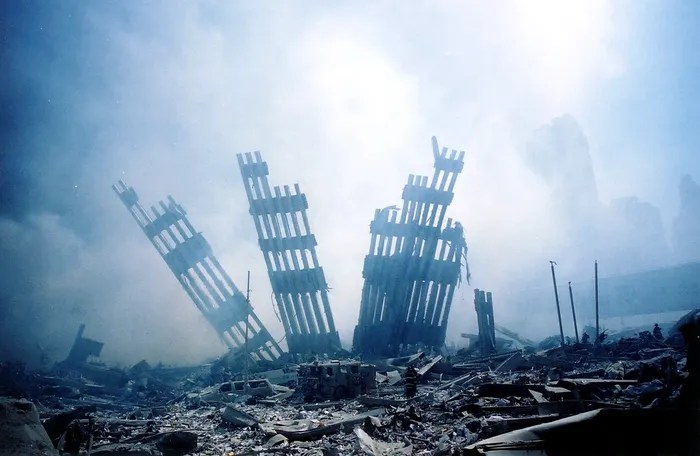
Finally, Yvette and I hoorayed over the sight of daylight at ground level. The stairwell exited at the main plaza where the copper globe fountain had been. I gasped with shock as I caught a glimpse of the unrecognizable area. It looked like a war zone covered in two feet of gray debris and dust. “What the hell happened down here?” I asked under my breath.
“Hey Christine!” yelled my colleague Fred from over my left shoulder, “Looks like we made it,” he said. But before I could reply, a huge thunder and cracking erupted from behind us. Then, a strong wind swept toward us. People started to scream and run. Within seconds, the roof collapsed, and debris fell all around us. Then blackness. “Get down!” I yelled at Yvette pulling her hand to the ground. We curled together in a fetal position clinging to each other. I covered my head. Store windows smashed, roof chunks dropped and debris crashed around us. It felt like a tornado. “This is it,” I thought to myself, “This is where it ends for me. Is this all I get? 27 years? No fair.”
The first tower was collapsing, although we didn’t know what was happening at the time. I prayed. I never pray. I pleaded with God to either take me quickly or let me survive unharmed. I didn’t want any in-betweens. I feared being pinned down by a falling beam or getting badly injured and unable to move.
It seemed like an eternity before the crashing stopped. When it did, there was dead silence followed by coughing and cries for help. I couldn’t see anything. The smoke was so thick it was difficult to breathe. I spat the dry grit from my mouth. It was pitch black. We sat in the cold water in the blackness and I could feel the cold water on my rear end.
“Are you OK?” I asked Yvette.
“I think so. Are you?” she said.
“Yes.” I replied. I wondered how long we would wait before being rescued. Then I wondered if we would be rescued. Did anyone know to look for us?
“Help me. Hello? Help me. Is there anybody there?” cried a woman in front of us.
“Yes! We’re here, we’re right next to you,” I told her.
“Reach out to me! Where are you? Can you reach out to me?” she yelled.
We fumbled around with our hands extended until our arms touched. She crawled closer to us tripping over the debris that surrounded us. Many people were shouting to each other. “Hello? …. Help! Hello?” In the darkness, the people responded to each other’s cries, while panic, confusion and chaos grew with each second that passed. Everyone waited for the voice of authority, the voice of direction, someone who was coming to save us.
A man next to us lit his cigarette lighter so that he could see. At least three people shouted simultaneously, “No! No! Put that out! There could be gas in here!”
“Yvette, we’ve got to get out of here,” I said, “let’s crawl.”
Determined not to lose each other in the dark, we formed a human chain
on the ground with each person clutching the ankle of the person ahead. We crawled over the glass and debris toward a faint light that turned out to be the 1/9 subway entrance. We stood up but were unsure of how much clearance we had to stand. A few people stood in the doorway looking for help. The smoke and dust was so thick that I couldn’t see the faces of the people standing right in front of me–only featureless figures.
When we realized that there was no exit through the subway, we turned to move in the opposite direction. We started walking very slowing, tripping over broken debris. “My feet! Ouch! I can’t walk, I have no shoes!” cried Yvette.
I heard a man in front of us and asked if he could carry my friend who had lost her shoes. He whipped off his laptop and tossed it to the ground. I felt the thud as it hit the ground and reached down to pick up his bag. He lifted Yvette to give her a piggyback. “Girl, what have you been eatin’?” he joked with her.
A cluster of six or seven of us moved around in the dark. I don’t think any of us knew where we were going. A few seconds later we heard a man’s voice in the darkness.

“Follow my voice! There is an exit over here! Follow my voice!” We moved toward the man’s voice; toward a hazy faint light. At the bottom on a small stair well, two firefighters argued with each other over whether the exit was safe and clear or not. “I just took a dozen people out this way five minutes ago!” one fireman insisted as he gathered us together. “Come on! Let’s move!” he shouted.
Once we were outside, I barely recognized Vesey Street. The street was littered with smashed up cars with dangling bumpers.
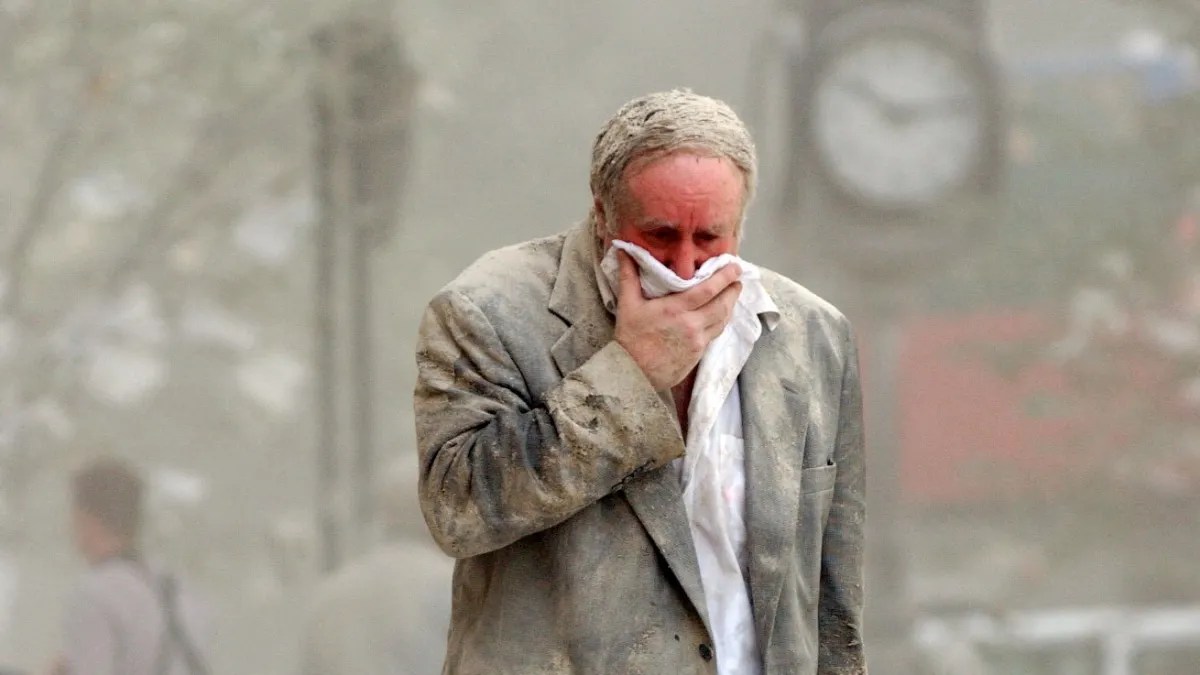
The man carrying Yvette put her down and gave her a hug. I handed him his laptop bag, which he accepted with a pleasant surprise. We thanked the man and both hugged him. I kissed his soot-covered cheek. All of our faces were caked with gray soot. I don’t think we’d ever recognize each other again, although I would like to thank that man.
Everything was coated in a foot of debris consisting of papers, file folders and dust. I kicked off my shoes so that I could run. The debris under my feet felt soft.
I looked around for someone to help us or tell us what to do. Where do we go? Is there a central check-in station? What now? I began sensing how chaotic the situation was. No one was in-charge. Even the policemen were frantic.
They shouted at people to keep moving. We ran North. We didn’t really know where we were going, but we knew that we needed to flee the area. We ran and ran and ran.
A few paramedics stopped us to ask if we were injured. They handed us water and told us to wash off our faces, but to avoid getting the soot in our eyes. The streets were filled with spectators watching in horror and fascination. Yvette and I kept running hand in hand and didn’t look back.
Reporters frantically snapped our photos without response and asked for comments. We kept moving.
Then, people started to scream when the second tower started to crumble. I looked back for a split second, but couldn’t watch. We just kept running.
One woman burst out crying in terror as we passed her in the street. Perhaps she saw how badly we looked and she knew someone in the building.
I took Yvette to her sister’s work on Houston and 8th Avenue and made my way home. I hitchhiked a series of three rides home. That may be the one and only time I hitchhiked in New York.
When I rang the doorbell and Craig opened the door, he collapsed to the ground with sobs of relief. He held me, grabbing my flesh to make sure I was real. He had been going crazy for hours, knowing that I was in the building, but not having heard from me since I left the house that morning. He was so happy, but told me to call my parents immediately. They, too, had been calling, wondering if he had heard from me. After a number of attempts, I finally reached my mother in Calgary, whose reaction of relief matched that of Craig’s.
Although people had told me what happened, I wasn’t really able to comprehend the facts on that day. I was still in shock with adrenaline racing through my system. In fact, I didn’t really start to process the terrorist attacks until the next day.
It has now been 12 days since the disaster. Each day I feel better than the day before and I’m getting stronger with each night’s rest. Craig and I have been attending memorials and candlelight vigils, taking walks in the park and trying to establish routine and normalcy to our lives.
September 11, 2001 was the worst day of my life and it was the best day of my life. It’s a miracle that I escaped.
Thank you very much for your thoughts and prayers over the last two weeks. I have booked a trip home to Calgary for the week of Canadian Thanksgiving and can’t wait to see my family and friends. Hugs will be issued to everyone!
Take care and stay close to your loved ones. Love to you,
Christine

 notebookm.com