Archive | science RSS feed for this section

On God and The Universe

18 Jan

By Lanny Morgnanesi

My mind of late is wandering into dangerous places, forcing theories and ideas into my consciousness that lack convention, precedent, and true understanding. I can only off load them by sharing. And so, I write … about God and the universe.

Let’s begin with something simple: monotheism, the belief that God is singular.

I appear somewhat alone in my view that Christianity, especially Catholicism, is not monotheistic. This contention is more about the choice of words than about actual beliefs. If Christians decided they were pantheistic, it wouldn’t change much.

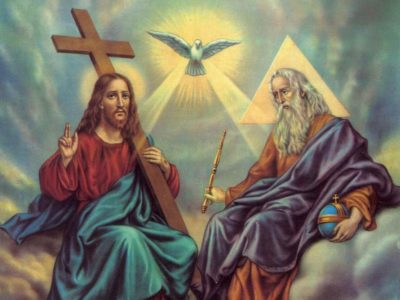
Supporting my argument is, or are, The Trinity – the Father, Son, and Holy Spirit. That’s three, not one. The claim, of course, is they are one. But I see three, and never understood the logic of this division that is not supposed to be a division. Next there is the glorification of Mary, the mother of Jesus. In visions, she has appeared to people and passed along messages from God. Indeed, people pray to her and ask that she intercedes with God. If you can tell God what to do, and God does it, well, you’re pretty much a God yourself, even if a minor one, like the Greek Muses, or Iris or Eros. Next are the 10,000 or so saints believed to have performed miracles, who are prayed to daily and who watch over and guard particular villages, peoples, and professions.
Admittedly, that’s a lot of Gods, and it seems we like lots of Gods, even while insisting there is only one. The Jews haven’t fallen into this trap, especially not the tempting one where God takes on flesh. They only go so far as a burning bush. In early Islam, there was an attempt to deify the pre-Islamic goddesses known as The Three Sisters (Al-Lat, Al-‘Uzza, and Manat). In the so-called Satanic Verses of the Koran, they were said to be daughters of Allah. But these verses were later attributed to the devil and retracted, the sisters were sent packing, and Islamic monotheism was restored.

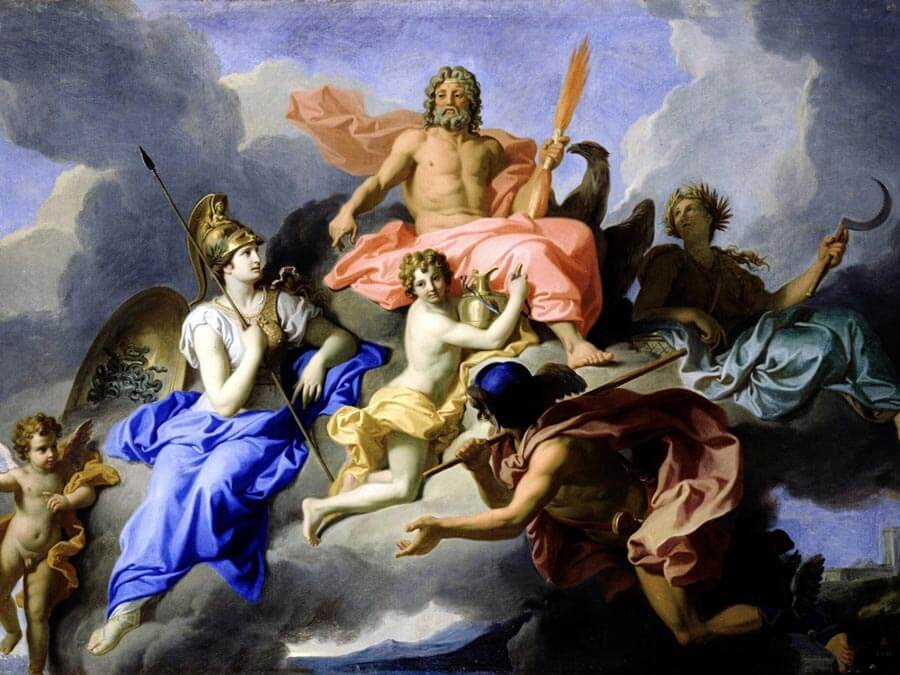
So it seems the multi-God legacy of ancient pagans, the Greeks, the Romans, and others remain firmly with us, even if we refused to admit it. While I can see the attractiveness of having a host of available entities for helping one navigate life, I accept a single creator, one powerful, governing force. I don’t want to use the terms he, him, or her, in reference to God, because I’m certain it is an entity without sex, nothing like an anthropoid, not someone we will eventually meet and gaze upon, and absolutely well beyond our elemental comprehension. We all would like to know God better, and Christians do through the human-form of Jesus Christ. In fact, they seem much more comfortable, much more absorbed with The Son than The Father, and that’s understandable. We know and understand humans but not an all-encompassing, unseen cosmic power.
I’m different, as I have suggested. I prefer the all-encompassing cosmic power. In my view, Jesus, as his story is told through scripture, limited his God-like self while on Earth. His main mission was to forgive the sins of man, save him, and grant him eternal life. Considering the vastness of the universe, with 2 trillion galaxies, and the mind-bending, unanswered question of why we are part of it, you might think Jesus would have talked a little about this, telling us what are job is, if we are alone among the stars, whether or not he will visit other planets, and what we will do in heaven, aside from worship, which, for all eternity, could get monotonous.  If he chose not to explain such things, why wasn’t he at least asked?

As a God, Jesus could have done so much more to help us understand our purpose, our place, and our incredible surroundings.
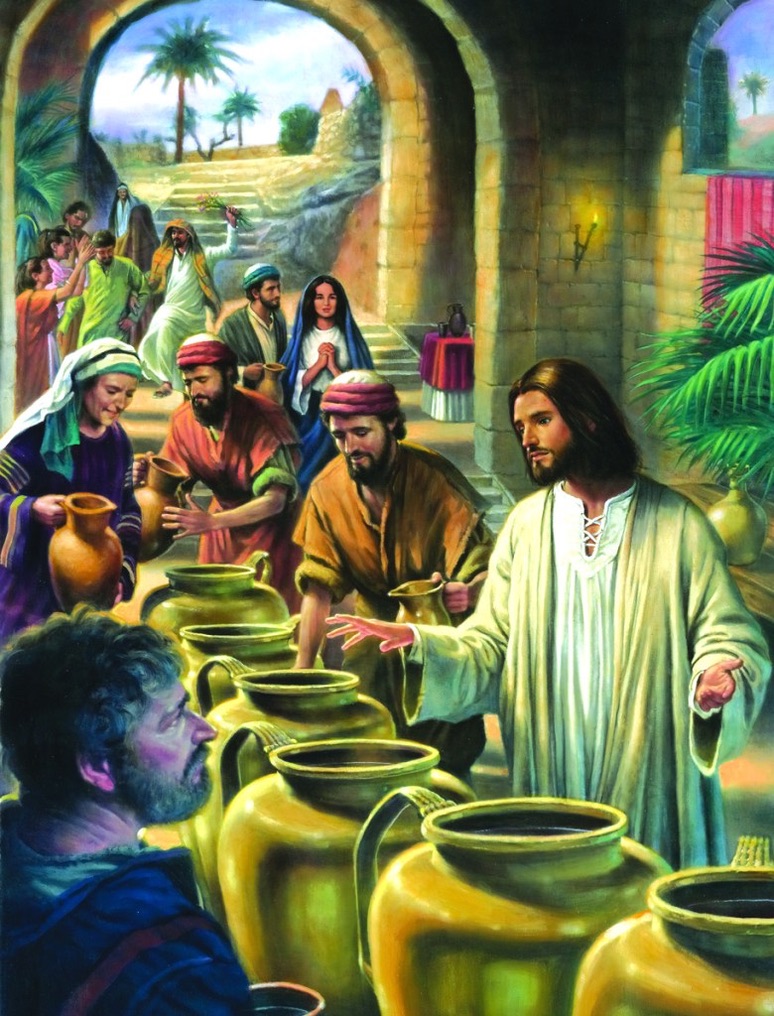
As limited as his role on Earth may have been, the teachings of Jesus were enough to build a global religion. And whether it is monotheistic or pantheistic, it really doesn’t matter. For me, the problem with religion does not involve the number of gods, but rather the fact that the tenets and precepts are tightly packaged and handed to us by other men. Those men, for the most part, have done a good job, but I am cursed with the need to use my own brain to establish my own tenants and precept.  I’m willing to borrow, but often I can’t.

In this regard, I may share something with Galileo, the great astronomer often called the father of modern science.. He said, “I do not feel obliged to believe that the same God who has endowed us with senses, reason, and intellect has intended us to forgo their use.”

And I haven’t.

If I may impose on the reader and indulge myself, I’d like to share the results of my thinking, my so-called religion, which, I fully admit, is not dogma but sheer speculation. It’s the best I can come up with.

I don’t claim truth because my first proposition is that God is 99 percent unknowable. That is where I start. I start, basically, saying we can’t know, we don’t know, we probably were not meant to know, and we don’t have the capacity to understand. The truth, if it were revealed, would make no sense to us, like a complex mathematical equation would make no sense to a chimp. This is what I maintain.

I acknowledge the gifted prophets, who are so tied into the universe that they grasp the one percent know ability of God, and attempt to teach us. I respect scripture and its overarching message, and I believe in one God.

My second major precept is that God is perfect and acts perfectly. My God doesn’t need extra work and doesn’t do extra work. My God gets it right the first time. This is much more controversial than you might imagine. In my thinking, the perfect, unknowable God created the universe – whatever the universe is – in the exact way God wanted it, and that it does exactly what God wants it to do. So … God does not need to watch over us and intervene into our lives, nor does God need to course correct the universe. It’s like a perfect machine, doing what it is designed to do, and doing it perfectly. If you lose your car keys, or get sick, praying to God won’t help. The machine can’t hear you and won’t change for you or anyone. It’s mostly likely unattended

We can learn, grow, and become better human because of the preaching and parables of Jesus, a person in touch with God, but to think of him as God and distinct from The Father is, for me, too difficult. Jesus as God represents a kind of course correction, which I maintain is unnecessary.

I cannot envision a magnificent God creating a man, deliberately marking him with original sin, making him weak and prone to sin, then sitting back – if God can even sit – and watching to see if this creation can overcome its imperfections, as if, within God’s great universe, this was some kind of pastime or preoccupation, as if God did not know the outcome. I don’t think God would send a savior to help the poor souls he himself deliberately set on the wrong path.

God, to me, has better and bigger things to do than test or challenge the human specks inhabiting a small rock in an endless mega-verse. It is true the Greek gods enjoyed the antics and foibles of mortals, and used them as playthings, sheer entertainment. It is doubtful the real God does this. At least this is what I believe.

But let’s speak of the machine, God’s universe. How does it work?

I see two components at work: time and probability.

Time and probability, as established by God, keep the machine, without interference by its creator, on its mission, whatever that might be.

Let’s begin with probability.
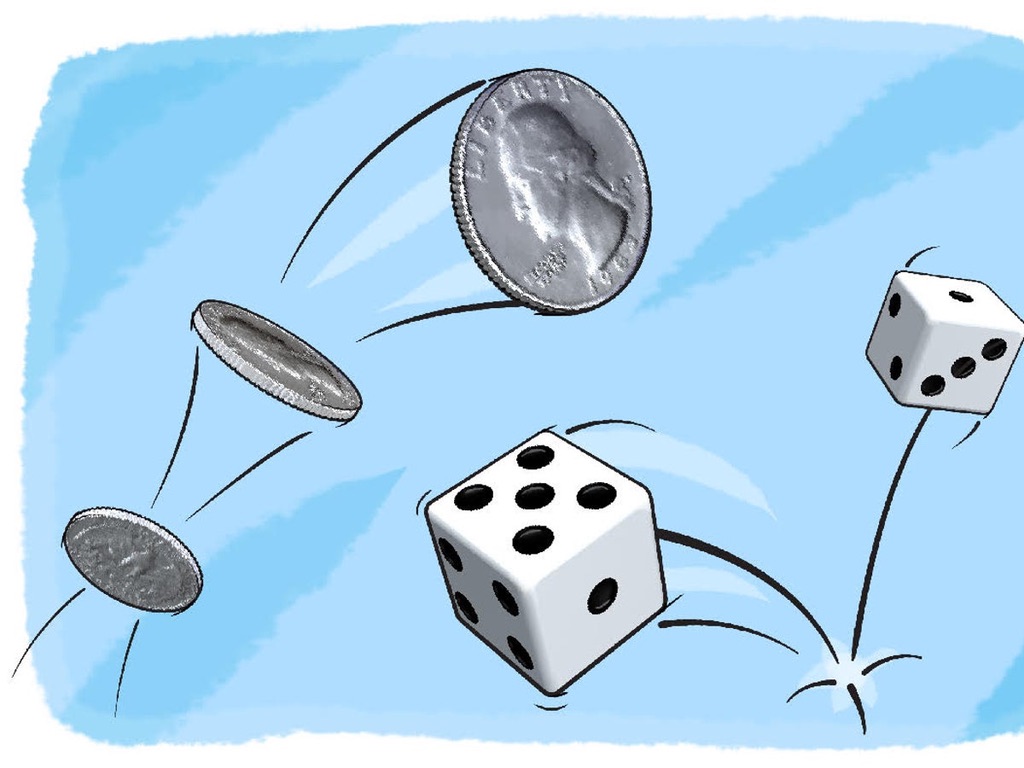
We are all familiar with probability. Consider the coin flip. If you flip a coin five times, there is a real possibility it could come up heads – or tails – all five times. But if you flip it 10,000 times, the law of probability will ensure that heads comes up about 5,000 times, as will tails, meaning the probability over many occurrences and over time is 50-50. That’s the law. Established, I propose, by God.

It’s the same with the building of the universe, its functions, and even us, the God specks.

God establishes what the end goal is, sets his probability for that goal, builds in an infinite amount of time, and lets the machine run. Maybe he wanted the dinosaurs to remain on Earth forever, and maybe he didn’t. Well, the machines put them here and probability, in the form of a massive asteroid that hit Mexico 66 million years ago, took them away. That may have been a low probability event (we don’t know), but if the existence of dinosaurs on Earth is a God goal, then over infinite time higher probability events will bring them back.

We are here now because of events whose probability we cannot be sure of, meaning we cannot be sure we are here to stay.

Probability also affects individual behavior. Probability, I propose, is mainly built into our DNA. Our DNA allows for the great majority of us to rise each morning, eat, get some kind of work done, and sleep at night – all while producing a heirs. Most of us will not commit murder. Most of us will not paint the Mona Lisa, or compose a Fifth Symphony, or figure out the speed of light. But some will. The probability exists for that. By my theory, our little world, for some reason, requires all these things, and so we have them. It needs people who are not afraid of heights so we call build towers and expansive bridge. And it needs people who ARE afraid of heights and risks so that we all won’t kill ourselves doing dangerous things. It also appears that, for some reason, at least here and there, we need both a Hitler and a Mother Teresa, and so God creates them, in the proper numbers, through the probability and miracle of DNA.

We are granted a degree of free will that allows us to decide whether or not to call in sick today or to finally clean up the back closet. But the engineer who designed the pyramids did not do so freely. Something within him forced it. God’s hand.
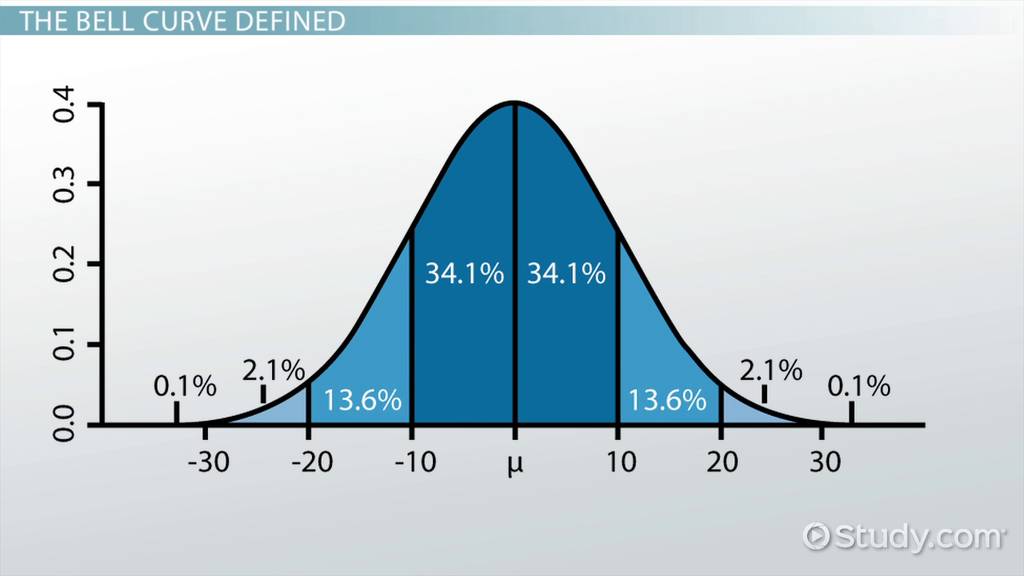
But I don’t envision a God with hands. I envision God as a bell curve. Gods is mathematical, and the universe and all humans operate like a bell curve, with lots of possibilities for common things and only a few possibilities for extreme things. A one end, where there is little room under the curve, is the horrible and disastrous. On the other end, where there is little room under the curve, is the wonderful and the exalted. As the curve rises and falls, the horrible and disastrous and the wonderful and exalted remain but decrease in occurrences. At about the middle to the curve, about 65 percent of the curve, where it is high and with room under it for most of us, are, roughly speaking, Mr. and Mrs. Normal.

And that’s how it all works. God is a bell curve, and his tools are probability and time.

I sort of faulted Jesus for not doing enough on Earth, and now – with respect – I will fault God for doing too much. God really over did it. When we look closely, we see that God incorporates tremendous complexity and beauty into everything – the big, the small, the in-between. God astounds us with our galaxy as well as the appearance of a blade of grass under a microscope. God obviously is not on a budget, has no time constraints, must be able to work quickly, cares about every aspect of the creation, never shirks or simplifies, never favors the tremendous over the nearly invisible, and provides the same rapt attention to everything. There is nothing simple about any of the aspects of the creation.

Bringing the ancient Greeks back for a moment, their logic convinced them that there was a starting point, a primal, singular component to all things. And so they invented the atom. It sounded good, and the best scientists of the modern world embraced it. Now, of course, we know there are a  multitude of sub-atom particles.

The elemental component escapes us.
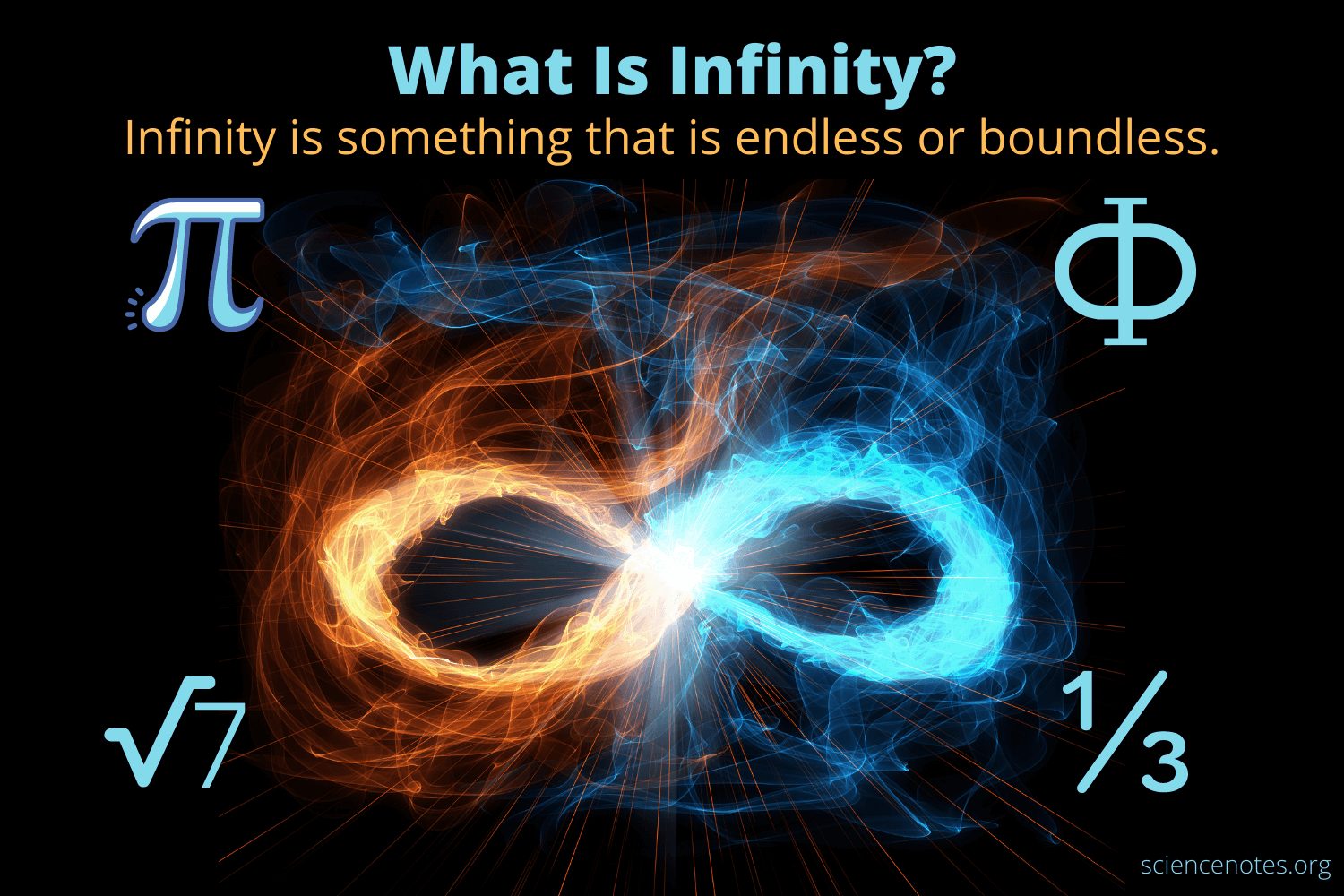
 I could never out reason a Plato or Aristotle, but I must say my reason tells me something quite different about the primal piece of existence. I don’t believe it exists. Our intellect cannot grasp my idea, but I will share it nonetheless: There is no smallest and there is no largest. Find the largest and keep searching and you will eventually find something larger. Find what you think is the smallest, keep searching and you will find smaller. There will be no end to it. Small will begat smaller, and smaller will begat even smaller – and it will do so infinitely. There will be no end to it. The same for large. There is level after level after level.

The God of creation went in one direction and never stopped. Then he went in the other direction and never stopped.  

Once you accept this idea, it follows logically that our God has a God, and that the second God has a God, and that God has a God … and so on, toward infinity, which we are incapable of understanding but seems to be the core of everything.

It reminds me of football, when there is a penalty close to the goal, you move the ball half the distance to the goal. If there is a second penalty, you again move the ball half the distance to the goal. Theoretically, under this rule, the ball would always get closer to the goal but never, ever reaches it.

Well, I’ve exhausted myself.

***

The great 17th-century philosopher, Baruch Spinoza, would disagree with all I have said about a plan, a machine, and an unknown purpose. He boldly proclaimed,“Nature has no intentions, no mercy, no plan – and calling this God is humanity’s refusal to accept insignificance.”

I accept my insignificance but still say there’s a plan. I just have no idea what it is.

On the Resilience of Consciousness, or, An Ode to a Departed Friend

5 Aug

By Lanny Morgnanesi

            You are eating outside at a restaurant in a New Jersey tourist town. The people who walk by are varied, colorful, animated. Each one, everyone, has consciousness. They are creatures of thought and understanding, aware of their surroundings, aware of their fears and limitations, aware of their joys and sorrows. And they walk, and talk, and work, exhibiting complex patterns and wide ranges of motion and activity. Below the surface, within and around them, are intricate, beautiful, biological, chemical mechanisms that create their consciousness, permit their existence, dictate their actions, and allow them life. Some of these mechanisms we understand. Some we do not. Some we think we understand but aren’t sure. The mechanisms in certain individuals make them highly intelligent in mathematics, or music, or art, or philosophy, or war, or in figuring out how to configure the plumbing in a 50-story building. The mechanisms make people weak or strong, sometimes capable of near-superhuman feats. The mechanisms can create anxiety and depression and make people prisoners of their own minds. They create heroes and villains. Mostly, the mechanisms allow our species to conduct themselves normally and efficiently, below greatness and above infamy.

If you could look at the structures of these mechanisms, see into them, observe them on a microscopic or even smaller level, watch them work, watch them create and destroy, the chemicals, the neurons, the proteins, the DNA, the transmitters, the receptors, it would be like observing the face of God.

            Now, pull back. Way back. Into the vast heavens of galaxies and the infinite.

            You no longer see the creatures in the small tourist town. Although complex, from this perspective they are inconsequential and meaningless, as if they didn’t exist, yet they do, but for what purpose? Let’s forget them for now.  So unimportant. Look at the stars. So many stars. Two hundred billion trillion of them in 2 trillion galaxies. If you could see everything up there, you’d see less than 5 percent of our actual universe. The rest is hidden and undetectable. That’s just our universe. Some scientists, obviously the silly ones, believe the universe we know is just one of an infinite number of invisible universes. The scientists say in those infinite universes, everything has happened. You became rich in one. Married a movie star in another. Became a king in a third. Were a pauper, a beggar, a thief, a Mafia don, the first person on the moon. If this were true, the God who created the multiverse could not be comprehended by the shallow, limited human mind. All prophets, all scripture would be meaningless. That God’s purpose and nature would be far removed from the anything taught us by the wise and peaceful Nazarene who lived in a small town, on one planet, in a singular universe.

            If we discount the hidden, the pattern of things high in the sky are no less and no greater that the patterns inside our bodies. They are only larger. All of it made from the same building blocks. All of it in compliance with the same governing rules.

            Now zoom back in close to the people walking the streets of the tourist town. Look down at the weed growing through a crack in the concrete. Zoom in even closer and see the worlds within the world of the weed. Now closer, and closer, and closer. It will never stop. You can never get close enough. Level after level after level.

  Up and down. In the heavens or under foot. Infinite complexities on infinite levels. So which one is the distinguishing level? The rung of importance? The level that matters most? Is it our level? We tend to think so.

            Our prejudiced is triggered by our ability to think, to communicate, to build and destroy civilizations, to philosophize, to love and hate – and our inability to properly detect intelligence in other species and organic matter. Ants build civilizations and get work done. They receive little credit for it. We are awed when we see non-primates using tools, then go on our way and forget about it. Germaphobes and others acknowledge the vast preponderance of bacteria in the world but never dream we might exist solely for it. We know – at least some of us do – that plants talk to each other. A tomato plant being eaten by a bug will signal the danger to other tomato plants, who then go into defensive mode. Yet we don’t consider them conscious beings.

            Our consciousness, because it is ours, ranks supreme. We know that all life share much, DNA for example. Eternal consciousness? Sorry. That’s our monopoly.

If God has singularly granted homo sapiens heaven-bound consciousness, then God did so as an exception to the rules, laws, forces, element, and constants that every other aspect of the universe must conform to. And God did so to creatures that are a mere speck of almost nothing and hardly any use at all to the universe. Why? I haven’t heard any convincing answers.

             Our concept of consciousness is that it is constructed and operated by the organic components of the body, and that when those components decay and die with the body, something remains to reassemble and transport consciousness to a spiritual world, preserving our thoughts, our memories, our relationships, our recognition of friends and relatives. We believe this without identifying the earthly components that perform the reassembling and the transporting. We explain it by saying the components are not earthly.

Nothing like this—spiritual intervention — has ever been found, for sure, in the universe. And for this reason, I cannot believe that the consciousness once existing inside a human is retained somewhere else after death. For me, the state of post-death resembles the state of pre-life, meaning consciousness, as we know it, cannot exist without the body. It dies with the body.

            Recently an old friend, my college roommate, succumbed to stage four cancer. The final days were difficult. All he wanted was to pass. When the end was within hours, I asked him to be honest. I ask if he expected to go somewhere. I was thinking that by approaching death he might be closer to truth, and that he would be willing to share that truth with me.

            There was nothing surprising about his answer, be it newly revealed truth or just long-held ideas. He said he is a Christian, that he believes in the afterlife, that he expects to go to the place most call heaven. I told him, for his sake and mine, I wished it true. He said, if possible, he’ll get back to me later with confirmation.

            Nothing yet.

            My friend said he was a Christian, and I guess that’s true. Maybe not entirely true, not exactly true. His Polish-born parents, who came to America during Hitler’s rise, raised the family as Orthodox Catholic. Several years ago, at his father’s funeral, an aunt told him he was Jewish. The Catholicism was a safe cover. I’m not sure why, and I didn’t tell him, but I was hoping he’d convert back. Instead, he continued to attend a place called Son Light Bible Church.

            The pastor at Son Light, for certain, would have discouraged a return to Judaism. At the funeral service for my friend, he said the only way to heaven was through Jesus Christ, which Christ himself says in the Bible. Without accepting Christ, the pastor said, not even good works can save you.

But I suspect even if my friend had converted and lost his right to heaven, the pastor would still acknowledge the release and reconfiguration of his consciousness. It just wouldn’t go to the good place.

  I wish I could believe in the resilience of consciousness and the eternity of memory. I wish I did not have to sit here in a tourist town in New Jersey, with a view of the sky, a view of the prancing anthropoids, and a view of the lowly weeds, thinking of what might or might not remain of my friend, realizing that everything just seems the same to me. Like one family. Like a complete set of Legos. If one thing goes to heaven, it should all go to heaven. But it all can’t go to heaven.

Can it?

“Would you like a refill on that coffee?” the waiter asked.

“Yes, thank you,” I said, curious if my decision will in any way affect the universe, wondering if anyone’s memory of this day will reach heaven, worried that, all scripture aside, I am doomed to never find out.

Do robots get it?

13 May

female_robot

Image by Rhex Firemind

A story of mine was recently published in the online science fiction journal, Ripples In Space.

It’s about artificial intelligence in a young female robot and a visiting scientist who wants to determine if she is capable of comprehending unconventional thought patterns.

It’s short and you can read it in a flash.

I call it   “Learning”

Click to read. Thanks.

Lanny Morgnanesi

One day soon we will all be smart

29 Mar

Aliens

After scientists took control of the atom, weapons with the destructive power of hell were possible. Because they were possible, they were made.

Once we established a vast network of digital communications, it was possible to know almost everything that was said or written – and in some cases thought. Because it was possible, governments, corporations and marketers took possession of this information.

Teams of scientists are planning a one-way trip to Mars. They won’t be able to come back, but because they know they can at least get there, they will go.

If it can be done, it will get done. This is immutable.

Law, regulation, ethics and good sense always resist. It never matters.

Now, there is something new to consider.

We are in possession of a “God Hand” that allows us to alter and enhance the qualities and features that comprises Homo sapiens.

DNAFor years we’ve toyed with our genes, but two recent developments have brought this work to an advanced stage where even scientists are shouting, “Stop!”

The developments are:

  • Specific pieces of DNA can now be easily and accurately targeted and manipulated.
  • The changes made can now be inherited.

“I personally think we are just not smart enough — and won’t be for a very long time — to feel comfortable about the consequences of changing heredity, even in a single individual,” said David Baltimore, a former president of the California Institute of Technology and a member of a group of biologists calling for a moratorium on gene editing.

The group published a paper on the topic in the journal Science. A story on it appeared in the New York Times.

George Q. Daley, a stem cell expert and member of the group, said taking control of our genetic destiny “raises enormous peril for humanity.”

Controlling inherited DNA mean we can control, beauty, disease, intelligence and probably even behavior, maybe mortality.

I shudder at the thought of small armies of Frankenstein monsters roaming the cities and countryside. But I cannot displace the dreamy idea of our still barbaric species living in peace and harmony, with a focus not on the accumulation of capital but on the development of knowledge, betterment, the arts and sciences, altruism and the ability to provide everyone with the resources for living.

This, in effect, is a chance to rise above and beyond what our present species is capable of.

This is extraordinary, which is why it will be done.

Will it be done right and fair and with justice? Probably not at first.

In the beginning, people will prefer the inherited traits for beautiful rather than intelligence. For those who do choose intelligence, we’ll have to worry about them creating a superior class and lording over us.

But think of the potential.

Science is giving us a second chance. We can be like those big-headed movie aliens who visit Earth and know everything and look down on us as if we are quarreling children.

Future cityIf we were supreme and peace loving, we could do the impossible just with the money saved on weapons and warfare. For one, we could rebuild our cities. There would be high-speed rail lines running everywhere, self-driving cars and wide roads without potholes. Food, college and health care would be free.

And we could fund the Mars expedition so they’d be able to come back.

Best yet, when those explorers stepped off their spacecraft, they’d be the big-headed aliens.

Let’s see where this goes. It might be wise to invest in companies that make large-size hats. From a personal standpoint, those who are 10s and do nothing may be knocked down to a 5. Still, it is likely you’ll go the winter without the flu or even a sniffle. Getting into Harvard will be harder. When playing poker or games of chance, be sure those at the table haven’t been to the genetics lab.

For myself, I can see a self-help book in the works.

By Lanny Morgnanesi

Nearly every physicist in the world will insist that you – yes, you — have married a movie star, earned millions of dollars and lived in an exotic locale. They know you’ve done this – even if you don’t –because their research proves it. Strangely, this is what science has come to, and it’s bunk.

18 Sep

Quantum

Basic science once was easy. Now it’s difficult for even scientists, and those who pretend to understand it probably don’t.


There is no logic to it. Nothing in the observable world compares to it. Metaphors can no longer explain it. Wild imagination is required just to discuss it.


In ancient times, when there was a lunar eclipse, people would say their god ate the moon and later vomited it up. Don’t laugh. The stories our scientists tell today also sound like fables.


Consider this standard, nearly universal tenant of science:


We cannot predict what a particle will do because it actually does everything while inhabiting a multitude of universes.


What this means on a larger scale is that each one of us has married a movie star, become a millionaire and done nearly everything else that is possible to do — and maybe more. We just didn’t do it in the single universe we wake up to every day. We did it somewhere else.


There is no word yet on how to jump our consciousness to those other universes, where clearly we are having a lot more fun.


Rather than just accept such ideas, which evolve from a desperate, almost ruthless attempt to boil science down into a single theory of everything, I take the position that human being are incapable of fully understanding what exists and how the universe works.


It’s a concession few are willing to make, but I have made it.


To their credit, scientists keep trying to figure it all out. The problem is, they try too hard.


In the time-honored tradition of changing the facts to fit the theory, scientists – mainly physicists — make their single-theory equations work by adding 10 or more dimensions to the four we know. They have pushed the limits of logic by describing a key component of matter as having only two dimensions while at the same time saying it seems to have only one. Perhaps most interesting but hardest to accept is that the theory assumes our universe is one of many universes and that the history we know is but one occurrence of infinite occurrences, meaning all things in all ways have happened.


Yes, you have driven a Lamborghini and owned a house in the South of France.


Only by assuming such things can a single theory work.


Feynman quoteModern physics used to be about spheres revolving around a central core of matter. The planets revolved around a sun; electrons around their nucleus. Big and small objects sort of worked the same.


The catastrophe of science began when it was determined that big and small did not work the same. Things were far more complex than a bunch of balls circling around other balls.


Scientists who longed for a single theory could not live with this duality of big being different from small. And so they struggled for a theory that would handle both. These theories only worked with 10 or 11 dimensions, with vibrating strings replacing atoms, with everything having not one life but a history of every possible life.


There actually is an assortment of these theories. And, mathematically, they all work – which I think means they can predict what is observed or sort of observed. In the new science, you really can’t observe anything.


Any scientist reading this will know I am not one of them. For the past several decades, however, I have tried keeping up with their progress. I’ve enjoyed and felt comfortable with Einstein’s theories of special and general relativity. They were complex and not entirely in line with what we experience in life, but scientists found believable ways to explain them using stories of clocks on trains and twin space travelers.


Next came quantum mechanics, which defied all logic and seemed impossible and ridiculous but could not be proven wrong. Then, when physicists started trying to unify theories on the four forces of nature (gravity, electromagnetism and the weak and strong forces of the atom), a big mess started to accumulate and I could not keep up.


But recently, I checked back to see if anything sensible had developed. I picked up the book, “The Grand Design” by Stephen Hawking (the guy in the wheelchair) and Leonard Mlodinow (a physicist at Caltech). Like any survey of science for the layman, it starts off good.


The authors even make jokes about their profession.


stephen-hawkingAbout all those new dimensions, they say: “Ten dimensions might sound exciting, but they would cause real problems if you forgot where you parked your car.”


They included cartoons. One is of a woman introducing two men saying, “You both have something in common. Dr. Davis has discovered a particle which nobody has seen, and Prof. Higbe has discovered a galaxy which nobody has seen.”


The authors easily convey the genius of such minds as Richard Feynman (who in his spared time played bongos at a strip club), John Conway (the creator of a simple game that seems to explain the workings of God) and so many others.


But they also let on that few if any of today physicists really understand the things they expect us to believe.


Indeed, Feynman, a quantum god, once said that no one understands quantum mechanics. He described is as “nature as She is — absurd.”


Niels Bohr, a quantum pioneer, said that anyone who does understand quantum mechanics would be shocked by it.

It’s difficult to find a concise explanation of quantum mechanics, but author and theoretical physicist Sean Carroll said the theory tells us that what we can observe about the world is only a tiny subset of what actually exists.


Einstein recognized the importance and power of quantum theory while admitting an inner voice told him it was not the real thing.


Neils quoteI have this same problem. Something tells me that without elegance, logic and relative simplicity, a theory cannot be correct. The strange, counter-intuitive ideas of science, these mathematical attempts to explain what we are not yet capable of knowing, are earnest and hard-fought attempts to penetrate the impenetrable. They are not, however, for me.


I prefer to put in with Aristotle, who didn’t need to test, measure or even observe. If he could think it through and see the sense of it, he accepted it. If it explained the world and what he knew of it, that was enough.


Science is a marvel, but so are the philosophers and poets – so many of them ancient Greeks – who could explain the unseen and unknown without so much as a microscope. They were intuitive and in touch with the creation and they just knew.


That’s what I’m waiting for. A new Aristotle. A philosopher who just knows.


And even then, what is explained will be far short of reality. It will be a beautiful metaphor that we can grasp, glorify and use; one that will enable us to carry on in a long harmonic march toward the greater understanding of ourselves.


But I remained convince that the truth, the ultimate theory, is just not for us to know. We were created for another reason, a reason that will never be revealed. Something or someone else, a force not of this world, has the job of knowing. Tough luck for us.


The best part, however, is that few but me will admit it, and that the search continues. The search is good. It keeps us alive and gives us meaning, even if it takes us in circles.


As the biblical proverb says:


“It is the glory of God to conceal a matter; to search out a matter is the glory of kings.”


By the way, there are a few scientists who have come around to thinking their colleagues are dead wrong on quantum mechanics. For more, read this.

By Lanny Morgnanesi

Big war, small peace – did Stephen Hawking really know the truth?

29 Aug

Cambridge3

I was waiting, so I picked up a book. Inside, just a few pages in, was a simple sentence with the power to uplift, encourage, and promote optimism.


It seemed to confirm the idea that there was light amid the dark; that somewhere below the horrid nature of mankind there was good trying to surface.

Sadly, that sentence – written as a statement of fact – is probably wrong. Oddly, its author is one of the world’s most intelligent men.


Hawking book jacket-bioThe book was “My Brief History,” the 2013 autobiography of physicist Stephen Hawking, the man in the wheelchair with the synthetic voice whose life is now a major motion picture called, “The Theory of Everything.”


The movie is more a love story than a science story. Still, its title comes from Hawking’s pursuit of a unified way of explaining all forces in the universe.

In the book, Hawking talks about his birth in Cambridge, England, home of one of the world’s greatest universities. His reason for being born in Cambridge is what uplifted me. His casual little sentence was a gentle piece of history I had never heard of; one of those marvelous pieces of information that suggests we maintain a small degree of civility even as we try to utterly destroy each other. It was like reading for the first time about the unofficial Christmas truce during World War I, when soldiers from both sides climbed out of the trenches, sang songs together, exchanged presents and even played soccer.


In Hawking’s case, the scene is World War II. The scientist said his family moved to Cambridge because the English and the Germans had agreed it was not to be bombed. Also under protection was Oxford, and in Germany the universities at Heidelberg and Goettingen.


I had never heard anything of the sort, but recognized that such an agreement could easily have been buried in the rubble of all the other destruction. Visualizing the leaders of these two warring countries shaking hands on this was heart-warming. I actually pictured them doing it.


But I guess even Hawking can get things wrong.


The fact-checking site Snopes.com said the agreement mentioned by Hawking had been an Internet myth. It’s likely to spread further now with Hawking’s book. Additional searches could not confirm the agreement.


Of course, Cambridge was without strategic value and bombs were precious, so it was much safer to be in Cambridge than in London. Hawking’s father probably moved the family there just to lessen the odds of being killed.


With many others doing the same, the myth of protection probably evolved and spread. I’m sure it made living in Cambridge a lot more comfortable.


Cambridge bombedMyth or not, in 2010 a BBC website ran a story on the 70th anniversary of the bombing of Vicarage Terrace in Cambridge. It has a woman named Barbara Wright remembering the incident. She was six. There’s a photo.


“Suddenly there was a huge noise,” she said. “The actual walls on either side came in and practically touched us.”


The story said nine people were killed in the attack, and that they were the first British civilian casualties of the war.


The fact that the myth exists even when there is proof that Cambridge was bombed shows the power of myth and the need to believe in good things.


If anyone can shed additional light on the myth, the truth, or Stephen Hawking, please comment. Perhaps the full story still remains to be told. Please don’t, however, write if you have info that the Christmas truce was a myth. Let’s at least leave that one in place. After all, they made a movie out of it.


The trailer is below, along with that for the new Hawking movie.


By Lanny Morgnanesi


<iframe width=”560″ height=”315″ src=”//www.youtube.com/embed/Salz7uGp72c” frameborder=”0″ allowfullscreen>


embed trailer

Is the mother of invention dead?

11 Jun

pots2

It has been said that in very ancient times a person with bad teeth would die. Disease didn’t kill them. Starvation did. Apparently, there was no soft food. All this changed with the invention of pottery, allowing for the cooking of soups and stews.

While I tend to think tooth-less early man would tenderize his meat with a rock before starving, or just eat berries, I nevertheless brought up the pot as a life-saving invention while speaking to a millennial.

Millennials are members of a generation that greatly mourns the passing of the American age and the lost opportunities that went with it.

“I wish it were as easy now as it was back when they had the first pot,” he said. “Nothing was invented so almost anyone with a good idea could change the face of history.  You didn’t need a Ph.D. in nuclear science. You didn’t have to know a lot. All you needed was a good idea and you’d be famous.  How hard could it have been to invent something like the pot?”

I argued that coming up with the idea for a pot when there were no such things as pots required more than an idea, that strong vision and imagination was needed.

“Well, I’m not saying I could have invented the pot, but you do see my point, don’t you? I mean, what did it take to invent the wheel? Anyone could have done it. Or even fire. These people didn’t go to school. The field was wide open. Nowadays, it requires too much. Too much has already been invited; too much is known.”

I felt bad because he and perhaps many others were victimized by the times; their creativity stifled by a bad economy and the aggressive, eager multitudes in developing countries. Still, he made me wonder just how hard or easy it might have been to invent the pot.

The usual case is that most people are blind to innovation. They just can’t see possibilities outside of normal routine. There are, however, a few who do. After first being treated like loons and maniacs, they eventually win over the tribe and move society forward.

But I guessing it is likely that pottery and even the wheel may have been discovered by accident, in multiple places, at multiple times. These were things waiting to happen. In that respect, I can sympathize with the millennial.

I tried thinking of something relatively simple that has changed people’s lives in that past 100 years or so. Sliced bread? Air in tires? The ballpoint pen? There must be something. Nothing really hit me, although I’m certain it is there. If someone reading can think of it, please comment and let me know.

In the meantime, I think my millennial friend is just going to have to become a nuclear scientist, or something of that sort – and if he’s to change the world he still will need an incredibly creative, open, unfettered mind.

By Lanny Morgnanesi


How soon before McDonald’s opens in an Arctic shore town?

12 May

Ice Age

As a child I was shocked to learn there were Ice Ages. My concern was they would return.

With the globe warming up, I no longer worry.

As an adult, I’ve always been of the mind that the Earth is cataclysmic, dynamic and without care for the creatures and life forms that inhabit it. Because of this, I haven’t spent much time trying to figure out what’s going on with the current variety of climate change. I’m not even sure I could.

It is clear to me, however, that today’s Earth will not be tomorrow’s Earth. Nature has never worked that way.

There aren’t many trees on the Mid-western plains of the United States because they once were under water. Humans or pre-humans walked out of Africa and into Europe because there was no Mediterranean Sea.

So now the ice is melting and temperatures are getting warmer. Surely, the great amount of carbon gases being produced by the dominant species is a contributor. But are there stronger, natural, cyclical factors at work?

Maybe. But I wouldn’t know.

Does it matter?

Human cultures seem unable and unwilling to actively and intentionally reverse things. It is possible the market place could do the job on its own when advances make clean energy more profitable than dirty energy. Until then, we will suffer the disadvantages.

Just as past civilization have migrated due to changing climate, we will, too.  The Earth won’t even flinch.

When the shock of the coming changes wears off, we should focus on the benefits. And there are benefits.

Temperature change chartThink about it this way: If you lived in an ice world and have fully adapted and someone says they could melt it for you, you’d say no. If you lived in a world without ice and someone says they could freeze it for you, you’d say no.

No one wants change, even if their butts are as cold as mountain snow. The good in change often is obscured by the status quo and a locked-in mindset.

Since we are changing, let’s look for the good that has been ignored.

  • We can grow wheat in Canada.
  • They’re making real estate again.
  • New tourist destinations are coming.
  • There will be new access to abundant minerals and resources.
  • You can ship goods across the top of the world and save bundles of money. (The once mythical Northwest Passage is real).

Polar bearUntil recently, I hadn’t heard anyone talk about such things. It would be rather insensitive in light of the many species losing their habitats and the wealthy losing their beachfront homes.

But it is being talked about now.

The Obama Administration this week released a national strategy for the Arctic in advance of a conference of eight polar nations, where temperatures are warming twice as fast as everywhere else.

“Our pioneering spirit is naturally drawn to this region for the economic opportunities it presents and in recognition of the need to protect and conserve this unique, valuable and changing environment,” the president said.

I think the key words are “economic opportunities.”

My experience is little gets done unless there is money to be made.

While the environmentalists moan, complain and argue about climate change (not necessarily bad), visionary entrepreneurs are jumping in an investing. They see the possibilities. From a strategic and security standpoint, the U.S. cannot let other countries – Russian, for example, which has miles of Arctic coasts – get ahead or dominate in the new, warmer world.

And it won’t.

It’s just a shame the kind of mobilization and investment that is about to occur couldn’t have been used to combat the climate change in the first place.

Then again, maybe it wouldn’t have worked. Maybe nature has its own plan and our CO2 really is not a factor. I wish there was a way to know.

Either way, I’ve finally stopped worry about the coming of a new Ice Age and having to wear animal fur 24 hours a day. I guess that is some consolation.

By Lanny Morgnanesi

Smart pills may be in your future

21 Nov

The young man hoping to attend medical school explained that Adderall doesn’t make you smarter; it just lets you focus.

“But it won’t be long before there are drugs that do make you smarter,” he said. “The ethical questions will be: do you take them or not?”

Other issues may quickly overshadow this one. For example, can and should employers require the use of this new artificial intelligence?

Will users be held in higher or lower regard? Do we respect them or mock them? Should an asterisk be placed after the names of Nobel Prize winners who juiced?

It would seem more beneficial to life and career if those on the medication announced it. Doctors, lawyers and other professionals could put it in their ads.

Society might slowly form two strata, those who do and those who don’t. Or will we all eventually use – just as we all eat?

In the end, will we be better off or worse?

Such things will be decided much later.

For now, there is Adderall.

Adderall and drugs like it originally were used for something called attention deficit hyperactivity disorder, A.D.H.D. Then they were used to calm down unruly children. Now they are used to make inadequate schools look better.

An Oct. 9 article in the New York Times by Alan Schwarz cites examples of family physicians giving Adderall to children who are struggling in elementary school.

Schwarz interviews Dr. Michael Anderson, a pediatrician in a poor area of Georgia who claims A.D.H.D is an imaginary syndrome used to mask poor academic performance in inadequate schools.

He gives out the drug so students do better.

“I don’t have a whole lot of choice,” he said. “We’ve decided as a society that it’s too expensive to modify the kid’s environment. So we have to modify the kid.”

It is difficult to say how many doctors do this, but their numbers must be growing. Parents of A.D.H.D. children say they can no longer get adequate supplies of Adderall because so many others now take it.

Well, Adderall won’t be in much demand when the real stuff hits the market. I hope they come up with a more descriptive name than Adderall, something like Instant Einstein or Bottle Smarts. And I hope I have stock in the company that gets the first patent. What I really look forward to is writing a very good novel while on this drug. There may not be a novel in me, but there surely is one in those pills.

Of course, it will be hard to sell a good novel when everyone is capable of writing one. Perhaps I need a different plan.

I’ll have to think this over . . . if you can call such an unassisted exercise thinking.

 — By Lanny Morgnanesi

Secrets of the Universe Revealed – Or Not?

29 Aug

A pause in the conversation led the old man to look up at the cloud formation and think about his future, which is death.

“I wonder if you learn everything,” he said. “How it all came to be; its meaning and purpose. It can’t be like that Big Bang crap. How could it all have gotten down into an infinitesimal speck, and how did it explode, instead of being sucked into itself like a black hole? And if there was nothing outside of it, how did it have a place to go?”

Death would be sweet if it meant getting all the answers. Without a body you couldn’t do much, but if you knew everything you’d feel pretty good about yourself. It would be like learning how the magician did the trick, only a trillion times better.

My intention was not to depress the old man, but I told him my theory of the moment.

“I doubt we get to know,” I said. “Our opinion of ourselves is exaggerated. Considering all that exists, I’d say we lack importance. I’m sensing we are the equivalent of a low-level employee who gets no time or attention from the boss.”

Top management, to whom the secrets might be disclosed, probably occupies another planet or dimension, is not prone to war and genocide and generally makes things easier for the CEO rather than more difficult.

While the Bible tells how Jesus came to save us, there also are passages like this one in Isaiah:

All the nations before him are as nothing; and they are counted to him less than nothing, and vanity.

In a wonderfully written New York Times column (The Man in the Moon) Lydia Netzer says:

When humanity was in its infancy, we thought the universe revolved around us. Then, with Copernicus, we aged into heliocentrism, became aware we were one of a family of planets inside the walls of our house, the solar system. Nearby stars gather like a town, rotating through the galaxy, our country. Clusters are like continents. We realized in stages that we were very insignificant. And then, almost like grown-ups, we pulled our boots on and began to try to leave a significant mark anyway.

Sitting in a car seat next to the old man, I couldn’t accept that in a few years he would know it all. It’s too grand a gift. In the military, personnel are told things on a “need to know” basis. As humans, do we really need to know?

Once we have performed on Earth, it’s likely we will be whisked away like a bad vaudeville act. There’s plenty more in the wings.

But all is not lost.

“In a way, we are immortal,” I said. “Since matter is neither created nor destroyed, every atom that is you remains as part of the creation. After you die, your atoms eventually scatter. They say we could easily have been part of someone like Socrates or Newton. Can you image that? On the other end, you may help create the next Newton. But you won’t be conscious of it.”

“If what you say is true, I’ll make the next Newton but never know an ounce of what he will know,” he said.

“Look, this is only what I’m thinking today,” I said. “Tomorrow, when the clouds are different and I read a different Bible passage and cut and paste from a different New York Times column, I’ll have another opinion for you.”

“So maybe I will get to know everything.”

“Maybe you will.”

And then he went off to play cards with some ladies who had outlived their husbands and only worry about getting from one place to another without it causing too much pain.

— Lanny Morgnanesi